
📌 Highlights
DiffDreamer targets agile quadrotor tasks in which the controller must predict external motion and simultaneously execute precise high-frequency physical control. Its central design separates these responsibilities while keeping the policy optimization pathways synchronized.
- The method couples a learned latent world model with a differentiable rigid-body simulator.
- The actor uses both history-dependent implicit features and explicit physical state.
- DiffDreamer reports the lowest aggressive-tracking errors across all three metrics.
- It passes 16, 12, and 8 gates at maximum gate speeds of 1.0, 1.5, and 2.0 m/s, respectively.
- The main unresolved deployment issue is reliance on motion-capture feedback in real-world experiments.
🎯 Introduction
Dynamic-gate racing and related agile aerial tasks require a vehicle to anticipate moving external objects while generating accurate control commands through narrow openings at high speed. Existing modular systems separate perception, prediction, planning, and control; they are interpretable and effective but often optimize their modules independently, allowing prediction or planning errors to propagate downstream.
World-model reinforcement learning offers integrated latent imagination, but a single learned rollout must often represent both partially observable, history-dependent environmental motion and fast, comparatively structured rigid-body dynamics. The paper argues that this entanglement can introduce model bias and inaccurate gradients for precise control. DiffDreamer therefore separates external dynamics from robot dynamics and combines latent prediction with differentiable physical optimization, including a reward decomposition for discrete task events and smooth motion objectives.
- Task setting: aggressive target tracking and dynamic-gate racing.
- Prior limitation: learned rollouts mix external environmental evolution with high-frequency robot dynamics.
- Paper-level objective: synchronize predictive latent imagination with differentiable physical rollouts.
🔬 Methodology
The controller is formulated as a POMDP with partial observations. DiffDreamer adopts a DreamerV3-style recurrent state-space model whose deterministic hidden state and stochastic latent feature encode history-dependent external dynamics. The simulator separately propagates the quadrotor’s explicit state using full nonlinear rigid-body equations, including position, velocity, quaternion attitude, and body angular velocity.
At each step, one action is sampled from the actor and applied to both pathways. The implicit state captures external motion such as target or gate trajectories, while the explicit state remains differentiable through the simulator. The actor conditions on the detached implicit state and explicit physical state; the critic receives their joint state. Detaching the latent actor input prevents actor optimization from backpropagating through the imagined latent input, while gradients from differentiable motion rewards flow through the explicit rollout.
The reward is split into a discrete component for task milestones and a differentiable component for continuous motion. The critic estimates returns from the discrete component using bootstrapped λ-returns, and the actor combines the critic-driven loss with the negative cumulative differentiable reward. For dynamic-gate racing, the differentiable term rewards velocity toward the gate and penalizes velocity away from it and aggressive angular motion, while the discrete term supplies a positive reward for successful passage.
equation 8
Meaning: These equations define the quadrotor’s continuous-time position, velocity, quaternion, and angular-velocity dynamics used by the differentiable simulator.
equation 9
Meaning: This specifies the joint state used by DiffDreamer: the actor receives detached implicit latent features and explicit physical state, while the critic receives their combination.
equation 10
Meaning: The critic is trained on the discrete or non-differentiable reward component, using bootstrapped λ-returns over the joint implicit-plus-explicit state.
equation 11
Meaning: The actor objective combines the critic-driven implicit pathway with the simulator-driven differentiable-reward pathway.
📊 Experiments
The paper evaluates two end-to-end benchmarks in VisFly, a high-fidelity PyTorch quadrotor simulator with explicit differentiable physics. Aggressive Tracking requires continuous tracking of a fast 3D target while keeping it centered in the camera field of view at a prescribed distance. Dynamic-gate Racing requires sequential traversal of moving gates in the shortest possible time. The policy outputs collective thrust and body-rate commands, and the simulator uses the full nonlinear rigid-body dynamics. Target and gate trajectories are cubic curves with randomly sampled control points; a three-dimensional constant-acceleration EKF is used as an external-motion prediction comparison.
Training compares DiffDreamer with DreamerV3, PPO, and BPTT across five independent random seeds under shared observations, rewards, randomized trajectories, speeds, initial states, and fixed identified physics parameters. The training curves report mean and standard deviation. DiffDreamer converges faster and reaches higher final reward on both tasks, with larger gains in dynamic-gate racing. For external prediction, the world model observes the first half of each trajectory and forecasts the remainder open loop; the paper reports more accurate target and gate prediction than the EKF during agile motion.
For aggressive tracking, evaluation uses ten randomized scenarios with unpredictable target maneuvers. For dynamic-gate racing, evaluation uses five randomized environments containing four moving gates, with maximum gate speeds of 1.0, 1.5, and 2.0 m/s; the primary metric is the average number of gates passed within 512 simulation steps. DiffDreamer leads the reported tracking and racing comparisons. The representation ablation finds broader reconstruction-error and target-distribution densities when odometry is removed and absolute position is reconstructed. The reward ablation shows that removing the discrete reward reduces gate counts to 2, 2, and 0, while removing the differentiable motion reward reduces them to 7, 4, and 2 at the three speeds.
Real-world validation uses a custom 3.5-inch-propeller quadrotor with an NVIDIA Jetson Orin NX and Betaflight flight controller. Policies run onboard at over 100 Hz, but motion capture provides odometry for the vehicle and moving objects. Calibrated physical parameters, bounded thrust commands, and a controlled indoor environment support proof-of-concept transfer rather than a complete onboard-perception evaluation.
tab:tracking_mpc
Caption: Aggressive tracking errors.
| Method | Horizontal |e_h| | Vertical |e_v| | Distance |e_d| (m) |
|---|---|---|---|
| DreamerV3 | 0.318 ± 0.275 | 0.314 ± 0.307 | 1.003 ± 0.556 |
| BPTT | 0.198 ± 0.227 | 0.235 ± 0.219 | 0.835 ± 0.532 |
| Elastic Tracker | 0.333 ± 0.306 | 0.382 ± 0.305 | 0.793 ± 0.404 |
| DiffDreamer | 0.168 ± 0.163 | 0.215 ± 0.177 | 0.381 ± 0.282 |
Why It Matters: DiffDreamer has the lowest mean error on all three metrics. Lower values are better; horizontal and vertical errors are dimensionless normalized image-plane distances, while distance error is measured in meters.
tab:racing_mpc
Caption: Dynamic-gate racing performance.
| Method | v = 1.0 | v = 1.5 | v = 2.0 |
|---|---|---|---|
| DreamerV3 | 3.0 ± 0.9 | 1.0 ± 0.9 | 0.0 ± 0.0 |
| BPTT | 6.0 ± 3.4 | 0.0 ± 0.5 | 0.0 ± 0.0 |
| PPO | 14.0 ± 2.1 | 8.0 ± 2.3 | 3.0 ± 1.2 |
| MPC | 12.0 ± 0.9 | 4.0 ± 0.9 | 1.0 ± 0.9 |
| DiffDreamer | 16.0 ± 1.0 | 12.0 ± 0.5 | 8.0 ± 1.4 |
Why It Matters: The entries report gates passed within 512 simulation steps, averaged over randomized trajectories and time steps. Higher values are better, and DiffDreamer leads at all three maximum gate speeds.
fig:overview
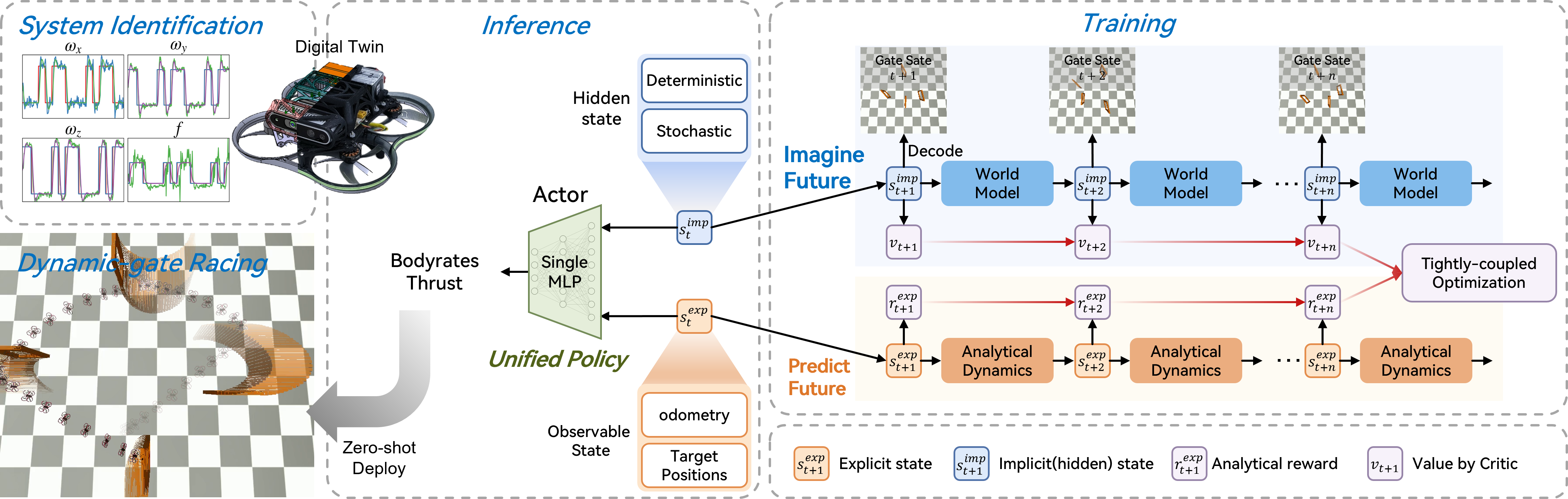
Caption: A schematic overview of DiffDreamer for dynamic-gate racing. The quadrotor must predict the future motion of dynamic gates while executing precise flight control. DiffDreamer trains the actor through a tightly coupled dual-pathway process: a learned world model imagines future environmental states (e.g., target motion), while a differentiable simulation predicts the quadrotor's physical dynamics and provides analytical gradients. The policy takes both implicit latent states and explicit physical states as input to generate control commands. The quadrotor is digitally reconstructed and calibrated through system identification for zero-shot transfer to the real world.
Why It Matters: This figure captures the central system design: learned prediction handles external motion, while differentiable simulation handles the vehicle’s physical rollout and gradients.
fig:sim_exp
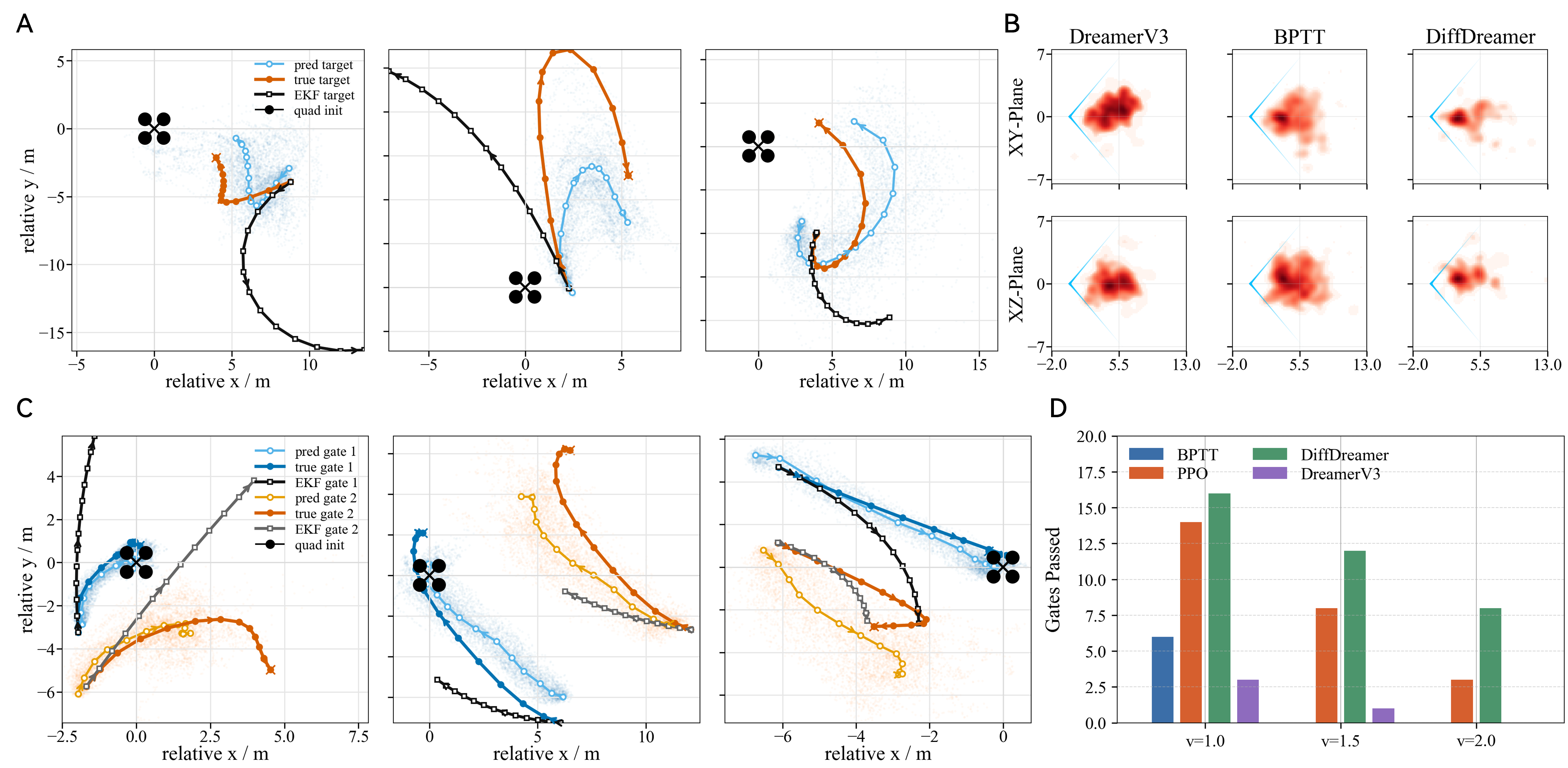
Caption: The experimental results. (A) The predicted trajectory of the target over a 2-second horizon in aggressive tracking. The scattered points denote imagined trajectory samples. (B) Heatmaps illustrating the spatial distribution of the target within the quadrotor's body frame. More intense colors correspond to higher spatial density. The region bounded by the blue rays represents the camera's actual field of view (FOV). (C) The predicted trajectories of the next two gates over a 2-second horizon in dynamic-gate racing. (D) The average number of successfully passed gates during dynamic-gate racing.
Why It Matters: The figure links external-motion prediction to tracking stability and gate-passing performance across both simulated benchmarks.
fig:reward_curve
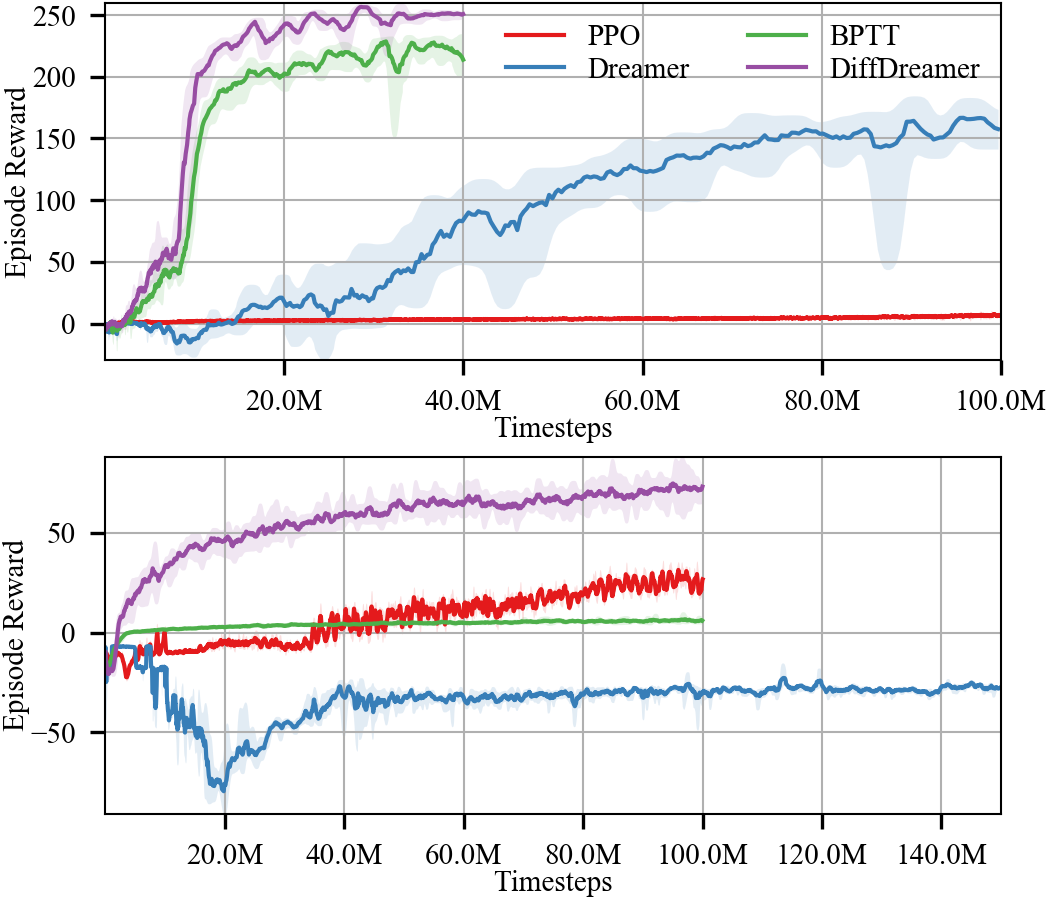
Caption: Training reward curves for aggressive tracking (top) and dynamic-gate racing (bottom). Solid lines and shaded regions represent the mean and standard deviation across five independent random seeds, respectively.
Why It Matters: The training curves provide the paper’s main evidence that the coupled method improves convergence and final training reward relative to the evaluated baselines.
fig:ablation
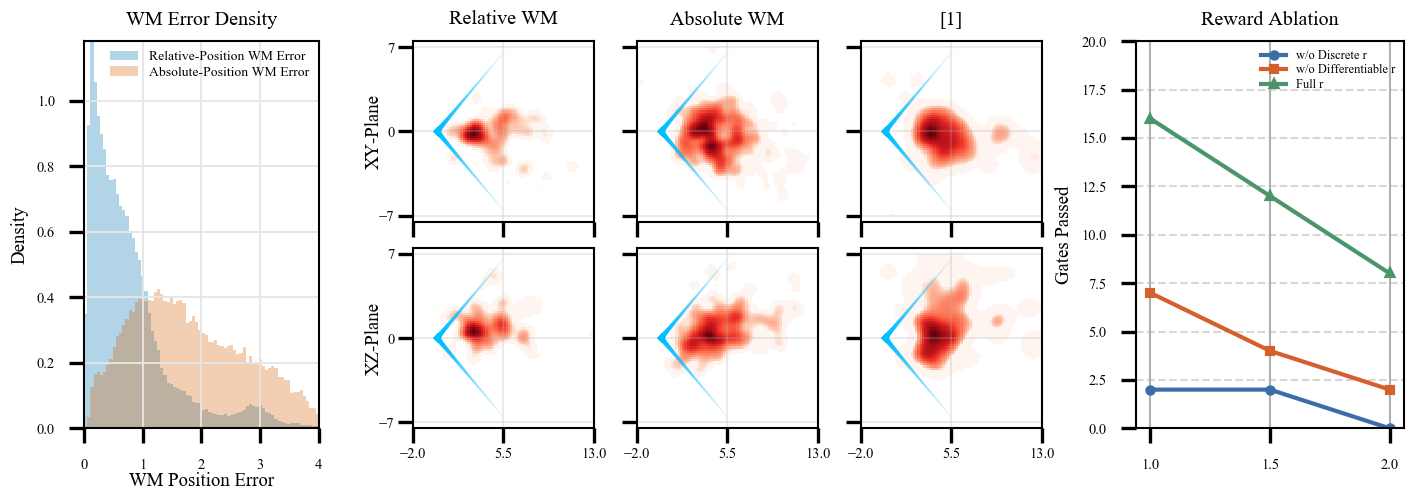
Caption: Ablation studies. Left and center: Odometry/representation ablation: reconstruction-error densities and target distributions in the quadrotor's XY/XZ planes. Relative and absolute world models are compared with Elastic Tracker (labeled [1])~ji2022elastic; blue rays bound the camera field of view. Right: Reward ablation: gates passed within 512 steps versus maximum gate speed (m/s), using the full reward or removing the discrete gate-passing or differentiable motion component.
Why It Matters: The ablations test both the relative-state representation and the division between discrete gate-passing and differentiable motion rewards.
fig:real_world
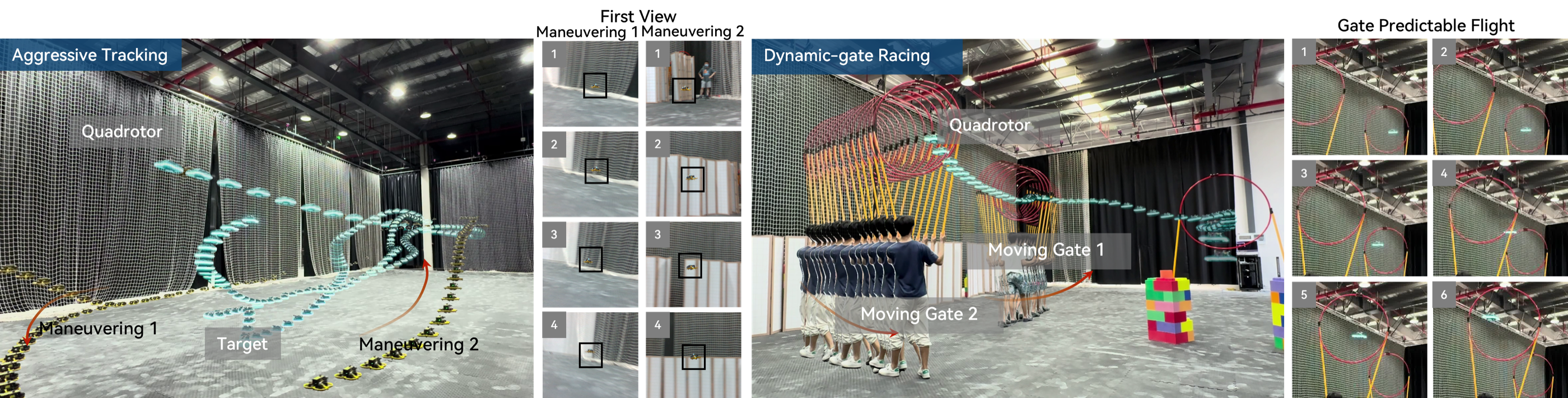
Caption: Real-world experiments using DiffDreamer for aggressive tracking and dynamic-gate racing. Left: flight trajectories and selected consecutive frames showing tight target tracking. Right: dynamic-gate racing, where the quadrotor anticipates the future positions of moving gates.
Why It Matters: The real-flight examples show proof-of-concept sim-to-real transfer, while also motivating attention to the paper’s motion-capture and indoor-test limitations.
🔮 Conclusion
DiffDreamer’s main result is a structural combination of two complementary optimization mechanisms: latent imagination for external, history-dependent motion and differentiable simulation for explicit robot dynamics. The reported experiments show faster convergence than model-free, model-based, and differentiable-RL baselines, lower aggressive-tracking errors than the evaluated alternatives, and stronger dynamic-gate performance across all tested gate speeds. The real-flight experiments provide proof-of-concept evidence that calibrated dynamics and the coupled policy can transfer to a physical platform.
The evidence supports the method most strongly in the controlled VisFly benchmarks and in bounded indoor flight with motion-capture state feedback. The authors explicitly limit the conclusion by noting that other embodiments, contacts, discontinuities, actuator limits, and fully onboard perception remain open challenges.
🛠️ Future Research Improvements
A direct next step is to evaluate the coupled latent-and-physical rollout design on additional robotic embodiments and tasks, while preserving a differentiable model for the controllable physical state. Such extensions will need to address contacts, discontinuities, actuator limits, and other effects that complicate analytical differentiation.
The most important deployment-oriented improvement is replacing motion-capture feedback with onboard perception and explicitly measuring robustness to perception noise. Further evaluation should also separate the effects of simulator calibration, prediction quality, action-rate limits, and observation errors so that the contribution of the dual-pathway optimization can be assessed outside the controlled experimental setup.
🏭 Potential Industry Use Scenarios
The paper’s demonstrated capabilities could support agile aerial inspection or cinematography in which a vehicle must track a moving object while maintaining a stable relative viewpoint. The aggressive-tracking formulation directly provides the relevant control pattern: predict target motion, keep the target within the camera field of view, maintain a desired distance, and regulate unstable motion.
Dynamic-gate racing suggests a broader use case for autonomous drones navigating changing aerial corridors, moving checkpoints, or other sequential spatial constraints. However, these scenarios remain prospective: the paper validates only controlled indoor flights with motion-capture state feedback, bounded thrust, and calibrated vehicle dynamics, so industrial deployment would require onboard perception, safety handling, actuator-limit evaluation, and broader environmental testing.
💬 Critical Analysis
The paper’s strongest technical choice is the explicit separation of external and internal dynamics without disconnecting their action sequence. This preserves the predictive capacity of a world model for partially observable motion while using known rigid-body structure for gradient-based control. The reward ablation supports the claimed mechanism: removing either the discrete gate-passing reward or differentiable motion reward lowers performance at every tested gate speed. The relative-state ablation also supports the use of odometry-conditioned representations, showing broader reconstruction-error and target distributions when odometry is removed.
The main caveat is evaluation scope. The largest quantitative gains are established in a simulator with fixed identified physics parameters, randomized trajectories, and controlled task definitions. Real-world evidence is limited to proof-of-concept flights using motion capture for both vehicle and external-object state. The paper therefore demonstrates a compelling architecture for hybrid learned-and-physical control, but does not yet establish robustness under onboard visual perception, noisy state estimation, actuator saturation, contacts, or substantial model mismatch.