
📌 Highlights
MisconceptDialogue makes a useful distinction between a tutor's behavior and the instrument used to score that behavior. Its strongest result is a paired measurement finding: the same 2,250 remediation dialogues receive a mean RSR of 42.1% under strict matching and 81.3% under the primary LLM-as-judge, a 39.2 percentage-point spread. Because the dialogues do not change, this difference is attributable to what the evaluator credits rather than to a change in tutoring output. Numeric extraction sits close to strict matching at 45.8%, while the semantic judges range from 75.4% to 81.3% in the reported means.
The capability findings are more cautious. In detection, more context helps on datasets containing only incorrect responses but hurts on mixed-label MathDial, indicating that apparent context gains can arise from exploiting class priors. Diagnosis accuracy is not predicted by detection performance. In the end-to-end ablation, oracle diagnosis, model diagnosis, detection-only input, the automated pipeline, and direct tutoring produce no significant condition effect under the tested protocol. The paper therefore argues for criterion-aware, human-anchored evaluation while explicitly limiting its capability claims to simulated students and the tested diagnosis-presentation format.
- Measurement criterion changes reported RSR more than the tested tutor model, strategy, or pipeline information.
- Four LLM judges from three vendor families converge, and 200 human annotations provide an external anchor.
- Mistake identification, misconception diagnosis, and remediation are empirically distinct tasks.
- The wrong-diagnosis control provides little evidence of reliable fine-grained diagnostic-label uptake.
🎯 Introduction
The paper starts from a learning-science problem: misconceptions are coherent patterns of incorrect reasoning, not merely careless mistakes, so remediation may require cognitive conflict or a strategy matched to the misconception's ontological category. Intelligent tutoring research has long linked effectiveness to accurate diagnosis and appropriate intervention, while recent LLM tutoring work has expanded the range of available dialogue systems. Yet existing benchmarks commonly isolate mistake identification, misconception classification, or feedback quality. They do not necessarily test whether one tutor can carry information coherently from detecting an error through diagnosing its cause and selecting an effective remediation strategy.
MisconceptDialogue identifies a parallel measurement problem. A final answer string, a numerically equivalent answer, and evidence of conceptual understanding are related but distinct targets. Applying exact-match conventions from answer-focused math NLP to open-ended tutoring dialogues may therefore report a lower-bound stress test rather than a complete measure of learning. LLM-as-judge evaluation introduces its own risks, and LLM-simulated students trade ecological validity for scale and experimental control. The paper's objective is consequently twofold: evaluate the complete detect–diagnose–remediate pipeline and determine how much measured success changes when the scorer, rather than the tutor or dialogue, changes.
🔬 Methodology
The framework orthogonalizes tutoring, pipeline information, and evaluation. Five open-weight tutors—Qwen-2.5-7B, Mistral-7B, Llama-3.1-8B, Phi-4, and Qwen3.5-9B—operate on tasks covering detection, diagnosis, and remediation. Detection uses BEA 2025, MathDial, and Bridge under single-turn, two-turn, and full-context conditions. Diagnosis uses the Math Misconceptions Benchmark with a closed set of 55 educator-validated misconceptions. Remediation uses 106 scenarios derived from those misconceptions, split into 36 factual, 34 procedural, and 36 conceptual cases; each scenario includes a target response, a taxonomy-linked label, and a held-out verification problem.
For remediation, the tutor follows one of five strategies: Counterexample, Analogy, Cognitive Conflict, Direct Instruction, or Socratic Questioning. Experiment 3 assigns 30 scenarios to each strategy–type cell, producing 450 dialogues per tutor and 2,250 dialogues overall. A GPT-5-mini simulated student completes five tutoring turns and then attempts the verification problem. The same dialogue is scored three ways: strict word-boundary matching, numerical extraction with tolerance, and a human-calibrated LLM judge that can credit paraphrases and reasoning evidence. Experiment 4 changes the tutor's supplied information instead, comparing oracle and model diagnoses, detection-only input, a fully automated pipeline, and direct tutoring, with a wrong-diagnosis condition that swaps the fine-grained label while holding detection fixed. This design makes the paper's main comparisons paired and interpretable.
Remediation Success Rate
Meaning: RSR is the fraction of scenarios in which the simulated student solves a held-out verification problem after tutoring. The paper compares this outcome under different scoring criteria, tutor conditions, and misconception types.
📊 Experiments
Experiment 1 evaluates mistake identification on BEA 2025, MathDial, and Bridge using Macro F1 and accuracy. The five tutors are tested with the final response only, two previous turns, or the full dialogue history. On BEA 2025 and Bridge, which contain only incorrect responses, full context improves F1 for all five models; on mixed-label MathDial, full context reduces F1 for all five, with reported changes from -0.026 to -0.163. The paper attributes this to a growing incorrect-prediction bias: mean incorrect predictions rise from 55.8% to 79.7%, correct-class recall falls from 0.444 to 0.202, and incorrect-class recall rises from 0.565 to 0.793. This is a strong warning against interpreting aggregate gains without checking label balance.
Experiment 2 uses the Math Misconceptions Benchmark, containing 55 misconceptions and 220 examples, to compare zero-shot, five-shot, chain-of-thought plus rubric, retrieval-augmented generation, and Generate-Retrieve-Rerank diagnosis. Qwen3.5 reaches 0.545 in zero-shot diagnosis accuracy, while Mistral's best reported condition reaches 0.255. The authors contrast this with detection: Mistral has the strongest mixed-label detection F1 in Experiment 1 at 0.492, while Qwen3.5's corresponding detection F1 is 0.438. The divergence indicates that recognizing an incorrect answer and identifying its underlying misconception are different capabilities.
Experiments 3 and 4 provide the central paired evidence. On identical remediation dialogues, mean RSR is 42.1% strict, 45.8% numeric, 81.3% for GPT, 75.4% for Claude, and 78.2% for Gemini, with answer reveal rates between 6.0% and 8.7%. The strict-versus-judge difference is statistically large in the paper's paired McNemar test, with chi-squared 765.7, p < 10^-50, and a 95% bootstrap interval of [36.6, 41.8] percentage points. In the progressive oracle ablation, mean RSR ranges from .766 to .813 and the condition effect is not significant, with GLMM chi-squared 6.47 and p=0.263. Human calibration on clean and borderline subsets shows semantic judges within a few percentage points of consensus, whereas strict matching reports 52% against an 88% human consensus on the clean subset. The results support multi-criterion reporting, but they do not establish real-student learning.
tab:exp1
Caption: Exp.~1: Mistake identification (Macro F1 / Accuracy) across five models, three datasets, and three context conditions.
| Dataset | Context | Qwen2.5-7B F1 | Qwen2.5-7B Acc | Mistral-7B F1 | Mistral-7B Acc | Llama-3.1-8B F1 | Llama-3.1-8B Acc | Phi-4 F1 | Phi-4 Acc | Qwen3.5-9B F1 | Qwen3.5-9B Acc |
|---|---|---|---|---|---|---|---|---|---|---|---|
| BEA 2025 | Single | 0.237 | 0.553 | 0.108 | 0.193 | 0.253 | 0.610 | 0.257 | 0.627 | 0.218 | 0.487 |
| BEA 2025 | Multi (2) | 0.259 | 0.633 | 0.173 | 0.350 | 0.276 | 0.707 | 0.284 | 0.743 | 0.234 | 0.540 |
| BEA 2025 | Multi (full) | 0.309 | 0.863 | 0.187 | 0.390 | 0.290 | 0.770 | 0.307 | 0.853 | 0.285 | 0.747 |
| MathDial | Single | 0.473 | 0.509 | 0.492 | 0.630 | 0.430 | 0.442 | 0.345 | 0.348 | 0.438 | 0.445 |
| MathDial | Multi (2) | 0.426 | 0.435 | 0.439 | 0.468 | 0.365 | 0.365 | 0.214 | 0.325 | 0.402 | 0.404 |
| MathDial | Multi (full) | 0.314 | 0.320 | 0.466 | 0.499 | 0.327 | 0.335 | 0.289 | 0.302 | 0.275 | 0.292 |
| Bridge | Single | 0.204 | 0.442 | 0.131 | 0.150 | 0.158 | 0.463 | 0.011 | 0.017 | 0.014 | 0.021 |
| Bridge | Multi (2) | 0.263 | 0.652 | 0.203 | 0.439 | 0.242 | 0.570 | 0.119 | 0.217 | 0.097 | 0.169 |
| Bridge | Multi (full) | 0.301 | 0.823 | 0.219 | 0.489 | 0.257 | 0.628 | 0.164 | 0.327 | 0.135 | 0.253 |
Why It Matters: The table exposes the dataset-balance interaction. Full context improves F1 on the all-incorrect BEA 2025 and Bridge datasets but reduces F1 on mixed-label MathDial for every model, supporting the authors' class-prior interpretation.
tab:exp2
Caption: Exp.~2: Misconception diagnosis Acc@1 across five models and five prompting conditions (55 misconceptions, $n$=220). Bold marks the per-model best. Post-hoc parsing corrections: Appendix Table~tab:parsing-correction.
| Condition | Qwen2.5 | Mistral | Llama3.1 | Phi-4 | Qwen3.5 |
|---|---|---|---|---|---|
| (A) Zero-shot | 0.359 | 0.077 | 0.291 | 0.436 | 0.545 |
| (B) Few-shot (5) | 0.291 | 0.241 | 0.273 | 0.441 | 0.473 |
| (C) CoT + rubric | 0.355 | 0.214 | 0.286 | 0.423 | 0.509 |
| (D) RAG | 0.355 | 0.232 | 0.236 | 0.400 | 0.459 |
| (E) Gen-Ret-Rerank | 0.377 | 0.255 | 0.332 | 0.477 | 0.518 |
Why It Matters: Diagnosis results do not follow detection results. Qwen3.5 has the highest zero-shot diagnosis accuracy at 0.545, while Mistral's best diagnosis result is 0.255 despite its strongest mixed-label detection F1 in the preceding experiment.
tab:exp3
Caption: Exp.~3: RSR (\%) on the same 2,250 dialogues (5 models $ $ 5 strategies $ $ 3 types $ $ 30 scenarios; $n$=450 per row). Columns group Strict/Numeric as automatic criteria and GPT/Claude/Gemini as LLM-as-judge variants: GPT-5-mini, Claude Haiku 4.5, and Gemini 3.1 Flash Lite. GPT-5.4 cross-check is reported in Appendix~sec:appendix-crossfamily. ARR = answer reveal rate.
| Tutor Model | Strict (%) | Numeric (%) | GPT (%) | Claude (%) | Gemini (%) | ARR (%) |
|---|---|---|---|---|---|---|
| Qwen-2.5-7B | 44.4 | 46.4 | 81.8 | 76.2 | 79.1 | 6.9 |
| Phi-4 | 42.4 | 47.1 | 83.6 | 78.2 | 81.1 | 6.4 |
| Qwen3.5-9B | 43.3 | 46.4 | 84.4 | 77.8 | 80.4 | 8.7 |
| Llama-3.1-8B | 40.2 | 44.4 | 79.1 | 74.4 | 76.9 | 6.7 |
| Mistral-7B | 40.2 | 44.4 | 77.8 | 70.2 | 73.6 | 6.0 |
| Mean | 42.1 | 45.8 | 81.3 | 75.4 | 78.2 | 6.9 |
Why It Matters: This is the decisive paired comparison: the same 2,250 dialogues receive substantially different RSR values depending on whether the evaluator requires surface agreement, numerical agreement, or semantic evidence of understanding.
fig:pipeline
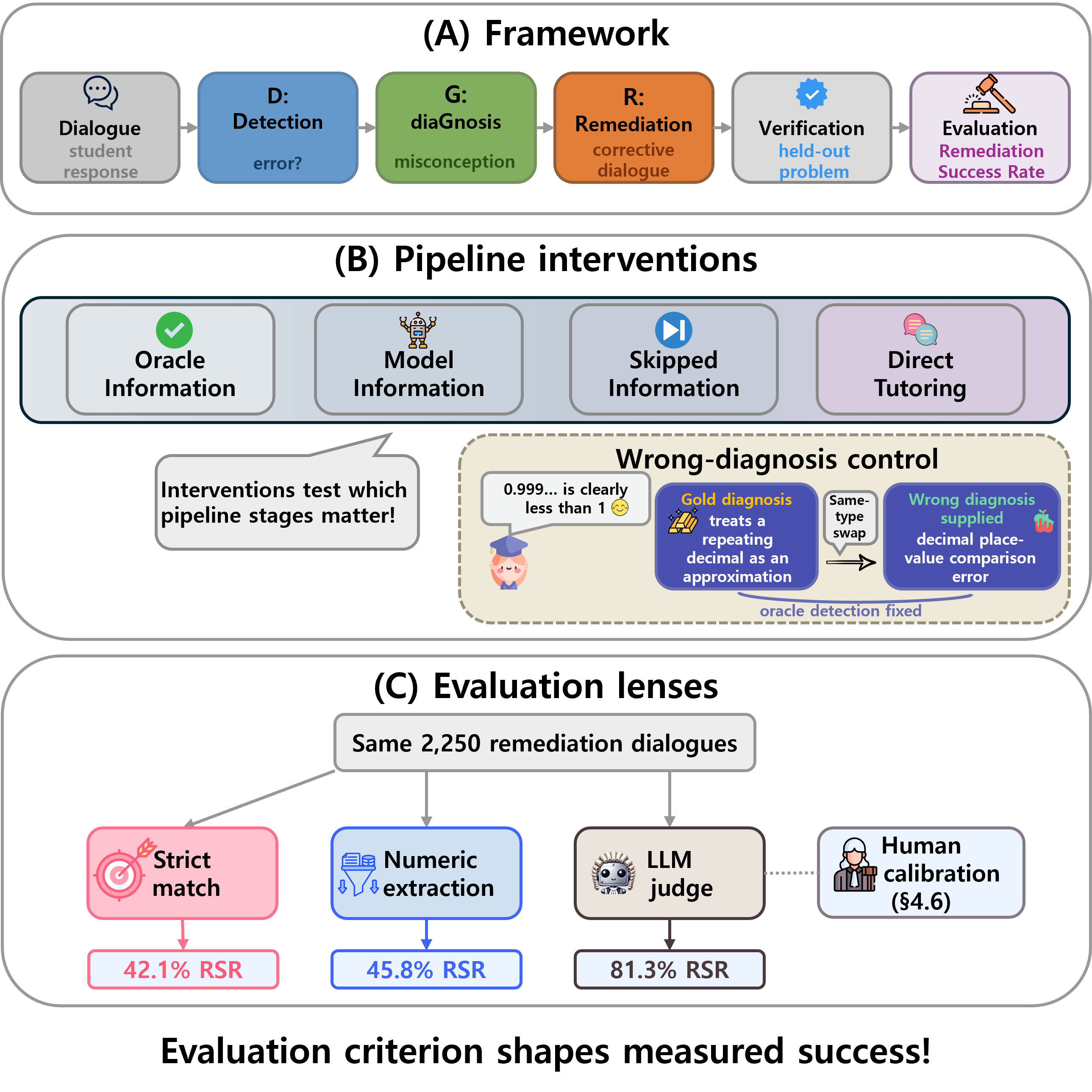
Caption: Overview of MisconceptDialogue. (A) The D-G-R pipeline moves from student dialogue through detection, diagnosis, remediation, verification, and final evaluation. (B) Pipeline-information interventions vary what information the tutor receives---oracle, model-generated, skipped, or direct tutoring---with a wrong-diagnosis control that swaps the diagnosis while holding detection fixed ( :exp4). (C) Three evaluation lenses---strict match, numeric extraction, and a human-calibrated LLM-as-judge ( :human-eval)---score the same 2,250 remediation dialogues, shifting measured RSR from 42.1\% to 81.3\%.
Why It Matters: The figure makes the paper's core experimental separation visible: tutor-side information interventions and scorer-side evaluation lenses are applied as distinct factors. It also connects the end-to-end pipeline to the headline criterion-induced shift in measured RSR.
🔮 Conclusion
The paper's main conclusion is that scoring criteria must be treated as a first-class part of tutoring evaluation. On fixed dialogues, strict matching, numerical extraction, and semantic judging produce materially different estimates of remediation success, and the largest shift comes from whether the evaluator credits conceptual understanding beyond an exact answer string. The capability results are more qualified: structured pipeline information does not produce a detectable advantage over direct tutoring in this simulated protocol, and the wrong-diagnosis control finds little evidence of reliable fine-grained label conditioning.
For builders, the practical takeaway is not that one scorer is universally correct. It is that every reported RSR should identify its criterion, quantify disagreement, and be anchored against human judgment. The paper presents the calibrated measurement protocol as a prerequisite for a future real-student study, not as evidence that simulated tutoring has already improved classroom learning.
🛠️ Future Research Improvements
The most important next step is validation with real learners and expert tutors, measuring not only final verification answers but also transfer, retention, reasoning quality, and conceptual change. Future studies should vary the diagnosis-presentation format, student profiles, and tutor scale so that a null result cannot be attributed to one prompt interface or a uniformly recoverable simulator. Evaluation should retain paired multi-criterion scoring, direct auditing of disagreement cases, independent judge families, and broader human annotation. More balanced detection benchmarks, larger misconception taxonomies, and stronger checks of strategy fidelity would also clarify whether the observed flat strategy effect reflects pedagogical equivalence or limitations of the simulated protocol.
🏭 Potential Industry Use Scenarios
An educational product team could use the framework as a pre-deployment audit for tutoring models: replay identical learner interactions through strict, numeric, and semantic scorers; inspect disagreement clusters; and require human review before shipping high-stakes features. The detection and diagnosis separation could support separate monitoring dashboards for error recognition and misconception classification rather than one blended quality score. Oracle and wrong-diagnosis controls could test whether a production tutor actually uses diagnostic state, while answer-reveal tracking could flag tutoring that solves the problem for the learner. These uses remain evaluation and quality-assurance scenarios, not evidence that the protocol predicts classroom outcomes without real-student validation.
💬 Critical Analysis
The strongest aspect of the study is its experimental separation of scoring from generation. Applying multiple criteria to the same dialogues makes the 39.2 percentage-point RSR gap substantially more persuasive than a comparison across unrelated runs. The cross-family judges and human subsets further reduce the likelihood that the result is caused by one evaluator. The detection experiments are also valuable because they expose how label imbalance can make more context look beneficial when the model is primarily shifting its class prior.
The capability conclusions require more restraint. The oracle ablation has enough power for larger effects but leaves smaller effects possible, and the simulated student may recover under generic tutoring in ways that obscure fine-grained diagnosis benefits. The diagnosis swap holds broad misconception type fixed and tests one presentation format, so it does not establish that diagnostic information is useless in general. Human agreement is moderate, the clean subset is quality-screened, and shared model lineage remains a concern despite cross-family checks. Finally, semantic judging can itself encode hidden standards. The paper appropriately treats judge calibration as evidence for a measurement instrument, but builders should continue to audit judge rationales, boundary cases, and real learning outcomes rather than treating an LLM judge as ground truth.