
📌 Highlights
RoboWorM evaluates embodied video world models for physical consistency and inference efficiency, using setup-specific robot and camera priors.
The paper reports that KIVA improves hallucination-detection accuracy from 58.4% for frontier VLMs to 73.5%; RIGIS raises Spearman correlation with human preferences from 0.326 to 0.749.
Across the evaluated acceleration methods, caching has the strongest reported trade-off: a 1.7× mean speedup with a 0.004 RIGIS decrease, and a 2.3× best speedup in selected configurations.
The authors identify limitations in contact-level validity, deformable materials, force-driven dynamics, and attributing degradation to internal model computations.
🎯 Introduction
The paper frames video world models as potential simulators for robotic manipulation, synthetic trajectory generators, and tools for policy ranking and model-based planning. Their usefulness depends on whether generated videos preserve the physical system they depict.
Prior video-generation benchmarks focus on perceptual quality and text alignment, while robotics evaluations often rely on VLM judges that the authors argue lack strict geometric and kinematic reasoning. Simulation-based checks can also be affected by errors in converting real setups to simulation.
RoboWorM’s objective is to use deployment information already available to practitioners, including robot kinematics and fixed camera configurations, to evaluate within-view motion, cross-view geometry, and the physical effects of inference acceleration.
🔬 Methodology
The benchmark draws on five public teleoperation datasets and covers single-arm, bimanual, and humanoid morphologies, with single- and multi-view camera configurations. Tasks are divided into Markovian and non-Markovian regimes. The paper’s benchmark description reports 1,605 episodes in its overview and 1,608 episode-camera instances in the detailed benchmark section; these are different counts as stated in the supplied main-body extraction.
KIVA trains a diffusion keypoint reader on real-world video, with normalized 3D coordinates from robot forward kinematics as targets and a coordinate-wise Huber loss. At inference, it estimates trajectories from video and averages five DDIM samples. It then measures fixed-link-length deviations and third-order jerk, with scores normalized using real-video references.
RIGIS processes synchronized views with a modified VGGT-based model to estimate depth and camera pose, reconstructs and reprojects the scene, and combines visual and depth agreement with temporal camera stability. Higher RIGIS indicates better multi-view consistency.
The supplied extraction contains the KIVA reader equation, but its structure is difficult to interpret without the paper’s surrounding definitions; the detector and normalization equations below are more directly tied to the described metrics.
KIVA rigidity and jerk detectors
Meaning: The rigidity term measures deviation from known robot link lengths; the jerk term measures third-order changes in estimated keypoint trajectories. The factors scale the reported quantities to millimeter-based units.
KIVA real-video normalization
Meaning: Normalizes a segment’s rigidity or jerk statistic by the corresponding 95th-percentile statistic on real-video references.
📊 Experiments
The benchmark uses DROID, RoboChallenge, the AIST Bimanual corpus, RoboCOIN, and NVIDIA GR00T Teleop GR1. It evaluates DreamGen, DreamDojo, and Ctrl-World. The paper reports 291 single-view videos for embodied-physics human evaluation and 300 multi-view videos for multi-view consistency, graded on a three-point scale by two annotators with expert resolution.
The evaluation includes Visual Integrity, PSNR, text alignment, and FVD, alongside KIVA and RIGIS. Speedup is measured as dense-baseline generation time divided by accelerated generation time per segment, excluding model-loading and VAE-decoding overhead. The paper reports 29,000-plus rollouts across nine acceleration methods.
In the human-alignment comparison, the paper reports KIVA accuracy of 73.5% versus 58.4% for frontier VLMs and RIGIS Spearman correlation of 0.749 versus 0.326. It also reports caching at a 1.7× mean speedup with a 0.004 RIGIS decrease; World-Cache reaches a 1.8× mean and a 2.3× benchmark-best speedup in DreamGen humanoid and single-arm multi-view configurations. Token pruning is reported at 1.2× speedup with a 13.4% NR loss.
The supplied table extraction for dense-model comparisons is malformed or incomplete, so numeric model-by-model table values are omitted. The paper states that Ctrl-World dominates the multi-view tracks and DreamDojo leads the single-view tracks, but the extracted dense-baseline table is not suitable for reliably reconstructing all headers and cells.
tab:benchmark_comparison
Caption: Comparison of Video World Model Evaluation Benchmarks. derives deterministic, deployment-aware metrics from dataset-native hardware priors, scaling across multi-view setups, complex morphologies, and long-horizon tasks while auditing cross-view geometry and inference acceleration. Prior benchmarks rely on external VLMs or off-the-shelf models that do not exploit priors such as camera calibration, robot proprioception, and actions. Off. Alg. denotes off-the-shelf algorithms; Hybrid combines Off. Alg. and VLM; IK / Sim denotes Inverse Kinematics and Simulation; ``Prior Alg.'' denotes deterministic algorithms driven by dataset priors.
| 5cData Diversity | 4cEvaluation Dimensions | |||||||
|---|---|---|---|---|---|---|---|---|
| Benchmark | \# | |||||||
| Samples | Data | |||||||
| Sources | Robot | |||||||
| Morphologies | Multi-View | |||||||
| Setup | Long-Horizon | |||||||
| Tasks | Evaluator | |||||||
| Paradigm | Cross-View | |||||||
| Geometry | Speedup | |||||||
| VBench | 800 | N/A | N/A | Hybrid | ||||
| VBench2.0 | 1260 | N/A | N/A | Hybrid | ||||
| WorldModelBench | 350 | 3 | 1 | Hybrid | ||||
| PAI-Bench | 2808 | 12 | 2 | VLM | ||||
| H2R-Bench | 240 | 1 | 2 | VLM | ||||
| RoboTrustBench | 1207 | 1 | 1 | VLM | ||||
| MiraBench | 906 | 3 | 3 | VLM | ||||
| EWMBench | 100 | 1 | 1 | Off. Alg. | ||||
| RoboWM-Bench | 240 | 1 | 2 | IK / Sim | ||||
| 1,605 | 5 | 3 (inc. Humanoid) | Prior Alg. |
fig:quantitative_human_alignment
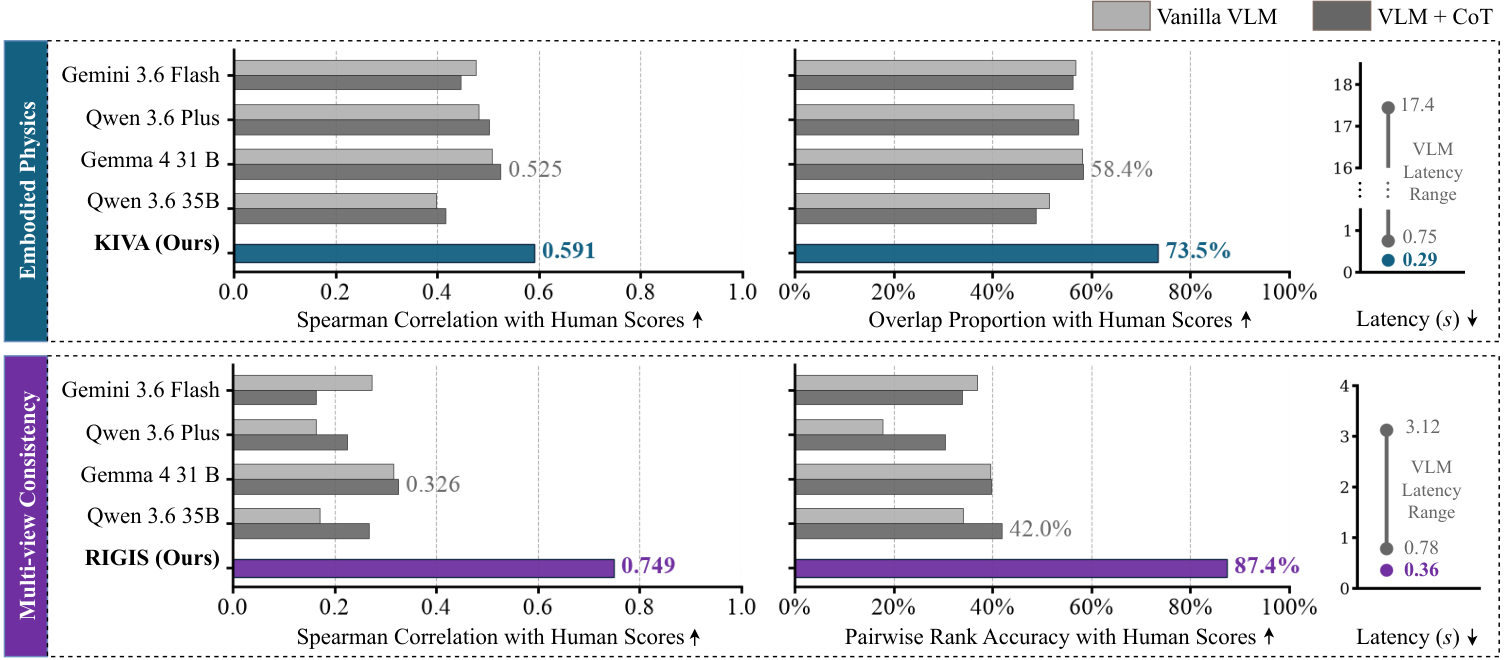
Caption: Our metrics KIVA (top) and RIGIS (bottom) shows significantly higher human alignment correlation and accuracy, while achieving better processing latency.
Why It Matters: Summarizes the central human-alignment comparison supporting the proposed physical metrics.
fig:accel_tradeoff
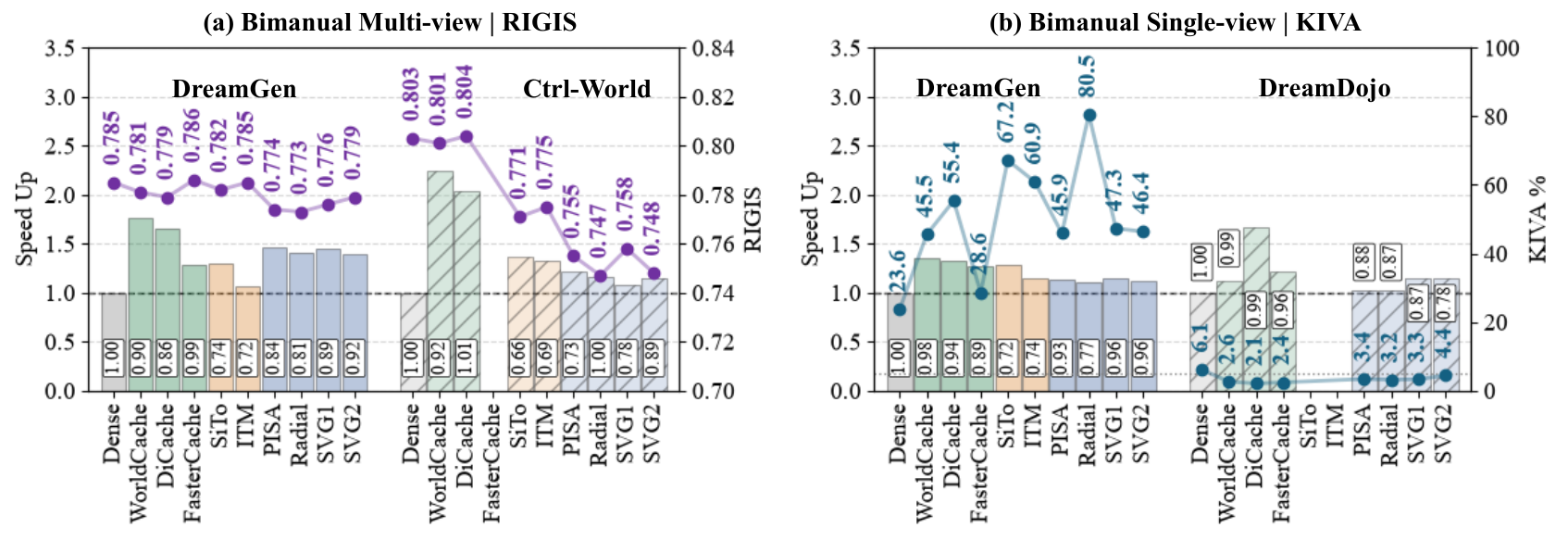
Caption: Acceleration mechanisms exhibit distinct speed--quality trade-offs. Caching achieves the largest speedups with near-zero degradation; token pruning degrades most. Bars show speedup, the middle axis physical audit, and dots mean NR. See Fig.~fig:supp_accel_tradeoff_single_arm, fig:supp_accel_tradeoff_humanoid for other embodiments.
Why It Matters: Shows the measured speed and physical-audit trade-off across acceleration mechanisms.
🔮 Conclusion
The authors conclude that physical auditing can expose failures that generic visual assessment misses. KIVA and RIGIS provide complementary measures of within-view kinematics and cross-view geometry, and the acceleration audit shows why deployment throughput should be evaluated together with physical fidelity.
The paper’s stated limitations are that its metrics do not verify contact-level validity, do not cover deformable materials or force-driven dynamics, and do not explain which internal computations cause acceleration-related fidelity loss.
🛠️ Future Research Improvements
Extend the audit with contact-level checks or full physics simulation, as the authors identify contact validity as outside the present metrics.
Develop evaluations for deformable materials and force-driven dynamics, which are not captured by the rigid-body focus.
Investigate which model layers or computations cause physical-fidelity loss under acceleration; the current audit observes output degradation without locating its source.
Design evaluations that separate task regime from rollout depth in configurations where their supports are disjoint.
🏭 Potential Industry Use Scenarios
A robotics team generating synthetic manipulation rollouts could use KIVA to screen for link deformation and irregular trajectories before using videos for policy development or planning.
Teams developing synchronized multi-camera world models could use RIGIS to assess whether generated views maintain a consistent scene and stable camera geometry.
For latency-sensitive applications, the audit suggests comparing acceleration options on both generation speed and physical metrics. The reported caching results motivate testing cache methods on the specific model and embodiment in use; the paper does not establish real-robot deployment success.
💬 Critical Analysis
The paper’s central strength is its use of embodiment and camera priors to define measurable constraints, then comparing those metrics with human judgments and VLM evaluators. This makes the evaluation more specific to structured robotic setups than generic perceptual scoring.
The benchmark spans multiple morphologies and task regimes, but its reported results remain tied to its selected datasets, model checkpoints, and camera configurations. The supplied extraction does not provide a clean, fully recoverable acceleration-results table, limiting independent inspection of all per-method comparisons.
The reported association between non-Markovian tasks and KIVA degradation is confounded with rollout depth in two configurations; the paper itself cautions that these factors cannot be separated there. Builders should also treat real-video normalization as setup-dependent and verify it on their own reference data.
The paper says code and the full benchmark dataset will be publicly released upon publication. Reproducibility therefore depends on checking the eventual release for checkpoint details, calibration procedures, and implementation compatibility.