
📌 Highlights
MVRCap addresses comprehensive video captioning by training a model to produce structured descriptions that cover six dimensions: entity attributes, actions and interactions, temporal information, camera language, scene and environment, and style and atmosphere. Its central idea is to reward captions that answer hierarchical questions about video content, while separately penalizing factual contradictions and excess length. The pipeline combines supervised fine-tuning on structured captions with GRPO, using an SFT model as a stable reference policy.
The authors report results on three benchmarks. On VDC, MVRCap reaches 49.7 average accuracy and 2.6 average score, compared with 43.5 and 2.2 for Qwen2.5-VL-7B. On CAPability, its Video Avg. and All Avg. F1 are 37.29 and 55.18, versus 31.13 and 49.57 for the baseline. On VC4VG-Bench, the reported total score is 65.4% for MVRCap-8B and 74.6% for MVRCap-32B. These results support the authors’ claim of improved benchmark performance; the approach’s dependence on generated QA data and LLM judging remains a practical caveat.
- Six explicit caption dimensions organize static, dynamic, temporal, cinematic, environmental, and stylistic content.
- The reward combines hierarchical QA coverage, factuality verification, and a soft length constraint.
- The reported experiments include VDC, CAPability, VC4VG-Bench, and ablations of training stages and reward components.
🎯 Introduction
Video captioning converts a changing visual stream into natural language, so a useful caption must represent more than objects and a salient action. The paper argues that existing systems often produce inventories of entities and primary motions while missing causal relationships, event order, viewpoint changes, lighting, and other context needed for a coherent narrative. The authors characterize this as a limitation of approaches that favor local object recognition over global scene reasoning.
The paper’s objective is to move from flat enumeration toward structured visual reasoning. It proposes a six-dimension taxonomy spanning physical composition, dynamic evolution, observational context, and aesthetic tone. The authors also describe a problem with synthetic instruction tuning: a model may imitate linguistic complexity without grounding it reliably in video, leading to hallucinations, especially about temporal dynamics. They therefore seek a training signal that checks both what a caption covers and whether its claims remain consistent with the video-derived reference information. Figure 1 presents their contrast between unordered atomic-fact matching and structured probing.
🔬 Methodology
MVRCap starts with a multi-dimensional annotation paradigm. Entity Attributes and Scene and Environment describe subjects, their properties, spatial layout, and setting. Actions and Interactions and Temporal Information represent behavior, causal effects, state changes, chronological order, and scene transitions. Camera Language captures movement, focus, and depth of field; Style and Atmosphere relates visual composition to mood. The data workflow produces two resources: MVRCap-SFT, a set of structured video-caption pairs, and MVRCap-QA, hierarchical questions and answers used to score generated captions. The pipeline figure depicts these datasets and validation steps.
The paper reports 4K SFT video-caption pairs generated with Gemini 2.5 Pro and screened by GPT-5 against source videos, with human review of a subset of failure cases. It reports another 5K video samples for QA construction, yielding 205K QA pairs. The QA hierarchy ranges from semantic foundation and structure to high-fidelity details and semantic logic. Cross-model checks and human quality assurance are described for the QA pairs. During training, the base Qwen2.5-VL-7B-Instruct model is first fine-tuned using token-level likelihood on structured captions. This establishes a reference policy for GRPO.
For each video query, GRPO samples a group of candidate captions, assigns composite rewards, and standardizes each candidate’s reward relative to the group. The objective clips policy updates and includes a KL penalty against the reference policy, helping constrain optimization. Coverage uses a frozen judge to answer dimension-specific questions using only the candidate caption; dimension-level accuracy is averaged to avoid letting one dimension dominate. A separate factuality judge checks object, action, and temporal contradictions against the ground-truth caption. A soft length term penalizes output above a target. Equation 2 defines coverage aggregation, Equation 3 combines the reward terms, and Equation 1 gives the policy objective.
equation 1
Meaning: The clipped group-relative policy objective uses sampled outputs and their advantages, while the KL term constrains the updated policy relative to the SFT reference.
equation 2
Meaning: Coverage averages question-answer correctness within each dimension and then averages across dimensions, as judged from the predicted caption.
equation 3
Meaning: The composite reward weights coverage, factuality, and conciseness terms for each generated caption.
📊 Experiments
The authors evaluate on three named benchmarks: VDC, CAPability, and VC4VG-Bench. The stated default baseline is Qwen2.5-VL-7B-Instruct. The implementation details report 2.0 FPS for RL video input, length settings Lmax = 1280 and Lcache = 256, 8 rollouts per iteration, Qwen3-30B-A3B-Instruct as judge model, and experiments on 16 NVIDIA H100 GPUs. VDC reports accuracy and score together; higher values indicate better results in the paper’s comparisons. CAPability reports F1 by dimension, including Video Avg., defined as the mean of four dynamic dimensions, and All Avg. VC4VG-Bench reports Score/% across content and necessity categories.
On VDC, MVRCap’s average is 49.7/2.6 (Acc/Score), compared with 43.5/2.2 for Qwen2.5-VL-7B. On CAPability, Video Avg. F1 rises from 31.13 to 37.29 and All Avg. from 49.57 to 55.18. On VC4VG-Bench, MVRCap-8B reports total 922/65.4, compared with Qwen3-VL-8B at 601/42.6; MVRCap-32B reports 1052/74.6, compared with Qwen3-VL-32B at 933/66.2. The benchmark table preserves each paired Score/% value. These are author-reported comparisons, and cross-model differences should be interpreted in light of the paper’s stated model configurations.
The training-stage ablation reports the best values for Base + SFT + RL across VDC accuracy/score and CAPability Video/All F1. The authors say direct RL has a cold-start problem, while SFT supplies the schema foundation. The reward-component ablation reports a full-system row of 49.67 VDC Acc, 2.60 VDC Score, 37.29 Video F1, and 55.18 All F1. However, the extracted checkmark alignment in that table is ambiguous, so component-specific numeric attribution needs verification against the original table before reuse. The supplied main-body extraction lists no result-focused experiment figure; the numeric comparisons are presented in tables.
tab:vdc
Caption: Quantitative comparison on the VDC benchmark.
| Model | Detailed (Acc/Score) | Camera (Acc/Score) | Short (Acc/Score) | Background (Acc/Score) | Object (Acc/Score) | Average (Acc/Score) |
|---|---|---|---|---|---|---|
| Qwen2.5-VL-7B | 46.1/2.3 | 41.3/2.2 | 37.5/2.0 | 45.8/2.4 | 46.9/2.4 | 43.5/2.2 |
| MVRCap (Ours) | 51.6/2.7 | 49.2/2.6 | 41.4/2.2 | 53.6/2.8 | 52.5/2.7 | 49.7/2.6 |
Why It Matters: The reported average rises from 43.5/2.2 to 49.7/2.6, with accuracy and score shown together as Acc/Score.
tab:Cap_f1score
Caption: Quantitative comparison on the CAPability benchmark. The F1 Score across all dimensions. ``Video Avg.'' represents the mean score of the four dynamic dimensions.
| Model | Video Avg. | All Avg. |
|---|---|---|
| Qwen2.5-VL-7B | 31.13 | 49.57 |
| MVRCap | 37.29 | 55.18 |
Why It Matters: Summarizes the reported dynamic-dimension mean and overall mean for the baseline and MVRCap. The extracted full table contains many dimensions, but this compact comparison preserves only the two clearly identified aggregate columns.
Table 1
Caption: Quantitative captioning evaluation results on VC4VG-Bench.
| Model | Environment (Score/%) | Subject (Score/%) | Motion (Score/%) | Camera (Score/%) | Style (Score/%) | Necessity-L1 (Score/%) | Necessity-L2 (Score/%) | Total score (Score/%) |
|---|---|---|---|---|---|---|---|---|
| Qwen3-VL-8B | 269/59.7 | 181/39.2 | 107/31.9 | 28/19.3 | 16/94.1 | 357/58.1 | 244/30.7 | 601/42.6 |
| MVRCap-8B (Ours) | 348/77.2 | 295/63.9 | 182/54.3 | 80/55.2 | 17/100.0 | 497/80.9 | 425/53.4 | 922/65.4 |
| Qwen3-VL-32B | 341/75.6 | 311/67.3 | 205/61.2 | 59/40.6 | 17/100.0 | 460/74.9 | 473/59.4 | 933/66.2 |
| MVRCap-32B (Ours) | 379/84.0 | 353/76.4 | 222/66.3 | 81/55.9 | 17/100.0 | 513/83.6 | 539/67.7 | 1052/74.6 |
Why It Matters: The comparison reports higher total scores for MVRCap than the listed Qwen3-VL models at both sizes; the table retains the paper’s Score/% pairs.
fig:intro
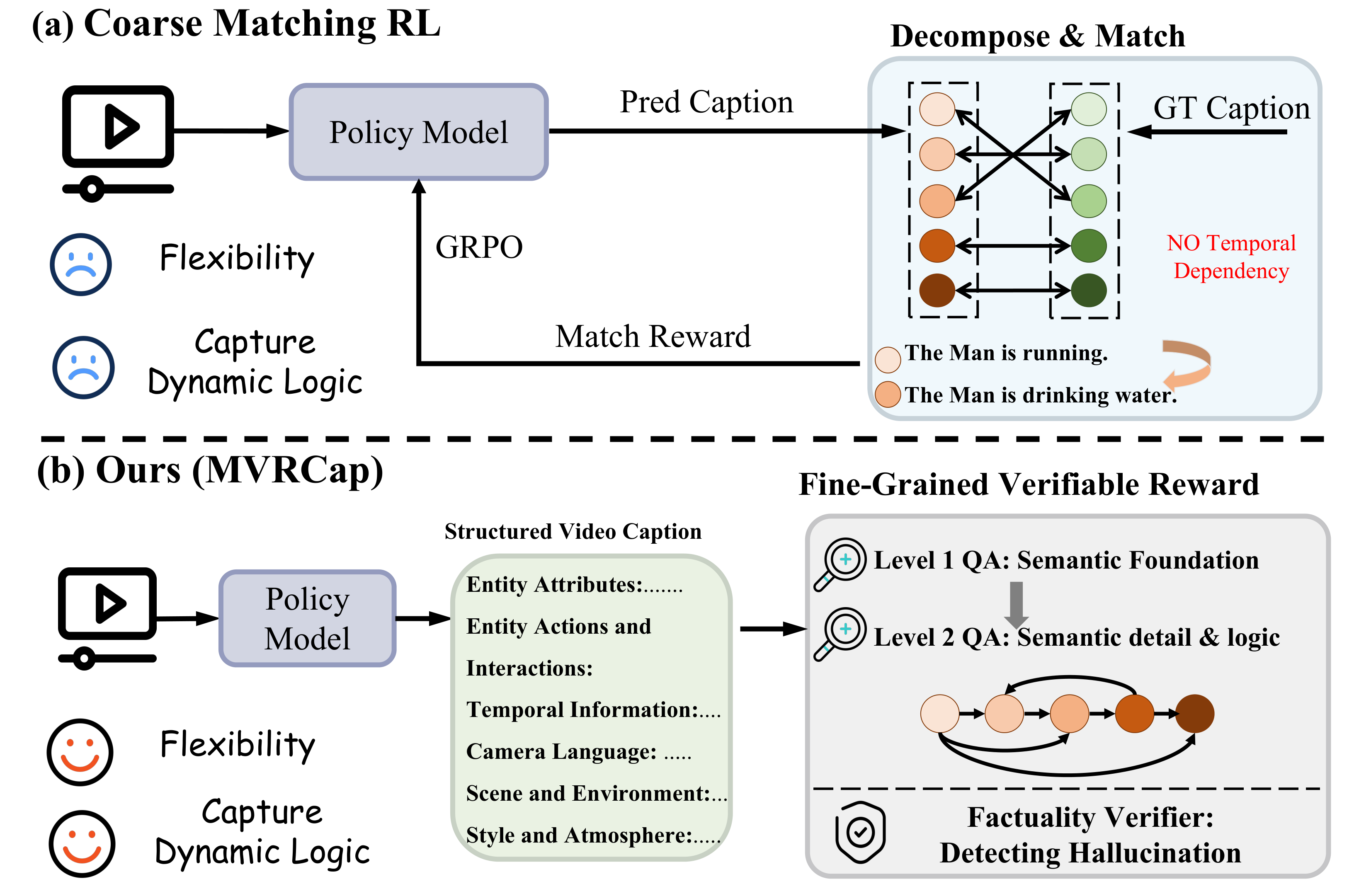
Caption: (a) Coarse Matching RL treats captions as unordered sets of atomic facts, failing to capture dynamic logic. (b) In contrast, our approach leverages Structured Visual Probing. We employ a Fine-Grained Verifiable Reward that integrates hierarchical QA probing and factuality verification to enforce supervision across six key dimensions.
Why It Matters: Contrasts the paper’s motivating failure mode—flat matching of atomic facts—with structured QA probing and factuality verification.
fig:data
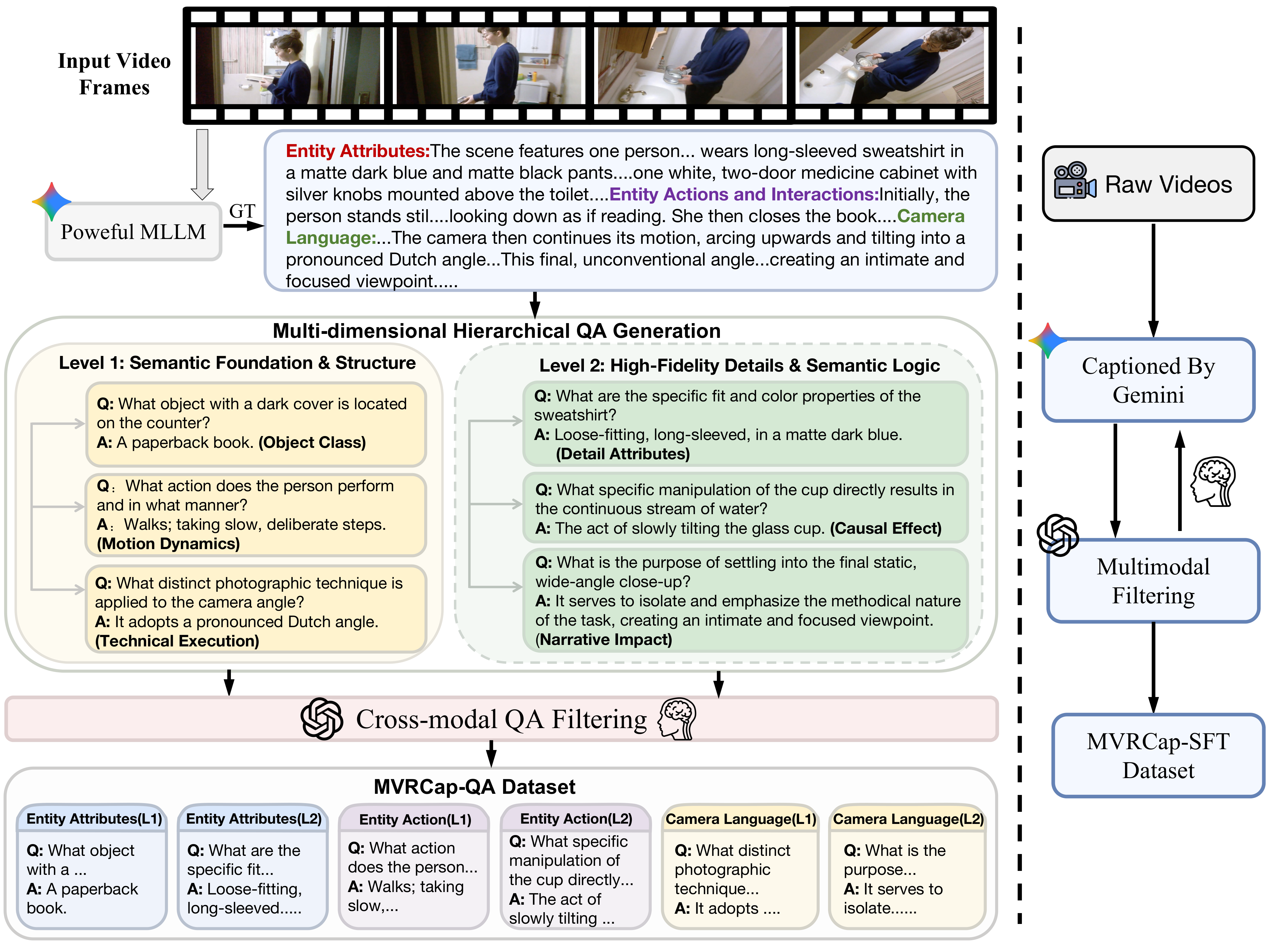
Caption: The Data Construction Pipeline for MVRCap. The left panel details the construction of the MVRCap-QA dataset. For brevity, only three dimensions are visualized. The right panel illustrates the workflow for generating the MVRCap-SFT dataset. The human icons denote steps involving manual validation.
Why It Matters: Shows how the caption and QA datasets are generated and where model filtering and human validation enter.
fig:method
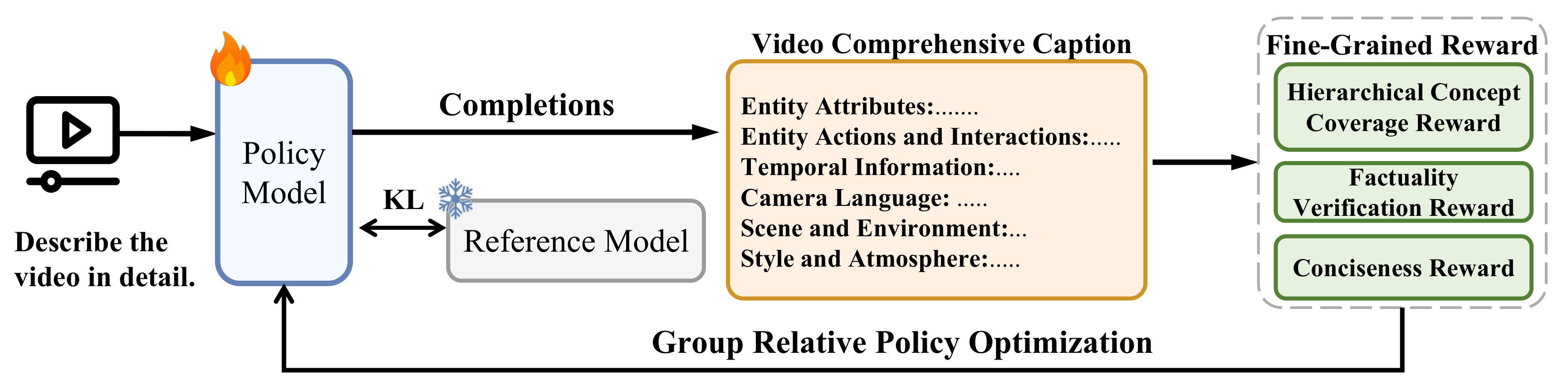
Caption: The Overall Framework of MVRCap.
Why It Matters: Summarizes the SFT-initialized policy, reference model, three reward components, and GRPO training loop.
🔮 Conclusion
The paper presents MVRCap as a two-stage approach for producing more complete video captions: SFT teaches a six-dimension structured format, and GRPO optimizes captions using QA coverage, factuality verification, and conciseness rewards. The reported results on VDC, CAPability, and VC4VG-Bench favor MVRCap over the cited baselines in the comparisons provided. The stage ablation supports combining SFT and RL, while the reward ablation’s extracted component mapping requires source-table verification before drawing finer conclusions.
For builders, the main takeaway is to make caption quality criteria explicit and testable. The paper’s evidence supports benchmark improvements under its evaluation setup, but leaves judge calibration, generalization to other video distributions, and operational cost as open questions. The authors conclude that their datasets and reward formulation encourage visual fidelity and structured coverage.
🛠️ Future Research Improvements
A natural next step is to measure how reliably the judge models score captions. The paper’s coverage judge answers questions using only the caption, while the factuality judge compares the candidate with a ground-truth caption. Human agreement and error analysis would clarify whether these signals track visual truth or inherit annotation phrasing and omissions. The paper describes human review during dataset creation, but the supplied main-body evidence does not report a quantified judge-validation study.
Further work could test robustness across domains, video lengths, frame rates, and event types, including cases where camera movement or temporal order is difficult to infer. The current reported setup uses 2.0 FPS during RL; evaluating alternative sampling rates would show whether the method’s gains depend on that choice. Ablations should also recover the exact reward-component mapping and report uncertainty across runs. Finally, measuring training and inference resource use would help compare the benefits of hierarchical rewards with their data-generation and judging overhead.
🏭 Potential Industry Use Scenarios
Structured captions could support video search and retrieval when users need to find not only an object or action, but also where it occurs, how events unfold, or how a camera moves. The six dimensions give indexing systems distinct fields for attributes, interactions, timing, environment, camera language, and atmosphere. This is a plausible application of the paper’s design, although the supplied evidence evaluates caption benchmarks rather than a deployed retrieval system.
Accessibility tools could use detailed captions to describe scene context and event sequences for viewers who cannot see the video. Media asset management and editing workflows could also use camera and style descriptions to organize footage or locate candidate shots. In safety, moderation, or audit workflows, temporal and factual checks may help reviewers identify claims that warrant attention. These are potential uses inferred from the method’s capabilities; the paper does not report industry pilots, user studies, service-level performance, or domain-specific risk evaluations, so builders would need to validate accuracy and appropriate human oversight in each setting.
💬 Critical Analysis
The method’s strongest design choice is that it separates completeness from factuality and length. A caption can cover many queried facts yet still contradict the video, so a distinct factuality reward addresses a meaningful failure mode. Dimension-wise averaging also reflects the authors’ goal of avoiding optimization that favors only easy or frequent content. The SFT-plus-RL ablation supports the value of staged training in the reported setup, and the benchmarks cover both static detail and dynamic caption dimensions.
The evidence has limits. Dataset creation depends on Gemini 2.5 Pro, GPT-5, a judge LLM, and human review; the main-body extraction gives dataset sizes and procedures but not quantified annotation agreement or error rates. The coverage judge sees captions without videos, which makes the reward scalable but means its ability to detect unsupported claims depends on QA construction and the reference answers. The comparison tables report benchmark scores, but they do not establish how performance changes across repeated runs or how robust the method is to domain shifts. The reward ablation’s flattened checkmarks are ambiguous in the supplied extraction, preventing confident attribution of each row to a specific component. These points make independent reproduction and careful judge validation important before relying on the approach in production.