
📌 Highlights
ACD-GS reframes 3DGS densification as a geometry-aware allocation problem. Its central claim is that rendered-depth curvature is a better structural cue than first-order photometric gradients for deciding where additional Gaussians are justified. The method therefore suppresses cloning at depth boundaries, promotes splitting of Gaussians that span multiple layers, and uses multi-view RGB residuals to retain appearance-driven refinement on textured surfaces. The paper reports results on Deep Blending, Mip-NeRF 360, and Tanks & Temples using 30K iterations on one NVIDIA RTX 5090. Across dataset groups, ACD-GS reduces storage and Gaussian count substantially while retaining competitive rendering metrics. The strongest caveat is that the authors acknowledge possible high-frequency texture degradation under extreme compression.
- Core mechanism: rendered-depth curvature controls structural densification.
- Asymmetric behavior: cloning is reduced while splitting is promoted near discontinuities.
- Cross-view verification: eight auxiliary cameras filter transient residuals.
- Capacity control: adaptive quotas and lifecycle-aware opacity pruning regulate growth.
- Reported outcome: roughly 60% fewer Gaussians and substantially lower storage across the evaluated groups.
🎯 Introduction
3D Gaussian Splatting represents scenes with explicit anisotropic Gaussian primitives and differentiable rasterization, providing high-fidelity novel-view synthesis with fast optimization and rendering. Its practical scalability depends heavily on how these primitives are created during training. Standard 3DGS accumulates screen-space positional gradients and clones or splits Gaussians once the gradient exceeds a fixed threshold. That signal measures local optimization pressure, but it does not directly identify whether the pressure comes from a textured planar surface, a smooth slope, a thin structure, or a true depth discontinuity.
The paper argues that this ambiguity creates a persistent density-control trade-off. Aggressive thresholds can cause redundant growth, higher storage, unstable optimization, and floating artifacts near foreground-background transitions. Conservative thresholds can leave thin structures and sharp boundaries under-refined. Pixel-aware gradients, absolute gradients, and gradient-direction statistics improve parts of the optimization process, but the paper characterizes them as still primarily first-order and single-view. ACD-GS addresses this limitation by using second-order responses from rendered depth as a structural prior, while reserving multi-view photometric evidence for candidate verification.
The paper-level objective is therefore not simply to compress a finished Gaussian set. It is to prevent unnecessary primitives from being generated in the first place while preserving enough capacity for geometry and appearance. The proposed framework separates structural guidance, photometric confirmation, and global capacity regulation into one density-control module that can replace the standard densification stage.
🔬 Methodology
ACD-GS begins with the standard accumulated positional-gradient statistic, where the projected center of each Gaussian supplies the screen-space location used by the gradient computation. Instead of applying one fixed operation rule to all candidates, the method renders depth from the current Gaussians and computes the magnitude of a discrete Laplacian. The response is clipped at the mean plus three standard deviations, normalized, and soft-thresholded with τ = 0.15. Each visible Gaussian samples the resulting confidence map at its projected center, producing a value in [0, 1]. This design makes the structural signal scene-derived rather than dependent on an input depth map.
The central asymmetry is expressed through operation-specific gradient modulation. For a Gaussian with base gradient g_i and edge confidence e_i, the cloning statistic is multiplied by 1 − αe_i while the splitting statistic is multiplied by 1 + βe_i. The reported defaults are α = 0.8 and β = 1.5. Thus, a Gaussian near a depth boundary becomes less likely to be cloned, avoiding ambiguous foreground-background duplication, but more likely to be split into smaller primitives that can represent separate depth layers. In smooth regions, the modulation approaches the original gradient behavior and retains capacity for appearance modeling.
Curvature alone is not sufficient for textured flat regions, so ACD-GS adds a multi-view photometric gate. Before a densification step, K = 8 auxiliary training cameras are sampled. Each view receives a mean absolute RGB residual map against its ground-truth image, which is binarized using a photometric threshold. The Gaussian center is projected into each valid view, and the resulting binary residual observations are aggregated into a cross-view score. Only candidates with sufficient multi-view residual consensus enter the densification pool. The valid-projection indicator establishes image support; the paper explicitly states that it is not an explicit occlusion test.
Finally, capacity-aware optimization controls global growth. The current positive-gradient distribution determines an adaptive threshold subject to a quota N_allow = floor(μN_total), with μ = 0.008 as the default. When enough candidates exist, the quota bounds the selected operations; otherwise, a top-10% fallback avoids marginal gradients. The final threshold is lower-bounded by 0.8 times the baseline threshold. Opacity pruning is annealed with training progress so that early low-opacity primitives can explore while late training removes more redundant elements. Figure 2 presents this complete pipeline.
equation 1
Meaning: This is the accumulated screen-space positional gradient inherited from standard 3DGS and used as the base signal for densification decisions.
equation 2
Meaning: This computes the magnitude of the discrete depth Laplacian, providing a curvature proxy that responds to structural discontinuities and high-curvature regions.
equation 3
Meaning: This clips isolated depth-curvature spikes using statistics of the rendered response before normalization.
equation 4
Meaning: This normalizes the clipped curvature map so it can be converted into a bounded structural confidence signal.
📊 Experiments
The authors evaluate ACD-GS on Mip-NeRF 360, Tanks & Temples, and Deep Blending against vanilla 3DGS, Mip-Splatting, Mini-Splatting, AbsGS, GDAGS, and Pixel-GS. All models are trained for 30K iterations on a single NVIDIA RTX 5090. ACD-GS runs its curvature-aware density control every 100 steps from iteration 600 through completion. Rendering quality is measured with PSNR and SSIM, where higher is better, and LPIPS, where lower is better. Efficiency is measured with storage size, Gaussian count, and training time, all reported with downward arrows in the source tables.
On Deep Blending, the reported mean row gives ACD-GS 25.12 PSNR, 0.834 SSIM, 0.215 LPIPS, and 133.44 MB, compared with 3DGS at 24.03 PSNR, 0.831 SSIM, 0.205 LPIPS, and 375.23 MB. The paper also reports scene-level values such as 26.42 PSNR and 41.76 MB on Aquarium, and 29.04 PSNR and 111.74 MB on Bedroom. On the mean row shown for the Tanks & Temples and Mip-NeRF 360 comparison, ACD-GS records 24.44 PSNR, 0.7818 SSIM, 0.2104 LPIPS, and 327.15 MB, while 3DGS records 24.39 PSNR, 0.7754 SSIM, 0.2175 LPIPS, and 739.56 MB.
The efficiency comparison is the clearest systems result. ACD-GS reports 545 seconds, 151.90 MB, and 0.6420 million points for Deep Blending; 345 seconds, 274.30 MB, and 1.1600 million points for Mip-NeRF 360; and 333 seconds, 150.40 MB, and 0.6357 million points for Tanks & Temples. Against GDAGS, the paper reports storage reductions from 360.60 MB to 151.90 MB on Deep Blending, from 707.10 MB to 274.30 MB on Mip-NeRF 360, and from 319.50 MB to 150.40 MB on Tanks & Temples. The authors characterize these as 57.8%, 61.2%, and 52.9% reductions, respectively.
The ablations support the proposed decomposition. On Deep Blending, adding curvature-guided asymmetric densification reduces storage from 360.60 MB to 302.40 MB while increasing PSNR from 25.22 to 25.38. Adding multi-view photometric gating reduces storage further to 159.70 MB and improves SSIM from 0.840 to 0.841 while reducing LPIPS from 0.223 to 0.221. Adding capacity-aware optimization reaches 151.90 MB, 25.59 PSNR, and 0.845 SSIM. The sensitivity study reports that K = 8 improves the quality metrics over K = 4, while K = 12 adds points and storage without consistent quality improvement. For the quota, μ = 0.008 provides higher PSNR and SSIM than μ = 0.004 with the same LPIPS, while μ = 0.012 does not improve quality. Figures 1, 3, and 4 provide the storage-quality, qualitative-rendering, and primitive-distribution views of these results.
Table 1
Caption: Quantitative Comparison on Deep Blending
| Method | SSIM↑ | PSNR↑ | LPIPS↓ | Size(MB)↓ |
|---|---|---|---|---|
| 3DGS | 0.831 | 24.03 | 0.205 | 375.23 |
| Mip-Splatting | 0.822 | 23.82 | 0.211 | 558.38 |
| Mini-Splatting | 0.824 | 24.11 | 0.221 | 925.68 |
| AbsGS | 0.790 | 23.49 | 0.240 | 395.14 |
| GDAGS | 0.819 | 23.89 | 0.215 | 363.26 |
| Pixel-GS | 0.829 | 24.56 | 0.203 | 671.01 |
| ACD-GS | 0.834 | 25.12 | 0.215 | 133.44 |
Why It Matters: The mean Deep Blending results quantify the quality and storage trade-off.
Table 3
Caption: Efficiency Metrics Comparison
| Method | Deep Blending Time(s)↓ | Deep Blending Size(MB)↓ | Deep Blending Points(M)↓ | Mip-NeRF 360 Time(s)↓ | Mip-NeRF 360 Size(MB)↓ | Mip-NeRF 360 Points(M)↓ | Tanks & Temples Time(s)↓ | Tanks & Temples Size(MB)↓ | Tanks & Temples Points(M)↓ |
|---|---|---|---|---|---|---|---|---|---|
| 3DGS | 842 | 367.30 | 1.5500 | 683 | 638.40 | 2.7000 | 552 | 373.10 | 1.5800 |
| Mip-Splatting | 1007 | 563.20 | 2.3400 | 956 | 991.10 | 4.1200 | 716 | 569.60 | 2.3700 |
| Mini-Splatting | 1125 | 959.10 | 4.1300 | 893 | 1108.60 | 4.6900 | 857 | 1011.00 | 4.2700 |
| AbsGS | 795 | 400.40 | 1.6900 | 683 | 716.40 | 3.0300 | 433 | 309.40 | 1.3100 |
| GDAGS | 628 | 360.60 | 1.5800 | 517 | 707.10 | 2.9900 | 350 | 319.50 | 1.3500 |
| Pixel-GS | 978 | 694.80 | 2.9400 | 1083 | 1315.10 | 5.5600 | 946 | 1067.40 | 4.5100 |
| ACD-GS | 545 | 151.90 | 0.6420 | 345 | 274.30 | 1.1600 | 333 | 150.40 | 0.6357 |
Why It Matters: This is the main evidence for lower training time, storage, and point count across dataset groups.
Table 4
Caption: Comparison of different settings for $ $ and $ $, varying one parameter at a time.
| α | β | PSNR↑ | SSIM↑ | LPIPS↓ | Size(MB)↓ |
|---|---|---|---|---|---|
| 0.5 | 1.5 | 25.5890 | 0.8424 | 0.2387 | 161.37 |
| 0.8 | 1.5 | 25.5913 | 0.8450 | 0.2363 | 151.85 |
| 1.0 | 1.5 | 25.8259 | 0.8469 | 0.2520 | 162.54 |
| 0.8 | 1.0 | 25.4263 | 0.8412 | 0.2451 | 157.35 |
| 0.8 | 2.5 | 25.4441 | 0.8415 | 0.2436 | 164.87 |
Why It Matters: The parameter study shows the reported balance between stronger cloning suppression, splitting enhancement, quality, and storage.
fig:teaser
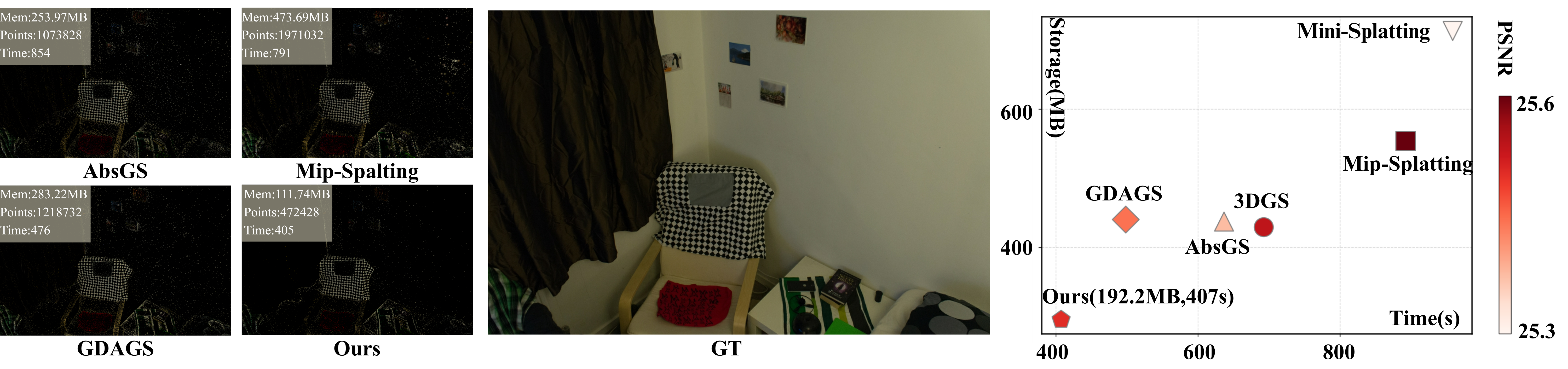
Caption: The point-cloud visualizations show our ACD-GS produces sparser Gaussians while preserving scene structure. The right plot (training time vs. storage, color-coded by PSNR) confirms that we achieve lower storage and faster training without sacrificing rendering quality.
Why It Matters: This figure summarizes the paper's central quality-efficiency claim by pairing spatial sparsity with the reported storage, training-time, and PSNR trade-off.
fig:overview
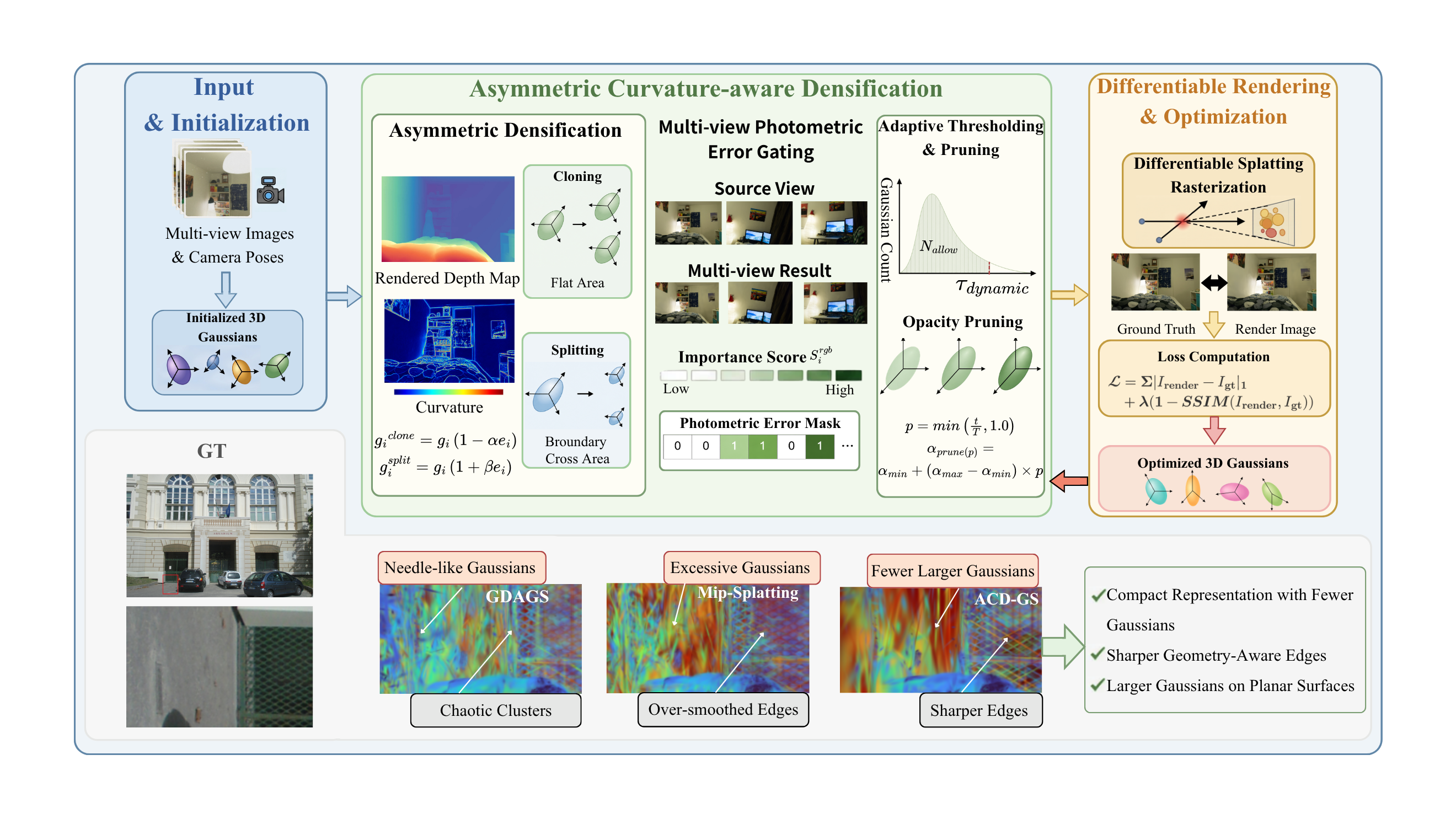
Caption: Overview of ACD-GS. Curvature-guided asymmetric densification suppresses cloning and promotes splitting near depth boundaries; multi-view photometric gating verifies candidates; capacity-aware thresholding and opacity pruning regulate growth. Depth is rendered from the current Gaussians rather than input.
Why It Matters: The overview makes the three-stage controller visible: structural guidance, cross-view verification, and capacity regulation.
fig:rgb_comp
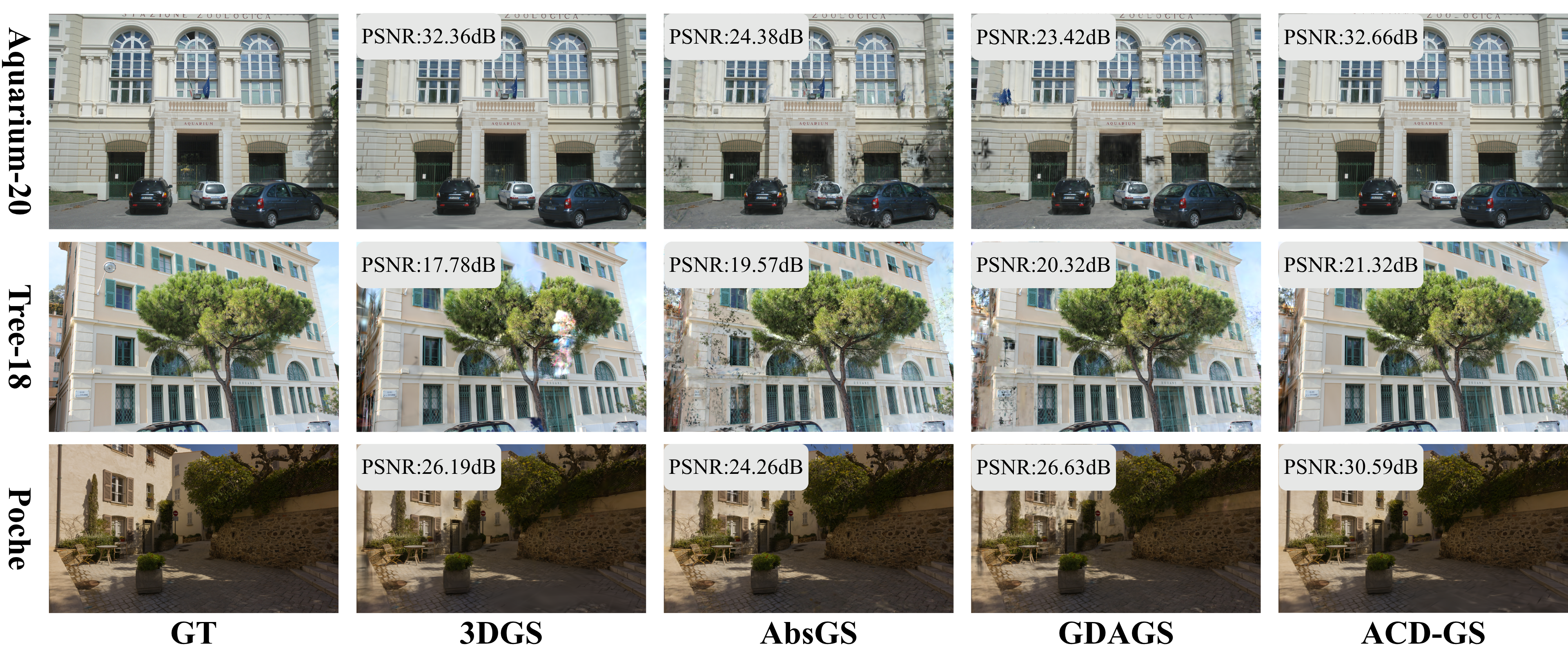
Caption: Qualitative comparison of novel view synthesis on the Deep Blending dataset.
Why It Matters: The qualitative comparison is the main visual evidence for whether compactness preserves novel-view appearance.
fig:density_comp
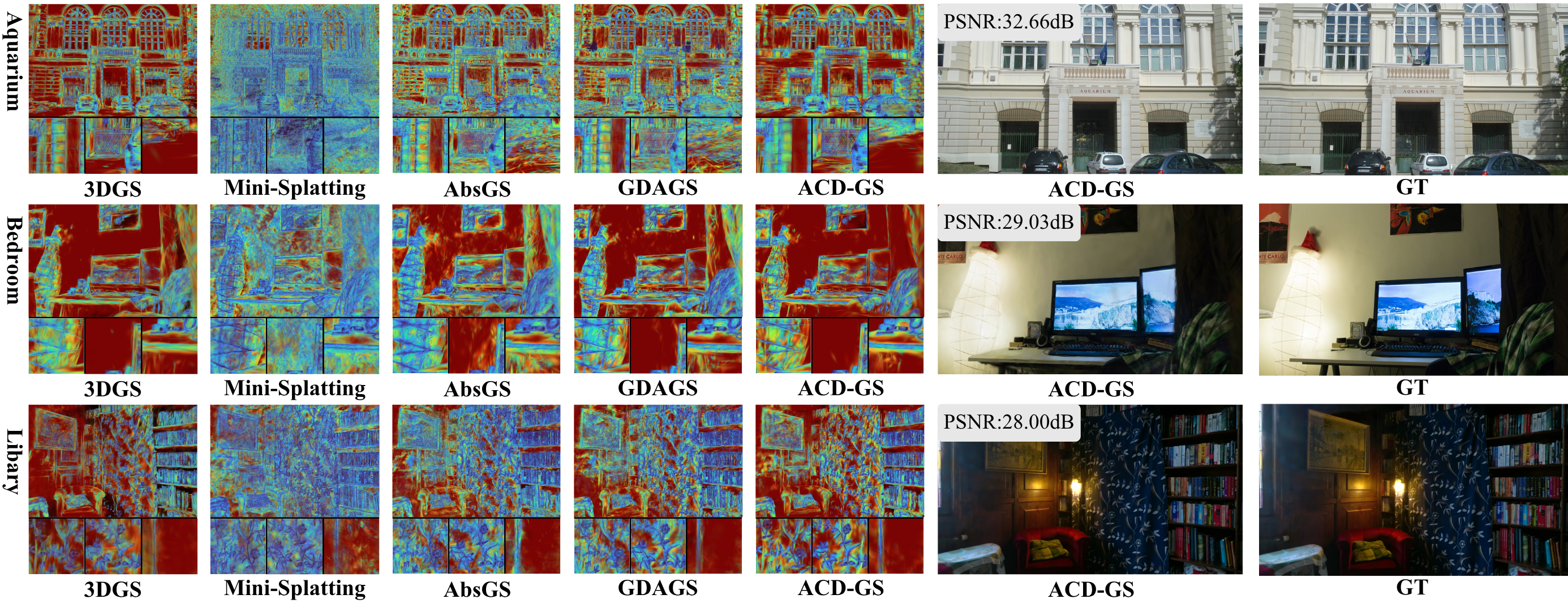
Caption: Visualization of Gaussians distribution
Why It Matters: The distribution visualization connects the reported point-count reduction to the claimed allocation of dense primitives near structural details and sparse primitives on planar regions.
🔮 Conclusion
ACD-GS presents a coherent training-time solution to one of the main scalability weaknesses of 3DGS. Rendered-depth curvature supplies structural information that first-order gradients lack, asymmetric modulation gives cloning and splitting distinct roles, multi-view residual gating reduces transient photometric overfitting, and capacity-aware pruning limits late-stage growth. Across the reported benchmarks, the method reduces Gaussian count and storage by roughly 60% while maintaining competitive rendering fidelity. The practical conclusion is strongest for systems where asset size and training efficiency matter, but the authors also acknowledge that extreme sparsification can compromise high-frequency texture detail.
🛠️ Future Research Improvements
The paper identifies two direct research directions. First, hybrid representations could replace or augment explicit spherical harmonics with lightweight multilayer perceptrons so that appearance detail is preserved under stricter point budgets. This would test whether ACD-GS can push compactness further without forcing geometry and texture to share the same explicit capacity. Second, ACD-GS could be integrated with downstream quantization and entropy-coding frameworks. Because the proposed method changes where capacity is allocated rather than how parameters are encoded, the combination could produce smaller assets, but that interaction is not evaluated in the main body. Additional work should also test parameter robustness across scenes, hardware, training budgets, and view distributions, while separately measuring the computational cost of depth rendering and auxiliary-view verification.
🏭 Potential Industry Use Scenarios
The reported storage and point-count reductions make ACD-GS a plausible component for interactive 3D content pipelines where compact assets are valuable. Potential scenarios include browser or mobile novel-view experiences, remote inspection and visualization, digital-twin viewers, and bandwidth-sensitive delivery of reconstructed environments. The method's training-time sparsification could also reduce the memory footprint of scene assets before they enter a downstream compression or streaming pipeline. Its real-time 3DGS foundation is relevant to applications that need fast view synthesis, while the geometry-aware allocation may help reduce floating artifacts around object boundaries. These are engineering extrapolations from the reported metrics rather than deployment demonstrations; the paper does not report production integration, mobile benchmarks, or end-to-end streaming measurements.
💬 Critical Analysis
The strongest aspect of ACD-GS is the division of labor among its signals. Curvature is used to reason about geometry, RGB residuals verify appearance needs across views, and capacity-aware rules regulate the global primitive budget. This separation is more interpretable than applying one gradient threshold to every operation, and the ablation table provides evidence that each module contributes to the final storage-quality trade-off. The reported efficiency gains are also substantial across three dataset groups, not confined to one qualitative example.
Several questions remain open. The method assumes that rendered-depth curvature is a reliable proxy for structural complexity, but the paper does not provide a broad failure analysis for noisy, reflective, transparent, or highly view-dependent scenes. The photometric gate adds repeated auxiliary-view rendering, yet the main body does not isolate that overhead from total training time. The evaluation uses one GPU and a fixed 30K-iteration protocol, so it is difficult to know whether the same balance holds under different hardware or convergence budgets. The Deep Blending ablation shows storage gains clearly, but LPIPS rises from 0.221 to 0.236 after adding capacity-aware optimization in the full configuration, so quality trade-offs should be inspected rather than summarized only as improvement. Finally, the paper's own limitation discussion indicates that compact explicit representations may lose high-frequency detail; hybrid appearance modeling and post-training compression remain pro...