
📌 Highlights
MolRSI treats molecular workflow development itself as a learning problem. It searches over model, scoring, training, and selection configurations while retaining evidence about successful workflows, failed modifications, and execution repairs for future tasks.
- Cross-task memory improved antibacterial workflow performance on all six reported antibacterial targets relative to search without prior-task experience.
- On a shared 271-compound S. aureus test set, MolRSI achieved AUROC 0.828 and AUPRC 0.300 versus 0.590 and 0.090 for the previous predictor.
- Prospective antibiotic screening produced 17 hits among 107 tested compounds, compared with 21 hits among 241 compounds for the previous expert-driven workflow.
- pMHC campaigns yielded five MART-1 hits and three SARS-CoV-1 hits; the compared Claude Science campaigns yielded no hits under the reported screening conditions.
- The main unresolved issue is that experimental outcomes are not yet fed back into the policy-update loop.
🎯 Introduction
Molecular discovery requires navigating large combinatorial spaces while satisfying competing biological objectives. Conventional and computational workflows combine library preparation, screening, counter-screening, model selection, training, scoring, and candidate prioritization, so the quality of the final candidates depends on many interdependent design choices.
Prior scientific agents can retrieve tools, execute code, or follow expert-defined protocols, but the paper argues that isolated campaigns do not retain the lessons needed to improve later workflow development. MolRSI's objective is therefore to combine systematic workflow optimization with persistent cross-task memory, allowing earlier workflow performance, refinement outcomes, and execution feedback to shape subsequent searches.
🔬 Methodology
MolRSI uses an Explore Agent to retrieve relevant literature, code, databases, tools, benchmarks, and algorithms, then packages them as executable skills with declared dependencies, interfaces, inputs, outputs, and execution steps. Skills are syntax- and dependency-checked and validated through isolated usage examples before reuse. The resulting library supports domain-specific molecular property prediction, protein folding, structure prediction, sequence design, scoring, and data processing.
Workflow search is implemented as experience-guided Monte Carlo tree search. MolRSI selects workflow families using current-task performance, an exploration bonus, and historical transfer information; selects parent workflows; proposes nonduplicate feasible modifications using refinement memory; executes and evaluates candidates using execution memory; and records the resulting workflow, score, resource use, failures, and repairs. This process operates within a task and across tasks.
The policy update is explicit: persistent memory M_t conditions the action distribution, new execution and evaluation experience E_t updates memory, and the updated memory defines the next policy. For direct transfer, MolRSI identifies a related source task using task type, metric, dataset size, and task-description similarity, then either reuses the best stored workflow or uses it to initialize further search.
Figure 1 summarizes the resource-library, memory, and recursive-search architecture.
eq:memory-conditioned-policy
Meaning: This defines how persistent memory changes the workflow-search policy after each new execution and evaluation update.
📊 Experiments
For antibiotic prediction, MolRSI was evaluated on six tasks covering S. aureus, P. aeruginosa, A. baumannii, E. coli, K. pneumoniae, and N. gonorrhoeae. Twenty-five source tasks—22 Therapeutics Data Commons tasks and three cytotoxicity tasks for HepG2, HSkMC, and IMR-90—provided experience, while the six antibacterial targets were held out from that memory pool. All methods used the same five similarity-based splits; mean validation AUPRC selected workflows, test AUPRC was reported across splits, and each task allowed up to 20 workflow evaluations. MolRSI without RSI achieved the highest mean test AUPRC, 0.361, and ranked first on four tasks and second on two.
The RSI ablation improved mean test AUPRC on all six antibacterial tasks. Zero-search transfer also exceeded search without RSI on S. aureus, A. baumannii, and K. pneumoniae. Across memory-pool analyses, transferred performance increased from approximately 0.32 with two source tasks to approximately 0.37 with all 25, exceeding the 0.361 mean achieved by search without RSI after 20 iterations. In prospective screening of approximately 12.1 million compounds, the MolRSI workflow selected 107 compounds; 17 met the MSSA MIC threshold of 32 µg/mL or lower, for a 15.9% hit rate versus 8.7% for the prior expert workflow. On the shared 271-compound test set, MolRSI achieved AUROC 0.828 and AUPRC 0.300 versus 0.590 and 0.090 for the previous predictor. C3 and C32 showed MRSA MICs of 1 and 8 µg/mL, respectively, while their tested human-cell CC50 ranges were 6.4–17.5 and 24.2–54.7 µg/mL.
For pMHC design, the no-RSI benchmark covered 14 miniprotein-binder tasks using a resource library of 65 executable skills. MolRSI achieved macro EF@1% 8.01 versus 7.62 for the next-best agent and macro EF@2% 7.29 versus 6.71. On held-out MART-1, the RSI-enabled workflow achieved EF@1% 3.65 and EF@2% 5.55, while the otherwise identical no-RSI system achieved 0.00 at both cutoffs. A 30-round design-workflow search improved the best-so-far objective to 6.76 for MART-1 and 7.56 for SARS-CoV-1, reported as 66% and 28% improvements over the initial configurations. Experimental screening produced five MART-1 hits among 251 evaluable designs and three SARS-CoV-1 hits among 266; Claude Science produced zero hits among 288 and 267, and removing the learned ranking procedure produced zero hits among 479 evaluable designs.
Figures 2–5 provide the search trajectories, ablations, prospective antibiotic validation, pMHC benchmark comparisons, and experimental binder recovery. The enrichment-factor equation defines the direction of the pMHC ranking metric: larger values indicate stronger concentration of confirmed binders near the top of the ranked list.
antibiotic-benchmark-ranks
Caption: Six-task antibacterial benchmark ranking; lower rank is better.
| Agent | S. aureus | P. aeruginosa | A. baumannii | E. coli | K. pneumoniae | N. gonorrhoeae | Mean rank |
|---|---|---|---|---|---|---|---|
| MolRSI without RSI | 1 | 1 | 2 | 1 | 2 | 1 | 1.33 |
| Biomni | 3 | 5 | 5 | 4 | 1 | 2 | 3.33 |
| Claude Science | 5 | 6 | 1 | 2 | 4 | 5 | 3.83 |
| STELLA | 4 | 3 | 3 | 3 | 6 | 6 | 4.17 |
| Codex | 2 | 4 | 4 | 6 | 5 | 3 | 4.00 |
| Claude Code | 6 | 2 | 6 | 5 | 3 | 4 | 4.33 |
Why It Matters: The reported ranks show that MolRSI without prior-task memory still led the six-task comparison under the shared evaluation setup.
antibiotic-mean-auprc
Caption: Mean test AUPRC across the six antibacterial tasks.
| Agent | Mean test AUPRC |
|---|---|
| MolRSI without RSI | 0.361 |
| Biomni | 0.317 |
| Claude Science | 0.303 |
| STELLA | 0.296 |
| Codex | 0.295 |
| Claude Code | 0.285 |
Why It Matters: Mean test AUPRC summarizes predictive performance across the six bacterial-species tasks.
antibiotic-prospective-results
Caption: Prospective antibiotic-screening and shared held-out prediction results.
| Comparison | Compounds or test set | Hits | Hit rate / AUROC | AUPRC |
|---|---|---|---|---|
| MolRSI screening workflow | 107 | 17 | 15.9% | — |
| Previous expert-driven workflow | 241 | 21 | 8.7% | — |
| MolRSI predictor on shared S. aureus test set | 271 | — | 0.828 | 0.300 |
| Previous predictor on shared S. aureus test set | 271 | — | 0.590 | 0.090 |
Why It Matters: The table separates prospective compound yield from predictive discrimination on the common held-out set.
eq:protein-ef
Meaning: This metric evaluates how strongly confirmed binders are enriched in the top-ranked fraction of candidates; higher EF is better.
fig:fig1
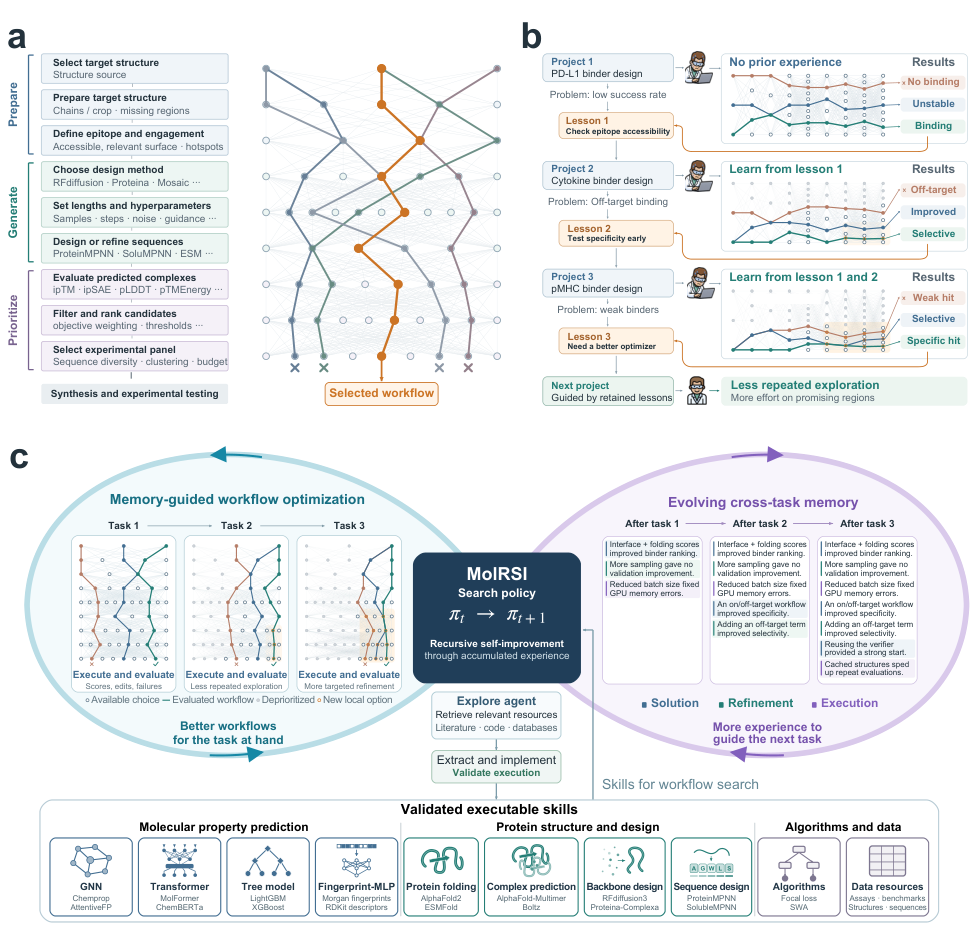
Caption: MolRSI motivation and architecture. (a) Molecular discovery involves a combinatorial space of decisions across preparation, generation and prioritization, illustrated for de novo protein binder design. Nodes represent options at each stage. The orange path traces one possible workflow. (b) Scientists accumulate lessons from experimental outcomes across projects, learning to avoid unproductive choices and focus exploration on promising regions. (c) MolRSI couples systematic workflow search with persistent cross-task memory. The Explore agent retrieves relevant resources from scientific literature and code repositories, then converts them into reusable, executable skills through implementatio...
Why It Matters: This is the conceptual architecture: resource discovery, workflow search, persistent memory, and policy improvement form one feedback loop.
fig:fig2
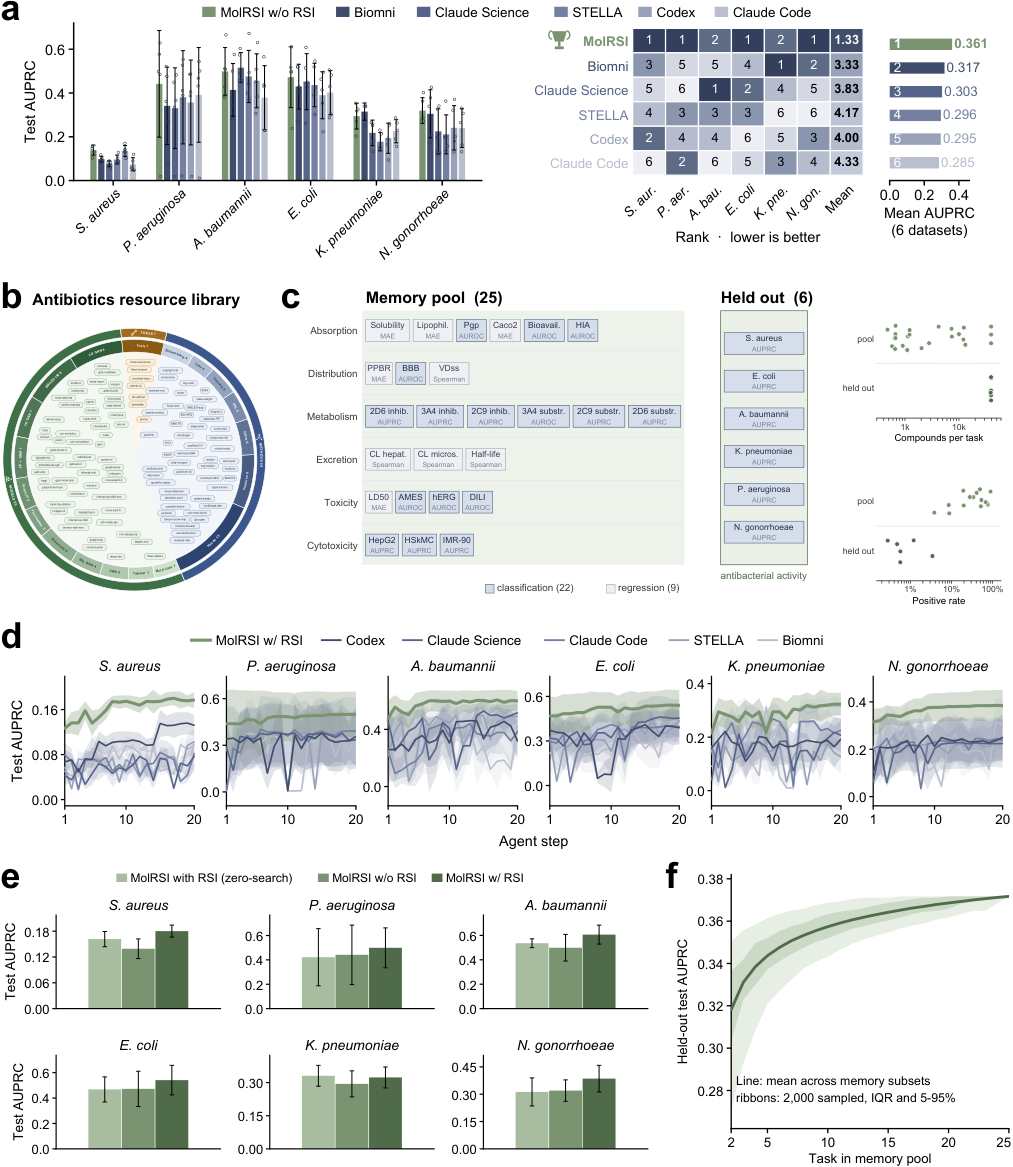
Caption: Computational evaluation of MolRSI for antibiotic discovery. (a) Test AUPRC and rankings of MolRSI without RSI and baseline agents across six antibacterial tasks. (b) Resource library. (c) Experience from 25 source tasks, excluding the antibacterial targets. (d) Search trajectories over 20 iterations. (e) Search with and without RSI and zero-search transfer, which retains model fitting and validation. (f) Zero-search transfer performance versus memory-pool size. The line shows test AUPRC averaged analytically across the six held-out antibacterial tasks and all possible subsets of each size from the 25-task memory pool. Darker and lighter shading indicate the interquartile range (IQR; 25th–7...
Why It Matters: The figure directly tests whether accumulated experience improves search quality, early search efficiency, and zero-search transfer.
fig:fig3
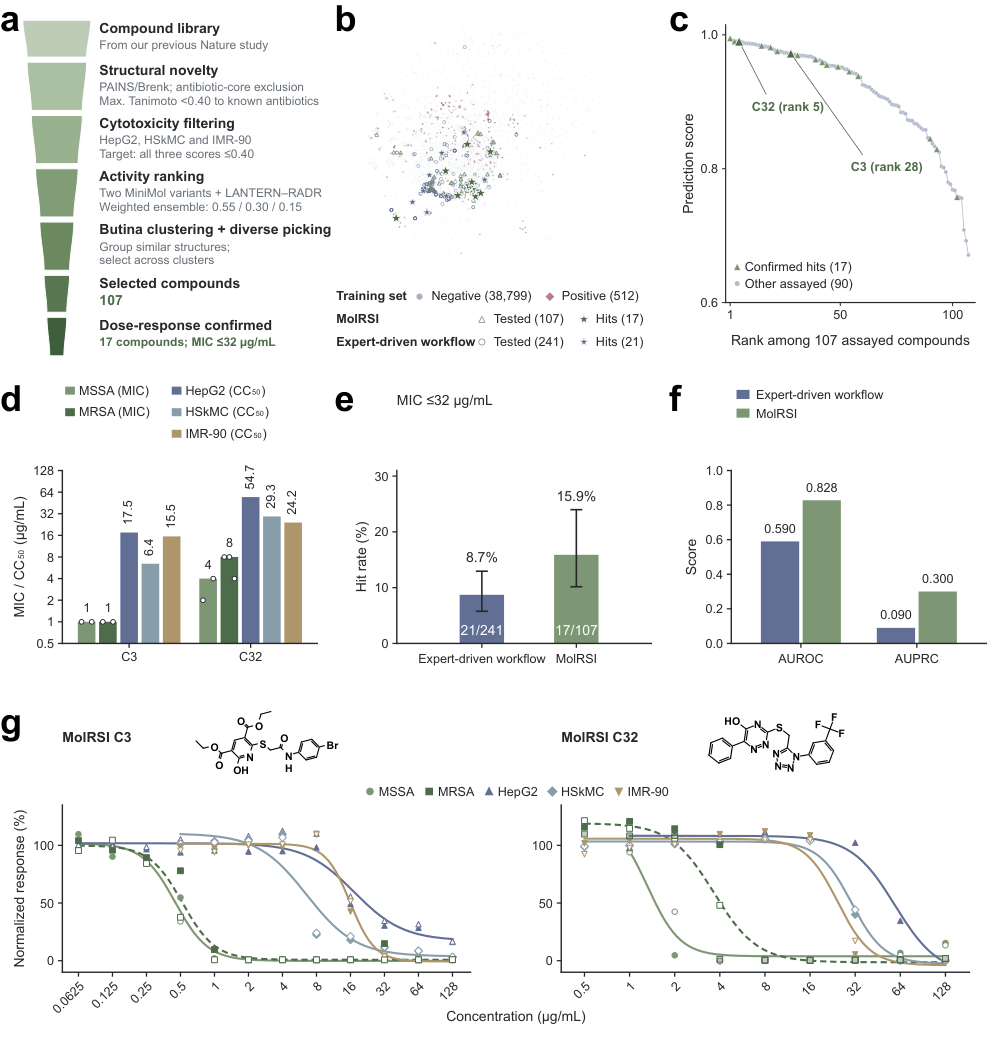
Caption: Virtual screening and experimental validation with MolRSI. (a) Screening workflow yielding 107 tested compounds; cytotoxicity-filter exceptions are detailed in Section S3.4. (b) t-SNE projection of training and tested compounds; stars indicate hits. (c) Activity-score ranking of tested compounds. (d) MSSA and MRSA MICs and HepG2, HSkMC and IMR-90 CC50 values for two selected hits, C3 and C32; dots show individual MIC measurements. (e) Hit rates for 107 MolRSI-selected and 241 expert-selected compounds, with 95% Wilson confidence intervals. (f) AUROC and AUPRC on the shared 271-compound held-out S. aureus test set. (g) Chemical structures and dose–response curves of C3 and C32. Symbols show...
Why It Matters: This connects computational workflow selection to prospective compound testing, activity, cytotoxicity, and predictive discrimination.
fig:fig4
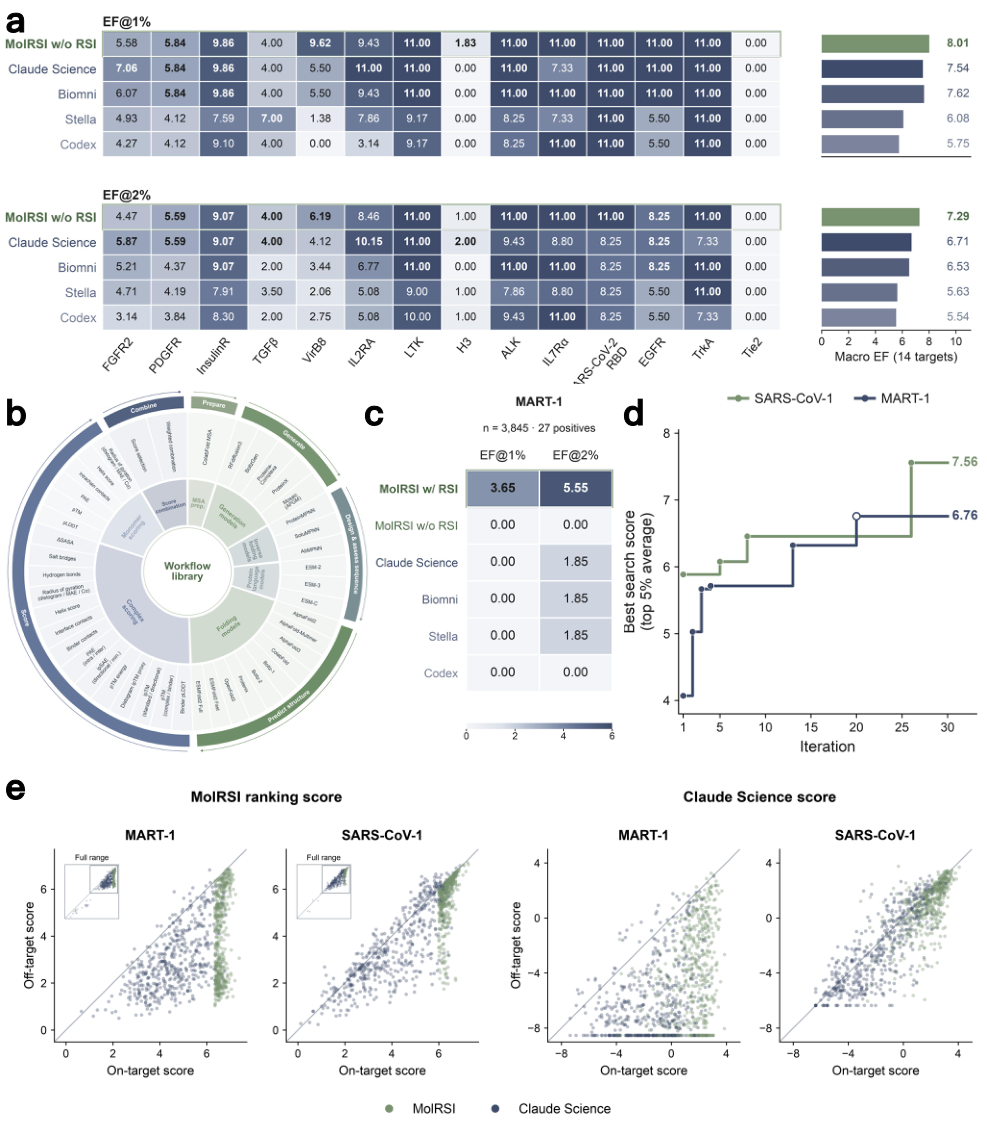
Caption: Benchmarking and experience-guided optimization of pMHC binder-design workflows. (a) Enrichment Factor (EF) at the top-ranked 1% and 2% cutoffs (EF@1% and EF@2%) for MolRSI and four agent baselines across 14 miniprotein-binder tasks. Heatmaps show individual tasks; bars show the unweighted macro average across tasks. (b) Protein resource library organized into input preparation, generation, sequence design and assessment, structure prediction, scoring and score combination. (c) EF@1% and EF@2% on the held-out MART-1 pMHC target for MolRSI with and without RSI and four agent baselines. (d) Best-so-far search objective, defined as the mean ranking score among the top 5% of candidates, during...
Why It Matters: The figure shows both benchmark-level prioritization and the effect of cross-task experience on pMHC workflow optimization.
fig:fig5
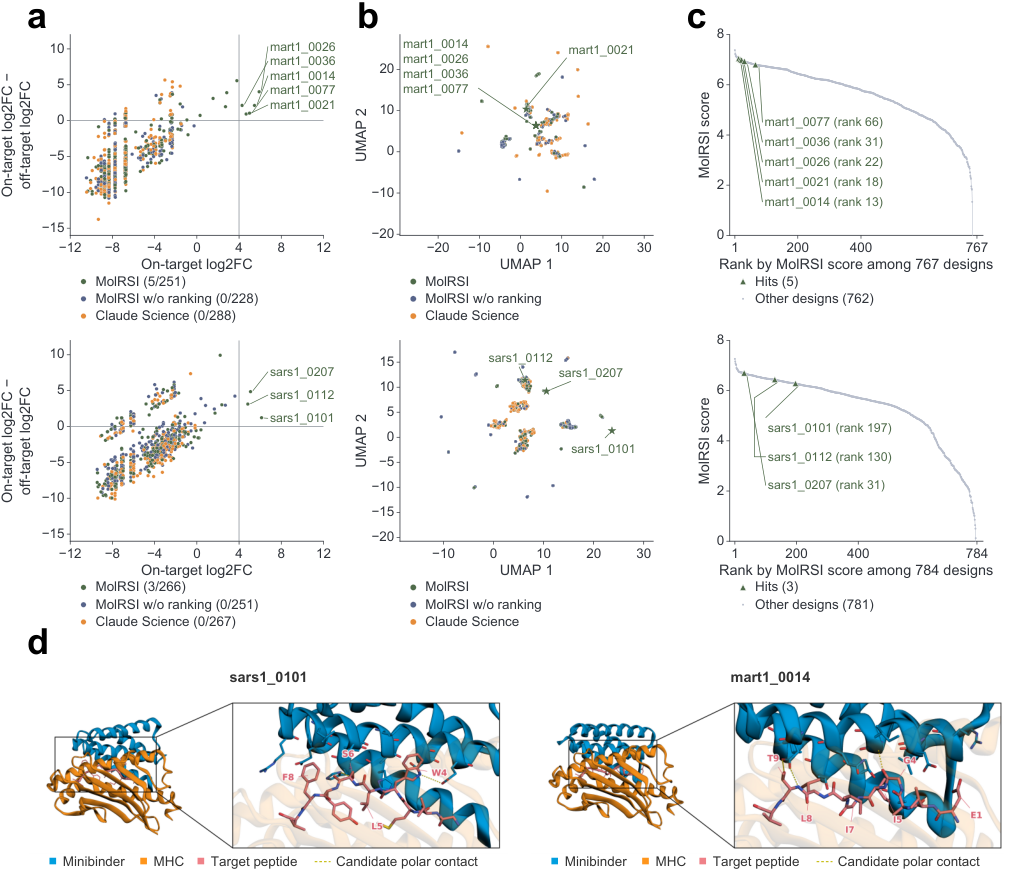
Caption: Prospective experimental validation of pMHC binder designs. Upper and lower rows in a–c show MART-1 and SARS-CoV-1, respectively. (a) On-target log2FC and its difference from the maximum available off-target log2FC. Dashed lines mark hit thresholds (x > 4, y > 0); legend values indicate hits/evaluable designs. (b) UMAP of predicted minibinder structures based on TM-align similarity; stars mark experimental hits. (c) Designs ranked by score, with hits highlighted in green. (d) Predicted complexes of sars1_0101 and mart1_0014. Minibinders, MHC and peptides are blue, orange and pink, respectively; yellow dashed lines indicate candidate polar contacts.
Why It Matters: This is the prospective test of whether learned ranking and workflow optimization recover experimentally enriched, target-preferential binders.
🔮 Conclusion
MolRSI shows that persistent experience can improve the search policy used to construct molecular-discovery workflows. Its computational benchmarks indicate better use of a fixed workflow-search budget, while antibiotic and pMHC experiments show that these workflow improvements can translate into higher prospective hit recovery and target-preferential binding.
The strongest evidence is the agreement between ablations and prospective validation: RSI improves antibacterial workflow performance, accumulated experience improves MART-1 prioritization, and removing the learned pMHC ranking procedure eliminates the reported experimental hits. At the same time, the study remains a demonstration across selected tasks rather than a complete laboratory-in-the-loop discovery system.
🛠️ Future Research Improvements
The paper identifies several directions for strengthening recursive scientific agents. Future systems should incorporate experimental successes and failures directly into policy updates, test whether inherited policies remain useful as biological targets and evaluation criteria change, and benchmark adaptation across longer sequences of related tasks. More systematic analysis of which source tasks contribute useful experience would also help determine when transfer is reliable.
A particularly important extension is to connect computational scores more tightly to biological outcomes. MolRSI currently uses development metrics to guide workflow search and reserves test outcomes for evaluation; laboratory feedback could instead help decide which workflow families, modifications, and candidate-selection rules receive additional search effort.
- Add wet-lab outcomes to solution, refinement, and execution memory.
- Evaluate transfer under larger target, assay, and objective distribution shifts.
- Measure how source-task diversity and relevance affect transfer quality.
- Report longer-horizon task sequences to test whether policy improvement compounds or saturates.
🏭 Potential Industry Use Scenarios
A plausible application is early-stage antibiotic discovery, where an agent could assemble activity, cytotoxicity, novelty, and diversity filters for large compound libraries and prioritize a smaller experimental panel. The reported 107-compound screen and higher hit rate indicate how workflow optimization could improve experimental throughput, although deployment would require additional validation across libraries, organisms, assays, and safety criteria.
A second scenario is protein and pMHC binder design for therapeutic discovery. An experience-aware system could reuse validated structure-prediction, sequence-design, scoring, and specificity procedures across targets, then optimize generation and prioritization workflows before synthesis or screening. The reported MART-1 and SARS-CoV-1 results support this as a research workflow pattern, not yet as evidence of clinical or production readiness.
The same architecture could support broader ADMET and molecular-property modeling programs by retaining which representations, models, losses, ensemble strategies, and execution repairs worked under particular data regimes. Operational adoption would require strong provenance, sandboxed execution, resource accounting, reproducible environments, and human review before experimental decisions.
💬 Critical Analysis
The paper's main strength is that it evaluates recursive workflow improvement at multiple levels: controlled computational benchmarks, RSI and zero-search ablations, transfer across source-task pools, and prospective wet-lab validation. The comparisons use shared inputs and evaluation objectives, and the study distinguishes validation metrics used for search from held-out test metrics used for final assessment. The pMHC experiments further connect ranking quality to experimentally recovered binders rather than relying only on computational scores.
The central caveat is attribution. Baseline agents retain their native tools and workflow-development procedures, so measured differences reflect the combined effects of search policy, resource access, model configuration, and execution strategy. Cross-task memory also depends on source-task relevance, and the paper acknowledges variation among experience pools. The experimental evidence is promising but limited to the reported antibiotic and pMHC settings, and the system does not yet use laboratory outcomes to update its policy.
For builders, the most important reproducibility risk is not the high-level MCTS loop but the details of resource-library construction, task matching, workflow validity checks, repair behavior, and score definitions. A faithful reproduction should preserve the split construction, search budgets, validation-versus-test separation, baseline constraints, and transfer ablations. The results justify treating experience memory as a serious systems component, but they do not establish that recursive self-improvement will generalize automatically to unrelated molecular domains or higher-stakes experimental programs.