
📌 Highlights
The paper’s central claim is that diffusion-model membership inference becomes substantially more reliable when the score is calibrated against an image-specific difficulty reference. Absolute denoising loss is not enough: Figure 1 reports a 45% overlap between member and non-member loss populations even at the optimal log-SNR. RMC removes this confound by comparing a fine-tuned checkpoint with its pretrained predecessor, while TSC removes it using neighboring points on the candidate’s own denoising trajectory. The strongest reported DDPM result is 62.31% TPR@1%FPR on CIFAR-10, versus 30.90% for PIAN. On realistic uncaptioned Stable Diffusion fine-tunes, RMC reaches 98.52% TPR@1%FPR on MS COCO with 20 queries.
The technical contribution is not simply a new threshold. It is a change in what is treated as evidence: membership is represented as a relative trajectory deviation rather than an absolute loss level. TSC’s symmetric stencil also supports comparisons across x-, v-, and ε-prediction models, where the informative region shifts with the training target. The principal caveat is operational: the auditor must obtain intermediate denoising predictions, and RMC additionally requires a known pretrained checkpoint.
- RMC calibrates across training time; TSC calibrates across diffusion time.
- TSC doubles CIFAR-10 TPR@1%FPR relative to the strongest listed baseline, from 30.90% to 62.31%.
- RMC uses two queries for strong results and 20 queries for near-perfect reported auditing on the three Stable Diffusion fine-tunes.
- The methods are evaluated on DDPM, DDPM++ flow-matching, and Stable Diffusion settings.
🎯 Introduction
Diffusion models are trained on large, heterogeneous collections that may contain personal photographs, copyrighted artworks, or proprietary material. Membership inference attacks address this provenance and privacy problem by asking whether a particular image was included in training. In diffusion models, the standard approach is to evaluate denoising or reconstruction loss and classify low-loss candidates as members. The paper argues that this formulation has a fundamental weakness: intrinsic image difficulty varies with high-frequency detail, layout complexity, and rare semantic content, so an easy unseen image can have lower loss than a difficult training image.
The paper-level objective is to separate these two effects using calibration across two time axes. For fine-tuned models, the pretrained checkpoint offers a baseline before the candidate could have been introduced by fine-tuning. For settings such as pretraining audits, where that checkpoint may not exist, the model’s own diffusion trajectory supplies nearby reference points. The study therefore develops RMC and TSC, evaluates them across multiple architectures and datasets, and tests whether the calibrated signal remains useful when the model predicts x, v, or ε rather than only the conventional noise target.
🔬 Methodology
The method places different generative trajectories in a common coordinate system. A noisy state is written as $z_t=\alpha_t x+\sigma_t\epsilon$, and the paper uses $\lambda(t)=\log(\alpha_t^2/\sigma_t^2)$ to align diffusion and flow-matching schedules. For a model with optional conditioning $c$, the native prediction head can target $x$, $v$, or $\epsilon$, while the audit evaluates a common squared denoising error. The resulting loss is converted to stabilized log-loss, $\ell_\theta(x,\lambda)=\log(L_\theta(x,\lambda)+\delta)$. This transformation operationalizes the paper’s multiplicative difficulty hypothesis: if two losses share a factor $H(x)$, subtraction in log space removes the shared image-specific offset.
RMC evaluates a candidate at a fixed log-SNR on both the fine-tuned checkpoint and its pretrained source. Its score is $r_{\mathrm{ref}}=\ell_{\theta_{\mathrm{FT}}}-\ell_{\theta_{\mathrm{pre}}}$, so a newly memorized example should have a negative residual. Figure 2 shows that the checkpoint losses on MS COCO have Pearson correlation $r=0.989$, and the residual concentrates non-members near zero while shifting members downward. This makes RMC particularly appropriate for fine-tuning audits, but not for unknown pretraining data.
TSC instead evaluates one model at $\lambda^*$ and at two symmetric context points $\lambda^- = \lambda^* - \Delta$ and $\lambda^+ = \lambda^* + \Delta$. Its score subtracts the average context log-loss from the target log-loss. Geometrically, this is the target’s deviation from the chord between its neighbors. The symmetric weights cancel a shared additive difficulty offset, linear trends, and antisymmetric trajectory components. The reported default window is $2\Delta=5$ log-SNR, with $\lambda^*$ tuned on shadow data. Figure 3 illustrates why this helps when a difficult member has higher absolute loss than an easy non-member.
equation 1
Meaning: Maps model-specific diffusion time to a common log-SNR coordinate, allowing trajectories from diffusion and flow-matching models to be compared on the same axis.
equation 2
Meaning: Defines the squared denoising error used to score a candidate image after selecting a target representation and optional conditioning.
equation 3
Meaning: Transforms raw loss into stabilized log-loss so multiplicative image difficulty becomes an additive offset that can be canceled by calibration.
equation 4
Meaning: RMC score: a more negative residual indicates that fine-tuning reduced the candidate’s loss relative to the pretrained baseline.
📊 Experiments
The experiments cover DDPMs on CIFAR-10, CIFAR-100, STL-10-U, and Tiny ImageNet; DDPM++ flow-matching models on CIFAR-100; and Stable Diffusion v1.4 fine-tuned on Pokémon, MS COCO, and Flickr30k. The main DDPM comparison uses Naive, SecMI, PIA, and PIAN. Stable Diffusion evaluation uses an uncaptioned threat model, while CLiD in the RMC comparison uses ground-truth captions. Performance is reported with AUC, ASR, and TPR@1%FPR, and timestep-dependent settings are tuned by maximizing AUC on a disjoint shadow split.
On DDPM benchmarks, TSC reaches 95.91 AUC, 90.15 ASR, and 62.31 TPR@1%FPR on CIFAR-10. The corresponding strongest listed TPR baseline is PIAN at 30.90%. On Tiny ImageNet, TSC reaches 12.27 TPR@1%FPR versus 6.10 for PIAN; on STL-10-U it reaches 9.57 versus 4.32 for PIAN. On Stable Diffusion, TSC leads all metrics on MS COCO and Flickr30k, reaching 29.16 and 30.28 TPR@1%FPR respectively. Pokémon is the exception: PIA with an optimized timestep reaches 61.30 TPR@1%FPR, compared with TSC’s 55.77. The paper attributes this to Pokémon’s limited scale and visual uniformity, which reduce variation in image difficulty.
RMC is especially strong on the fine-tuning datasets. With two queries, it reaches 90.63, 96.60, and 96.86 TPR@1%FPR on Pokémon, MS COCO, and Flickr, respectively. With 20 queries, the values rise to 96.64, 98.52, and 99.82. These results exceed the 15-query CLiD values of 64.75, 44.04, and 47.14. The parameterization study on nine CIFAR-100 DDPM++ flow-matching models reports that TSC is best in every x-, v-, and ε-loss/head configuration; its selected center shifts from -0.50 to 0.50 to 1.75 as the training target changes from x to v to ε. The paper reports an average 23.84 percentage-point improvement over the strongest baseline in that table.
The ablations support the proposed mechanism. Log-loss TSC reaches nearly 26% TPR@1%FPR in the score-domain experiment, while raw-loss TSC falls below Naive. Increasing queries from q = 3 to q = 45 improves log-loss TSC, whereas Naive remains near 4%. The temporal-filter study reports endpoint TSC at 35.30 TPR@1%FPR for q = 15 and 39.26 for q = 45, higher than the tested even, Gaussian, and reverse-window alternatives. The symmetry study further finds that the symmetric stencil has the highest mean low-FPR TPR among the compared reference arrangements.
Table 1
Caption: RMC on realistic Stable Diffusion fine-tunes. Reference calibration is evaluated without captions at λ = 1 log-SNR using either one or 10 paired noise draws. CLiD uses the ground-truth caption. Parentheses provide the number of model queries per candidate.
| Method | Queries | Pokémon AUC | Pokémon ASR | Pokémon TPR@1%FPR | MS COCO AUC | MS COCO ASR | MS COCO TPR@1%FPR | Flickr AUC | Flickr ASR | Flickr TPR@1%FPR |
|---|---|---|---|---|---|---|---|---|---|---|
| CLiD | 15 | 96.98 | 91.83 | 64.75 | 95.55 | 88.72 | 44.04 | 95.22 | 88.16 | 47.14 |
| RMC | 2 | 99.44 | 96.51 | 90.63 | 99.88 | 98.52 | 96.60 | 99.80 | 98.14 | 96.86 |
| RMC | 20 | 99.73 | 97.84 | 96.64 | 99.94 | 99.04 | 98.52 | 99.96 | 99.50 | 99.82 |
Why It Matters: RMC substantially exceeds CLiD in the reported uncaptioned reference-calibration comparison and reaches near-perfect auditing with 20 queries across the three fine-tuning datasets.
Table 2
Caption: Membership inference on DDPM benchmarks. Results reported as percentages. Parentheses give the number of model queries per candidate. SecMI follows its official protocol.
| Method | Queries | CIFAR-10 AUC | CIFAR-10 ASR | CIFAR-10 TPR@1%FPR | Tiny ImageNet AUC | Tiny ImageNet ASR | Tiny ImageNet TPR@1%FPR | STL-10-U AUC | STL-10-U ASR | STL-10-U TPR@1%FPR |
|---|---|---|---|---|---|---|---|---|---|---|
| Naive | 20 | 85.39 | 78.21 | 7.35 | 64.37 | 60.52 | 2.93 | 64.15 | 60.50 | 2.51 |
| SecMI | 12 | 88.24 | 80.91 | 10.20 | 66.37 | 61.88 | 2.91 | 68.12 | 63.33 | 3.03 |
| PIA | 2 | 91.90 | 84.88 | 25.80 | 68.99 | 64.25 | 4.43 | 69.46 | 64.51 | 4.08 |
| PIAN | 2 | 89.26 | 83.32 | 30.90 | 67.04 | 63.44 | 6.10 | 66.72 | 63.36 | 4.32 |
| TSC | 15 | 95.91 | 90.15 | 62.31 | 78.63 | 72.18 | 12.27 | 77.84 | 71.29 | 9.57 |
Why It Matters: On standard image-synthesis benchmarks, TSC is strongest on all three reported metrics for every dataset, with its largest gain appearing at 1% false-positive rate.
Table 3
Caption: Membership inference on Stable Diffusion fine-tunes (uncaptioned). SecMI denotes its LDM variant. PIA, is evaluated both over the original paper’s default timestep (t = 500) and an average optimal timestep over shadow models.
| Method | Queries | Pokémon AUC | Pokémon ASR | Pokémon TPR@1%FPR | MS COCO AUC | MS COCO ASR | MS COCO TPR@1%FPR | Flickr AUC | Flickr ASR | Flickr TPR@1%FPR |
|---|---|---|---|---|---|---|---|---|---|---|
| Naive | 10 | 84.84 | 77.43 | 28.37 | 76.61 | 69.92 | 7.16 | 77.96 | 71.66 | 10.08 |
| SecMI | 12 | 83.59 | 76.47 | 15.14 | 78.33 | 71.46 | 6.84 | 81.14 | 74.24 | 7.40 |
| PIA (t = 500) | 2 | 69.86 | 66.13 | 19.71 | 54.08 | 53.96 | 2.76 | 54.73 | 53.24 | 1.96 |
| PIA (optimal t) | 2 | 94.50 | 87.88 | 61.30 | 75.61 | 70.90 | 17.36 | 74.18 | 69.58 | 17.12 |
| PIAN | 2 | 53.34 | 54.15 | 1.92 | 69.20 | 64.08 | 13.88 | 69.15 | 65.10 | 12.40 |
| TSC | 15 | 91.37 | 84.03 | 55.77 | 85.55 | 78.42 | 29.16 | 84.60 | 77.98 | 30.28 |
Why It Matters: The uncaptioned Stable Diffusion results test image-level evidence without relying on unknown training prompts. TSC leads across all metrics on MS COCO and Flickr30k, while PIA is strongest on the smaller, more uniform Pokémon fine-tune.
Figure 1
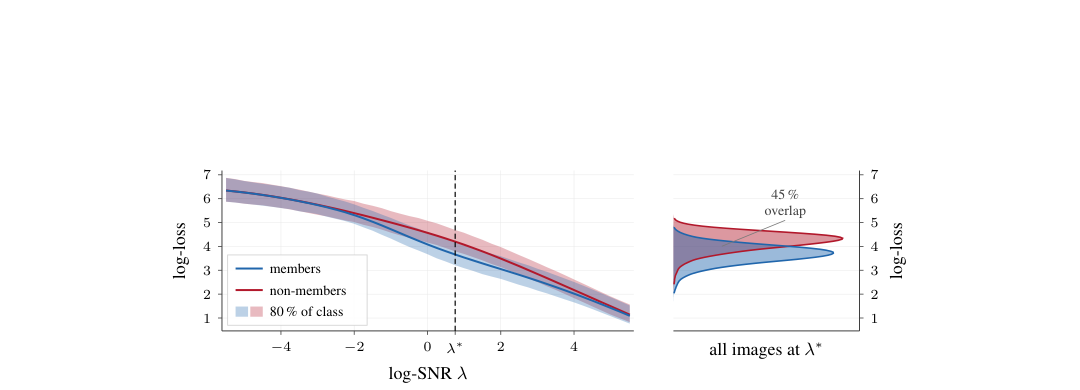
Caption: Figure 1: Image difficulty confounds absolute-loss thresholds. Left: CIFAR-10 DDPM log-loss trajectories for members (blue) and non-members (red) showing class means and 80% intervals. Right: Loss density at the optimal log-SNR (λ⋆). Even at maximal separability, the populations exhibit a massive 45% overlap, rendering absolute-loss thresholds ineffective.
Why It Matters: This figure establishes the central failure mode: even at the most separable log-SNR, absolute-loss populations overlap by 45%, so a fixed loss threshold cannot reliably distinguish membership from image difficulty.
Figure 2
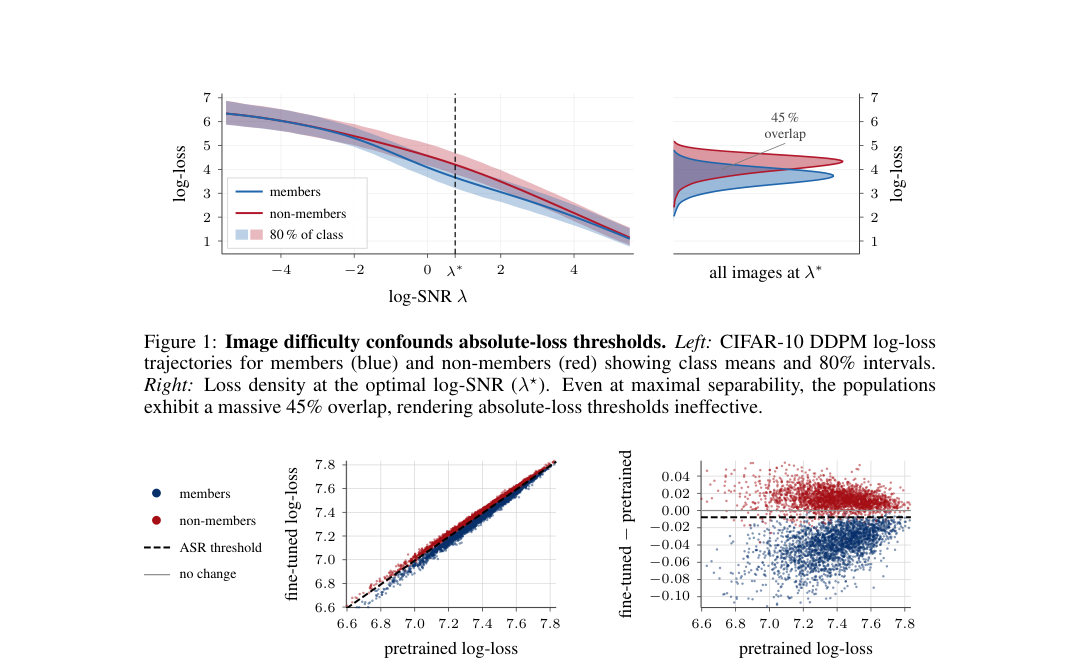
Caption: Figure 2: RMC on MS-COCO. Stable Diffusion fine-tuned on MS-COCO in realistic settings, uncaptioned. Left: Pretrained and fine-tuned log-losses are almost perfectly correlated (Pearson correlation r = 0.989). Right: Subtracting the pretrained loss removes this shared difficulty. Members shift below the ASR threshold (dashed ASR 98.6%), while non-members stay concentrated near 0.
Why It Matters: The figure visualizes why checkpoint subtraction works: the two losses share image difficulty, while their residual separates fine-tuning-associated membership behavior.
Figure 3
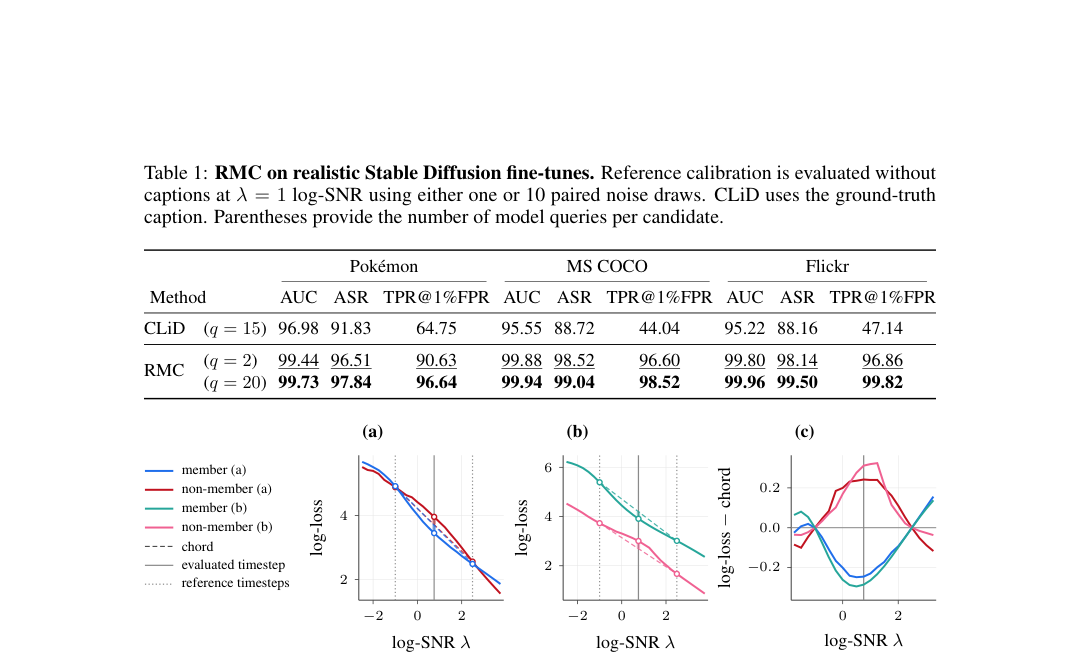
Caption: Figure 3: Temporal self-calibration. (a) A member/non-member pair where absolute loss correctly identifies the member. (b) A pair where absolute loss fails because the member is harder, yet a localized ”dip” is still visible. (c) Subtracting the local temporal reference (the chord between the reference timesteps) removes the absolute difficulty offset. Both pairs collapse into a shared calibrated view, distinctly separating members from non-members by their trajectory shape.
Why It Matters: This is the clearest qualitative explanation of TSC: the calibrated trajectory preserves a localized membership dip even when the member has a worse absolute loss than the non-member.
Figure 4
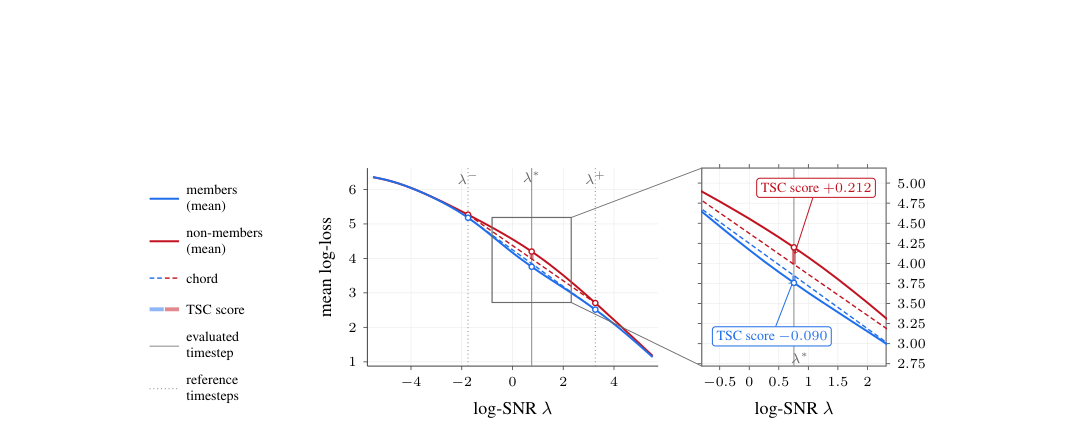
Caption: Figure 4: TSC on STL-10-U. Mean member and non-member log-loss trajectories (left) and a close-up of the selected window (right). The chords connect the two context points for each population, and the vertical bars at λ∗show the residual measured by the temporal score.
Why It Matters: The STL-10-U example connects the geometric stencil to the empirical score by showing the context chord and target residual on mean member and non-member trajectories.
🔮 Conclusion
The paper presents a coherent calibration view of diffusion-model membership inference. RMC uses a pretrained checkpoint to subtract image-specific difficulty across training time, while TSC uses a symmetric local contrast across diffusion time to remove the same confound without an external model. The reported evidence shows strong gains at strict false-positive rates across DDPM and Stable Diffusion settings, including 62.31% TPR@1%FPR on CIFAR-10 and 98.52% on MS COCO with RMC at 20 queries.
The practical conclusion is conditional rather than universal. These attacks are valuable when intermediate denoising outputs are available and when audit conclusions are interpreted statistically. A negative result does not prove that an image was excluded, and RMC cannot identify membership in the pretrained model’s earlier corpus.
🛠️ Future Research Improvements
The most direct next step is to reduce the access assumptions. TSC currently needs denoising outputs at selected noise levels, so adapting the calibration idea to interfaces that expose only final images would broaden its applicability. For RMC, future work should investigate whether related public checkpoints or ensembles of reference models can substitute for an unavailable fine-tuning ancestor.
The paper also identifies a need to track membership evidence across training stages. RMC measures the change between two checkpoints but does not separate membership in pretraining data from membership introduced during fine-tuning. Comparing successive checkpoints, studying overlap between pretraining and fine-tuning sets, and testing calibration under unknown training objectives would clarify how stable the residual is over a model’s lifecycle. Further evaluation should examine how shadow-data mismatch affects the selected log-SNR center and the reported low-FPR operating point.
🏭 Potential Industry Use Scenarios
The strongest supported use case is authorized provenance auditing for released or internally deployed diffusion models. A dataset owner could evaluate candidate images against a fine-tuned model to investigate whether proprietary examples were included, using RMC when the fine-tuning base checkpoint is available and TSC when only the audited model can be queried for denoising outputs. Model providers could use the methods as part of privacy and copyright risk assessments before releasing checkpoints, especially for candidate datasets containing personal photographs, artwork, or confidential material.
The evidence also supports operational red-team testing of different training objectives and parameterizations. Because the paper evaluates x-, v-, and ε-prediction settings and reports different informative log-SNR regions, an audit system should identify the target model’s training objective before choosing its query locations. These methods should be deployed with authorization, calibrated thresholds, and human review because their outputs are statistical evidence with both false positives and false negatives.
💬 Critical Analysis
The paper’s strongest aspect is that the proposed score follows a clear causal intuition: absolute loss contains both image difficulty and membership-related improvement, so subtracting a matched reference should remove part of the nuisance variation. The RMC result on MS COCO, where pretrained and fine-tuned losses have Pearson correlation $r=0.989$, directly supports this premise. TSC is also conceptually attractive because it does not require a second model and because the symmetric stencil has an interpretable geometric meaning. The parameterization study is important: it tests nine combinations rather than assuming that a method designed for ε-prediction transfers automatically.
There are several reasons to treat the reported gains as promising but scoped. First, both methods assume query access to intermediate denoising behavior, which limits direct use against common image-generation APIs. Second, TSC depends on shadow-data tuning and on a selected leakage window; the paper shows that this window shifts from $\lambda^*=-0.50$ to $0.50$ to $1.75$ as the training target changes from x-loss to v-loss to ε-loss. This makes model-specific calibration part of the attack’s practical cost. Third, the Pokémon result shows that TSC is not uniformly best: PIA reaches 61.30 TPR@1%FPR there, compared with TSC’s 55.77. The paper’s explanation that dataset uniformity reduces difficulty variance is plausible, but broader dataset-scale and distribution-shift tests would strengthen it. Finally, the metrics quantify attack discrimination, not definitive membership, so production conclusions must account for threshold uncertainty, candidate-image distribution, and the ethical...