
📌 Highlights
WorldBridge treats task generalization as two coupled problems: video generalization, which predicts how a new task should visually unfold, and action generalization, which grounds that prediction in executable behavior.
The clearest causal-style evidence is the RoboTwin 2.0 supervision sweep: OOD success increases from 25.07% with only ID video-action data to 55.90% after adding OOD videos, then to 70.70% with one OOD action demonstration per task. With 20 demonstrations, performance reaches 90.03%, while increasing from 100 to 550 demonstrations changes OOD success from 93.17% to 92.83%.
The full system combines a video expert and action expert, structured video-to-action attention, joint flow matching, dual-scale visual memory, action forcing, and a curated heterogeneous training corpus.
The reported benchmark profile is broad: 96.23% on full RoboTwin 2.0, 80.9% on Clean-to-Random, 82.8% on RoboCasa GR1 TableTop, 83.0% on RMBench, 57.6% on DOMINO Level-1, 84.4% on SimplerEnv-WidowX, and 26.03 RoboDojo average score with 19.15% average success rate.
- Core claim: broader video coverage can improve unseen-task execution when an inverse-dynamics bridge is already learned.
- Most actionable data result: one paired OOD action demonstration raises OOD success from 55.90% to 70.70%.
- Main engineering mechanisms: masked shared action space, structured attention, visual memory, action forcing, and inference decoupling.
- Key caveat: gains are demonstrated under benchmark-specific training and fine-tuning protocols.
🎯 Introduction
The paper distinguishes ordinary robustness to changed object arrangements, viewpoints, lighting, or appearance from task generalization, where the robot must execute behaviors beyond its original task set. In this setting, language understanding is insufficient: a model must infer the visual dynamics of a new interaction and produce the motor behavior that realizes it.
World Action Models are positioned as a natural foundation because video supplies dense supervision about physical interaction while action labels are comparatively sparse. The paper asks how much broader video coverage contributes when action supervision remains in-distribution, and when the video-to-action bridge becomes the limiting factor.
The RoboTwin 2.0 study motivates the architecture. ID video-action supervision gives 25.07% OOD success; adding 550 OOD videos without OOD action labels gives 55.90%; adding one paired OOD demonstration gives 70.70%. The authors interpret this as evidence that video expands modeled task evolution while sparse action supervision improves grounding.
fig:task_generalization
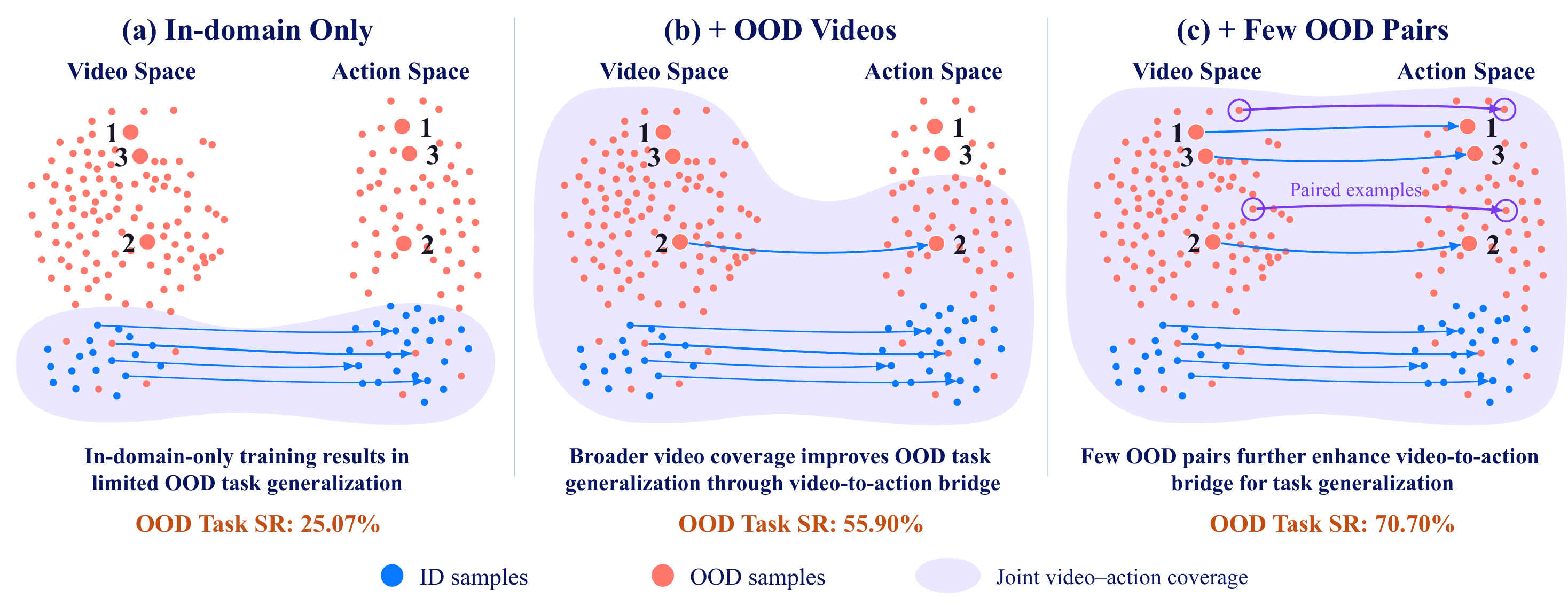
Caption: Task generalization under progressively expanded supervision. Compared with in-domain (ID) video-action training alone (25.07\% OOD success rate), adding out-of-distribution (OOD) videos increases success to 55.90\%, while adding a few paired OOD video-action examples further improves it to 70.70\%.
Why It Matters: The figure isolates the complementary effects of video coverage and paired action supervision.
🔬 Methodology
WorldBridge uses a Mixture-of-Transformers design with separate video and action experts. The experts retain modality-specific feed-forward networks and decoders but exchange information through joint self-attention. The video branch additionally receives language through cross-attention. The conditioning context is defined by $c = \left( \mathcal{E}_{\mathrm{VAE}}(\mathcal{O}), \mathcal{E}_{\mathrm{T5}}(\ell) \right)$, and the clean targets are future video latents and an action chunk.
Joint flow matching independently corrupts video and action targets: $\mathbf{z}(\tau_v) = (1-\tau_v)\mathbf{z} + \tau_v\boldsymbol{\epsilon}_v$ and $\mathbf{A}_t(\tau_a) = (1-\tau_a)\mathbf{A}_t + \tau_a\boldsymbol{\epsilon}_a$. The model predicts both velocity fields with $\left( \hat{\mathbf{u}}_v, \hat{\mathbf{u}}_a \right) = f_{\theta}\left( \mathbf{z}(\tau_v), \mathbf{A}_t(\tau_a), \tau_v, \tau_a; c \right)$, and inference integrates the fields from Gaussian noise toward clean video and action outputs.
Dual-scale memory samples recent observations for local motion and more widely spaced observations for task progression. The construction uses $\mathcal{O}^{\mathrm{short}}_t$ and $\mathcal{O}^{\mathrm{long}}_t$, then forms a temporally compressed context whose retained latent frames represent long memory, short memory, and the current observation. Action forcing assigns action-group timesteps with $\tau_{a,j} = s_{a,\lfloor j/g \rfloor}$, so the action expert must use context even when neighboring action tokens have different corruption levels.
The data pipeline standardizes robot and egocentric demonstrations into a 46-dimensional action space with arm joints, end-effector poses, grippers, dexterous hands, and waist controls. It applies semantic auditing, relative end-effector targets, masked normalization, stationary-boundary trimming, length filtering, forward-kinematics checks, state-action consistency checks, anomaly filtering, hand-pose plausibility checks, camera-frame alignment, and validity masks. The post-training attention structure routes memory and current observations through predicted future video before action prediction, while memory-heavy tasks can use a more direct information path.
fig:model
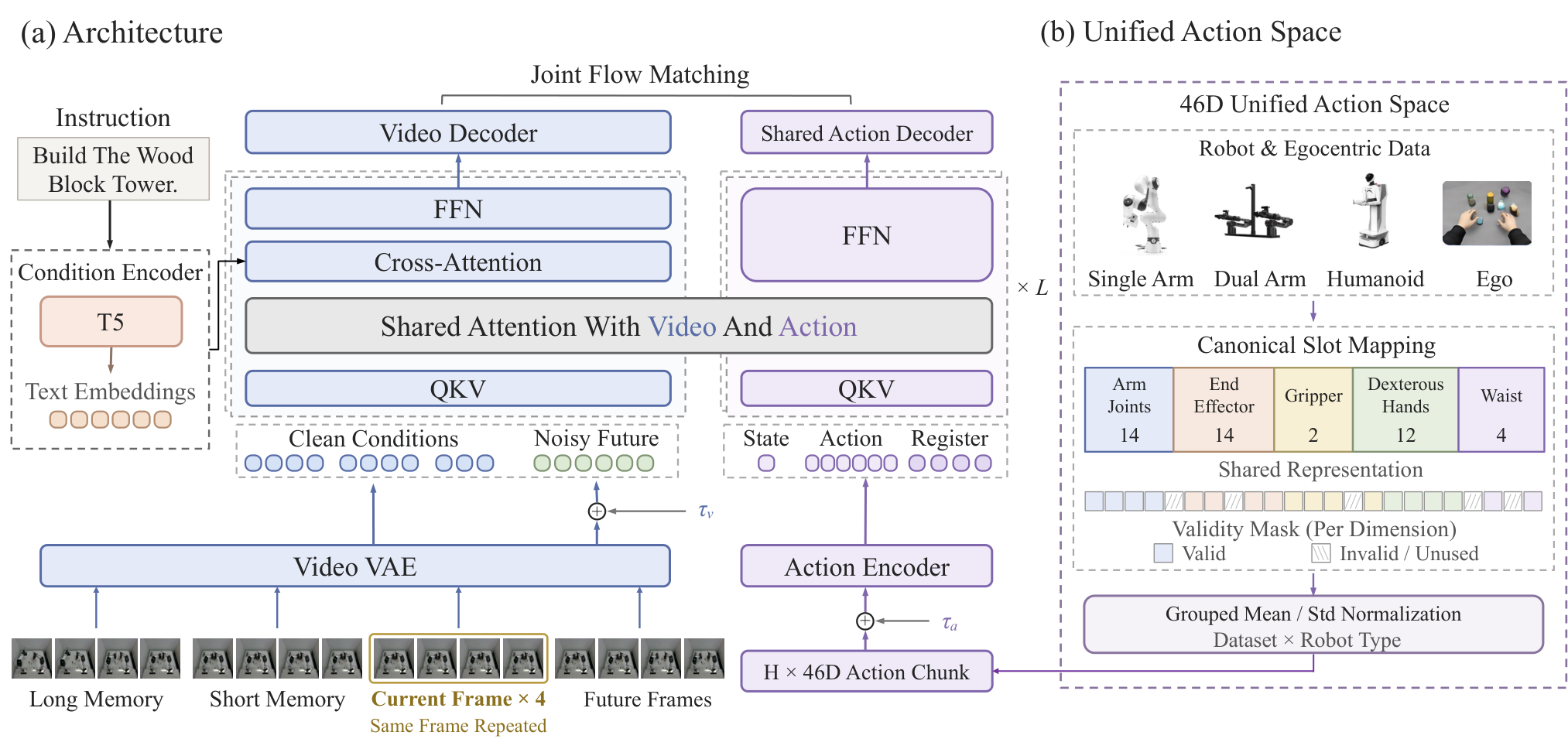
Caption: Overview of the WorldBridge model architecture.
Why It Matters: It shows the separation and coupling of the video and action experts, the unified action representation, and the joint flow-matching pathway.
fig:data_processing
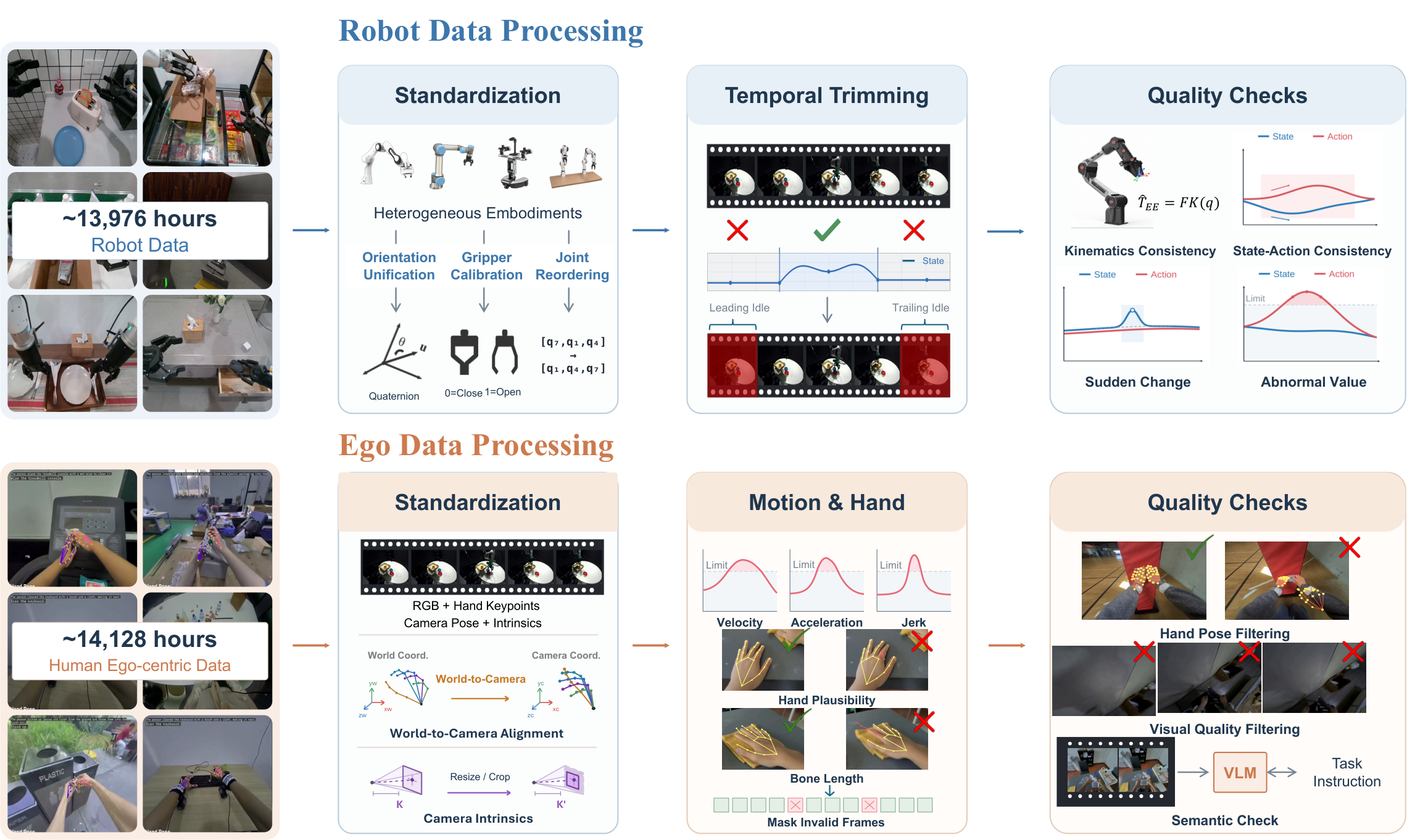
Caption: Overview of the WorldBridge data processing pipeline.
Why It Matters: It makes the preprocessing burden visible: heterogeneous embodiments and egocentric observations require standardization, coordinate alignment, and multiple quality checks before joint training.
equation 1
Meaning: The conditioning context combines VAE-encoded visual observations with T5-encoded language instructions.
equation 2
Meaning: Independent flow paths perturb future video and action targets at separately sampled noise levels.
equation 3
Meaning: The coupled transformer predicts the velocity fields needed to denoise both modalities.
equation 6
Meaning: The first-order solver update used to move both states from noise toward their predicted clean values.
📊 Experiments
The task-generalization experiments use RoboTwin 2.0 with a fixed ID/OOD task partition. With 550 ID videos and 550 ID actions, ID-only training reaches 91.85% ID success but only 25.07% OOD success. Adding 550 OOD videos without OOD actions raises OOD success to 55.90% while keeping ID success at 91.96%. One OOD action demonstration per task raises OOD success to 70.70%, five to 84.67%, and 20 to 90.03%. The gains saturate: 100 OOD actions reach 93.17%, while 550 reach 92.83%.
The benchmark suite includes RoboTwin 2.0, RoboCasa GR1 TableTop, RMBench, DOMINO Level-1, SimplerEnv-WidowX, and RoboDojo. RoboTwin 2.0 evaluates 50 language-conditioned ALOHA-AgileX tasks in Clean and Randomized scenes, with 10,000 trials per setting. WorldBridge reports 96.16% Clean and 96.30% Randomized success, averaging 96.23%; under Clean-to-Random it reports 88.3% Clean, 73.4% Randomized, and 80.9% average.
On RoboCasa GR1 TableTop, the paper reports 82.75% overall success over 1,200 trials, rounded to 82.8% in the comparison table. On RMBench, which contains nine non-Markovian dual-arm tasks and caches all historical frames, WorldBridge reaches 83.0% average success. On DOMINO Level-1, evaluated over 35 moving-target tasks and 7,000 episodes, it reaches 57.6% success and 64.6 manipulation score. On SimplerEnv-WidowX, the four task rates are 95.8%, 83.3%, 91.7%, and 66.7%, for an 84.4% average.
The ablations support the proposed mechanisms: action forcing increases RoboTwin/RoboCasa/RoboDojo success from 91.28/67.50/14.50 to 93.31/69.17/16.52; adding short memory gives 93.98/74.33/16.90; adding long memory gives 95.20/78.58/21.07. Robot-only pretraining raises RoboTwin Clean-to-Random average success from 62.7% to 77.4%, and adding egocentric pretraining raises it to 80.9%. RoboDojo exposes a mixed profile: WorldBridge has the highest listed average score among the compared rows at 26.03, while DM0.5 has a slightly higher average SR of 19.34 versus 19.15.
fig:real_robot_task_success_rates
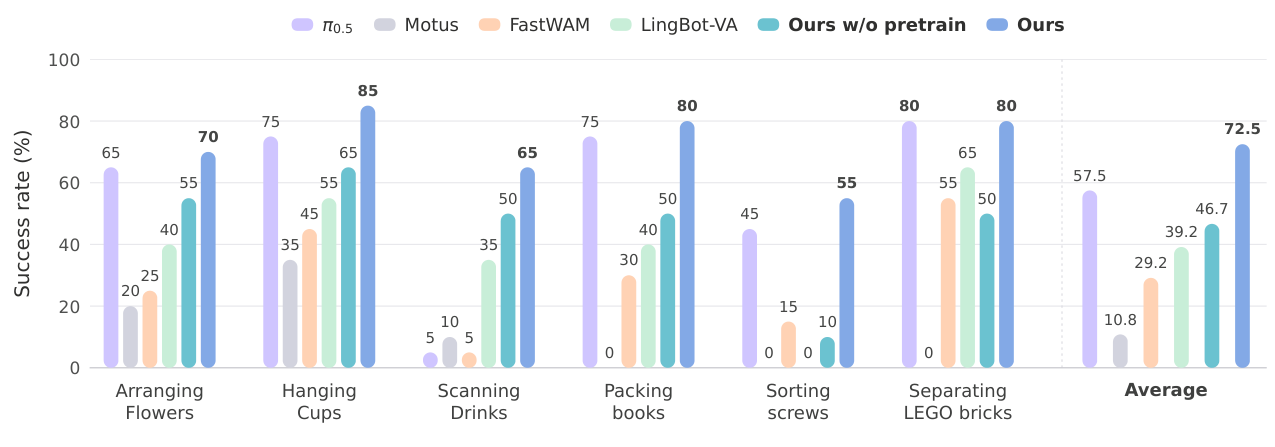
Caption: Task success rates across five methods.
Why It Matters: This figure provides the direct visual comparison for the real-robot success-rate evaluation.
tab:ood_shot_results
Caption: Average success rates (%) on RoboTwin 2.0 under different amounts of OOD action supervision. OOD action counts denote the number of demonstrations per task.
| Exp. Index | # ID Videos | # ID Actions | # OOD Videos | # OOD Actions | ID SR (%) | OOD SR (%) | Overall SR (%) |
|---|---|---|---|---|---|---|---|
| 1 | 550 | 550 | 0 | 0 | 91.85 | 25.07 | 71.81 |
| 2 | 550 | 550 | 550 | 0 | 91.96 | 55.90 (+30.83) | 81.14 |
| 3 | 550 | 550 | 550 | 1 | 91.70 | 70.70 (+14.80) | 85.40 |
| 4 | 550 | 550 | 550 | 5 | 92.30 | 84.67 (+13.97) | 90.01 |
| 5 | 550 | 550 | 550 | 20 | 92.25 | 90.03 (+5.36) | 91.58 |
| 6 | 550 | 550 | 550 | 50 | 90.22 | 92.27 (+2.24) | 90.83 |
| 7 | 550 | 550 | 550 | 100 | 92.50 | 93.17 (+0.90) | 92.70 |
| 8 | 550 | 550 | 100 | 100 | 93.21 | 88.83 | 91.90 |
| 9 | 550 | 550 | 550 | 550 | 91.55 | 92.83 | 91.93 |
Why It Matters: This is the paper's main controlled evidence for the relative value of video and action supervision.
tab:robotwin2_results
Caption: Success rates (%) on RoboTwin 2.0~pmlr-v306-chen26 under two training-data settings. Each setting is evaluated in Clean and Randomized scenes, with their average reported. Clean-only training corresponds to the Clean2Random protocol.
| Method | Full Clean | Full Randomized | Full Average | Clean2Random Clean | Clean2Random Randomized | Clean2Random Average |
|---|---|---|---|---|---|---|
| Long-WAM (IDM) | 94.70 | 94.20 | 94.40 | -- | -- | -- |
| MotuBrain | 95.80 | 96.08 | 95.94 | -- | -- | -- |
| Kairos | 96.90 | 95.20 | 96.05 | -- | -- | -- |
| OpenWAM-α | 93.74 | 93.46 | 93.60 | 89.4 | 48.7 | 69.0 |
| Qwen-RobotManip-Context | -- | -- | -- | 84.7 | 69.4 | 77.1 |
| WorldBridge (Ours) | 96.16 | 96.30 | 96.23 | 88.3 | 73.4 | 80.9 |
Why It Matters: The table shows both near-ceiling full-data performance and a substantial advantage under Clean-to-Random transfer.
tab:simulation_benchmarks
Caption: Results on RoboCasa GR1 TableTop, RMBench, DOMINO Level-1, and SimplerEnv-WidowX. We report success rates (\%) and the DOMINO manipulation score (MS)
| Method | RoboCasa GR1 SR | RMBench SR | DOMINO SR | DOMINO MS | Spoon | Carrot | Cube | Eggplant | SimplerEnv Avg. |
|---|---|---|---|---|---|---|---|---|---|
| InternVLA-A1.5 | -- | -- | 29.3 | 42.5 | 92.4 | 85.4 | 69.5 | 75.7 | 80.8 |
| OA-WAM | -- | -- | -- | -- | 83.0 | 71.1 | 65.0 | 98.2 | 79.3 |
| DynamicWAM | -- | -- | 38.2 | 53.2 | -- | -- | -- | -- | -- |
| Long-WAM | 78.7 | -- | 34.9 | 45.1 | -- | -- | -- | -- | -- |
| MemoryWAM | -- | 83.0 | -- | -- | -- | -- | -- | -- | -- |
| WorldBridge (Ours) | 82.8 | 83.0 | 57.6 | 64.6 | 95.8 | 83.3 | 91.7 | 66.7 | 84.4 |
Why It Matters: The table demonstrates that the model's strongest advantages appear across dynamic, memory-dependent, and heterogeneous manipulation settings.
🔮 Conclusion
The paper's main conclusion is that task generalization in World Action Models benefits from explicitly separating video coverage from action grounding while allowing the two capabilities to interact through a learned bridge. The RoboTwin supervision sweep shows that videos of unseen tasks can improve control without OOD action labels, and sparse paired examples can substantially strengthen the transfer.
WorldBridge operationalizes this idea with coupled flow-matching experts, structured attention, dual-scale memory, action forcing, heterogeneous-data curation, and inference acceleration. Across the reported benchmarks, the model is particularly strong on Clean-to-Random transfer, memory-heavy manipulation, moving-target interaction, and multi-task simulation evaluation.
🛠️ Future Research Improvements
A useful next step would be to test the video-to-action supervision law across more diverse task partitions, robot embodiments, camera configurations, and physical environments. The current controlled study establishes a strong pattern on RoboTwin 2.0, but broader validation is needed to determine whether the observed diminishing returns and one-shot action-label benefit are robust.
Future work should also isolate the effects of data scale, preprocessing quality, architecture, and adaptation compute. In particular, matched-budget comparisons could clarify whether the gains come primarily from the video-action bridge, the large curated corpus, dual-scale memory, or the combination. Evaluation should report calibration, failure modes, recovery behavior, and per-task deployment statistics alongside aggregate success.
- Evaluate cross-embodiment transfer with systematically masked action channels.
- Compare different OOD video quality and diversity levels at fixed frame and compute budgets.
- Measure robustness to corrupted language, missing cameras, delayed observations, and imperfect proprioception.
- Report per-task confidence, recovery success, and safety violations in real-world trials.
🏭 Potential Industry Use Scenarios
A practical use case is data-efficient onboarding of new manipulation tasks in warehouses, laboratories, and light manufacturing. Teams could collect broad visual demonstrations of task variants, then add a small number of robot action demonstrations for the variants that require precise grounding. The paper's results suggest that this may be more efficient than labeling full robot trajectories for every visual task variation, although the benefit depends on the quality of the learned bridge.
The shared action representation and masked supervision are relevant to fleets containing single-arm, dual-arm, humanoid, and dexterous platforms. Egocentric hand data could provide additional visual and geometric coverage before robot-specific adaptation, while dual-scale memory and asynchronous execution are relevant to long-horizon sorting, packing, inspection, and rearrangement workflows.
The real-robot examples cover arranging flowers, scanning drinks, separating LEGO bricks, packing books, sorting screws, and hanging cups. These examples suggest potential fit for sequential placement, memory-dependent inspection, bimanual coordination, deformable or cluttered object handling, and precision grasping, but production deployment would require safety constraints, monitoring, recovery policies, and platform-specific validation.
fig:real_robot_task_execution
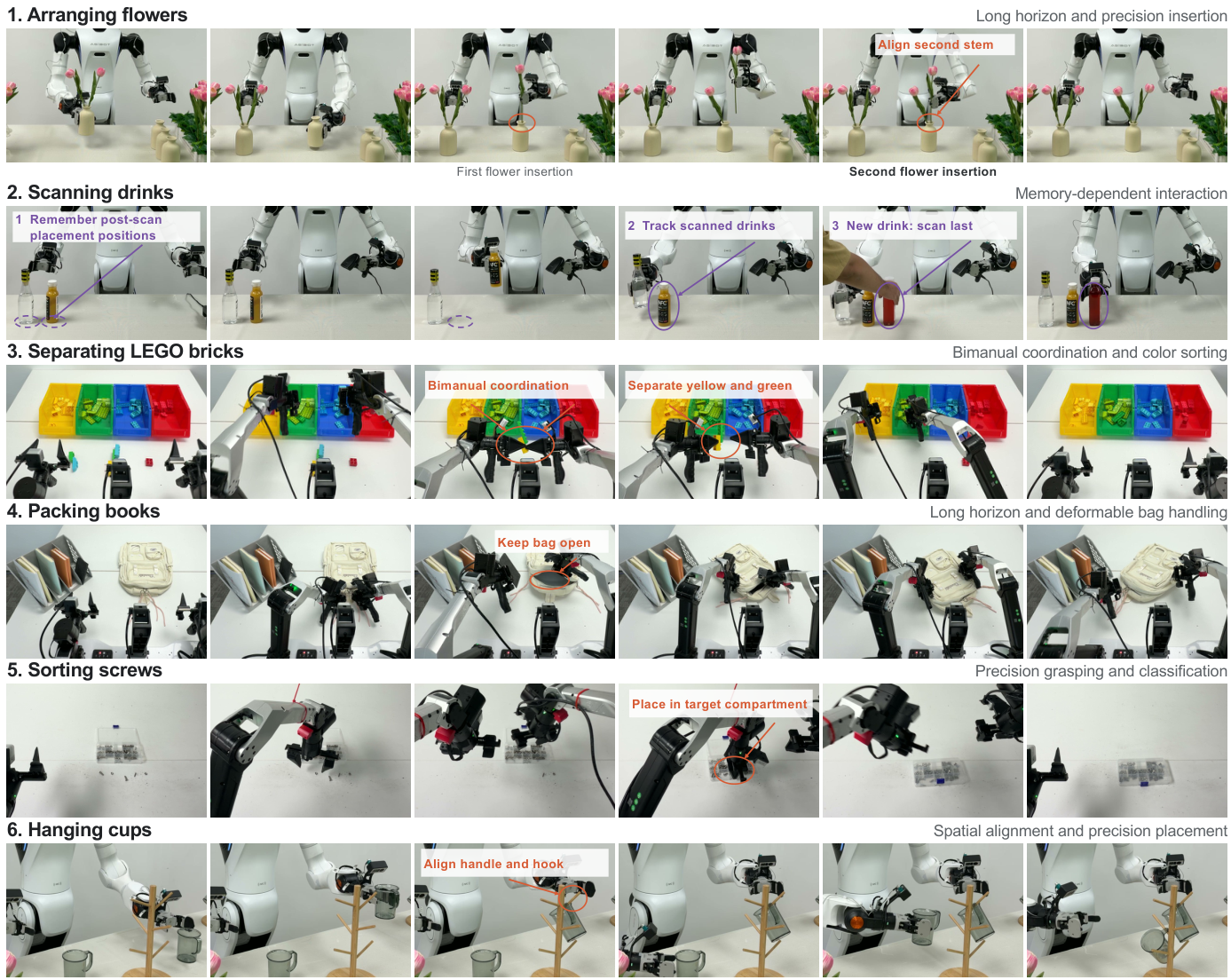
Caption: Representative real-robot executions on six manipulation tasks. From top to bottom: arranging flowers, scanning drinks, separating LEGO bricks, packing books, sorting screws, and hanging cups. Arrows and circles highlight key operations, including sequential flower insertion, bimanual brick separation, and precise placement. The drink-scanning task probes three aspects of memory: remembering post-scan placement destinations, tracking previously scanned drinks, and processing the newly introduced drink last.
Why It Matters: The examples show the kinds of sequential, memory-dependent, bimanual, and precision behaviors that the architecture is intended to support.
💬 Critical Analysis
The strongest part of the paper is the supervision-factor study. By holding ID data fixed and varying OOD videos and OOD action demonstrations, it provides clearer evidence for the proposed video-to-action mechanism than a simple end-to-end benchmark comparison. The progression from 25.07% to 55.90% to 70.70% OOD success is especially informative because it separates visual coverage from action grounding.
The engineering design is coherent with the stated problem. Structured attention makes future visual dynamics an explicit control-conditioning path; action forcing encourages action tokens to use context; dual-scale memory addresses both local motion and longer task state; and validity masks make heterogeneous supervision usable. The ablation results support each of these mechanisms, although the ablations do not fully disentangle architectural effects from data and training choices.
The benchmark evidence is broad but should be interpreted carefully. RoboTwin 2.0 and RoboCasa results are strong, while RoboDojo shows that aggregate success is not uniformly dominant across dimensions: WorldBridge has a higher average score than the listed alternatives but a slightly lower average SR than DM0.5. Cross-paper comparisons also inherit differences in training data, fine-tuning, model scale, and evaluation protocol. Reproduction should therefore prioritize matched-data ablations and direct evaluation rather than relying only on leaderboard position.
- Most convincing evidence: controlled video-versus-action supervision sweep.
- Most important reproducibility risk: extensive embodiment-specific data processing.
- Most meaningful unresolved question: how much of the gain remains when compute, data volume, and adaptation budgets are matched.
- Deployment assessment should include failure recovery and safety metrics, not only task success.