
📌 Highlights
The paper presents two linked contributions: SHAKTI, a large Hindi AI-text detection benchmark, and TRIDENT, a detector based on round-trip translation. SHAKTI combines human-written and LLM-generated Hindi across news, Wikipedia, question answering, and essays, and includes five adversarial transformations. TRIDENT compares a text with its translated-and-reconstructed version, using the resulting consistency as an authorship signal. The authors report that TRIDENT-S has the strongest overall performance and describe evaluations across languages, attacks, and unseen LLMs; the supplied evidence bundle does not include the numeric result tables needed to verify those comparisons independently.
The practical promise is a detection signal that can be explored without access to a generator’s token probabilities. The central caveat is dependence on translation behavior: changes in translation model or language pair may change the detector signal. SHAKTI’s breadth supports more varied evaluation than a single-domain dataset, but benchmark coverage alone does not establish reliable real-world performance. Builders should treat the method as a candidate for controlled evaluation and inspect its errors before using predictions to make consequential authorship judgments.
- Core claim: generated text tends to show greater RTT consistency than human-written text.
- Three variants: fixed threshold, GMM-based dynamic threshold, and supervised logistic regression.
- Key caveat: translation-model sensitivity and missing numeric comparison tables in the supplied evidence.
🎯 Introduction
The paper frames AI-generated text detection as a trust and integrity problem as language models become more capable and accessible. It identifies Hindi as underserved by research that remains largely English-centric. Existing Hindi datasets discussed in the paper cover narrower settings: AG_hi focuses on news, while IndicDetect covers three Indic languages and several domains. The authors argue that dataset scale, genre coverage, generator diversity, and systematic adversarial evaluation remain uneven, limiting assessment under realistic shifts.
The paper also describes limitations in detector approaches. Supervised methods may degrade outside their training distribution; some zero-shot techniques need model probabilities unavailable for many commercial systems; and rewriting-based methods can depend on the rewriting model and may alter meaning. The paper’s objective is to expand Hindi evaluation through SHAKTI and investigate whether translation-induced changes offer a complementary detection signal. Its main hypothesis is that generated text may be more stable under round-trip translation, whereas human writing may undergo greater lexical, semantic, and stylistic drift.
🔬 Methodology
TRIDENT first translates an input from source language L1 into intermediate language L2, then translates the result back into L1. A sentence encoder represents the original and reconstructed text, allowing comparison of their consistency and drift. The paper motivates this operation as a controlled perturbation: it aims to retain meaning while changing lexical, syntactic, or stylistic form. The authors use several RTT-derived signals rather than relying only on a single surface feature. Their feature vector includes lexical distance, semantic consistency, angular and embedding distances, KL and Jensen–Shannon divergence, and a probability-related feature. The supplied material does not fully define every feature or the precise preprocessing and translation configuration.
The variants use different decision procedures. TRIDENT-S applies a fixed threshold chosen using labelled validation data. TRIDENT-D fits an unsupervised two-component Gaussian mixture to consistency scores and uses the midpoint of the component means as its boundary. TRIDENT-C trains logistic regression on RTT-derived features. The operator and classifier equations below specify the transformation and decision forms as extracted from the paper. The paper also constructs SHAKTI from human Hindi texts in four genres and generated text from eight model families, followed by rewriting, homoglyph, synonym, misspelling, or whitespace perturbations.
Round-trip translation operator
Meaning: Defines the transformation that sends source text through an intermediate language and reconstructs it in the source language.
RTT feature vector
Meaning: Lists the feature components used by the supervised detector; the supplied description identifies lexical, semantic, geometric, distributional, and language-model-based signals but does not fully define each symbol.
Two-component consistency model
Meaning: Models consistency scores as a two-component Gaussian mixture for the dynamic-threshold variant.
GMM decision threshold
Meaning: Sets the dynamic decision boundary at the midpoint of the low- and high-consistency component means.
📊 Experiments
The paper reports experiments on SHAKTI and publicly available datasets, with evaluations described across Hindi and seven additional languages: Urdu, Arabic, Russian, Chinese, English, and Korean. The stated comparisons include conventional statistical, rewriting-based, and supervised detection methods. The paper also describes cross-domain and cross-generator evaluation, adversarial perturbation tests, unseen-LLM generalization, and an analysis of translation-model choice. The supplied extraction does not name the external dataset benchmarks individually or expose the detailed result tables, so their identities, split protocol, and numeric scores cannot be reported here without exceeding the evidence.
The authors’ reported headline result is that TRIDENT outperforms the compared baselines on evaluated Hindi datasets and that TRIDENT-S has the strongest overall performance among its variants. They also report multilingual applicability and robustness evaluations, while noting that results vary by language and translation model. The supplied figure captions establish that the paper compares TRIDENT-S F1 using mBART against LLM-based translation models and includes an ROC figure with AUC 0.882 and selected threshold 0.875. The ROC caption describes a TPR–FPR trade-off on SHAKTI. The extraction does not include the comparison’s plotted values, metric settings, or numeric ablations; these claims therefore cannot be expanded into a complete benchmark table from the available evidence.
The supplied dataset comparison reports SHAKTI at 1,006,800 total samples: 83,900 human-written, 503,400 LLM-generated, and 419,500 adversarial samples. These figures describe dataset composition, not detection accuracy. A separate benchmark comparison lists SHAKTI at 1.01M and shows its Hindi coverage alongside existing resources. No algorithms or numeric detector-comparison tables are present in the supplied main-body artifact bundle.
tab:threshold
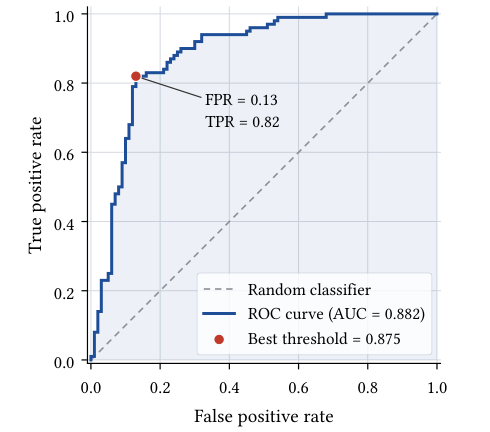
Caption: Receiver operating characteristic (ROC) curve of TRIDENT on the SHAKTI dataset, showing the trade-off between the true positive rate (TPR) and false positive rate (FPR). The model achieves an area under the curve (AUC) of 0.882, with a selected decision threshold of 0.875.
Why It Matters: Provides a reported ROC summary and operating threshold for SHAKTI, though the extracted caption does not give the curve’s pointwise values.
tab:dataset_comparison
Caption: Comparison of Hindi AI-generated text detection datasets in terms of domain coverage, data scale, LLM diversity, and adversarial robustness.
| Dimension | AG_hi | IndicDetect | SHAKTI (Ours) |
|---|---|---|---|
| Language coverage | Hindi (BBC/NDTV) | Hindi/Telugu/Tamil | Hindi |
| Domain coverage | News | Google News, IJHR Journal, Poetry, Bollywood Hungama | Essay, news, Wikipedia, QA |
| LLM diversity | 26 LLM, GPT versions, Bloom, BARD, mGPT, Mistral, Gemma, mT5 versions | GPT-4.1, Qwen-Plus, DeepSeek-v3.2 | GPT3.5, Llama 3.2, Mistral, Gemma 3, GPT-5, Gemini, Aya, Sarvam |
| Attack coverage | --- | Perturbation, Whitespace, Insert-Paragraph, Alternative Spelling, Misspelling, Synonym Swap | Rewrite, Homoglyph, Synonym, Misspelling, Whitespace |
| Prompt for generation | Simple text generation method | research-style, open-ended narrative, opinion-oriented prompts | Instruction-based, Task-oriented prompt |
| Human-written samples | 7,043 | 4,000 | 83,900 |
| LLM-generated samples | 29,627 | 12,000 | 503,400 |
| Adversarial samples | --- | 12,000 | 419,500 |
| Total samples | 36,670 | 28,000* | 1,006,800 |
| Primary focus | Hindi news detection | Multilingual detection and robustness under distribution shifts | Large-scale Hindi AI-text detection with coverage of Hindi-specific LLMs and adversarial robustness |
Why It Matters: Shows dataset scale and coverage for three Hindi detection resources; counts do not indicate classifier performance.
🔮 Conclusion
The paper’s central takeaway is that round-trip translation consistency can serve as a signal for distinguishing human-written from LLM-generated text, and that a broader Hindi benchmark can support systematic evaluation across genres, generators, and perturbations. The authors report TRIDENT-S as the strongest overall variant and describe evaluations beyond Hindi. They also identify sensitivity to translation-model choice, which qualifies the method’s transferability. The supplied evidence supports these as reported findings, but lacks detailed results tables for checking the size and consistency of the gains.
🛠️ Future Research Improvements
A clear next step is to quantify how translation model and language-pair choices affect accuracy, calibration, latency, and failure rates. The paper reports sensitivity to the translation model, but the supplied evidence does not provide enough comparison values to identify a stable default. Future evaluations should also report results separately by genre, source, generator, and each adversarial transformation, so aggregate performance does not hide weak subgroups.
The paper’s reported misclassifications suggest testing texts that are repetitive or formulaic, as well as cases where translation introduces substantial linguistic changes. Further work could establish reproducible feature definitions, release implementation and data where possible, and report consistent splits and baselines across all evaluated languages. These are reviewer-proposed directions grounded in the stated model sensitivity, error types, and breadth of the benchmark; the supplied evidence does not establish that the authors tested them all.
🏭 Potential Industry Use Scenarios
If further validated, RTT-based detection could be explored as one signal in Hindi-language content review for publishing, education, or user-generated content systems. Its translation-based operation may be relevant where a service cannot inspect the language-model probabilities behind generated text. SHAKTI’s news, encyclopedic, question-answering, and essay genres provide a starting point for testing whether performance differs across content types, while its perturbations can inform robustness checks against edited or reformatted text.
The evidence does not establish production readiness, acceptable false-positive rates, latency, privacy characteristics, or performance on live user content. Any operational use should therefore be limited initially to evaluation or decision support, with human review and local validation across the target language variety and content policy. The model’s translation dependency also means that a deployment would need to track translation service changes and reassess detector behavior when its translation component is updated. The paper provides a research benchmark and detector evaluation, not an industry deployment study.
💬 Critical Analysis
The work pairs a concrete methodological hypothesis with a benchmark designed to expose variation in genre, generator, and adversarial conditions. The three TRIDENT variants allow comparison between fixed, adaptive, and supervised decision strategies, and the paper includes analysis of translation-model dependence and representative errors. SHAKTI’s reported scale and composition are substantial in the supplied comparison, giving researchers a potentially useful resource for Hindi detection experiments.
Several points need verification before drawing strong conclusions. The supplied extraction lacks the main detector-performance tables and most experiment details, so the magnitude of gains, baseline settings, ablations, and per-language behavior cannot be audited here. Translation-induced stability may reflect properties of a particular translator, language pair, or text genre rather than authorship alone. Dataset source and generation choices may also create cues that models exploit; shared preprocessing helps, but does not by itself rule out source or length confounds. The paper’s own error caption recognizes that both formulaic generated writing and linguistic or translation variation can mislead the detector. Reproducibility and generalization claims should be judged against released data, code, exact translation configurations, and independently replicated results.