
📌 Highlights
Chronos-2 reframes multivariate forecasting as contextual inference: a single pretrained model uses group attention to infer dependencies among targets and covariates at inference time.
The strongest benchmark evidence comes from fev-bench, where the model outperforms statistical, tree-based, deep-learning, and foundation-model baselines while maintaining sub-second forecasting for 100 series.
The model is especially practical when future covariates, missingness, heterogeneous scales, or related series are available, but specialist systems remain stronger in some domains without fine-tuning.
- 120M-parameter encoder-only Transformer with alternating time and group attention.
- Synthetic pretraining covers instantaneous, lagged, linear, and nonlinear multivariate dependencies.
- Probabilistic quantile forecasts support uncertainty-aware decisions.
- Group attention improves fev-bench win rate by 10.7 percentage points over univariate inference.
- Hydrology exposes the main deployment caveat: zero-shot median NSE is 0.68 versus 0.90 for a domain-specific LSTM ensemble.
🎯 Introduction
The paper targets forecasting problems in which natural and human-centric systems evolve as coupled processes: epidemics spread across populations, economic indicators co-evolve, ecosystems exchange carbon and energy, and weather drives runoff. These systems are observed as collections of time series whose joint dynamics contain predictive information.
Classical models capture relatively simple temporal structure, while modern task-specific machine-learning models require dataset-level training and tuning. Existing time-series foundation models enable zero-shot inference but commonly treat each series independently, preventing them from modeling interactions among targets and external drivers. Chronos-2 addresses this gap with group attention and synthetic multivariate pretraining, aiming to infer relationships directly from historical context.
🔬 Methodology
Chronos-2 uses a T5-derived, encoder-only Transformer with 120M parameters. Time attention aggregates information across patches within one series, while group attention aggregates across all series assigned to the same group at a shared patch index. A group can represent one series, multiple related targets, variates of a multivariate series, or targets together with covariates.
The tokenizer scales each input dimension using historical statistics, appends time-index and missingness metadata, splits the resulting sequences into non-overlapping patches, and maps them to high-dimensional embeddings. Unknown future targets and past-only covariates are zero-filled and marked by masks, while known future covariates are supplied over the forecast horizon. Forecast patches are decoded in a single forward pass rather than autoregressively.
The model produces quantile forecasts instead of assuming a parametric predictive distribution. The quantile head includes extreme quantiles 0.01 and 0.99 to improve coverage of rare events. Pretraining combines univariate generators such as Gaussian processes, trend-seasonality-irregularity processes, autoregressive processes, and exponential smoothing with random instantaneous mixing, nonlinear MLP transformations, temporal causal models, and recurrent neural networks.
fig:arch
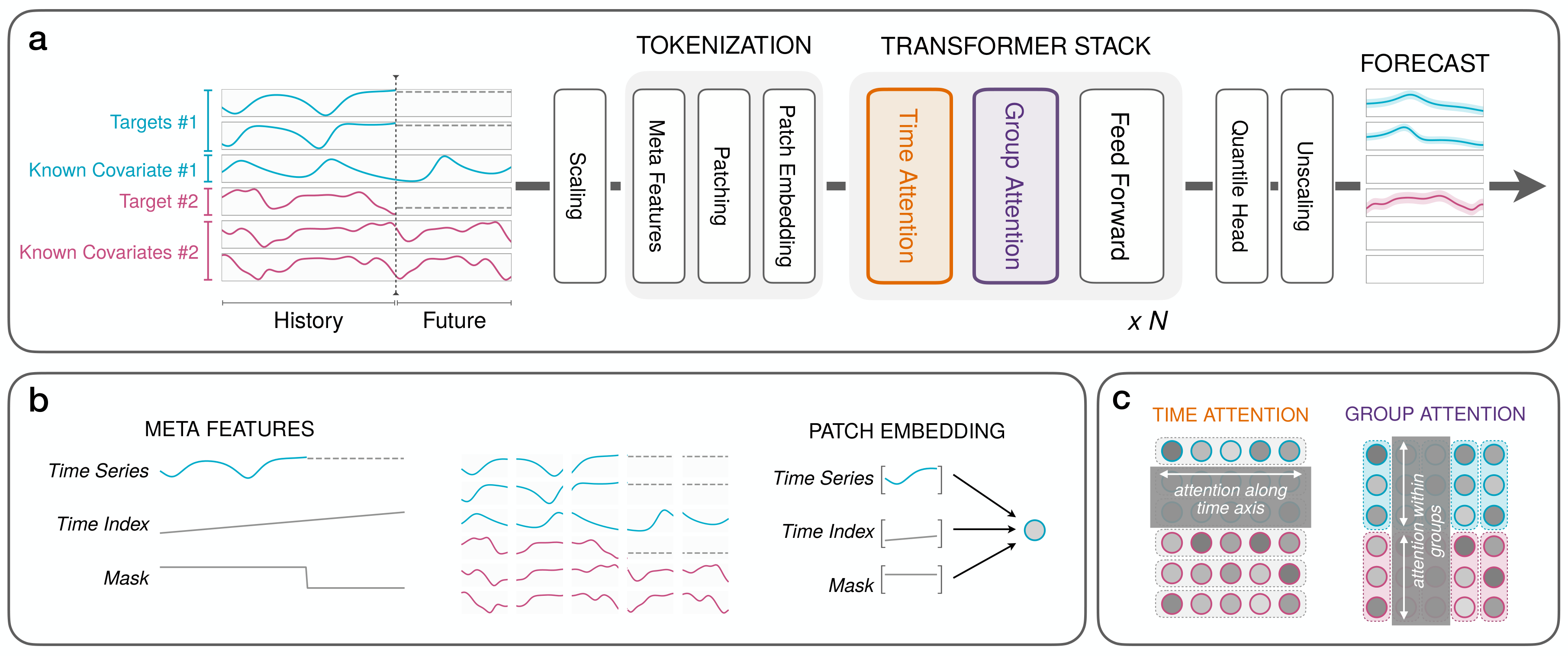
Caption: Figure 1: The complete Chronos-2 pipeline. (a) Architecture overview: Input time series (targets and covariates) are first normalized (scaling) and then tokenized for downstream processing. The Transformer stack alternates between time and group attention layers. The output from the Transformer stack is mapped to quantile predictions through a neural network. The figure illustrates two time series tasks, the first (in cyan) with two targets and one known (future) covariate, and the second (in pink) with one target and two known covariates. (b) Tokenization: Meta features are appended to the time series which indicate the position of an observation (time index) and whether it is missing (mas...
Why It Matters: The architecture makes the central implementation idea explicit: the same backbone can switch between univariate and multivariate forecasting through group assignments.
fig:data-fig
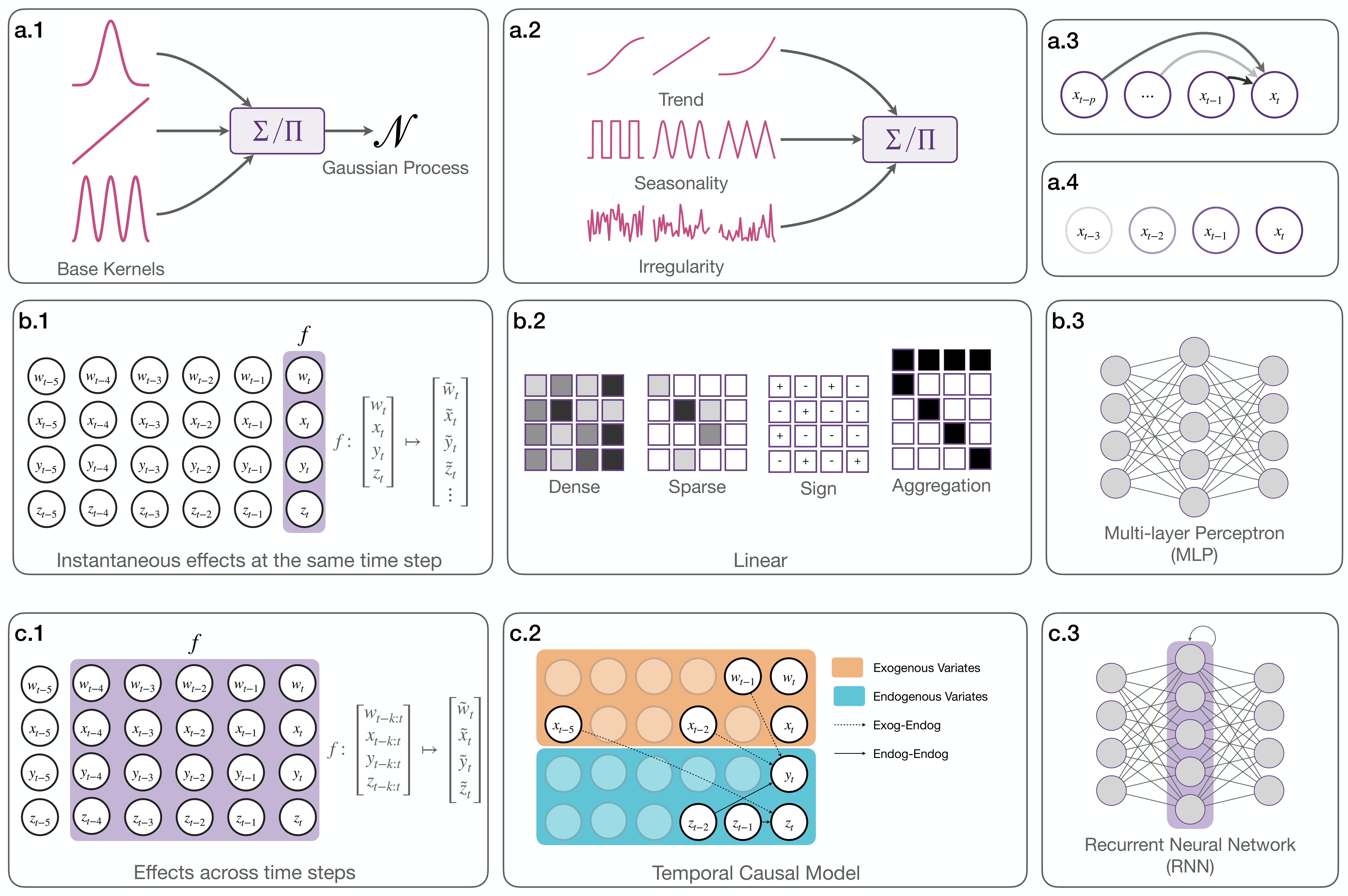
Caption: Figure 2: Generation of multivariate synthetic training data. We generate multivariate synthetic time series by applying random transformation functions to time series sampled from univariate generators. Univariate generators produce diverse temporal patterns to serve as the building blocks for multivariate data. These include: (a.1) KernelSynth (Ansari et al., 2024a), which draws samples from Gaussian processes defined by the random composition of basic kernels (e.g., linear, periodic); (a.2) Trend-Seasonality-Irregularity (TSI), which stochastically combines structural components; and parametric simulations using random (a.3) Autoregressive (AR) and (a.4) Exponential Smoothing (ETS) proce...
Why It Matters: The synthetic corpus is designed to expose the model to both static coupling and delayed dynamic interactions before zero-shot deployment.
relative-WIS-score
Meaning: The epidemiology figure uses this relative score; values greater than 0 indicate improvement over the baseline.
relative-RMSE-score
Meaning: The CPI case uses this relative score against a Seasonal Naive baseline; larger positive values indicate lower model RMSE.
📊 Experiments
The main benchmark suite includes fev-bench with 100 tasks, 68 of which involve multivariate dependencies; Chronos-Bench-II with 27 primarily univariate tasks; and GIFT-Eval with 97 primarily univariate tasks. Baselines include AutoETS, AutoARIMA, AutoTheta, statistical ensembles, LightGBM, CatBoost, DeepAR, TFT, PatchTST, TiRex, TimesFM-2.5, Toto-1.0, Moirai-1.1, Moirai-2.0, Granite-TTM-R2, TimePFN, and TabPFN-TS. Point forecasts use MASE, probabilistic forecasts use SQL or WQL, and the paper also reports win rate, skill score, and improvability.
On fev-bench, Chronos-2 improves MASE win rate over the best statistical model by 41.6 percentage points and SQL win rate by 46.9 percentage points. Its MASE skill score exceeds the strongest task-specific model by 11.8 percentage points and the strongest TSFM by 5.2 percentage points; the corresponding SQL improvements are 15.1 and 4.7 percentage points. Enabling group attention adds 10.7 percentage points in win rate and 4.1 percentage points in skill score relative to univariate inference. The reported average runtime is under one second per 100 series on an A10G GPU, with end-to-end speedups of 50× over CatBoost and 1000× over TFT when training and tuning are included.
The scientific case studies extend evaluation to RespiCast epidemiology data covering ARI and ILI across 31 European countries over 67 rolling windows from October 2024 to January 2026, German CPI components covering 110 Level 4 product groups from 2021–2025, FLUXNET carbon and energy fluxes across 65 sites, and CAMELS-DE rainfall-runoff data covering 1,582 catchments. Chronos-2 improves over the RespiCast Hub-Ensemble at longer horizons, beats AutoETS on the majority of CPI item-window pairs at both 3-month and 12-month horizons, obtains the lowest RMSE distributions among the evaluated carbon-flux models, and reaches median NSE 0.68 on CAMELS-DE versus 0.15 in univariate mode.
For hierarchical forecasting, Tourism-Q contains 89 quarterly series across 4 levels and Tourism-M contains 555 monthly series across 8 levels. Group attention reduces mean coherence error from 3.8% to 2.0% on Tourism-Q and from 15.2% to 4.4% on Tourism-M. With bottom-up reconciliation, Chronos-2 achieves median SQL of 0.56 on Tourism-Q and 0.60 on Tourism-M, outperforming the compared HierE2E, ETS, and ARIMA systems. The figure-level and text-level evidence supports the mechanism claim, but the supplied main-body extraction does not include the appendix tables with complete per-model rows.
fig:main-results
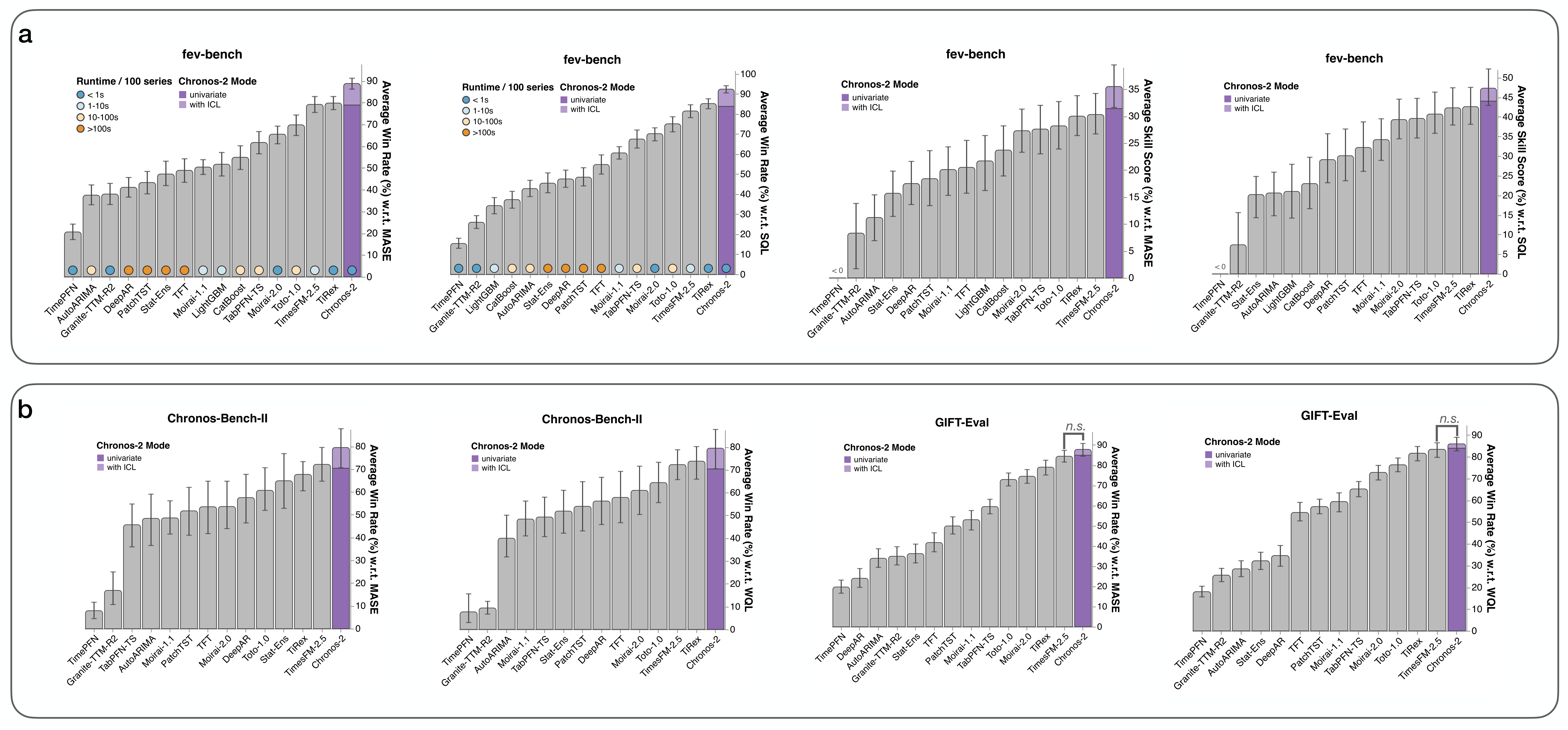
Caption: Figure 3: Evaluation of Chronos-2 on time series forecasting benchmarks (best viewed in color on a screen). Performance is evaluated using the Mean Absolute Scaled Error (MASE) and Scaled/Weighted Quantile Loss (SQL/WQL) for point and probabilistic forecasts, respectively. The Win Rate measures the proportion of pairwise comparisons where a model outperforms competitors, while the Skill Score reflects the average percentage improvement over a Seasonal Naive baseline. Dark purple bars denote Chronos-2 in univariate mode (group attention disabled); light purple segments highlight the performance gain attributed to in-context learning (ICL) via group attention. Error bars indicate 95% confiden...
Why It Matters: This is the central aggregate benchmark result and directly compares univariate mode, in-context group attention, accuracy metrics, statistical significance, and runtime.
fig:quali-main-results
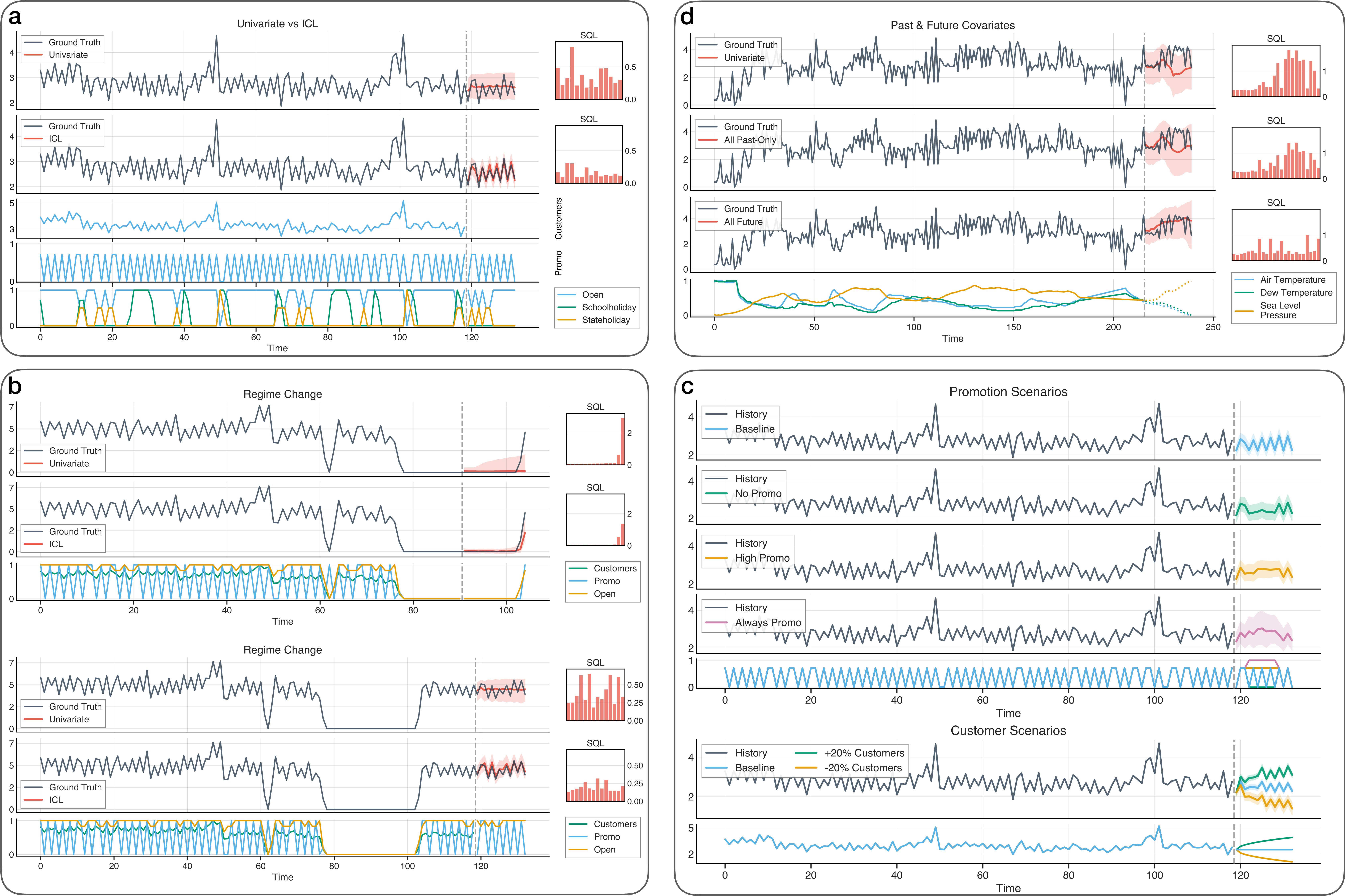
Caption: Figure 4: Qualitative analysis of in-context learning (best viewed in color on a screen). Probabilistic forecasts show the 10% to 90% quantile interval; bar charts show SQL forecast errors per time step. (a) Retail sales forecasting: univariate inference versus in-context learning with covariates including promotions, customer traffic, and holiday indicators. Covariates are shown in the lower panels. (b) Regime change: store closure at different positions relative to the forecast horizon. The top and bottom rows show the same series with different forecast origins, so that the closure falls within the forecast horizon (top) or entirely within the historical context (bottom). (c) Scenario an...
Why It Matters: The qualitative analysis shows how covariates change forecasts, identify regime changes, support counterfactual scenarios, and reduce uncertainty when future information is available.
fig:hierarchical
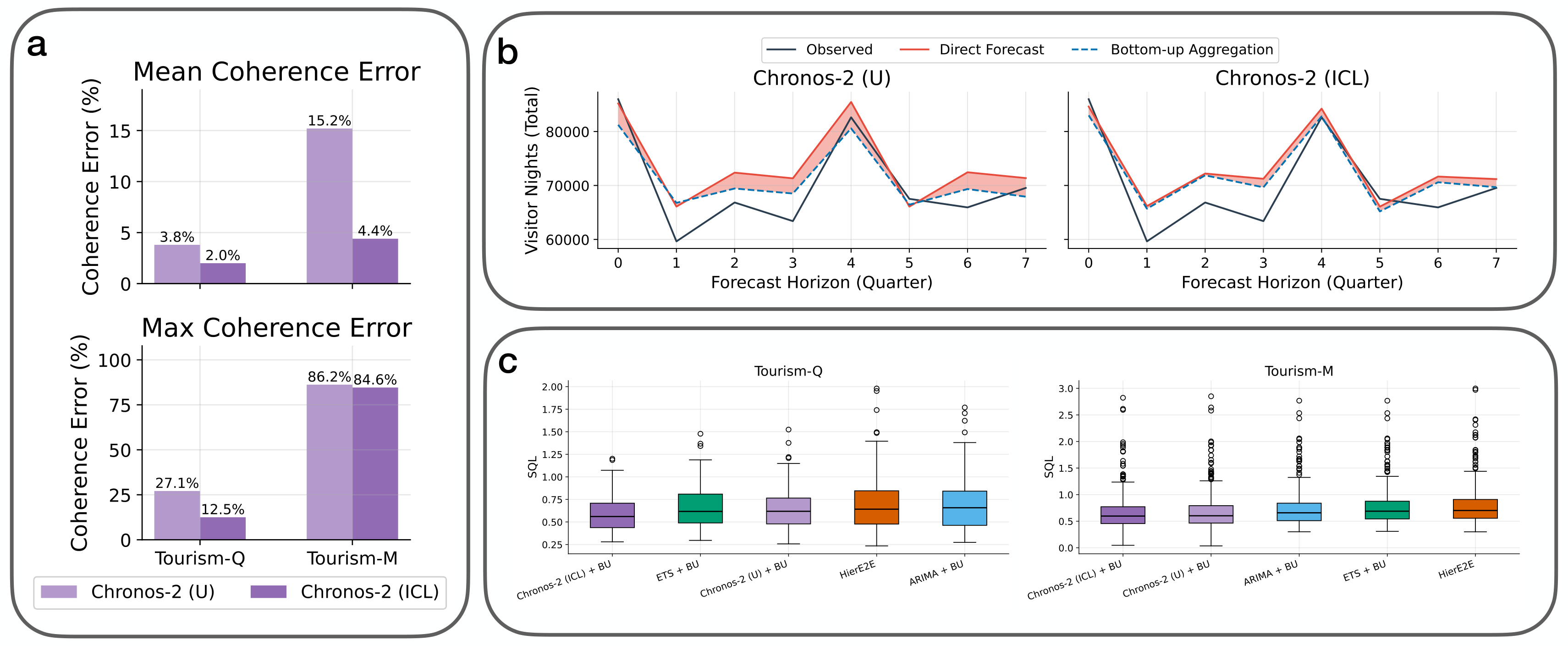
Caption: Figure 8: Hierarchical forecasting with Chronos-2. (a) Mean and maximum coherence error on the Tourism-Q and Tourism-M datasets for Chronos-2 (U) and Chronos-2 (ICL). Enabling ICL reduces the coherence error on both datasets. (b) Root-level forecasts on Tourism-Q. Solid red line shows the direct forecast generated by the respective models for the root level, while the dashed blue line shows the bottom-up aggregated forecasts. The shaded region shows the coherence gap. Chronos-2 (ICL) produces a narrower gap than Chronos-2 (U) indicating that group attention implicitly learns the aggregation structure. (c) Distribution of per-series scaled quantile loss (SQL) with bottom-up reconciliation on...
Why It Matters: This result is important for builders working with aggregation trees because it shows that group attention reduces incoherence before reconciliation and remains competitive after bottom-up reconciliation.
table:benchmark-comparisons
Caption: Selected main-body benchmark comparisons reported for fev-bench.
| Comparison | Metric | Reported result |
|---|---|---|
| Chronos-2 versus the best statistical model, Statistical Ensemble | MASE win-rate increment | 41.6 percentage points |
| Chronos-2 versus the best statistical model, Statistical Ensemble | SQL win-rate increment | 46.9 percentage points |
| Chronos-2 versus the strongest TSFM, TiRex | MASE win-rate increment | 9 percentage points |
| Chronos-2 versus the strongest TSFM, TiRex | SQL win-rate increment | 7.2 percentage points |
| Chronos-2 versus the strongest TSFM, TimesFM-2.5/TiRex | MASE/SQL skill-score improvement | 5.2/4.7 percentage points |
| Chronos-2 with ICL versus univariate inference | Win-rate/skill-score improvement | 10.7/4.1 percentage points |
| Chronos-2 versus the next-best model | MASE/SQL improvability | 4.5%/3.6% versus 10.5%/10.4% |
Why It Matters: These values quantify both aggregate accuracy and the incremental value of group attention, while also showing that Chronos-2 remains close to the best available model on tasks it does not win.
table:case-study-comparisons
Caption: Selected numeric comparisons from the scientific case studies and hierarchical forecasting experiments.
| Setting | Metric | Reported result |
|---|---|---|
| CAMELS-DE, Chronos-2 ICL | Median NSE | 0.68 |
| CAMELS-DE, Chronos-2 univariate | Median NSE | 0.15 |
| CAMELS-DE, domain-specific LSTM ensemble | NSE | 0.90 |
| Tourism-Q, Chronos-2 U versus ICL | Mean coherence error | 3.8% to 2.0% |
| Tourism-M, Chronos-2 U versus ICL | Mean coherence error | 15.2% to 4.4% |
| Tourism-Q, Chronos-2 ICL with bottom-up reconciliation | Median SQL | 0.56 |
| Tourism-M, Chronos-2 ICL with bottom-up reconciliation | Median SQL | 0.60 |
Why It Matters: The comparisons show where context alone is effective, where fine-tuning is needed to match specialist systems, and how group attention improves hierarchical consistency.
relative-WIS-score
Meaning: The epidemiology figure uses this relative score; values greater than 0 indicate improvement over the baseline.
relative-RMSE-score
Meaning: The CPI case uses this relative score against a Seasonal Naive baseline; larger positive values indicate lower model RMSE.
🔮 Conclusion
Chronos-2 shows that a pretrained model can infer coupled temporal dynamics directly from context instead of fitting a separate model for every dataset. Its combination of group attention, diverse synthetic multivariate pretraining, quantile prediction, and patch-based decoding supports a broad range of forecasting formats.
The evidence is strongest for the claim that a single model can provide a competitive and efficient baseline across heterogeneous tasks. The hydrology and hierarchical experiments further show that zero-shot inference can be a useful initialization for specialist systems and can capture structural relationships without explicit hierarchy metadata.
🛠️ Future Research Improvements
The paper identifies several directions: enlarge synthetic pretraining with outputs from domain-specific simulators, add static metadata such as soil composition or demographic profiles, and support multimodal inputs for qualitative signals such as central-bank statements or epidemiological reports.
For builders, the most important validation priorities are testing static-feature cold starts, measuring robustness under domain and covariate shift, extracting interpretable coupling or causal structure, and extending the learned temporal representations to anomaly detection, classification, and clustering.
- Add static metadata for prediction in ungauged basins and other cold-start settings.
- Use domain simulators to increase coverage of rare and physically constrained dynamics.
- Evaluate causal or mechanistic interpretability of learned cross-series relationships.
- Test downstream tasks beyond forecasting.
🏭 Potential Industry Use Scenarios
A practical deployment pattern is a shared forecasting service that accepts arbitrary groups of targets, historical covariates, and known future drivers. Retail and energy teams can use it for promotion-aware sales forecasting, regime-change detection, load forecasting, and scenario analysis; public-health teams can use it as a rapidly deployable probabilistic component alongside epidemiological ensembles.
The same architecture is relevant to macroeconomic monitoring, ecosystem and agricultural operations, hydrological forecasting, and hierarchical demand planning. In domains with limited labeled history, zero-shot inference can provide immediate coverage, while lightweight fine-tuning can adapt the model when specialist accuracy or domain constraints justify additional training.
- Retail promotion and footfall scenario planning.
- Electricity-load forecasting with weather covariates.
- Public-health incidence forecasting across regions.
- Carbon-flux and ecosystem monitoring.
- Rainfall-runoff simulation and reservoir or flood planning.
- Hierarchical regional, product, or purpose-level demand forecasting.
💬 Critical Analysis
The paper's central architectural claim is well supported by the contrast between univariate and ICL modes: group attention improves benchmark scores, helps identify covariate-driven regimes, reduces hierarchical incoherence, and improves scientific case-study results. The breadth of evaluation is also valuable because the model is tested with domain-specific metrics rather than only a single generic benchmark.
The main caveat is that zero-shot generality does not eliminate domain adaptation. In CAMELS-DE, the zero-shot model reaches median NSE 0.68 while the specialized LSTM ensemble reaches 0.90; fine-tuning is needed to bridge that gap. The model also lacks native static-metadata support, and synthetic pretraining may not represent every causal, physical, or institutional mechanism in deployment data.
Reproduction should therefore separate model capability from data-interface quality. Engineers should verify group definitions, future-covariate availability, scaling and masking behavior, context and horizon lengths, calibration under distribution shift, and end-to-end latency on their hardware. The reported benchmark advantages are compelling, but the supplied main-body evidence does not expose complete per-model tables for every benchmark, so detailed model-by-model claims should be checked against the full paper and released implementation.