
📌 Highlights
TabAbax extends TabICLv2 at two points upstream of its in-context transformer: its synthetic pretraining prior and its column–row encoder. The encoder adds learned Fourier scalar features and repeats the column–row interaction pair once before compressing each row. The prior uses richer node-level converter functions, exact one-hot width matching, multiple class-frequency distributions, and no post-hoc monotone warping of regression targets. The ICL transformer itself remains at 12 layers.
On the full 142-dataset BeyondArena suite, the paper reports 1,238 Elo and 10th place among 41 evaluated methods, 68 above TabICLv2. On TabArena’s full 13-dataset regression suite, the result is 2,024 Elo and 7th among 99 methods, 336 above TabICLv2 and 21 above TabFM. The prior-only regression ablation reaches 1,916 Elo, while the paper flags possible weak-signal coverage loss from filtering and bounded context as limitations.
- Strongest reported result: TabArena regression at 2,024 Elo across 13 datasets.
- Prior-only regression ablation: 1,916 Elo, compared with the TabICLv2 baseline at 1,688.1.
- The authors identify possible weak-signal coverage gaps and limits from bounded context.
🎯 Introduction
Tabular prediction supports scientific and operational decisions in areas including healthcare, finance, logistics, and manufacturing. Tables encode heterogeneous variables through schemas, numerical scales, missingness patterns, and categorical structure. For decades, dataset-specific pipelines—especially gradient-boosted trees—have been competitive, while deep-learning alternatives have only more recently reached parity. Tabular foundation models offer a different setup: pretrain across synthetic or real tabular tasks, then predict on an unseen dataset by conditioning on its labeled examples rather than retraining model parameters.
The authors frame recent TFM progress around richer priors, more expressive encoders, real-data pretraining, and language-model approaches. Their stated motivation is a mechanistic finding that deeper ICL transformers yield weak gains and that many ICL layers carry little load. They therefore target the synthetic prior and column–row encoder that feed the ICL stack. The paper’s objective is to modify those components within TabICLv2’s framework and test whether the resulting model improves benchmark performance, particularly on regression.
🔬 Methodology
For a table with n rows and m columns, TabAbax preserves TabICLv2’s column embedding, row interaction, compression, and ICL stages, with reported runtime complexity O(n² + nm²). The grouped embedding forms feature tokens from columns at circular offsets (j, j+1, j+3) mod m and applies a shared linear projection. The paper says this pattern avoids reusing a column pair in more than one group for tables with at least seven columns, reducing cross-feature confusion at the cost of strict permutation invariance; random-shuffle ensembles inherited from TabICLv2 mitigate that concern.
Observed scalar values are transformed through sine and cosine components at 16 learned frequencies before grouped projection. A separate learned embedding handles missing values. The column-wise set transformer uses inducing-point attention; row-wise attention uses learnable [CLS] tokens to fold each row into one vector. TabAbax applies the column–row pair twice with untied weights, so the second pass can re-evaluate feature dependencies on updated representations. Target embeddings are injected into training tokens. The compressed rows then enter the unchanged 12-layer ICL transformer, where query-aware scalable softmax adjusts query scaling with log n to mitigate attention fading in long contexts.
The model is pretrained entirely on synthetic SCM datasets, with separate classification and regression training. Task configuration samples row and feature counts, feature types and cardinalities, target type, and context/query split. A random directed acyclic graph propagates latent vectors in topological order through node functions. TabAbax draws richer converter families and hyperparameters per node, enforces agreement between declared categorical cardinality and emitted one-hot width, and draws class frequencies from multiple distributions including a Dirichlet prior. It disables post-hoc monotone target warping and rejects datasets that fail the final signal check. The classifier uses cross-entropy; the regressor predicts 999 quantiles trained with summed pinball loss.
The report gives two equations central to the representation: the grouped projection and scalar Fourier map are included below. It reports released checkpoint sizes of 231.15 MB for the 28.85M-parameter classifier and 239.03 MB for the 29.84M-parameter regressor. Training is described as three stages on 8 H20 GPUs, totaling approximately 2,700–3,500 GPU-hours.
Equation 1
Meaning: This equation defines the shared linear projection for each grouped feature token, combining the current column with columns at the two specified circular offsets.
Fourier scalar encoding
Meaning: This maps each observed scalar into a bounded multi-scale representation using the learned frequencies; the paper specifies K=16.
📊 Experiments
The authors evaluate on BeyondArena and TabArena. BeyondArena contains 142 datasets (98 classification and 44 regression), with IID, grouped, and temporal splits and strata covering dataset scale, dimensionality, and feature type. Its size distribution is 80 datasets below 10K rows, 35 between 10K and 100K, and 27 above 100K. TabArena contains 51 datasets (38 classification and 13 regression), with 29 below 10K rows, 20 between 10K and 100K, and two above 100K. Its Elo rating is anchored at default Random Forest = 1000; the reported leaderboards include 99 evaluated entries. The paper also reports average rank, oracle improvability (lower is better), and win rate alongside Elo.
On BeyondArena overall, TabAbax reaches 1,237.7 Elo, rank 10 of 41, compared with 1,170.0 for TabICLv2. It reports 1,287 Elo on regression and 1,219 on classification, respectively 127 and 43 above their stated TabICLv2 baselines. On TabArena overall it reaches 1,676 Elo, rank 11 of 99, 115 above TabICLv2’s 1,561.0. The largest result is TabArena regression: 2,023.7 Elo versus 1,688.1 for TabICLv2 and 2,003 for TabFM. The classification suite result is 1,646.7 versus 1,570.6 for TabICLv2.
The prior-only ablation retains the TabICLv2 architecture and changes the training prior. On TabArena regression it reaches 1,915.8 Elo, 227.7 above baseline, while the full model reaches 2,023.7; on classification it reaches 1,582.6 versus 1,570.6 for baseline, while the full model reaches 1,646.7. These results support the authors’ interpretation that prior changes account for a larger share of the regression gain, while architectural changes add more on classification. They do not isolate individual prior modifications or each encoder element. Results tables below preserve the reported split and metrics; the regression comparison figure is attached here.
tab:benchmarks
Caption: Statistics of the benchmark suites considered in our evaluation. Sizes are counted in number of instances per dataset; the size columns report the number of datasets in each range.
| Benchmark | # Datasets | Cls. | Reg. | <10K | 10K–100K | >100K |
|---|---|---|---|---|---|---|
| BeyondArena | 142 | 98 | 44 | 80 | 35 | 27 |
| TabArena | 51 | 38 | 13 | 29 | 20 | 2 |
Why It Matters: These counts establish the task and dataset-size coverage used for the reported comparisons.
tab:split
Caption: Classification vs.\ regression split under the official TabArena metrics. The prior-only ablation rows (the unmodified TabICLv2 architecture trained with the improved prior; Section~sec:ablation) isolate the prior contribution to the full model's $+$76 classification and $+$336 regression Elo gains over the TabICLv2 baseline. Rank is the mean per-dataset rank, Improv.\ the oracle improvability (\%, lower is better), and Win the per-dataset win rate. Full per-suite tables: Tables~tab:app-classification and~tab:app-regression.
| Method | Classification Elo↑ | Rank↓ | Improv.↓ | Win↑ | Regression Elo↑ | Rank↓ | Improv.↓ | Win↑ |
|---|---|---|---|---|---|---|---|---|
| TabAbax (ours) | 1,646.7 | 20.2 | 13.83 | 0.804 | 2,023.7 | 10.1 | 3.30 | 0.907 |
| TabAbax-prior only | 1,582.6 | 24.7 | 14.74 | 0.758 | 1,915.8 | 13.6 | 4.11 | 0.872 |
| TabICLv2 (baseline) | 1,570.6 | 25.7 | 14.56 | 0.748 | 1,688.1 | 24.4 | 6.35 | 0.760 |
Why It Matters: The prior-only rows provide the paper’s direct ablation evidence. They show a much larger Elo increase over baseline for regression than classification; lower oracle improvability is better, while Elo and win rate are higher-is-better.
fig:tabarena-reg-top15
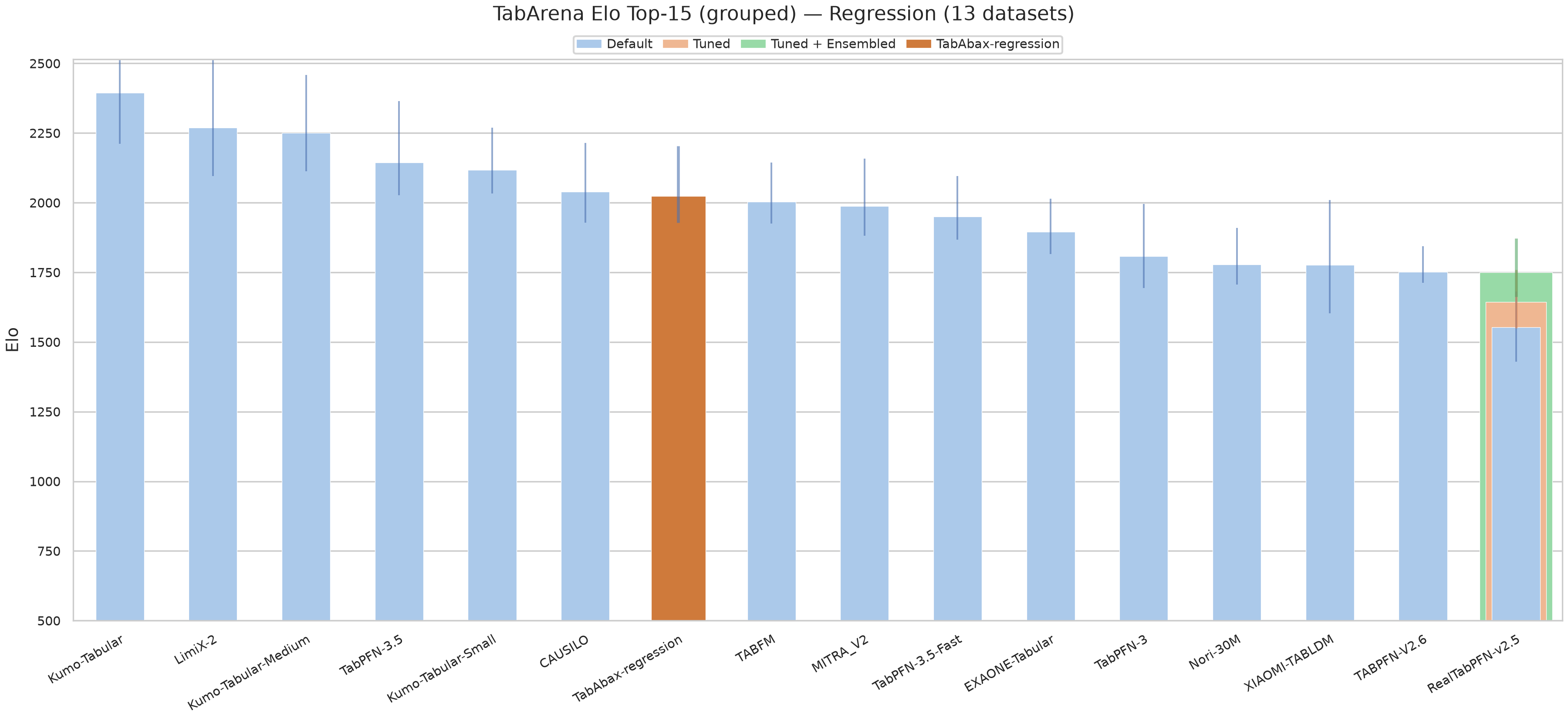
Caption: TabArena regression Elo across all 13 datasets of the benchmark's full regression suite (top-15 grouped leaderboard). (dark orange bar; arena entry TabAbax, regression checkpoint) reaches an Elo rating of 2,024, ranking 7th of all 99 evaluated methods, $+$336 over the TabICLv2 official default baseline (1,688), $+$217 over TabPFN-3 (1,807), and $+$21 over TabFM (2,003). The full 99-method table is in Table~tab:app-regression.
Why It Matters: This is the paper’s clearest benchmark comparison for its strongest reported task area, and it places the regression result against TabICLv2, TabPFN-3, and TabFM.
fig:beyondarena-all-top15
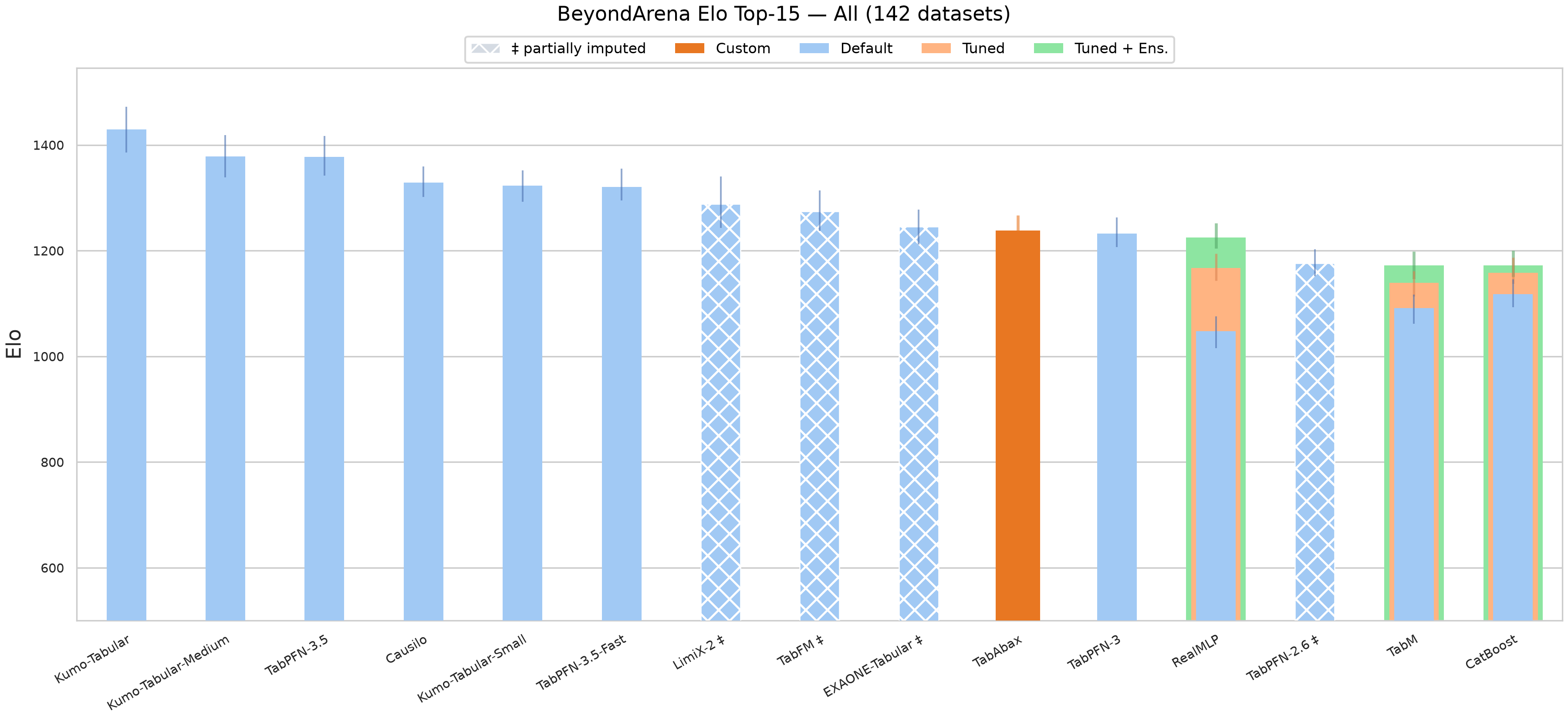
Caption: BeyondArena overall Elo across the full 142-dataset suite (98 classification, 44 regression; top-15 leaderboard). (dark orange bar) reaches an Elo rating of 1,238, ranking 10th of the 41 evaluated methods, $+$68 over the TabICLv2 baseline (1,170). Methods marked $ $ are partially imputed.
Why It Matters: The mixed-task result shows that the model’s reported improvement is not limited to TabArena’s regression suite.
🔮 Conclusion
The paper presents TabAbax as an upstream extension of TabICLv2: improved synthetic data quality and complexity paired with Fourier scalar encoding and a second column–row pass. Its benchmark results show positive gains over the TabICLv2 baseline, with the largest reported advantage on regression. The prior-only ablation supports a substantial role for prior quality in that regression result, while the full model’s classification gain is less attributable to the prior alone.
The authors conclude that SCM prior quality control can improve regression without increasing model size or altering the inference architecture. That is a promising result within the evaluated suites, but the authors’ own limitations make generalization to weak-signal tasks and very large contexts an open question.
🛠️ Future Research Improvements
The authors identify deeper interaction after row compression as a promising next direction. Their stated plan is to add deeper pre- and post-compression interaction stages while remaining within a linear-time inference budget. This would test whether useful feature relationships can continue to be modeled after each row has been folded into a compact representation, rather than spending all additional interaction before compression.
They also plan to scale the hidden dimensions of the column–row encoder and ICL backbone together with parameter count. The report says this should be used to study whether gains from prior changes and deeper pre-compression interaction persist, amplify, or saturate at larger capacity. A further evaluation priority follows from the paper’s limitations: measure whether predictability filtering reduces coverage on weak-signal, high-noise tasks and quantify the tradeoff between corpus diversity and filtering quality. The present paper does not report those follow-up experiments.
🏭 Potential Industry Use Scenarios
The paper motivates tabular prediction through operational and scientific settings such as healthcare, finance, logistics, and manufacturing, where schemas combine numerical and categorical variables and labeled examples may be available for a new task. In principle, an in-context tabular model could be evaluated in workflows where teams need a pretrained starting point for prediction on a new dataset without fitting a task-specific model. The reported separate classification and regression checkpoints correspond to two common prediction task types.
The strongest direct evidence for a practical evaluation target is the TabArena regression result, alongside positive mixed-task results on BeyondArena, which includes grouped and temporal splits. Those results justify testing TabAbax as a candidate in offline comparisons on relevant, held-out organizational data. They do not establish clinical, financial, or operational readiness, nor do they show that a particular deployment outperforms a tuned task-specific pipeline. Teams should verify context-size limits, data-shift sensitivity, label quality, uncertainty behavior, and performance on weak-signal tasks before considering use in a decision workflow.
💬 Critical Analysis
A strength of the study is that it changes upstream components while holding the ICL transformer depth fixed, then trains prior-only variants to separate some of the effects. The comparison spans two named benchmarks and reports mixed-task, classification, and regression results, with multiple aggregate views on TabArena. The prior-only regression score is a meaningful mechanistic clue: it suggests that improvements to the synthetic training distribution can matter without changing the inference architecture.
The attribution remains partial. The ablation tests the improved prior as a bundle, so it cannot establish which of the function-family, categorical-width, class-frequency, or target-warping changes drives the gain. Likewise, it does not separately test Fourier encoding and the second column–row pass. This limits how confidently engineers can transfer any single design choice.
The paper reports that filtering may remove weak-signal tasks from the effective pretraining corpus, creating a possible coverage gap precisely for noisy real-world problems. Bounded context and sensitivity to demonstrations also constrain deployment. The benchmark scores are encouraging evidence on the specified suites, but the report does not establish performance under a particular organization’s shift, missingness, context size, or operational cost constraints. Reproduction and task-specific validation remain necessary.