
📌 Highlights
The paper's central finding is that RLVR can teach a correct reasoning strategy in-distribution without making that strategy robust to distribution shift. MONO reaches approximately 90% accuracy on the in-distribution inversion task, but its derivation share falls below 50% on the three harder OOD settings and its accuracy reaches 6% on Length Change.
MIXED co-trains on bijective inversion tasks and preserves derivation more often under OOD shifts while maintaining similar in-distribution behavior. The intervention is notable because bijective tasks request one solution and are not uniformly harder or closer to the multi-solution OOD evaluation.
The strongest practical lesson is to evaluate and shape strategy selection separately from final reward. The paper's mixture ablation shows that a higher derivation rate can coexist with worse accuracy when the model receives insufficient practice producing multiple distinct solutions.
- Task: invert synthetic string functions under controlled distribution shifts.
- Failure mode: derivation collapses into brute-force enumeration on OOD tasks.
- Intervention: co-training with bijective inversion tasks.
- Mechanism: outcome-only RL can implicitly favor higher information per token.
- Main caveat: synthetic strategy evidence does not establish broad real-world transfer.
🎯 Introduction
RLVR has produced positive generalization results in mathematics, coding, synthetic string tasks, and games, but those results do not establish that learned reasoning strategies transfer reliably. The paper targets this gap by asking when and why an RL-trained model abandons an effective strategy under OOD conditions.
The proposed framework reverses a function-simulation setup: given source code for f and a target y, the model must recover multiple inputs x satisfying f(x)=y. Non-bijective functions provide multiple valid solutions and make derivation, case analysis, and brute-force enumeration observable. Training and evaluation use disjoint function sets, while OOD shifts vary the number of requested solutions, output length, and the relationship between input and output lengths.
Inversion objective
Meaning: Defines the inverse problem used to expose and evaluate reasoning strategies.
🔬 Methodology
The benchmark uses 24 non-bijective functions, with 18 functions for RL training and 6 held out for evaluation. Training contains 50,000 tasks, and each evaluation set contains 1,024 randomly generated tasks. In-distribution examples use target outputs of length 4–6 and request two candidate solutions. The four OOD axes request three to six answers, use target outputs of length 6–10, combine both changes, or use Length Change functions where x and y have different lengths.
Qwen2.5-7B-Instruct is trained with GRPO plus DAPO improvements, especially filtering groups with zero reward variance. MONO trains only on non-bijective inversion, whereas MIXED co-trains bijective inversion with the original tasks at a 1:1 ratio. Traces are categorized as derivation when they structurally reverse the function and use case analysis as needed, and as enumeration when they guess all digits directly.
The theoretical view models reasoning as search over a solution space. Derivation is considered more effective because it can remove many candidates structurally in one step, whereas enumeration rejects candidates individually. The proposed bit-rate analysis then explains why outcome-only reward can still favor strategies that make larger progress toward the correct solution set.
Verifier accuracy
Meaning: Defines the outcome-based metric used to reward distinct correct solutions and penalize over-generation.
Search uncertainty
Meaning: Quantifies the information required to identify correct solutions within the full search space.
Bit-rate requirement
Meaning: Relates rollout length and per-action information capacity to the amount of uncertainty that must be removed.
Actor-critic credit assignment
Meaning: Formalizes how progress in success probability can credit individual reasoning actions.
📊 Experiments
The main evaluation covers the held-out inversion functions and four controlled OOD splits: More Answers, Longer Outputs, Longer Outputs & More Answers, and Length Change. MONO achieves high in-distribution accuracy and uses derivation in 85% of traces, but the paper reports that its accuracy remains above 80% only on the mild More Answers shift and falls to 6% on Length Change. MIXED improves OOD behavior by retaining substantially more derivation, with the largest reported advantage on Length Change.
The bit-rate interventions shorten the rollout budget from 8,000 to 5,000 tokens or constrain the digit-level solution space. Both interventions make the task harder but increase derivation share, supporting the proposed mechanism. The mixture-ratio ablation shows a monotonic increase in derivation as the bijective fraction rises, while the paper reports that the 1:1 mixture is most accurate because heavier bijective training reduces practice with producing multiple distinct solutions.
For external transfer, the paper evaluates MATH500, Minerva-Math, AIME24, AIME25, AMC23, and OlympiadBench in zero-shot settings. MIXED has the highest reported average, while MONO is stronger on MATH500 and is described as more reliable for sustained mechanical execution. A separate Sokoban experiment mixes an auxiliary variant requiring success within optimal_steps + 2 actions; the authors present this as suggestive evidence for agentic transfer rather than a direct validation of the derivation/enumeration framework.
Table 1
Caption: Table 1: Zero-shot transfer to math benchmark: MATH500 (Hendrycks et al., 2021), Minerva-Math (Lewkowycz et al., 2022), and OlympiadBench (He et al., 2024). Accuracy in %.
| Benchmark | Qwen | MONO | MIXED |
|---|---|---|---|
| MATH500 | 76.0 | 77.2 | 75.8 |
| Minerva-Math | 36.0 | 34.9 | 37.5 |
| AIME24 | 10.0 | 10.0 | 13.3 |
| AIME25 | 3.3 | 0.0 | 10.0 |
| AMC23 | 47.5 | 55.0 | 62.5 |
| OlympiadBench | 37.6 | 38.1 | 39.9 |
| Average | 35.1 | 35.9 | 39.8 |
Why It Matters: Provides the paper's only recovered numeric table for zero-shot transfer and shows specialization differences between MONO and MIXED.
Figure 2b strategy shares
Caption: Reasoning strategy collapse and generalization in OOD tasks (Sec. 4). The MONO model performs normally ID but collapses, which relies on brute-force enumeration OOD. In comparison, MIXED model shows similar ID performance, but surprisingly doubles analytical derivation reasoning on OOD and lead to better generalization. These reveal the challenges of reasoning strategy generalization and how to enhance the generalization of reasoning in RLVR.
| Evaluation split | MONO derivation share (%) | MIXED derivation share (%) |
|---|---|---|
| Inv. (ID) | 85 | 95 |
| More Ans (OOD) | 76 | 95 |
| Longer Outputs (OOD) | 30 | 65 |
| Longer Out. & More Ans (OOD) | 27 | 69 |
| Len Change (OOD) | 48 | 91 |
Why It Matters: Makes the paper's strategy-level explanation of the accuracy gap explicit.
Figure 6b mixture ablation
Caption: Figure 6: Analyzing the recipe of mixtures. (Details in Sec. 6.2)
| Bijective mixture | Inv. (ID) | More Ans (OOD) | Longer Outputs (OOD) | Longer Out. & More Ans (OOD) | Len Change (OOD) |
|---|---|---|---|---|---|
| 25% Bijective | 83 | 86 | 53 | 61 | 72 |
| 50% Bijective | 95 | 95 | 65 | 69 | 91 |
| 75% Bijective | 97 | 97 | 78 | 79 | 99 |
Why It Matters: Shows that increasing the auxiliary-task fraction increases derivation share, but does not by itself establish the best accuracy setting.
fig:teaser
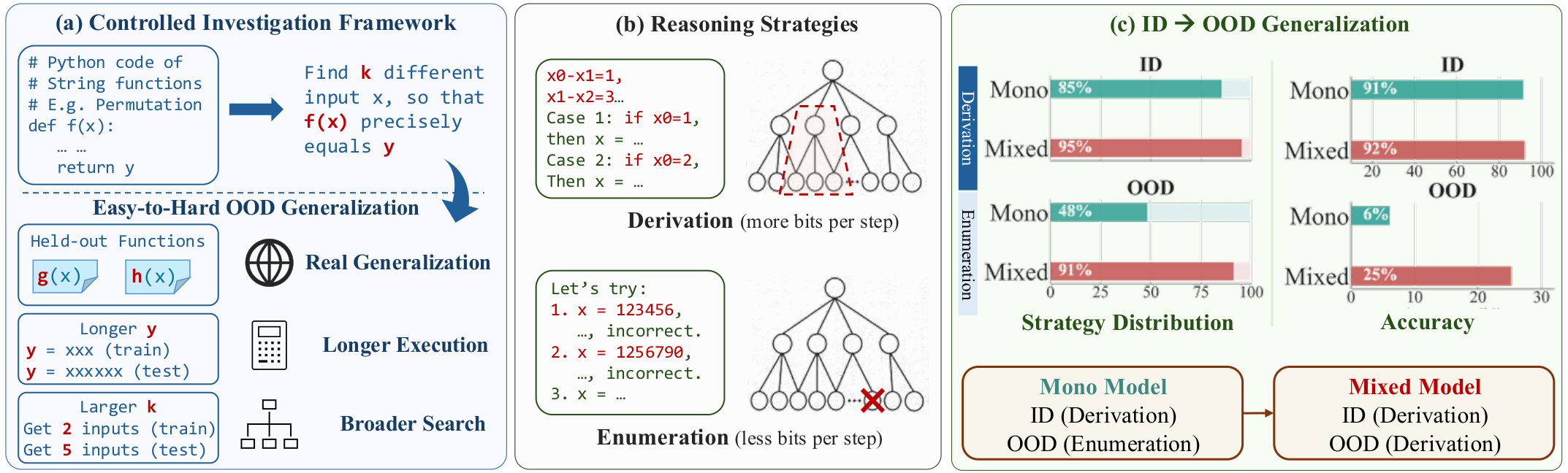
Caption: (a) To clearly define OOD generalization for LLM reasoning, we construct a controllable framework via solving string function equations, mirroring real-world math and coding. (b) We categorize two major reasoning strategies, the more effective Derivation and or total brute-force Enumeration. (c) We reveal how reasoning strategies reflect the challenges of OOD generalization. The Mono model learns derivation for ID cases, yet drastically collapses to enumeration for OOD. With Mixed better incentivizing the derivation strategy, it achieves much better OOD accuracy under similar ID performance. These form a systematic framework of understanding RLVR.
Why It Matters: The teaser defines the task, contrasts derivation with enumeration, and summarizes the paper's central OOD failure and intervention.
fig:nbj_with_bj

Caption: Evaluation Accuracy During RL
Why It Matters: This is the main training-evaluation comparison between MONO and MIXED across in-distribution and four OOD settings.
fig:strategy-budgets

Caption: Tightening bit rates incentivizes the more generalizable derivation strategy. Notation follows Fig.~fig:nbj_strategy; ``short'' and ``constrained'' are the shorter $T$ and constrained solution space in Sec.~sec:theory-verification.
Why It Matters: The figure tests whether shorter rollout budgets and constrained solution spaces increase use of the proposed high-bit-rate strategy.
fig:probe_strategy
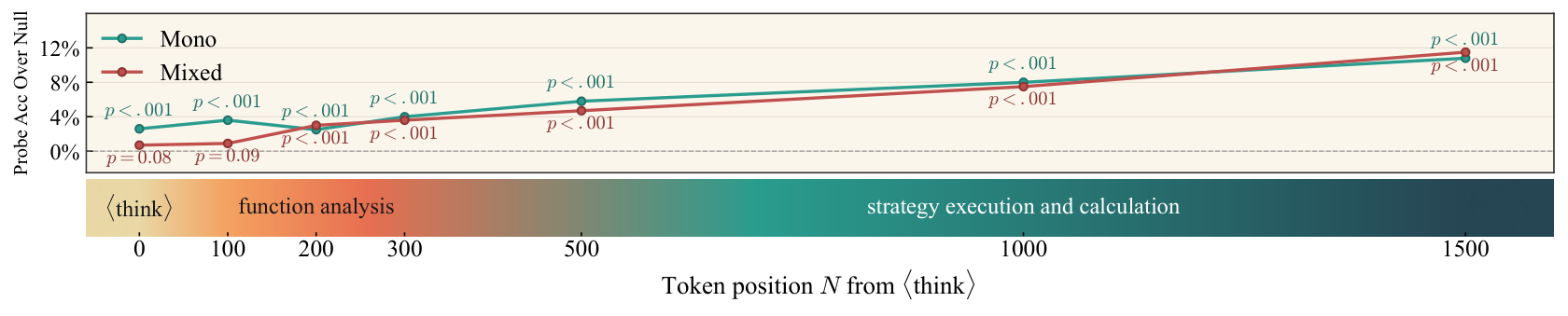
Caption: Probing reasoning strategies from hidden states. The y-axis is the delta over a strong null condition (i.e., 76\% for the Mixed model), and we use p-value to read the significance of probing.
Why It Matters: The hidden-state probe examines whether strategy commitment is detectable before or after function analysis.
fig:mix_ratio

Caption: Validation Accuracy
Why It Matters: This ablation evaluates how the fraction of bijective auxiliary data affects validation performance.
Figure 6
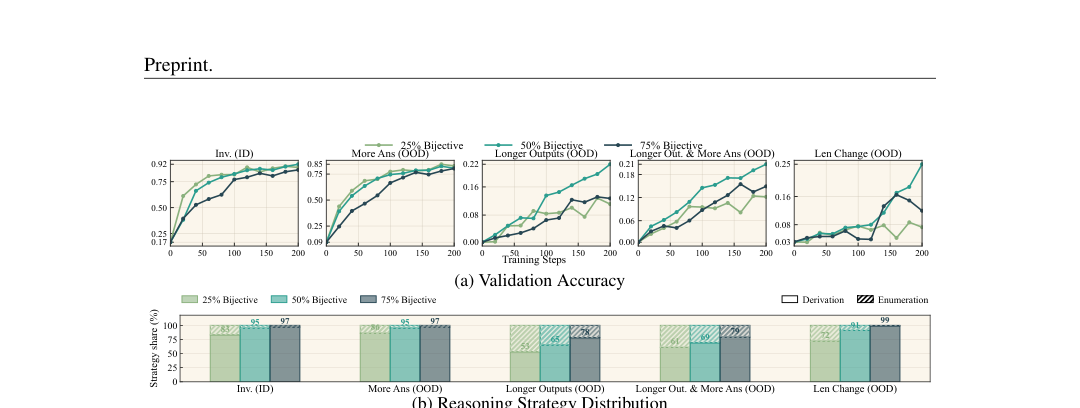
Caption: Figure 6: Analyzing the recipe of mixtures. (Details in Sec. 6.2)
Why It Matters: The mixture analysis separates strategy selection from task-specific execution and shows why the highest derivation rate is not the same as the best accuracy.
🔮 Conclusion
The paper argues that RLVR generalization depends not only on whether a model learns to solve its training tasks, but also on whether it preserves an effective reasoning strategy under OOD shifts. In the controlled inversion setting, MONO learns derivation in-distribution but often reverts to enumeration, whereas MIXED restores more robust derivation through bijective-task co-training.
The bit-rate analysis provides a coherent explanation for why outcome-only rewards can shape reasoning processes without process labels: actions that remove more uncertainty produce larger improvements in success probability and receive stronger implicit credit. The math-transfer results support the idea that structural strategy and execution skill are separable, but they do not establish broad domain transfer.
🛠️ Future Research Improvements
A useful next step is to test the strategy-collapse hypothesis across larger and smaller language models, different base checkpoints, and alternative outcome-based RL algorithms. This would clarify whether the effect is tied to Qwen2.5-7B-Instruct, GRPO-style training, or a broader property of RLVR.
The synthetic framework should be connected to real mathematical and coding tasks with explicit trace audits, held-out task structures, and execution-sensitive metrics. Future evaluations should distinguish strategy selection, mechanical execution, answer diversity, and verifier behavior rather than treating final accuracy as a single sufficient measure.
The agentic extension also deserves more direct testing. Sokoban provides an initial signal, but future work should define interpretable high- and low-information planning strategies and evaluate held-out environments, intervention robustness, and real execution success.
🏭 Potential Industry Use Scenarios
Post-training teams could use controlled auxiliary tasks to encourage reasoning patterns that remain stable when production inputs become longer, require more answers, or contain unfamiliar structures. The paper's bijective-inversion result suggests that auxiliary data need not resemble the final task exactly if it sharpens a desired strategy.
Coding and mathematical-agent pipelines could add trace-level diagnostics that detect transitions from structural reasoning to brute-force search, then use those diagnostics for data curation, model selection, or targeted RL mixtures. This is especially relevant when a verifier can confirm correctness but cannot explain why a strategy will remain reliable under distribution shift.
For multi-step agents, the bit-rate idea could guide curriculum design around tasks that reward progress toward constrained goals. The paper's Sokoban evidence is preliminary, so deployment decisions would require task-specific validation and failure analysis.
💬 Critical Analysis
The paper's strongest design choice is the controllable separation between task identity, difficulty shift, strategy category, and outcome verification. This makes the central failure mode unusually legible: the model is not simply incapable, and the in-distribution behavior is not an obvious reward-hacking shortcut. The held-out-function split and multiple OOD axes also provide a stronger test than a single harder benchmark.
The main interpretive risk is scope. Derivation and enumeration are unusually clean categories for the synthetic inversion task, while real reasoning often combines planning, retrieval, calculation, and verification. The LLM-based trace judge and the use of zero-shot math transfer provide useful evidence, but neither fully demonstrates that the same strategy variable explains broad LLM reasoning behavior.
The mixture ablation is particularly important because it limits the paper's strongest intervention claim. More bijective data increases derivation, but the 1:1 mixture is reported as most accurate because the model still needs practice with multi-answer execution. This supports a nuanced conclusion: robust reasoning requires both a transferable strategy and sufficient task-specific competence.