
📌 Highlights
WebHarbor packages 153 executable, Dockerized website environments and 3,518 tasks for GUI web agent research. The tasks include information seeking, account management, bookings, purchases, authentication, and persistent state changes. The design targets a gap between live sites, which offer realistic interfaces but can change or block access, and synthetic environments, which may lack visual fidelity or deep workflows. Tasks scope each reconstruction; coding agents implement it, and human reviewers audit the rendered site and end-to-end task behavior.
For training, the authors use a Qwen 4B-level agent and report an average score of 75.8 across WebVoyager and Online-Mind2Web, compared with 70.6 for OpenWebRL-4B (RL) in their 4B comparison. The results also include WebArena and the WebHarbor test set. Their interpretation is that training on the offline suite can transfer to unseen tasks and sites. That evidence is bounded by the tested model and evaluation settings: the authors trained only one 4B model, and replicas and automated judges can miss important real-world behavior.
- 153 Dockerized environments and 3,518 tasks, built around task-relevant workflows.
- Human audits address visual fidelity, functionality, and task validity during iterative construction.
- The reported 4B results suggest transfer, with gaps in model-scale coverage and replica fidelity.
🎯 Introduction
The paper studies environments for GUI web agents that interpret rendered pages and act through browser interactions. Reliable evaluation requires stable outcomes; reinforcement learning also needs executable state transitions and repeatable resets. Live websites provide realistic observations but introduce content drift, bot detection, and geographic restrictions. The authors report that about 38% of Online-Mind2Web tasks were blocked by bot detection and 22% of WebVoyager tasks were outdated because sites had changed. Such failures constrain both reproducibility and access to authenticated workflows.
Existing controlled benchmarks also leave a coverage gap. Human-built environments can support complex interactions but cover relatively few sites, while automatically synthesized environments may emphasize generated worlds over task-grounded reconstructions or provide limited multimodal content and post-authentication functionality. The paper’s objective is to combine offline execution, realistic interfaces, functional workflows, and controlled resets. WebHarbor addresses this with task-scoped website reconstructions, human-agent iteration, and a suite intended for both evaluation and RL. Figure 1’s storefront comparison illustrates the visual-fidelity issue in one example; it does not establish fidelity across every environment.
🔬 Methodology
WebHarbor begins with tasks rather than attempting to reproduce an entire commercial service. A task specifies entry and terminal pages, observable entities and attributes, required browser actions, and state changes. These requirements define the routes, data, assets, and interactions the local environment must support. The authors start with the 15 sites and 643 tasks in WebVoyager, then extend site coverage to Online-Mind2Web websites while excluding its original tasks, which they characterize as primarily information-seeking. Contributors identify functional areas, propose workflows, and review them for feasibility and interaction depth.
Coding agents inspect target services in a rendered browser, recording page structure, navigation, URLs, controls, and visual appearance. They build self-contained applications using SQLite and bundled visual assets, sourced from the target or visually similar public alternatives. Agents then execute the tasks, add unsupported routes or state transitions, populate missing content, reset the environment, and rerun the complete workflow. Human contributors audit visual fidelity, functional correctness, data realism, and task validity, then give actionable feedback for further implementation. The reported average is 2–3 review rounds of 1–2 hours each per environment.
For the split, the authors hold out all 15 WebVoyager sites, 15 additional sites, and 20% of tasks from the remaining 123 sites for training, yielding 2,288 training tasks. They filter test candidates through model executions and agreement between scripted verifiers and an OpenCode agent, then limit each site to two test tasks, producing 306 test tasks. Training uses the OpenWebRL SFT checkpoint, its multimodal multi-turn GRPO objective, and a ReAct-style GUI harness; the environment and task source are the main controlled difference described. No numbered equations or algorithm blocks were present in the supplied main-body extraction.
📊 Experiments
The authors evaluate WebHarbor on four benchmarks: its 306-task test set, WebVoyager, Online-Mind2Web, and WebArena. Online-Mind2Web covers 300 tasks across 100+ live websites; WebVoyager has 643 tasks on 15 live sites; WebArena uses a 226-task subset. WebArena-NL disables automatic login and supplies credentials in task descriptions. The protocol uses a 1280×1000 viewport, temperature 0.6, top-p 0.95, and top-k 20, with a 30-step budget except for 50 steps on WebArena. Online-Mind2Web uses an o4-mini AgentTrek judge, WebVoyager uses a GPT-4.1 benchmark judge, and WebArena uses programmatic state validators. The paper reports pass/success rates, where higher values indicate more tasks completed; WebHarbor reports verifier and Agent-Judge pass rates and their agreement.
In the listed 4B comparison, WebHarbor-4B scores 81.2 on WebVoyager and 70.4 on Online-Mind2Web, averaging 75.8. The base scores 52.6 and 32.0 (average 42.3); OpenWebRL-4B-SFT scores 60.2 and 47.0 (53.6); OpenWebRL-4B (RL) scores 74.1 and 67.0 (70.6). These results support the authors’ transfer claim, although the two live-web scores exclude invalid trials such as reCAPTCHA. On WebArena with automatic login, WebHarbor-4B reports 28.8 overall; in WebArena-NL it reports 26.1, a 2.7-point drop. The site-level exception is Reddit, where its WebArena-NL result is 3.9.
On the WebHarbor test set, WebHarbor-4B obtains verifier and Agent-Judge pass rates of 30.0 and 41.5, with 87.0 consistency. GPT-6-Astra reaches 86.7 and 95.4 with the GUI harness, and 83.0 and 95.7 with OpenCode. The authors also report that four agents score 4.4–18.8 points higher on WebHarbor than on live WebVoyager while preserving all six pairwise model orderings; Spearman correlation is 1.000 and Pearson correlation is 0.802. They describe this as ranking consistency, not proof that the benchmarks are interchangeable. The supplied extraction does not provide a verified main-body ablation table, so no numeric ablation is asserted here.
tab:single-column-main-result1
Caption: Performance on WebVoyager and Online-Mind2Web, excluding invalid trials (e.g., reCAPTCHA). $^*$ marks results reported by OpenWebRL~ yang2026openwebrl. Bold and underlined values are the best and second-best results in each column.
| Model | WebVoyager | Online-Mind2Web | Avg. |
|---|---|---|---|
| Qwen3-VL-4B-Thinking (base) | 52.6* | 32.0* | 42.3 |
| OpenWebRL-4B-SFT | 60.2* | 47.0* | 53.6 |
| OpenWebRL-4B (RL) | 74.1* | 67.0* | 70.6 |
| WebHarbor-4B | 81.2 | 70.4 | 75.8 |
Why It Matters: This controlled 4B comparison reports WebHarbor-4B’s live-web performance against the base, SFT, and live-web-trained RL baselines. The paper’s prose states that the average is 5.2 points above OpenWebRL-4B (RL).
tab:single-column-main-result2
Caption: Success rates (\%) of 4B models on WebArena by site, with and without automatic login (NL gives the credentials in the task instead). Subscripts give the drop from WebArena to WebArena-NL. Bold and underlined values are the best and second-best results in each column of each setting.
| Setting | Model | Shopping | Admin | GitLab | Map | Overall | |
|---|---|---|---|---|---|---|---|
| WebArena (auto-login) | Qwen3-VL-4B-Thinking | 25.5 | 15.8 | 15.4 | 14.3 | 12.5 | 17.3 |
| WebArena (auto-login) | OpenWebRL-4B-SFT | 36.4 | 24.6 | 23.1 | 23.2 | 18.8 | 26.1 |
| WebArena (auto-login) | OpenWebRL-4B (RL) | 29.1 | 21.1 | 7.7 | 23.2 | 9.4 | 20.4 |
| WebArena (auto-login) | WebHarbor-4B | 32.7 | 33.3 | 26.9 | 25.0 | 21.9 | 28.8 |
| WebArena-NL (no auto-login) | Qwen3-VL-4B-Thinking | 30.9 | 12.3 | 7.7 | 8.9 | 12.5 | 15.5\(_{-1.8}\) |
| WebArena-NL (no auto-login) | OpenWebRL-4B-SFT | 30.9 | 21.1 | 11.5 | 19.6 | 15.6 | 21.2\(_{-4.9}\) |
| WebArena-NL (no auto-login) | OpenWebRL-4B (RL) | 23.6 | 17.5 | 7.7 | 16.1 | 12.5 | 16.8\(_{-3.6}\) |
| WebArena-NL (no auto-login) | WebHarbor-4B | 34.6 | 24.6 | 3.9 | 30.4 | 25.0 | 26.1\(_{-2.7}\) |
Why It Matters: Site-level results show transfer differences across workflows, including the low Reddit score with login disabled.
tab:webharbor-test-results
Caption: Results on the 306-task test set. Verifier and Agent-Judge report pass rates under different judge methods, and Cons. reports their judge agreement on trials with both verdicts.
| Model | Harness | Verifier | Agent-Judge | Consistency |
|---|---|---|---|---|
| GPT-4.1 | GUI | 26.4 | 37.9 | 93.5 |
| GPT-4.1 | OpenCode | 1.0 | 1.3 | 99.6 |
| GPT-5.5 | GUI | 26.9 | 27.4 | 98.6 |
| GPT-5.5 | OpenCode | 79.7 | 90.7 | 90.2 |
| GPT-6-Astra | GUI | 86.7 | 95.4 | 90.3 |
| GPT-6-Astra | OpenCode | 83.0 | 95.7 | 88.1 |
| Qwen3.6-35B-A3B | GUI | 36.8 | 43.4 | 92.5 |
| Qwen3.6-35B-A3B | OpenCode | 57.4 | 66.0 | 88.7 |
| Base | GUI | 19.7 | 24.5 | 94.9 |
| OpenWebRL-4B-SFT | GUI | 29.1 | 35.5 | 90.6 |
| OpenWebRL-4B | GUI | 19.7 | 25.7 | 91.6 |
| WebHarbor-4B | GUI | 30.0 | 41.5 | 87.0 |
Why It Matters: The held-out suite reports two distinct grading pass rates and judge agreement, allowing readers to inspect both model outcomes and evaluation consistency.
fig:cmp-env-case-study
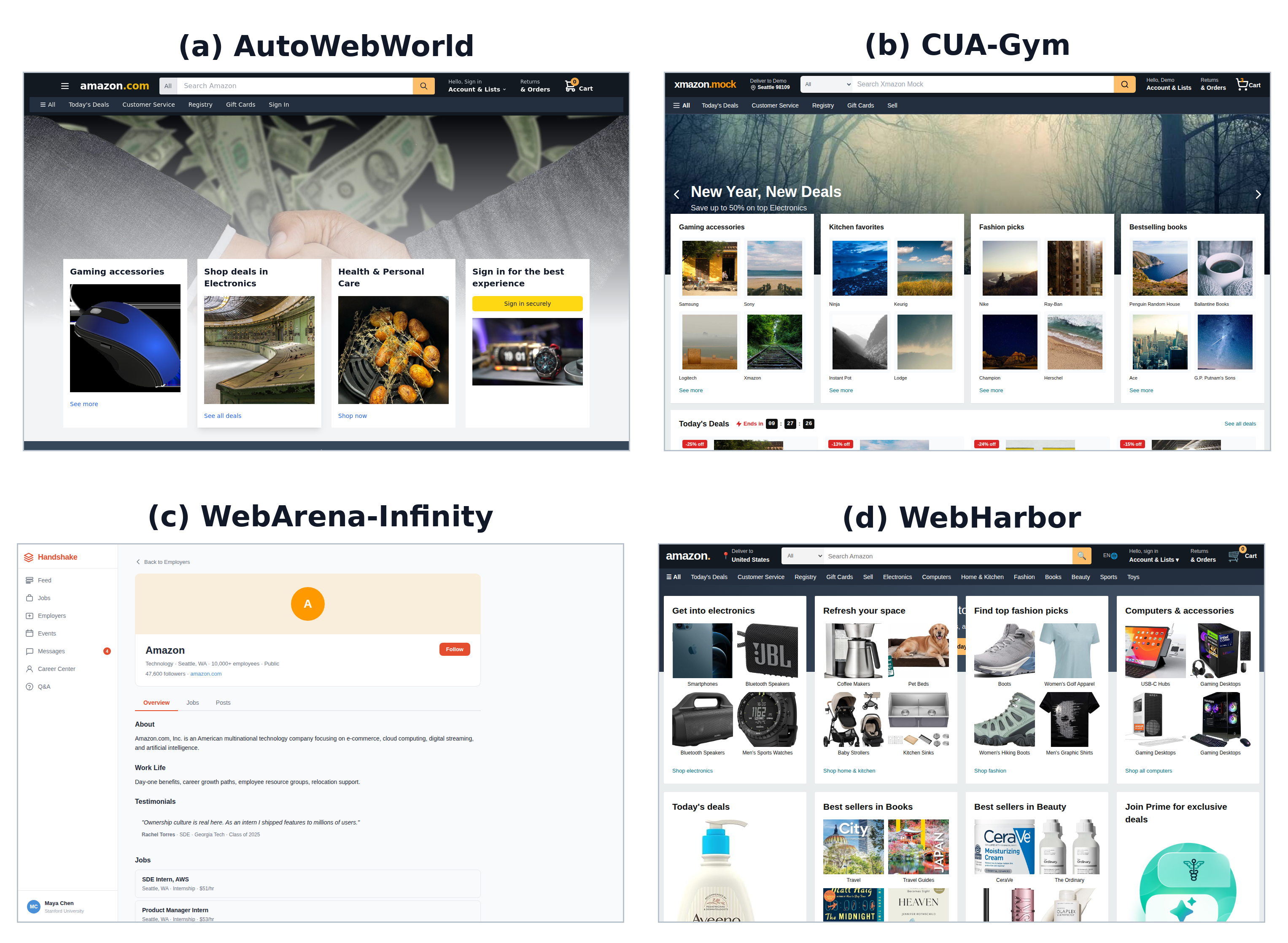
Caption: Comparison on visual fidelity. (a) AutoWebWorld captures broad Amazon cues, but its hero and card layout depart from the origin. (b) CUA-Gym recovers the storefront structure while filling product slots with generic scenery images. (c) WebArena-Infinity provides no Amazon website, its closest page is a lightweight Handshake template without images. (d) WebHarbor combines target-like navigation, dense merchandising hierarchy, and product-specific imagery, yielding the most coherent and visually faithful environment. See more cases in Appendix~app:visual-case-studies. Zoom in for details.
Why It Matters: The comparison illustrates the authors’ visual-fidelity argument with a concrete storefront example. It is qualitative evidence for one case, not a measure of functional correctness across the full suite.
fig:main
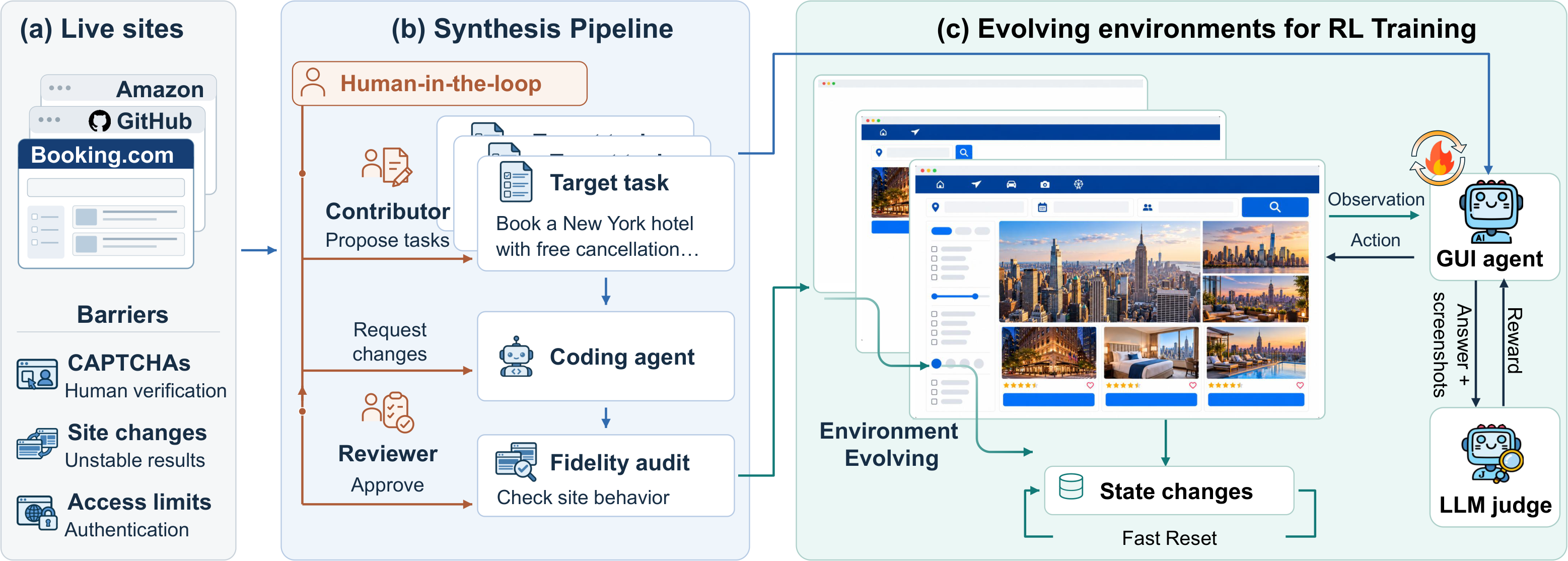
Caption: Overview of . (a) Live websites provide target interfaces and workflows but introduce access barriers. (b) Target tasks scope full-stack reconstruction, then coding agents implement and evolve each environment, while human reviewers audit visual fidelity, functional correctness, and task validity until approval. (c) Dockerized environments support deterministic and fast state resets and evidence-grounded rewards for both evaluation and RL.
Why It Matters: This figure summarizes the construction and execution workflow: tasks scope implementation, reviewers audit it, and Dockerized environments provide controlled resets.
fig:train-split-exclusion
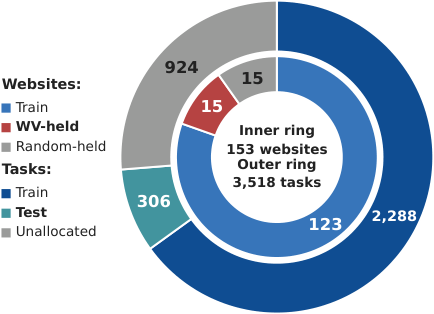
Caption: Train/test split: 123 train and 30 held-out sites (inner), and 2,288 train, 306 test, and 924 unallocated tasks (outer).
Why It Matters: It makes the site and task split explicit, which is essential context for interpreting the paper’s transfer and held-out evaluation claims.
🔮 Conclusion
WebHarbor contributes a broad offline environment suite built around task-grounded reconstruction and human review. Its 153 environments and 3,518 tasks provide controlled resets and workflows that include authentication and persistent state changes. The experiments report that RL training on the suite can transfer to held-out tasks and live-web benchmarks, with the tested 4B model outperforming the listed 4B baselines on the reported comparisons.
The evidence supports using the suite for reproducible evaluation and RL experimentation, while leaving open how results generalize to other model families, scales, and training methods. The authors also caution that replicas cannot capture all dynamics of live services and that strong synthetic-environment performance does not guarantee safe or equivalent real-world behavior.
🛠️ Future Research Improvements
The paper identifies several concrete gaps for follow-up work. First, test whether the reported RL gains persist across model families and scales: the study trains only one 4B model, so the transfer result does not establish a general scaling pattern. Second, compare alternative supervised fine-tuning data, RL algorithms, and agent harnesses, including general-purpose or CLI-based systems, to determine which gains come from the environment and which depend on the training recipe. The authors explicitly state that these comparisons were not systematic.
Evaluation could also improve its coverage of valid alternative solutions and subtle failures, which scripted verifiers and model-based judges may miss. The paper calls for more robust evaluation protocols; a practical next investigation is to audit disagreement cases and broaden human review on held-out tasks. Finally, client-heavy behavior such as interactive maps and real-time tickers is approximated or represented with static surrogates. Extending those behaviors and checking replicas against evolving target workflows would test where offline docking remains representative. These are research directions inferred from stated limitations, not results demonstrated in the paper.
🏭 Potential Industry Use Scenarios
WebHarbor’s demonstrated capabilities suggest a research and prototyping role for teams building browser agents: Dockerized replicas can support repeatable regression checks on task flows without depending on a live site’s availability or changing content. The suite’s seeded state and resets are also relevant to teams exploring agent training for workflows such as account management, bookings, purchases, and saved items, since these interactions can modify persistent state in a controlled local setting. The paper reports these as environment and training capabilities, not as deployed industry products.
For product engineering, a local replica could help reproduce agent failures, compare model or harness changes under the same initial state, and test whether an agent completes a workflow through visible UI actions. The test results include GUI and OpenCode harnesses, and their different outcomes show why harness choice should be evaluated alongside the model. Organizations would still need to validate task coverage, rights to site designs and assets, and performance on their own current services. Since the environments imitate target sites and do not fully represent personalization, external dependencies, or live dynamics, the paper does not establish production readiness or guarantee that simulated success transfers safely to users.
💬 Critical Analysis
The work’s strongest design choice is that it treats interface appearance, workflow function, and task validity as separate construction concerns. Task scoping makes a large reconstruction effort more tractable, while human review can identify defects that coding agents overlook. The authors report a substantial suite and held-out evaluation, and the 4B comparisons provide evidence beyond demonstrations of the environments themselves. The WebArena-NL results are especially relevant to the claimed coverage of authenticated workflows, though performance varies by site and drops on Reddit.
Several caveats constrain interpretation. The paper’s replicas are bounded by selected tasks and reviewer judgments; approximate interactive behavior may reduce realism for some workflows. Verifier and judge agreement is evidence of consistency between those methods, not proof that either captures every valid outcome. Live-web benchmarks also contain invalid or outdated trials, which affects comparability even when excluded trials are reported. Finally, the training evidence centers on one 4B model and a specific OpenWebRL-derived setup. The results motivate further controlled comparisons across training recipes and model scales, plus audits of failure cases and transfer to current live services. The paper appropriately frames synthetic performance as insufficient to guarantee equivalent or safe real-world behavior.