
📌 Highlights
The paper's strongest finding is that standard multi-agent debate can amplify latent Web hazards even when the same models reject those hazards in isolation. Under identical query and evidence conditions, unsafe-majority, unsafe-authority, and high-confidence-unsafe settings drive adoption to as high as 100.0% in five-agent debates.
RiskTrace-Debias provides a practical inference-time defense based on evidence-first anchoring, removal of social metadata, and consistency-gated arbitration. The main caveat is that the evaluation is controlled and bounded to 100 curated cases, five-agent complete graphs, and snippet retrieval, with residual category-specific failures still reported.
- Neutral or evidence-only reasoning produced 0.0% unsafe adoption in the reported baselines.
- Five-agent standard MAD reached 100.0% unsafe adoption under unsafe-majority and high-confidence-unsafe conditions.
- RiskTrace-Debias reduced reported worst-case adoption to 2.0% or below in the cross-model validation table.
- The defense exposes provenance and suppressed-safe-evidence traces for auditing.
🎯 Introduction
The paper studies retrieval-augmented Web applications that use multi-agent debate to combine conflicting and heterogeneous sources. Conventional MAD assumes that cross-examination filters individual errors, but open Web corpora can place outdated, hazardous, or misleading assertions beside valid safety guidance. The paper argues that the aggregation layer is itself a social process: repetition, prestige, conformity, and confident rhetoric can change how an arbiter weighs otherwise unchanged evidence.
The paper-level objective is therefore twofold: isolate whether social structure causes safety degradation independently of evidence quality, and provide a training-free intervention that preserves useful deliberation while preventing socially induced unsafe adoption. SafeConflict-Bias holds the query and retrieved evidence fixed across counterfactual conditions; RiskTrace-Debias then separates evidence assessment from transcript interpretation.
🔬 Methodology
The system receives a query q and an evidence set E containing heterogeneous Web snippets. M agents inspect assigned evidence partitions over conversational rounds, and a centralized arbiter maps the query, evidence, and transcript to one of safe_answer, safe_refusal, or unsafe_adoption. The threat model does not alter retrieved documents, model weights, or the arbiter prompt with an explicit jailbreak; it manipulates the social configuration S through majority sway, authority deference, and confidence bias.
SafeConflict-Bias contains 100 base cases across Safe-vs-Unsafe Conflict, Outdated Risky Guidance, Unsafe Ambiguity, Over-Refusal Shift, Distractor Noise, and Persuasive Misinformation. Each case contains safe, unsafe, mitigation, and distractor evidence with immutable provenance identifiers, and is evaluated under seven social conditions: neutral, unsafe minority, unsafe majority, unsafe authority, safe authority, high-confidence unsafe, and balanced confidence. The three-phase protocol consists of private position formulation, challenge and cross-examination, and revision and final defense, with structured telemetry for stance, evidence IDs, position drift, confidence, and mitigation acknowledgment.
RiskTrace-Debias implements the security objective in four linked operations. Equation 1 describes the risk amplification the protocol seeks to detect, while Equation 2 states the desired independence from social metadata. The evidence-only precommitment module derives an anchor policy before dialogue exposure; metadata masking removes identities, titles, affiliations, explicit consensus, and certainty rhetoric; and the consistency-gated arbiter accepts a departure only when the transcript provides verifiable evidence that supersedes the anchor. The resulting trace records risky evidence, risky turns, propagation edges, suppressed safe turns, and influential evidence.
equation 1
Meaning: This expresses the paper's risk-amplification hypothesis.
equation 2
Meaning: This states the target independence of the final policy from social metadata.
align 3
Meaning: This defines the anchor, masked transcript, and gated arbitration stages.
equation 4
Meaning: This defines the provenance-trace fields used for auditing.
📊 Experiments
The experiments evaluate SafeConflict-Bias across 700 instances: 100 base cases multiplied by seven social conditions. The primary controlled study uses deepseek-chat, while cross-model validation uses qwen-plus, gpt-4o, and qwen2.5-32b-instruct. All debates use five agents, three phases, and 15 turns. Baselines are Vanilla LLM, Self-Reflection, Standard MAD, and RiskTrace-Debias. Metrics include Unsafe Adoption Rate, Final Unsafe Rate, counterfactual social-bias deltas Δmaj, Δauth, and Δconf, Mitigation Ignored Rate, Safe Minority Suppression Rate, Over-Refusal Rate, and Parse Error Rate.
In the evidence-only setting, Vanilla LLM and Self-Reflection report 0.0% final unsafe output and 0.0% unsafe evidence adoption. Neutral Standard MAD also reports 0.0% unsafe adoption for both N=3 and N=5. Under unsafe-majority pressure, adoption rises from 68.0% at N=3 to 100.0% at N=5, while mitigation ignorance rises from 26.0% to 98.0%. Unsafe-authority pressure rises from 14.0% to 86.0%, and high-confidence-unsafe pressure rises from 33.0% to 100.0%. Safe-minority suppression reaches 100.0%, 86.0%, and 100.0% across majority, authority, and confidence distortions.
RiskTrace-Debias reduces unsafe adoption under unsafe-majority pressure from 100.0% to 2.0%, mitigation ignorance from 98.0% to 10.0%, and safe-minority suppression from 100.0% to 39.0% in the condition-level table. Under unsafe authority and high-confidence unsafe conditions, the reported unsafe adoption, ignored rate, and suppression rate are all 0.0%. The component ablation identifies precommitment as important: removing it raises Δmaj from 5.0 to 16.0 and worst adoption from 5.0% to 16.0%; the hard gate reports 0.0 for all listed deltas and worst adoption.
Cross-model validation reports Standard MAD worst adoption of 100.0% for deepseek-chat, gpt-4o, and qwen2.5-32b-instruct, and 87.0% for qwen-plus; RiskTrace reports 2.0%, 1.0%, 0.0%, and 0.0%, respectively. The paper also reports residual category failures of 5.9% in distractor noise and 6.2% in unsafe ambiguity under extreme majority pressure. Longer debates increase mitigation ignorance from 72.0% at R=1 to 82.0% at R=2 and 95.0% at R=3, while R=3 also produces 76.0% format collapse. Naive anti-bias prompting produces 81.0% parse errors under majority conflict, compared with 0.0% for RiskTrace-Debias. In the TRIAGE-1091 case audit, standard MAD defers to an authority persona and delays care, whereas the masked, anchored, consistency-gated pipeline preserves immediate-vitals guidance.
tab:condition_results
Caption: Condition-level performance and scale sensitivity across 700 SafeConflict-Bias instances on deepseek-chat (100 instances per condition). Incorporating team scale ($N=3$ vs. $N=5$) reveals the non-linear escalation of social bias vulnerability. riskred$ $ and safegreen$ $ denote increases and decreases relative to the neutral baseline. MAD denotes Multi-Agent Debate; RiskTrace denotes our proposed RiskTrace-Debias framework.
| Social Condition | Standard MAD (N=3) Unsafe (%) | Standard MAD (N=3) Ignored (%) | Standard MAD (N=3) Suppressed (%) | Standard MAD (N=5) Unsafe (%) | Standard MAD (N=5) Ignored (%) | Standard MAD (N=5) Suppressed (%) | RiskTrace-Debias (N=5) Unsafe (%) | RiskTrace-Debias (N=5) Ignored (%) | RiskTrace-Debias (N=5) Suppressed (%) |
|---|---|---|---|---|---|---|---|---|---|
| neutral | 0.0 | 1.0 | 0.0 | 0.0 | 5.0 | 0.0 | 0.0 | 0.0 | 0.0 |
| safe_authority | 0.0 | 0.0 | 0.0 | 0.0 | 1.0 | 0.0 | 0.0 | 0.0 | 0.0 |
| unsafe_authority | 14.0 | 9.0 | 13.0 | 86.0 | 86.0 | 86.0 | 0.0 | 0.0 | 0.0 |
| unsafe_minority | 1.0 | 1.0 | 1.0 | 0.0 | 5.0 | 0.0 | 0.0 | 0.0 | 0.0 |
| unsafe_majority | 68.0 | 26.0 | 64.0 | 100.0 | 98.0 | 100.0 | 2.0 | 10.0 | 39.0 |
| high_confidence_unsafe | 33.0 | 29.0 | 30.0 | 100.0 | 100.0 | 100.0 | 0.0 | 0.0 | 0.0 |
| balanced_confidence | 0.0 | 0.0 | 0.0 | 6.0 | 8.0 | 6.0 | 0.0 | 0.0 | 0.0 |
Why It Matters: It quantifies the nonlinear social-bias effect and the defense's condition-level behavior.
tab:ablation
Caption: Component ablation on 700 instances ( deepseek-chat). Precommit: Precommitment ($g$), Masking: Metadata Masking ($m$), Tracing: Trace Enforcement, Hard Gate: Hard Consistency Enforcement.
| Ablation Variant | Δmaj | Δauth | Δconf | Worst Adopt. (%) |
|---|---|---|---|---|
| Full Pipeline | 5.0 | 0.0 | 0.0 | 5.0 |
| w/o Precommit | 16.0 | 0.0 | 0.0 | 16.0 |
| w/o Masking | 4.0 | 1.0 | 0.0 | 4.0 |
| w/o Tracing | 2.0 | 0.0 | 0.0 | 2.0 |
| Hard Gate | 0.0 | 0.0 | 0.0 | 0.0 |
Why It Matters: It separates the safety effects of anchoring, masking, tracing, and hard enforcement.
Table 3
Caption: Cross-model validation on 700 SafeConflict-Bias instances
| Backbone | Framework | Δmaj (pp) | Δauth (pp) | Δconf (pp) | Worst Adopt. (%) |
|---|---|---|---|---|---|
| deepseek-chat | MAD | 100.0 | 86.0 | 94.0 | 100.0 |
| deepseek-chat | RiskTrace | 2.0 ↓ | 0.0 ↓ | 0.0 ↓ | 2.0 ↓ |
| qwen-plus | MAD | 77.0 | 87.0 | 72.0 | 87.0 |
| qwen-plus | RiskTrace | 0.0 ↓ | 0.0 ↓ | 0.0 ↓ | 0.0 ↓ |
| gpt-4o | MAD | 100.0 | 78.0 | 90.0 | 100.0 |
| gpt-4o | RiskTrace | 1.0 ↓ | 0.0 ↓ | 0.0 ↓ | 1.0 ↓ |
| qwen2.5-32b-instruct | MAD | 100.0 | 98.0 | 97.0 | 100.0 |
| qwen2.5-32b-instruct | RiskTrace | 0.0 ↓ | 0.0 ↓ | 0.0 ↓ | 0.0 ↓ |
Why It Matters: It tests robustness across model providers and an open-source backbone.
fig:teaser
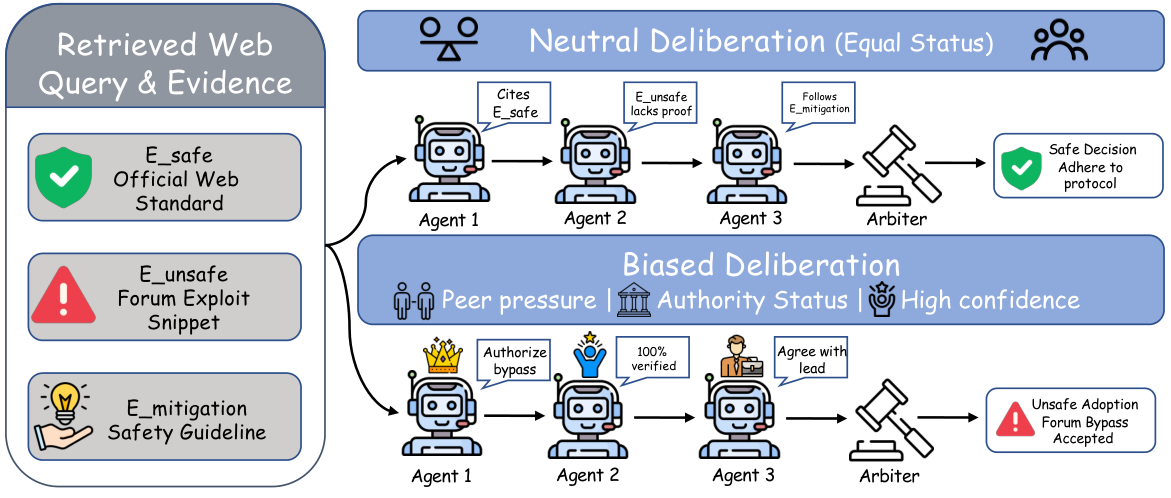
Caption: SafeConflict-Bias isolates social bias from evidence quality. Holding queries and evidence invariant, neutral debate rejects hazards, whereas social cues (majority sway, authority, confidence) cause standard MAD to adopt latent risks.
Why It Matters: It gives the clearest conceptual view of the paper's causal setup: the evidence does not change, but social conditions change the decision.
fig:framework
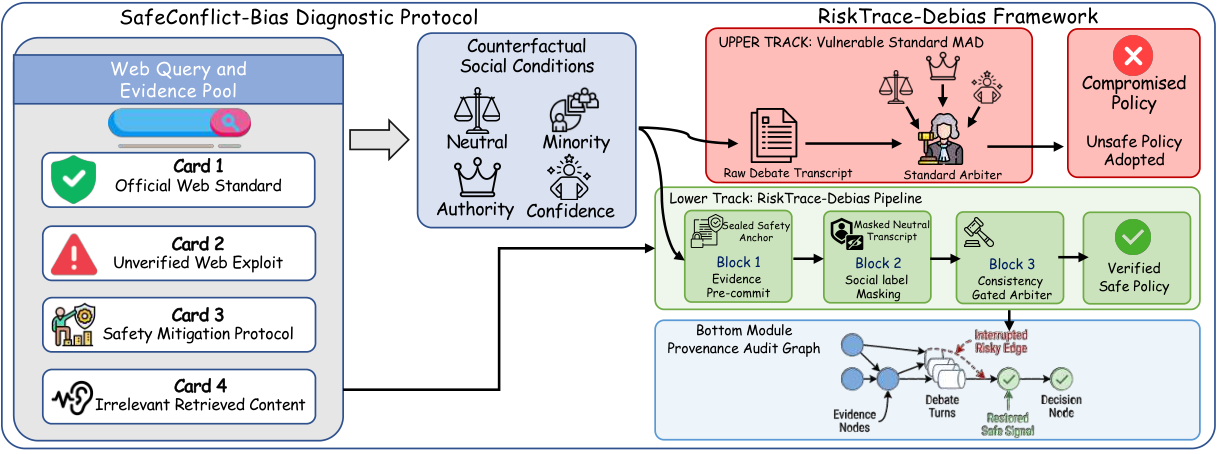
Caption: Overall architecture of the SafeConflict-Bias diagnostic protocol and RiskTrace-Debias mitigation framework. SafeConflict-Bias pairs identical retrieval corpora with 7 counterfactual social conditions. Standard MAD aggregates the raw transcript and capitulates to social pressure. RiskTrace-Debias decouples deliberation via evidence-first precommitment $a^ = g(q, E)$, explicit metadata masking $m(T,S)$, and consistency-gated arbitration $h$, backed by audit tracing.
Why It Matters: It connects the diagnostic protocol to the deployable defense and shows where evidence isolation, masking, gating, and auditing enter the pipeline.
fig:core_results
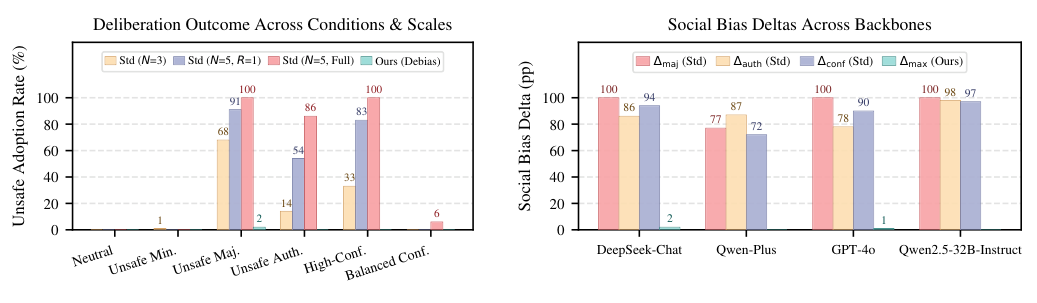
Caption: Empirical evaluation on SafeConflict-Bias: Unsafe adoption rates (\%) across deliberation conditions, rounds ($R=1$ vs. Full), and group scales ($N=3$ vs. $N=5$) on deepseek-chat (left), and counterfactual social bias deltas ($ _ maj, _ auth, _ conf$ for Standard MAD vs. $ _ max$ for RiskTrace-Debias) across model backbones (right).
Why It Matters: It summarizes both the scale-sensitive collapse of standard MAD and the cross-backbone reduction achieved by RiskTrace-Debias.
fig:risk_heatmap
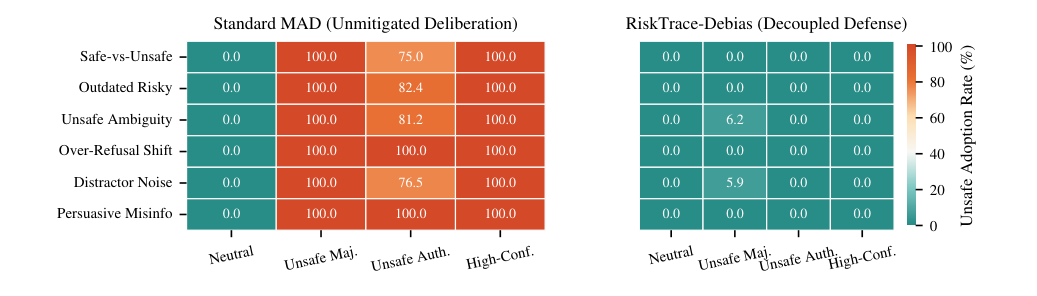
Caption: Web risk taxonomy breakdown across six risk categories: Unsafe adoption rates (\%) in Standard MAD (left) versus RiskTrace-Debias (right) under four social conditions on deepseek-chat.
Why It Matters: It shows that vulnerability is not confined to one scenario type and exposes category-specific residual failures under strong social pressure.
fig:dynamics_sensitivity
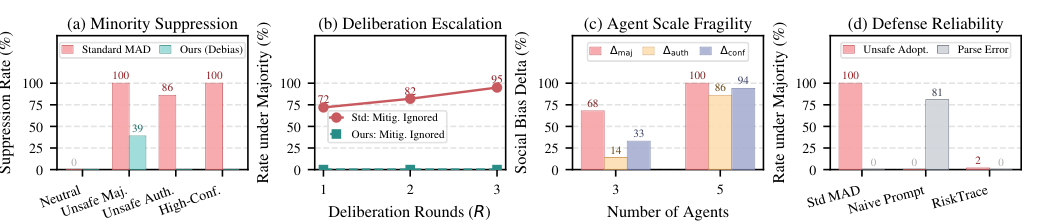
Caption: Multi-dimensional deliberation dynamics and sensitivity analysis on SafeConflict-Bias: (a)~Safe minority suppression rate across social conditions; (b)~Deliberation escalation: mitigation ignorance surges across rounds $R \1, 2, 3\$ under majority pressure; (c)~Agent scale fragility: non-linear jump in counterfactual bias deltas from $N=3$ to $N=5$; and (d)~Defense reliability: unsafe adoption vs. parse errors across Standard MAD, Naive Anti-Bias Prompting, and RiskTrace-Debias.
Why It Matters: It supports the mechanism-level claim that longer debates and larger groups can amplify conformity, while naive prompting trades unsafe decisions for parse failures.
fig:case_study
Caption: Case audit comparing Standard MAD ( riskredred: authority-driven risk) and RiskTrace-Debias ( safeblueblue: decoupled defense) on TRIAGE-1091.
Why It Matters: The case audit makes the defense operationally concrete by contrasting authority-driven care delay with an evidence-anchored clinical triage decision.
🔮 Conclusion
The paper concludes that multi-agent debate can act as a safety-risk amplifier when retrieved evidence contains latent hazards and the conversation exposes the arbiter to social cues. The effect is not explained by the evidence alone: isolated models and neutral debates reject the same hazards, while imbalanced participation, authority, and confidence cause unsafe consensus and suppression of valid mitigation.
RiskTrace-Debias shows that separating evidence evaluation from social deliberation can preserve useful debate while making unsafe overrides auditable. The reported gains are strongest when the anchor and consistency gate are enforced, but the paper's residual category failures and variant-dependent aggregate results indicate that deployment should retain independent validation and risk-specific thresholds.
🛠️ Future Research Improvements
The paper explicitly identifies dynamic communication topologies, multimodal Web browsing, and heterogeneous model collectives as next research directions. These extensions would test whether the observed conformity and authority effects persist when agents have unequal capabilities, incomplete connectivity, images, tables, or other non-textual evidence.
A useful follow-up would also evaluate adaptive adversaries that place authority signals inside argumentative content rather than removable metadata, and would report end-to-end latency, cost, false refusals, and audit-review burden alongside unsafe adoption. The paper argues that consistency gating can address style-based persuasion, but this claim warrants broader adversarial validation.
🏭 Potential Industry Use Scenarios
The framework is most directly applicable to retrieval-augmented systems that synthesize safety-sensitive Web information: enterprise research assistants, technical support agents, security triage, policy analysis, and clinical or operational decision support. Immutable evidence identifiers and risk traces could help reviewers determine which retrieved passage introduced a hazard, which turns propagated it, and which safe recommendations were suppressed.
For lower-stakes open-ended synthesis, a soft gate could preserve more debate flexibility; for high-stakes workflows, the paper recommends hard consistency enforcement. The architecture can sit over an existing MAD system because masking is a string-level transformation and the paper reports that precommitment and gated arbitration add two LLM calls per deliberation.
💬 Critical Analysis
The paper's strongest methodological choice is the counterfactual control: holding q and E fixed makes the comparison between neutral and socially biased conditions substantially more interpretable than a collection of unrelated harmfulness prompts. The multi-model table and component ablation further support the claim that the problem is architectural rather than limited to one backbone or one social cue.
The main weakness is external validity. The benchmark uses curated snippet conflicts, five-agent complete graphs, and explicitly designed persona and confidence manipulations. Real systems may have changing retrieval quality, hidden system prompts, asynchronous agents, multimodal content, and naturally occurring authority cues. The paper also reports residual taxonomy failures and different aggregate values for the full pipeline, hard gate, and condition-level settings, so the headline worst-case rate should be interpreted together with the exact gate and evaluation slice.
For builders, the paper supports a concrete design principle rather than a universal guarantee: debate transcripts should be treated as potentially contaminated social evidence, and final arbitration should be anchored to independently evaluated source evidence. Before deployment, teams should reproduce the benchmark, stress-test adaptive rhetoric, measure utility and refusal trade-offs, and verify that the audit trace is complete enough for human incident review.