
📌 Highlights
FlowTranslator replaces the learned scene-text renderer in an IIMT cascade with region-masked flow editing over a frozen text-to-image model. Its central technical observation is that ordinary coupled flow editing can remain at a near-zero displacement when the editable text region occupies only a small part of the image.
The paper reports average PRIM BLEU 20.6 and COMET 57.2, compared with 12.8 and 50.7 for UniTranslator, and ScenePair English-to-Chinese exact-match accuracy of 40.08%. The main limitation is script coverage: the frozen backbone performs poorly on Cyrillic text.
- Training-free IIMT with no task-specific parameter updates.
- RCR releases target-branch noise coupling early in the trajectory.
- CE amplifies the nascent edit during the middle of the trajectory.
- Strongest reported gains occur on photographed PRIM strips and whole-image ScenePair scenes.
🎯 Introduction
In-image machine translation must translate text embedded in an image and render the result back into the original regions while preserving the surrounding scene. Existing cascades use OCR, machine translation, and a rendering module, but rule-based removal and pasting can create seams, typography mismatches, and texture damage. Learned scene-text editors improve blending but require paired cross-lingual images or synthetic text composites.
FlowTranslator asks whether a frozen multilingual text-to-image model can perform the rendering stage without IIMT fine-tuning. The paper argues that inversion-free flow editing provides the required mechanism, but ordinary FlowEdit assumes a sufficiently large source–target velocity difference. Small, localized text edits violate that assumption, motivating mask-confined RCR and CE controls.
- Benchmarks cover synthetic and real imagery across seven languages and nine translation directions.
- The main objective is to transfer multilingual text rendering capability from a frozen T2I flow model to complete IIMT.
🔬 Methodology
The pipeline first extracts text boxes and strings with OCR, then asks a frozen LLM to produce matched source and target scene descriptions. A frozen VAE encodes the source image, and the OCR boxes are dilated and rasterized into the latent mask defined by equation 1. The same frozen DiT evaluates source- and target-conditioned velocities, while equation 2 updates only masked latent positions.
RCR addresses the root cause of the ignition failure by replacing perfect target/source noise correlation with scheduled partial decorrelation inside the mask. CE then feeds the accumulated displacement back into the target branch using a middle-trajectory sin^2 gate. RCR supplies room for divergence; CE supplies directional positive feedback. Neither control adds forward passes, and unmasked latents remain unchanged.
- Backbone: Z-Image-Turbo, a distilled 6B flow-matching T2I model.
- Reported settings: T=50 solver steps, n_max=45, gamma=1.3, 15% mask dilation, RCR kappa=0.5, CE c=0.4.
- The image is resized to a long side of 1024 with dimensions rounded to multiples of 16.
equation 1
Meaning: Creates the latent-resolution editable mask from dilated OCR boxes.
equation 2
Meaning: Defines the masked FlowEdit update driven by the difference between source- and target-conditioned velocities.
equation 3
Meaning: Controls the scheduled partial decorrelation of target-branch noise for RCR.
equation 4
Meaning: Applies the RCR perturbation only in the text mask.
📊 Experiments
The evaluation uses TTV, PRIM, and ScenePair. TTV contains 5,122 synthetic text images built from IWSLT14/17 and evaluates De→En, En→De, Fr→En, and Ro→En. PRIM contains photographed real-world 512 × 46 text strips and evaluates En→De, En→Fr, En→Cs, En→Ru, and En→Ro with 340 images per direction. ScenePair contains 1,280 real scene photographs and evaluates whole-image En→Zh translation with fixed text boxes and target translations.
For TTV and PRIM, edited text is read back with EasyOCR v1.7, scored with lowercased sacreBLEU and COMET, and compared with source-image SSIM where reported. ScenePair uses PP-OCRv6 exact-match accuracy and SSIM. On TTV, FlowTranslator obtains average BLEU 23.19 versus 21.17 for UniTranslator, but SSIM 0.746 versus 0.805. On PRIM, it obtains average BLEU 20.6 and COMET 57.2, while En→Ru remains weak at 4.6 BLEU and 43.9 COMET.
The ablations support the proposed mechanism. On PRIM, Masked FlowEdit reaches 16.88 BLEU, RCR alone 17.40, CE alone 20.21, and RCR+CE 20.57. Changing the edit window from the default 45 steps to 43 reduces BLEU to 18.95, while 48 steps reduces it to 14.99. On ScenePair, the controls raise exact-match accuracy from 33.44% to 40.08% while SSIM changes from 0.9533 to 0.9509.
- TTV: highest average BLEU among the listed systems, with the weakest direction En→De at 17.15 BLEU.
- PRIM: highest reported average BLEU and COMET, with the largest improvement over the masked baseline.
- ScenePair: 40.08% exact-match accuracy on real photographs translated into Chinese.
- CE provides most of the PRIM ablation gain; RCR adds a smaller complementary improvement.
tab:ttv
Caption: TTV benchmark with EasyOCR read-back and lowercased sacreBLEU. ``IIMT-tuned'' marks systems trained or fine-tuned on IIMT data. GPT-Image-1 and Qwen-Image are zero-shot prompted unified models. ``Masked FlowEdit'' is our baseline with identical hyperparameters and the trajectory controls disabled. Average columns are unweighted means over the four directions. For each metric, best in bold, second underlined.
| Model | IIMT-tuned | De→En | En→De | Fr→En | Ro→En | BLEU↑ | SSIM↑ |
|---|---|---|---|---|---|---|---|
| GPT-Image-1 | 20.75 | 19.61 | 27.38 | 24.50 | 23.06 | 0.734 | |
| Qwen-Image | 0.23 | 0.21 | 0.20 | 0.22 | 0.22 | 0.785 | |
| OCR+MT+T2I | ✓ | 15.37 | 13.22 | 21.60 | 18.34 | 17.13 | 0.771 |
| PEIT+T2I | ✓ | 10.91 | 8.77 | 18.51 | 14.54 | 13.18 | 0.769 |
| Translatotron-V | ✓ | 15.39 | 13.23 | 22.20 | 18.44 | 17.32 | 0.776 |
| UniTranslator | ✓ | 25.03 | 13.41 | 27.77 | 18.45 | 21.17 | 0.805 |
| Masked FlowEdit | 24.43 | 17.53 | 26.89 | 22.84 | 22.92 | 0.754 | |
| FlowTranslator (Ours) | 25.15 | 17.15 | 27.07 | 23.37 | 23.19 | 0.746 |
Why It Matters: The table shows strong TTV text recovery but lower structural similarity than the strongest IIMT-tuned systems.
tab:prim
Caption: PRIM benchmark with EasyOCR read-back. BLEU uses both official reference sets, while COMET uses the Google references. Averages are computed from unrounded per-direction scores.
| Model | IIMT-tuned | En→De | En→Fr | En→Cs | En→Ru | En→Ro | BLEU↑ | COMET↑ |
|---|---|---|---|---|---|---|---|---|
| PARSeq-mT-Render | ✓ | 9.5 / 41.7 | 13.8 / 46.9 | 7.7 / 43.9 | 5.5 / 48.1 | 12.8 / 53.5 | 9.9 | 46.8 |
| PEIT-Render | ✓ | 10.4 / 45.1 | 14.0 / 48.1 | 7.9 / 46.2 | 5.3 / 47.7 | 14.2 / 52.9 | 10.4 | 48.0 |
| Translatotron-V | ✓ | 1.7 / 34.3 | 1.9 / 30.2 | 1.1 / 30.5 | 0.9 / 32.0 | 1.3 / 33.9 | 1.4 | 32.2 |
| VisTrans | ✓ | 12.6 / 44.4 | 17.0 / 49.4 | 5.9 / 41.8 | 7.2 / 49.4 | 13.9 / 50.2 | 11.3 | 47.0 |
| UniTranslator | ✓ | 13.1 / 48.7 | 21.6 / 58.5 | 7.4 / 43.3 | 8.4 / 50.2 | 13.5 / 52.8 | 12.8 | 50.7 |
| Masked FlowEdit | 29.9 / 56.7 | 24.6 / 57.7 | 15.5 / 56.9 | 2.2 / 41.1 | 12.3 / 54.3 | 16.9 | 53.3 | |
| FlowTranslator (Ours) | 35.2 / 63.0 | 28.5 / 60.3 | 19.8 / 61.1 | 4.6 / 43.9 | 14.9 / 57.4 | 20.6 | 57.2 |
Why It Matters: It is the clearest quantitative evidence that the controls transfer to photographed text strips and outperform the listed trained and training-free baselines on average.
tab:scenepair
Caption: ScenePair En$ $Zh whole-image translation on 1,280 real scenes. All methods share the same text boxes and target translations. ``STE-tr.'' marks scene-text-editing training and ``Zh'' native Chinese glyph support. Rows without ``Zh'' are capability diagnostics rather than head-to-head competitors.
| Model | STE-tr. | Zh | ACC↑ | SSIM↑ |
|---|---|---|---|---|
| TextDiffuser | ✓ | 0.00 | 0.9434 | |
| DiffSTE | ✓ | 0.23 | 0.9796 | |
| AnyText | ✓ | ✓ | 36.80 | 0.8157 |
| TextFlux | ✓ | ✓ | 14.30 | 0.9506 |
| FLUX.1-Fill | 0.39 | 0.9231 | ||
| FLUX.1-Kontext | 0.00 | 0.4273 | ||
| Masked FlowEdit | 33.44 | 0.9533 | ||
| FlowTranslator (Ours) | 40.08 | 0.9509 |
Why It Matters: It measures whole-image text replacement under common boxes and translations, where FlowTranslator reaches the highest exact-match accuracy in the table.
fig:method-comparison
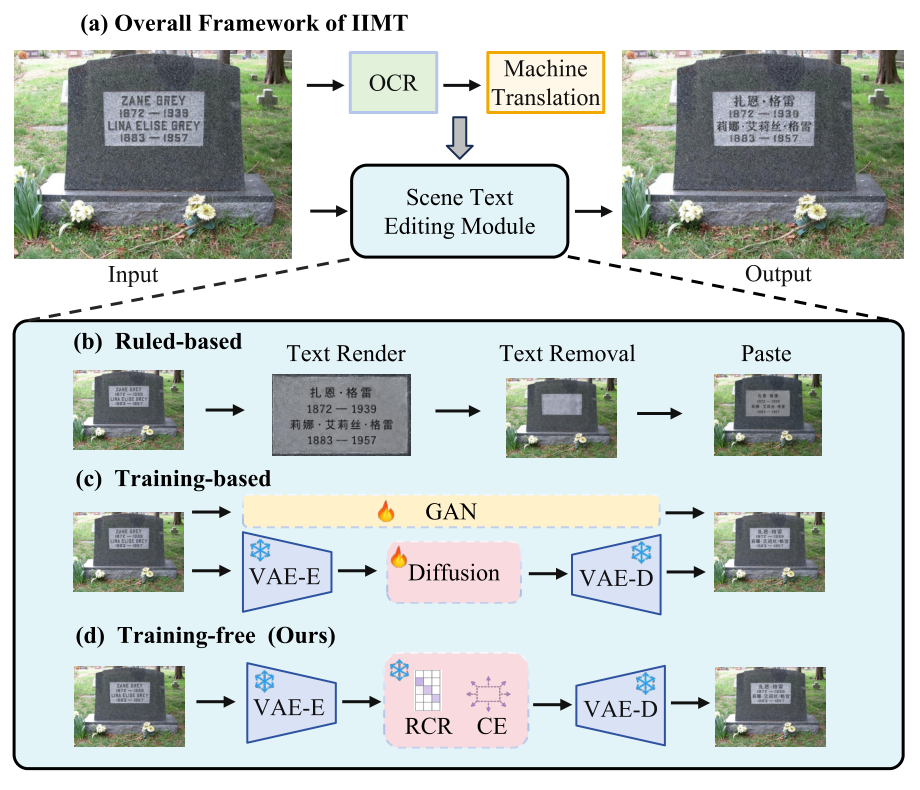
Caption: Overview of the IIMT framework and editor paradigms. (a) The pipeline: OCR extracts text → a translator produces the translation → a scene text editor generates the output image. (b) Rule-based: remove, render, and paste separately. (c) Training-based: a learned GAN or diffusion editor (requires extra training). (d) FlowTranslator (ours): training-free flow editing with trajectory controls (CE and RCR) for text translation with background preservation.
Why It Matters: It positions FlowTranslator within the standard OCR–translation–rendering cascade and contrasts its frozen flow-editing renderer with rule-based and trained alternatives.
fig:pipeline
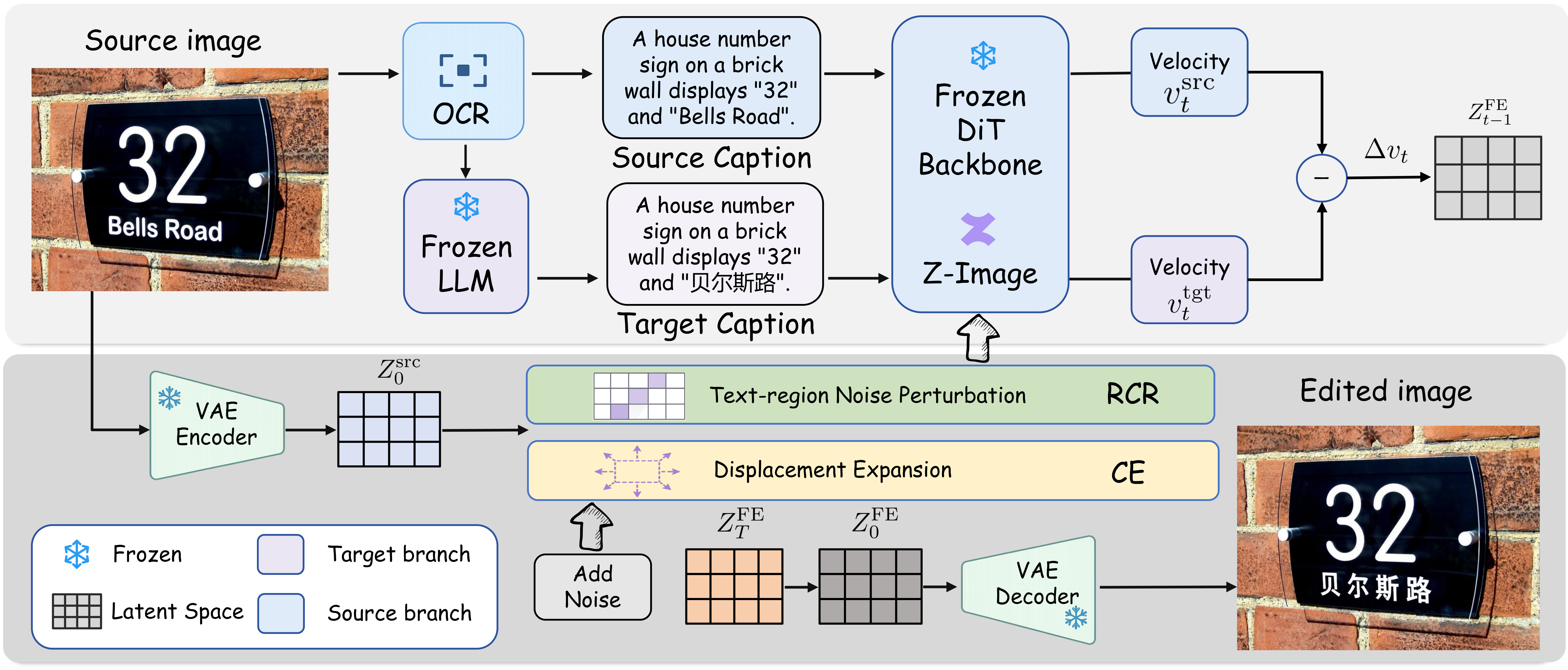
Caption: Overview of FlowTranslator. OCR extracts the source text and forms a source caption, while a frozen LLM translates it to obtain the target caption. A frozen VAE encodes the source image into $Z^src_0$, from which noise initialization produces $Z^FE_T$. At each editing step, the same frozen DiT predicts source- and target-conditioned velocities. Their difference updates the flow-editing latent. RCR perturbs the target-branch noise within the detected text region, and CE amplifies the accumulated displacement before it is fed back to the target branch. The final latent $Z^FE_0$ is decoded to produce the translated image.
Why It Matters: It exposes the full implementation path from OCR and LLM captioning through masked latent editing and final image decoding.
fig:ttv-qualitative
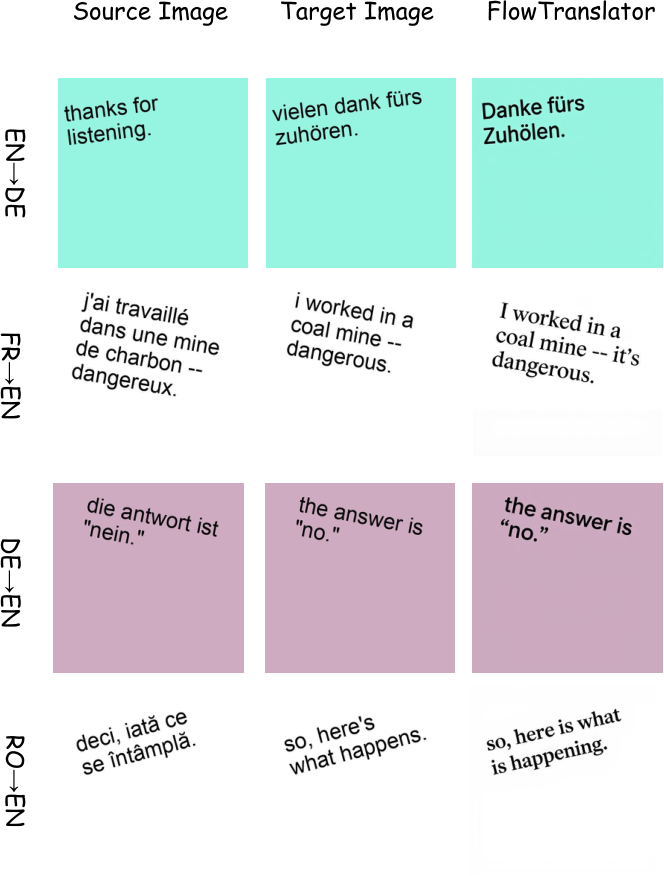
Caption: Qualitative results on TTV. Each row shows the source image, the benchmark target image, and the FlowTranslator output for one translation direction. The examples cover EN$ $DE, FR$ $EN, DE$ $EN, and RO$ $EN.
Why It Matters: It provides visual evidence that translated text can be rendered with similar layout and appearance while retaining the source background across four TTV directions.
fig:scenepair-comparison
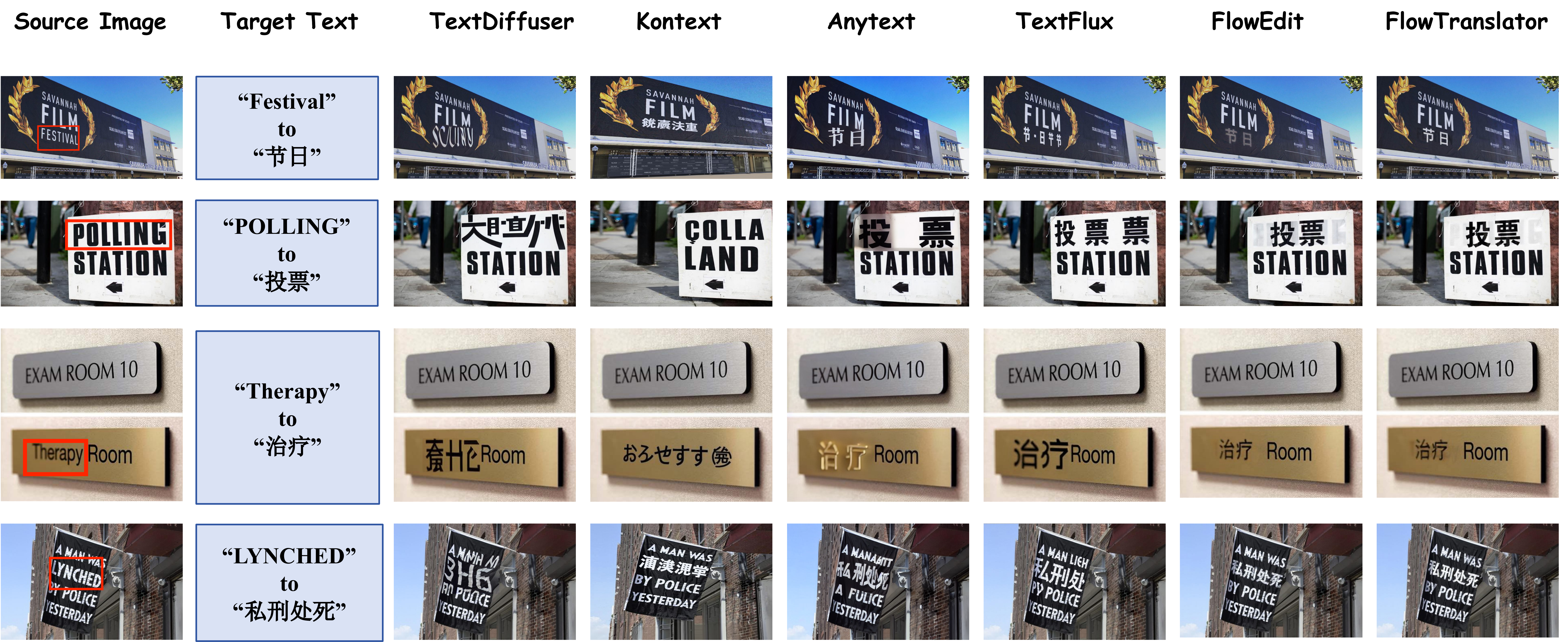
Caption: Qualitative comparison on whole-image ScenePair En→Zh translation. For each example, we show the source image (with red boxes marking text to be translated), the requested target text, and outputs of existing open-source methods, followed by FlowTranslator. FlowTranslator renders the requested Chinese text within the original region. It preserves both the surrounding scene and the local text appearance.
Why It Matters: It compares whole-image Chinese text replacement across editing systems and illustrates the claimed preservation of scene context and local text appearance.
🔮 Conclusion
The paper concludes that a frozen text-to-image flow model can serve as a competitive IIMT renderer when its branch coupling is adapted to the text-minority regime. RCR and CE resolve the localized edit ignition problem without task-specific training or additional forward passes. The reported results are strongest on PRIM and ScenePair, while TTV shows that the method can achieve high text recovery with some reduction in SSIM.
The central practical takeaway is that flow-based editing can provide a strong training-free baseline for IIMT, but its effectiveness is bounded by the language and glyph coverage of the underlying frozen generator.
- PRIM average BLEU: 20.6.
- PRIM average COMET: 57.2.
- ScenePair exact-match accuracy: 40.08%.
- Cyrillic rendering remains an explicit failure case.
🛠️ Future Research Improvements
The paper explicitly identifies broader script support as the next direction because En→Ru rendering inherits weaknesses from the frozen backbone. A useful follow-up would compare multiple flow-matching backbones with controlled script coverage rather than treating multilingual capability as a fixed property.
Further work should evaluate the complete IIMT pipeline with naturally occurring OCR and translation errors, report inference latency and memory use, and test more varied scene layouts, text densities, and resolutions. These evaluations would clarify whether the gains remain when the upstream inputs are not fixed by the benchmark protocol.
- Improve native rendering for Cyrillic and other underrepresented scripts.
- Measure end-to-end OCR, translation, and rendering error propagation.
- Study adaptive mask dilation and edit-window selection by text size and script.
- Report throughput, latency, and VRAM requirements for deployment.
🏭 Potential Industry Use Scenarios
The paper's task definition directly supports mobile photo translation, localized signage, and product imagery. A training-free renderer could be useful when a product must translate text across many languages without collecting paired before-and-after images for every language direction.
For production use, the system would need safeguards for OCR omissions, ambiguous translations, unsupported scripts, and visually sensitive edits. Human review or confidence-based fallback would be especially important for signage, packaging, and safety-critical instructions because the reported benchmarks isolate rendering in some settings and do not establish end-to-end reliability.
- On-device or cloud-assisted photo translation for signs and documents.
- Localization of product packaging and retail imagery.
- Multilingual editing of user-generated images where paired training data is unavailable.
- Visual content workflows requiring preservation of scene context and text-region appearance.
💬 Critical Analysis
The strongest aspect of FlowTranslator is the alignment between its mechanism and ablations: CE produces most of the PRIM improvement, RCR adds a complementary increment, and the edit-window study shows a clear under-editing versus over-editing tradeoff. The same controls also improve ScenePair exact-match accuracy, supporting the claim that they address a localized ignition problem rather than only a benchmark-specific artifact.
The evidence should nevertheless be interpreted carefully. TTV gains over Masked FlowEdit are small, SSIM is lower than several trained systems, En→Ru exposes a major script limitation, and EasyOCR read-back mixes rendering quality with recognizer behavior. ScenePair's fixed boxes and translations make the rendering comparison cleaner but leave open how the system behaves when OCR and LLM translation are imperfect. The method is therefore a compelling training-free rendering baseline, but not yet evidence of robust multilingual end-to-end deployment.
- Ablations support the proposed mechanism rather than only reporting aggregate gains.
- Cross-benchmark improvements are not uniform; the largest gains occur in harder small-text photographic settings.
- The frozen-backbone assumption improves data efficiency but transfers its script and visual-generation weaknesses directly to the application.
- The benchmark protocols provide strong rendering evidence but limited evidence about upstream pipeline robustness.