
📌 Highlights
The paper's central claim is that a research field can be modeled as an actionable dynamical system rather than only as a sequence of bibliometric observations. Its strongest evidence is the combination of held-out forecasting, natural-experiment validation, field-scale paired simulations, and a grounded natural-language interface.
- The model reads 1.20 million power-engineering abstracts and forms a typed hypergraph with 204,287 concepts after deduplication.
- The growth forecaster beats both tuned baselines in 13 of 15 unseen evaluation cells and has top-minus-bottom realized-growth decile medians of +0.32 versus +0.27 and +0.23.
- For December 2019, the top 100 all-unlinked pairs formed within 24 months at 72% versus a 1.75% base rate; under the stricter new-pair test, 50% formed within 24 months and 92% by March 2026.
- On 186 blind intervention bursts, predicted effects correlated with realized effects at r = 0.557, while natural-language answers on 215 new questions received 4.13 of 5 for faithfulness and 90% claim support.
- The main caveat is that effect rankings and directions are stronger than effect-size calibration, and many extrapolated or out-of-registry actions remain unvalidated.
🎯 Introduction
Power-engineering research shapes infrastructure that is long-lived, capital-intensive, and coupled to many economic sectors. The paper argues that decisions about research direction are difficult because interventions happen once, the foreclosed trajectory is never observed, and conventional expert elicitation and bibliometric indicators are retrospective. Existing forecasting work predicts topic growth or new concept links but extrapolates a single trajectory and does not learn how a field responds to interventions.
The paper therefore defines a research world model whose state is a typed concept hypergraph and latent embedding, whose transition is learned from the publication record, and whose actions include research interventions such as bursts of papers, new terms, or method adoption. The objective is to test whether this state forecasts concept growth and new links, whether operators recover effects in held-out natural experiments, whether the training scheme transfers to semiconductors and materials science, and whether natural-language questions can be compiled without delegating computation to a language model.
🔬 Methodology
The corpus contains 1,196,720 power-engineering abstracts harvested from 33 OpenAlex topics, reduced by deduplication to 1,142,498 papers. The reader extracts concepts with five roles—problem, method, object, setting, and metric—and their typed relations. The state also includes role-specific counts, typed edges, citation attention, external supply from 58.5 million papers in seven other OpenAlex fields, and time-respecting concept text embeddings. The growth and link cores process the 100,000 most active concepts in eight graph snapshots spaced six months apart, using message passing followed by a temporal transformer.
Growth heads forecast log growth at 12, 24, 36, and 60 months. The link core adds a gated graph stream, a typed-link head, concept text, and a residual pair scorer; a single readout scores all 15 combinations of the five concept roles. Operators then apply or estimate actions: entity insertion forecasts a term with no history, observation assimilation updates a term after papers appear, event readout predicts single-paper outcomes, intervention estimates burst effects, and the transition operator rolls the whole field forward in six-month negative-binomial steps. A fine-tuned Qwen3.8-27B decoder routes registered actions or compiles novel questions into programs over six state primitives, while the executor runs scenario and baseline simulations with shared random numbers.
The formal abstraction is the state transition S_{t+1} = T(S_t, a_t). In implementation, S_t is the typed hypergraph plus learned concept states, T is represented by the trained transition machinery and operators, and a_t encodes an intervention. This factorization is important because numerical effects are produced by the executor, while language models are restricted to question compilation and grounded answer writing.
Equation 1
Meaning: The research world model advances a latent field state S_t through a learned transition T under an action or intervention a_t. The same transition supports ordinary forecasts when the action is absent and counterfactual simulations when an action is injected.
📊 Experiments
The main dataset is the cleaned power-engineering OpenAlex corpus, with citation events and external-supply terms from seven other OpenAlex fields. Replication tests use semiconductors and materials science. Forecast evaluation uses walk-forward cutoffs from December 2013 to December 2021, with Spearman correlation over the 1,000 most active concepts for growth and typed average precision for links. Baselines include default, horizon-matched, and tuned LightGBM, a tuned multilayer perceptron, 11 link-prediction baselines, Adamic–Adar, and zero-shot Qwen3.8-27B.
For concept growth, the forecaster beats both tuned baselines in 13 of 15 unseen cells, exceeds tuned LightGBM in all 19 cells, and gives a top-minus-bottom decile median of +0.32 versus +0.27 for the tuned perceptron and +0.23 for LightGBM. Its top-100 enrichment is higher in 37 of 38 comparisons. For link forecasting, the December 2019 top 100 among roughly 2.05 million all-unlinked pairs achieve 72% precision within 24 months against a 1.75% base rate; on strict new pairs, precision is 50% within 24 months and 92% by March 2026.
Operator tests use held-out natural experiments. On 186 blind intervention bursts, the intervention operator reaches r = 0.557 against realized effects, equal to 0.78 of the noise ceiling; across 574 test bursts, predicted-sign rates increase from 55% to 87% on the method side and from 63% to 80% on the target side across effect-size thirds. The entity-insertion operator improves over its structural prior by +0.085 to +0.226 in Spearman correlation, while observation assimilation reaches 0.66 after one year. The natural-language interface routes 449 new questions exactly at 0.878 versus 0.768 for a general-purpose language model, and its answers on 215 new questions score 4.13 of 5 for faithfulness with 90% of claims supported.
Field-scale simulations evaluate 25 candidate directions, of which 19 meet the robustness criterion across mechanism families and validation origins. Moving papers to first-time method–target pairs produces 2.8 times as many five-year growers as equal-dose repackaging at the 2019 origin; a machine-generated flood lowers field entropy by 0.47 at five years from December 2025, while doubled computer-science inflow raises it by 0.25 at ten years. The prospective forecast covers 20,740 active concepts and predicts a +5.2 percentage-point share increase for the machine-learning-forecasting region by 2030, with large language models and quantum computing reaching 3.6 and 2.2 times their 2025 output, respectively.
Table 1
Caption: Forecasting new method–target links
| Evaluation subset | Method | December 2015 within 24 months | December 2015 by March 2026 | December 2019 within 24 months | December 2019 by March 2026 |
|---|---|---|---|---|---|
| All unlinked pairs, precision at 100 (%) | Link readout, horizon-specific link cores | 49 [39, 59] | 88 [82, 94] | 72 [63, 81] | 91 [85, 96] |
| All unlinked pairs, precision at 100 (%) | Link readout, default-scheme link cores | 55 [45, 64] | 91 [85, 96] | 67 [58, 76] | 87 [80, 93] |
| All unlinked pairs, precision at 100 (%) | Adamic–Adar | 30 [22, 39] | 71 [62, 79] | 23 [15, 31] | 51 [41, 61] |
| All unlinked pairs, base rate | Base rate | 1.40 | 6.80 | 1.75 | 5.47 |
| All unlinked pairs, enrichment (×) | Enrichment, horizon-specific link cores | 35.0 | 12.9 | 41.1 | 16.6 |
| New pairs, precision at 100 (%) | Link readout, horizon-specific link cores | 36 [26, 45] | 89 [82, 95] | 50 [41, 59] | 92 [86, 97] |
| New pairs, precision at 100 (%) | Link readout, default-scheme link cores | 29 [21, 38] | 83 [75, 90] | 42 [33, 52] | 85 [78, 92] |
| New pairs, precision at 100 (%) | Adamic–Adar | 18 [11, 26] | 56 [46, 66] | 15 [8, 23] | 40 [30, 50] |
| New pairs, base rate | Base rate | 0.81 | 4.63 | 1.02 | 3.59 |
| New pairs, enrichment (×) | Enrichment, horizon-specific link cores | 44.4 | 19.2 | 49.0 | 25.6 |
Why It Matters: The table gives the clearest numeric comparison for unseen method–target link discovery, including confidence intervals, base rates, and enrichment at both historical cutoffs.
Figure 1
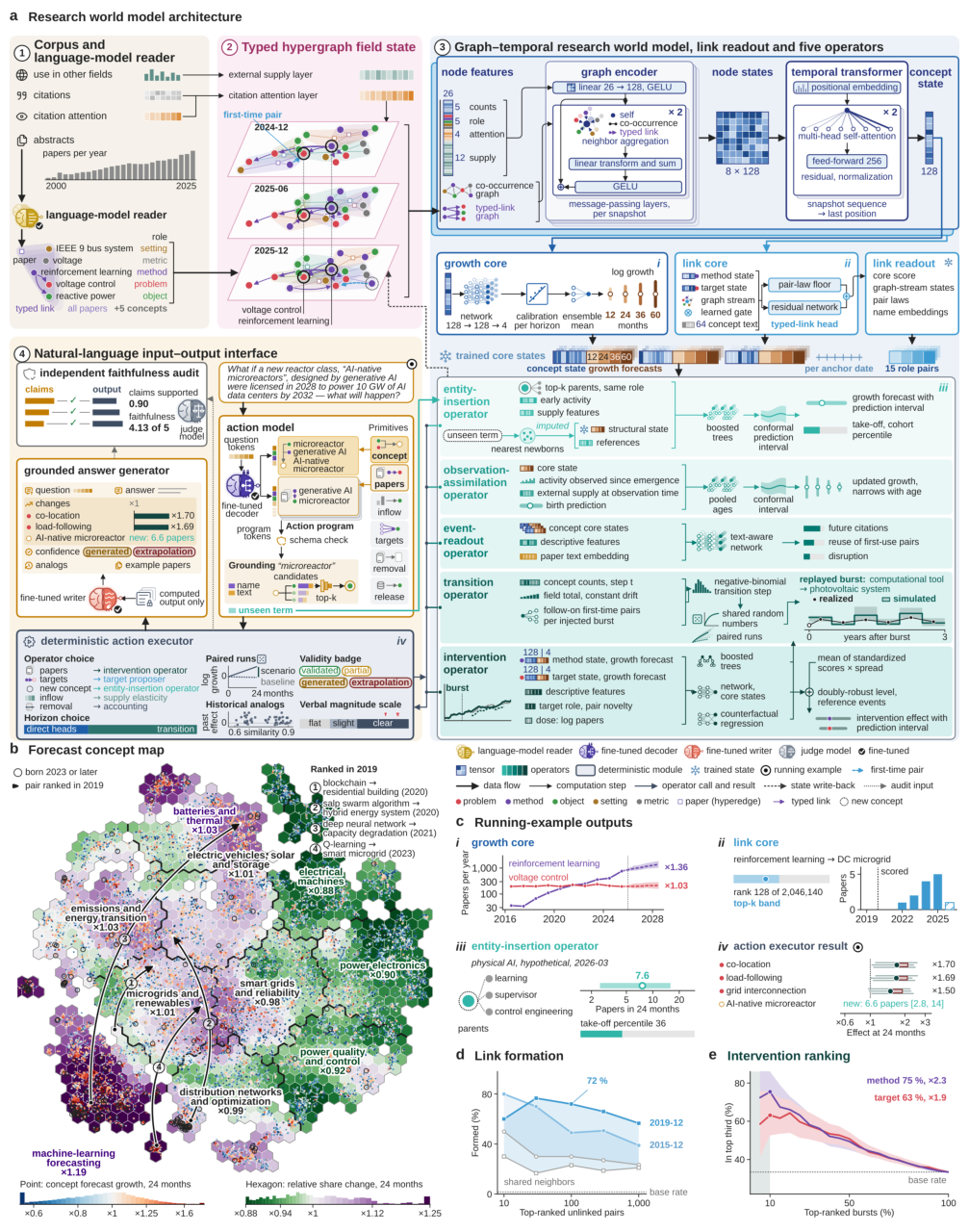
Caption: Fig. 1 | A research world model of power engineering. a, Architecture (schematic, with tensor dimensions as implemented). (1) A 7-billion-parameter reader distilled from a 27-billion-parameter teacher converts 1.20 million abstracts into role-typed concepts. Citations and use in seven other fields form the citation-attention and external-supply layers. (2) The field state, a monthly typed hypergraph (real subgraph around the running example). (3) The growth and link cores (stacked cards) share one architecture, in which a graph encoder and a temporal transformer return a 128-dimensional concept state, and are trained separately. The link core adds a graph stream with a learned gate, concept...
Why It Matters: This is the clearest system-level view, connecting corpus ingestion, typed graph state, forecasting cores, intervention operators, and the grounded question-answering interface.
Figure 2
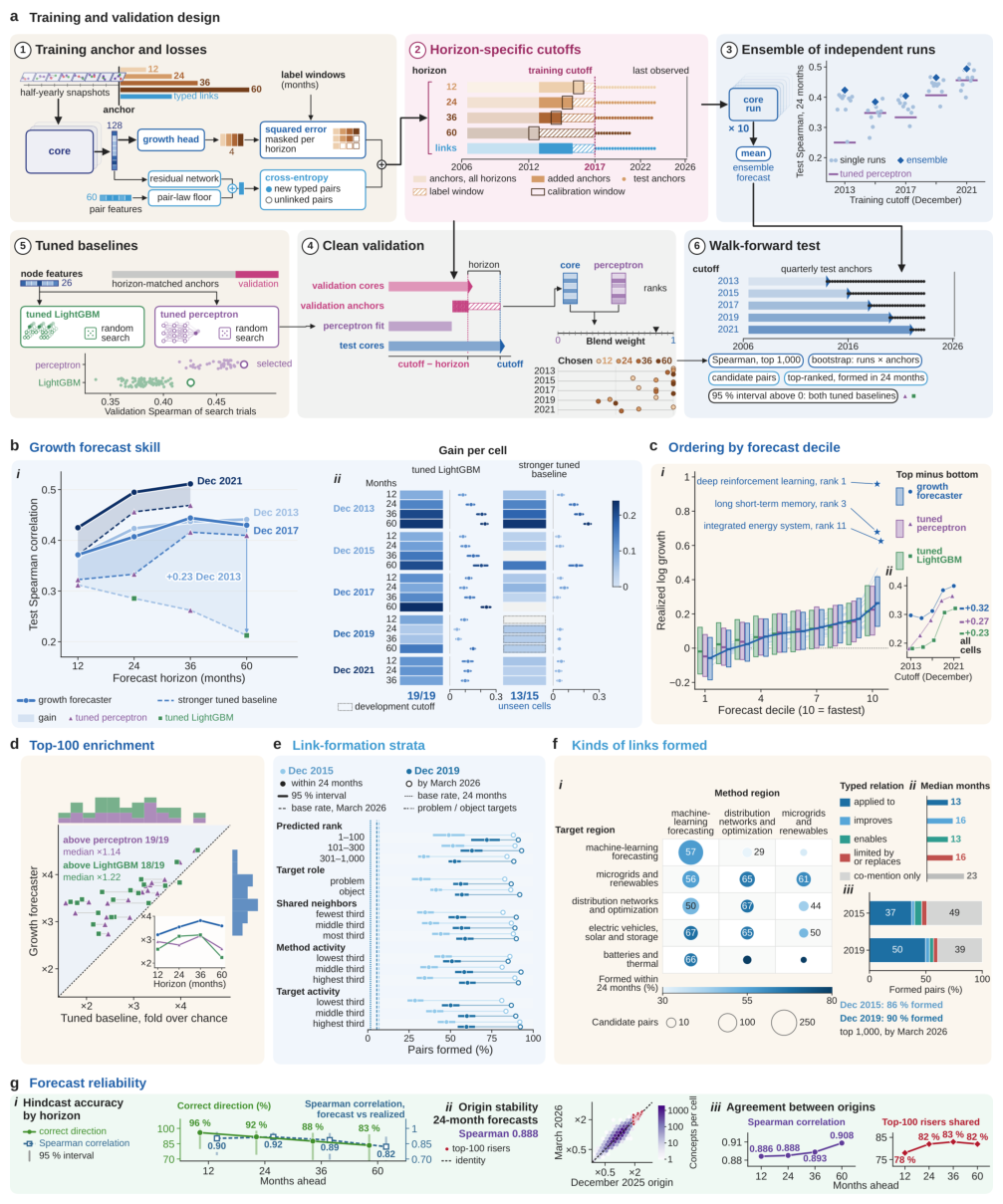
Caption: Fig. 2 | Training, validation and test of growth and link forecasting. a, Design, with mini-plots of results. (1) A training anchor with masked growth losses and a typed-link loss. (2) Horizon-specific training cutoffs. (3) Ten independent runs. (4) Blend weight chosen on validation cores trained at the cutoff minus the horizon. (5) Tuned baselines on the same 26 node features. (6) Walk-forward test at five cutoffs. b, b(i), test Spearman correlation over the 1,000 most active concepts by horizon for three cutoffs, growth forecaster (solid) against the stronger tuned baseline (dashed). b(ii), gain in each of 19 cells over tuned LightGBM and over the stronger tuned baseline (mean and 95% int...
Why It Matters: It summarizes the walk-forward design, baseline comparisons, ranking gains, link formation, and forecast reliability in one result-focused figure.
Figure 3
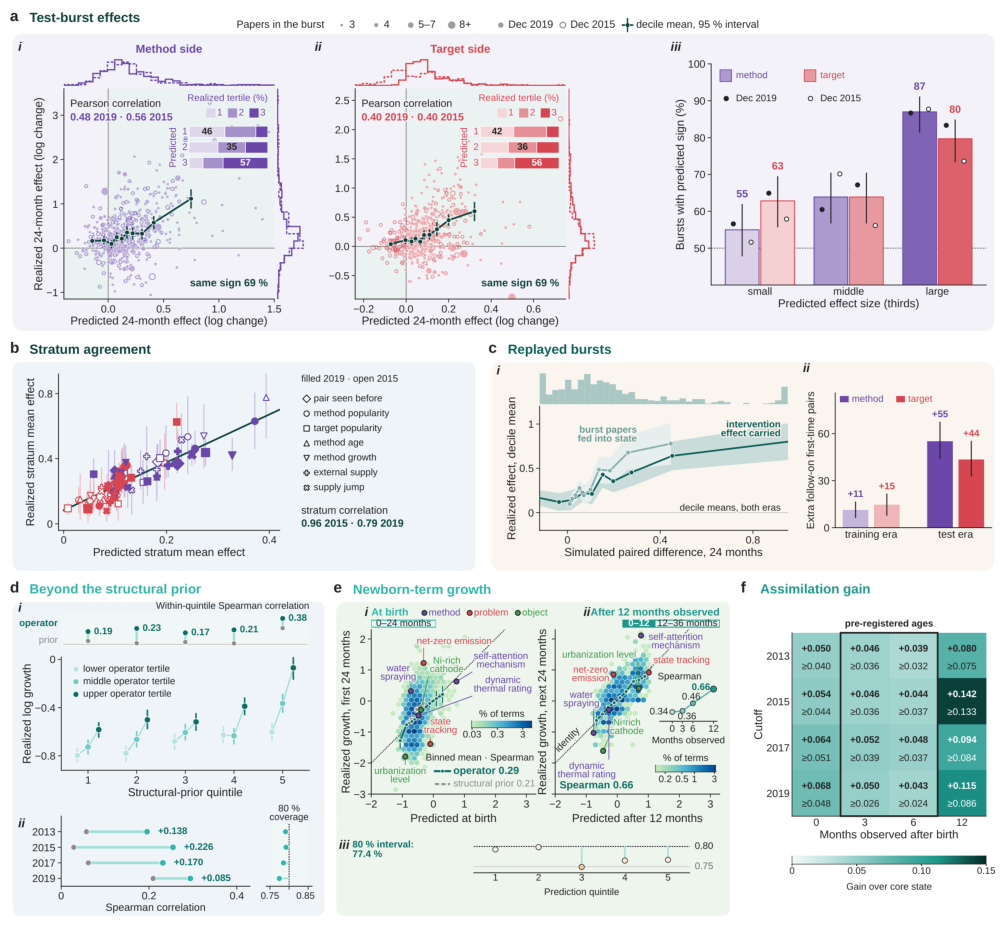
Caption: Fig. 3 | Operators on held-out natural experiments (power engineering). a, Intervention operator on 574 test bursts (filled, December 2019 cutoff; open, December 2015), predicted against realized 24-month effect relative to five matched controls. a(i), method side (Pearson 0.48 and 0.56). a(ii), target side (0.40 in 2019; 0.32–0.40 in 2015 across two seed sets). a(iii), share with the predicted sign by thirds of absolute predicted effect (all 574 bursts; method 55% → 87%, target 63% → 80%). b, Stratum means, predicted against realized (correlation 0.96 in 2015, 0.79 in 2019; criterion ≥0.6). c, Transition operator replaying the bursts. c(i), realized effect by decile of the simulated paired...
Why It Matters: It provides the central evidence that learned operators track realized effects in held-out natural experiments rather than only producing plausible simulations.
Figure 4
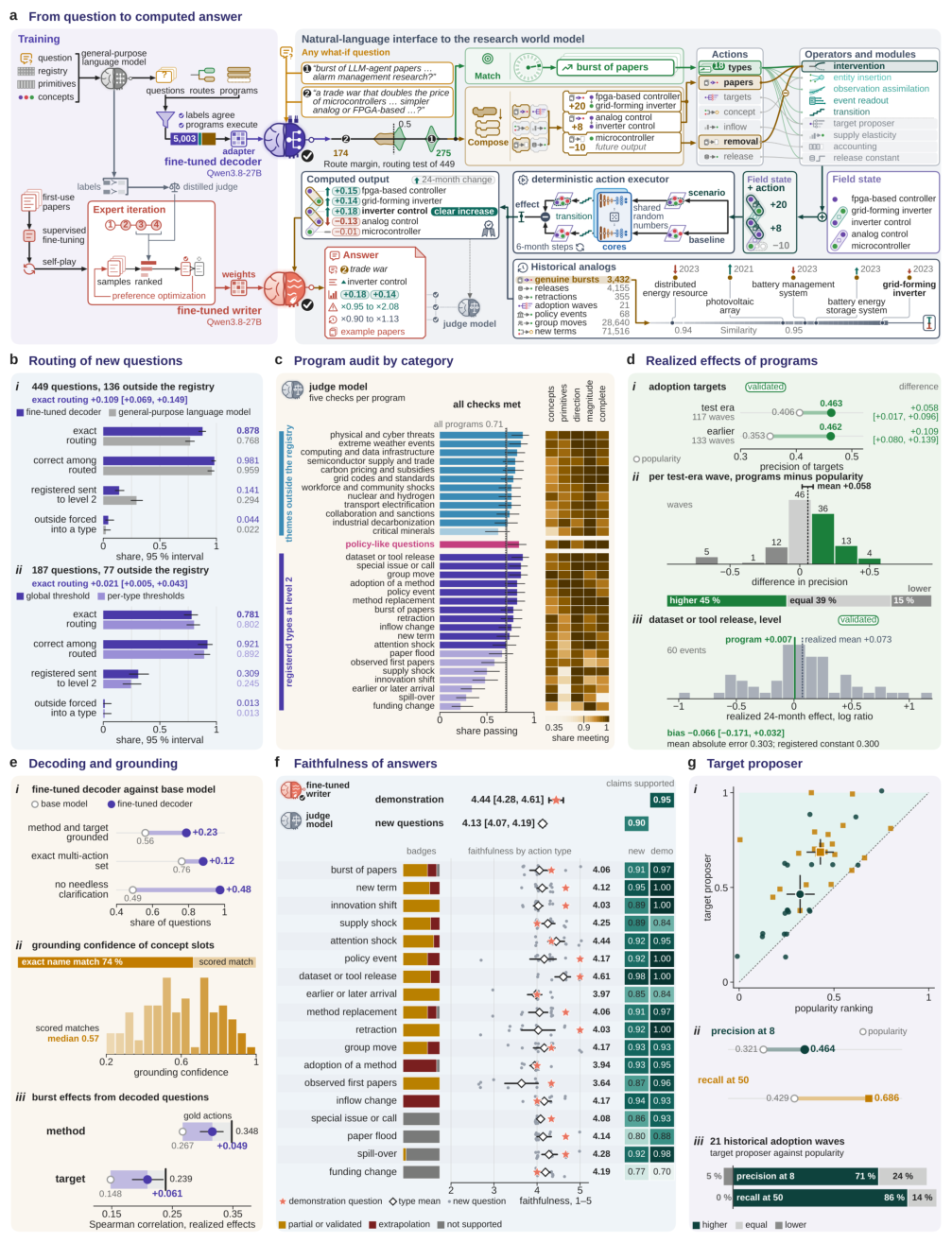
Caption: Fig. 4 | From a what-if question to a faithful answer. a, From question to computed answer (schematic with system outputs). Left, training of the fine-tuned decoder and of the grounded answer generator. Right, route margins of the 449 routing-test questions. At the threshold 0.5, the decoder routes 275 to level 1 and 174 to level 2. Example 1 is matched to a registered type, and example 2 is composed from state primitives, its removal of future output executed by the intervention operator as a burst with the opposite sign. The deterministic action executor runs scenario and baseline through the trained cores and the transition operator in 6-month steps with shared random numbers. Historical...
Why It Matters: It shows how a natural-language request is constrained by routing, schema checking, deterministic execution, grounding, and claim-level auditing.
Figure 5
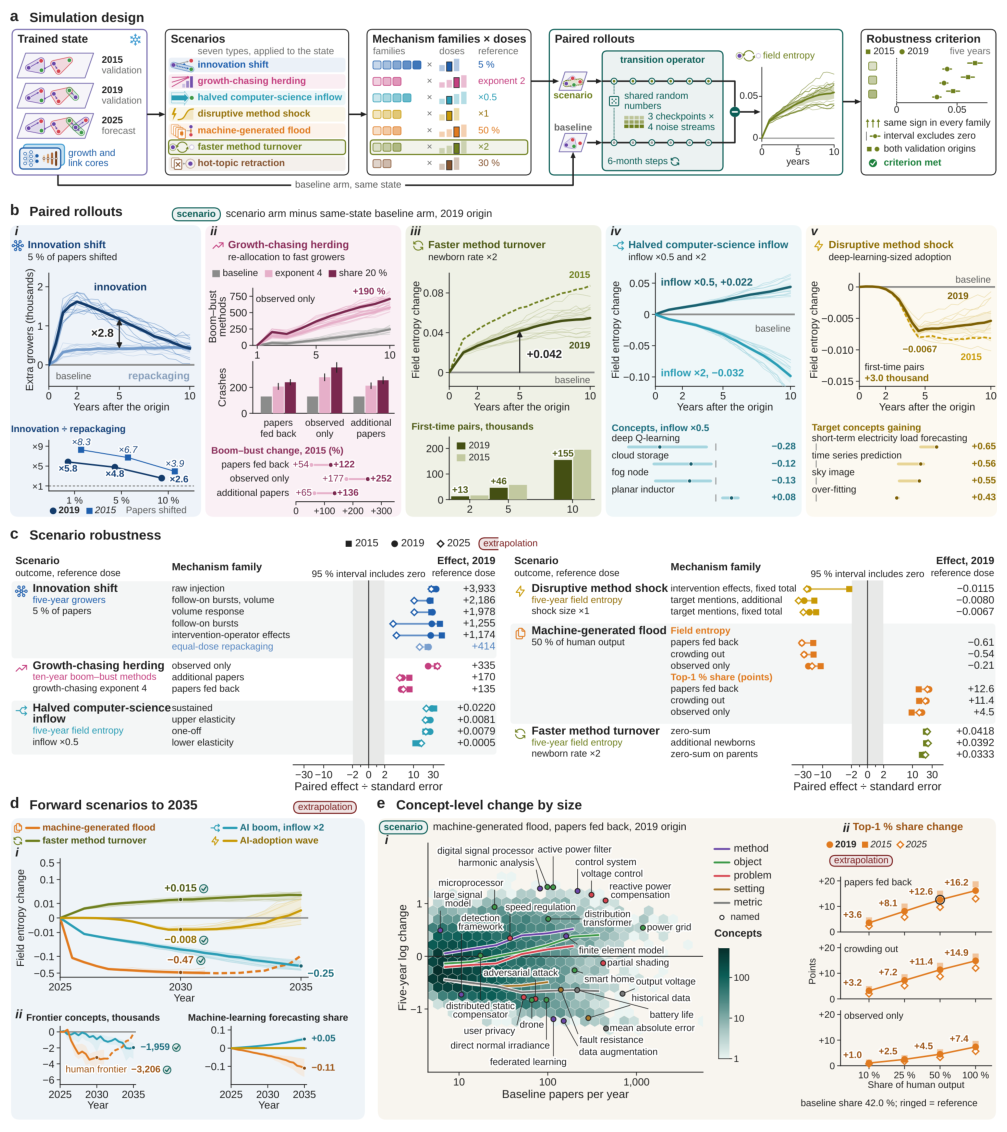
Caption: Fig. 5 | Field-scale scenarios with the transition operator. a, Simulation design. The trained state at the validation origins December 2015 and December 2019 and at the forecast origin December 2025 is perturbed by seven scenario types, each run under several mechanism families and a dose ladder. The scenario arm and a baseline arm from the same state are rolled forward by the transition operator in 6-month steps with shared random numbers, giving 12 paired trajectories. Their scenario-minus-baseline differences are shown for faster method turnover. A direction meets the robustness criterion only when every mechanism family gives the same sign with a 95% interval excluding zero at both val...
Why It Matters: It illustrates how field-level counterfactuals are stress-tested across mechanisms, doses, origins, and shared-noise paired rollouts.
Figure 6
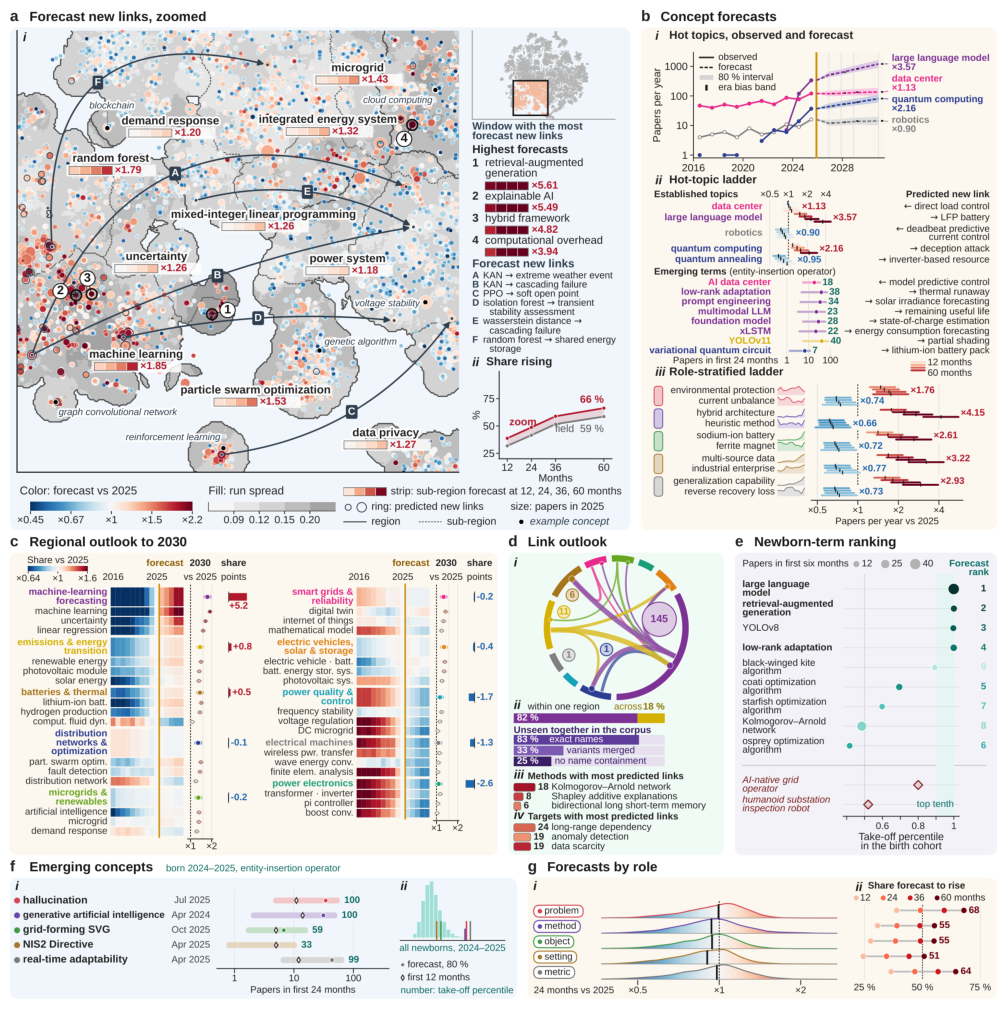
Caption: Fig. 6 | Forecasts of power engineering. Forward outputs are from December 2025 (second origin March 2026). Rankings are those of the growth forecaster, and levels, intervals and era bias bands those of the five-run ensemble. a, a(i), zoom of the field map on the window with the most forecast new links. Color, 24-month forecast versus 2025. Size, papers in 2025. 1–4, the highest-ranked concepts with at least 20 papers in 2025. A–F, method–target links forecast at December 2025 that no paper before 2026 connects. Fill, run spread; strips, sub-region forecasts at 12–60 months; rings, concepts with predicted new links. a(ii), share forecast to rise. b, b(i), hot topics, observed and forecast w...
Why It Matters: It exposes the prospective outputs builders would consume, including regional outlooks, emerging concepts, and predicted unseen method–target links.
🔮 Conclusion
The paper demonstrates a coherent architecture in which forecasting and counterfactual analysis share a learned representation of research-field dynamics. The strongest empirical results are not a single headline forecast but the agreement across several tests: growth and link prediction improve over strong baselines, intervention effects track held-out natural experiments, entity insertion and observation assimilation provide useful newborn-term forecasts, and a constrained language interface produces mostly supported answers from computed outputs.
The system also offers a useful operational distinction between validated, partial, extrapolative, unsupported, and generated answers. That distinction, together with scenario-baseline pairing and shared random numbers, makes the interface more suitable for exploratory research planning than an unconstrained conversational forecast. However, the paper does not establish that simulated effects are decision-grade estimates for arbitrary research policies.
🛠️ Future Research Improvements
The clearest next step is prospective calibration. The authors plan to score the December 2025 forecast against papers published in 2026 and 2027; those observations should test ranking stability, interval coverage, era-bias estimates, newborn-term takeoff, and predicted unseen links. Additional fields beyond semiconductors and materials science would help determine whether the representation and operators transfer because of general dynamics or because the replication domains share publication conventions.
The intervention layer would benefit from stronger identification designs and better magnitude calibration. The paper reports that funding-entry effects are confounded by funders entering already-growing topics, so the system returns no funding estimate. Future work could add policy shocks, randomized or quasi-random grant mechanisms, richer institutional covariates, and explicit sensitivity analysis for unobserved confounding. New-term operators also need training support for takeoffs outside the historical range, while link forecasting should learn relation types rather than only first co-occurrence for role pairs beyond method–target.
- Validate interval coverage across active and low-frequency concepts.
- Benchmark transfer across more fields, publication systems, and time periods.
- Add causal designs for funding, policy, and institutional interventions.
- Calibrate effect magnitudes and diagnose systematic underestimation.
- Evaluate judge-model agreement with human experts and multiple independent model families.
🏭 Potential Industry Use Scenarios
A research organization, utility, equipment manufacturer, or public-sector planning team could use the system as an exploratory portfolio instrument: rank emerging concepts, identify plausible method–target combinations, compare a proposed research push with a no-intervention baseline, and inspect how outcomes vary across doses and mechanism families. The field-scale simulations suggest a way to test questions such as whether reallocating work toward first-time method–target combinations changes diversity or whether a machine-generated literature flood concentrates attention.
A domain-facing interface could support technology scouting and research-program reviews by returning computed effects, historical analogs, uncertainty intervals, and identification badges in response to natural-language questions. Deployment should keep the system advisory: validated historical analogs and observed-data forecasts can inform prioritization, while generated or extrapolated scenarios should be presented as structured hypotheses requiring expert review.
- Research portfolio exploration and emerging-technology scouting.
- Scenario analysis for internal research programs and method adoption.
- Evidence-backed review of proposed technology or dataset releases.
- Cross-field monitoring of external research inflows and concept emergence.
- Decision-support dashboards that separate observed forecasts from generated counterfactuals.
💬 Critical Analysis
The paper is technically ambitious and unusually complete in linking representation learning, temporal graph forecasting, natural-experiment operators, simulation, and a language interface. Its evaluation is strengthened by walk-forward cutoffs, tuned baselines, hard-negative link tests, multiple independently trained runs, deduplication, pre-registered decision rules, and prospective forecast freezing. The natural-language layer is also designed with a sound separation of responsibilities: the executor computes, the writer verbalizes, and the judge audits.
The main concern is external validity. Publication records encode attention, reporting, indexing, and field-specific conventions rather than research dynamics directly. The intervention operator is trained from observational natural experiments and can rank effects without identifying their full causal magnitude. The paper acknowledges that funding effects are not identified, that external-field inflows are extrapolations, and that out-of-registry programs are not validated against natural experiments. A second concern is measurement dependence: concept extraction, alias resolution, role assignment, and deduplication all affect the state on which the model reasons. Finally, judge-model faithfulness is encouraging but not equivalent to human validation, and the system's prospective usefulness remains contingent on future observations confirming the frozen forecasts.
- Strongest evidence: held-out temporal tests and natural-experiment replay rather than qualitative plausibility alone.
- Most important reproducibility dependency: the corpus-cleaning and concept-resolution pipeline.
- Most important causal caveat: observational intervention data support partial identification, not universal policy effects.
- Most important interface caveat: fluent answers remain constrained only when the executor output and identification badge are preserved.