
📌 Highlights
Meta² addresses a central tension in long-horizon agents: offline harness optimization can generalize poorly and cannot react during a new run, while online evolution can lack reusable guidance and verifier feedback. The paper moves offline learning one level up by learning reusable evolution knowledge rather than a single universal harness.
- With GPT-5.6-Terra, Meta² reports 81.00% on Terminal-Bench 2.1 mean@5 and 44.44% on DeepSWE 1.1 mean@3.
- With DeepSeek-V4-Flash-0731, it reports 77.67% on Terminal-Bench 2.1 mean@5.
- A/B/C rollout contrasts produce act, avoid, and hold guidance for later within-run decisions.
- Task-local edits are discarded between runs; the frozen Meta-Skill is reused.
- The main caveat is that contrastive outcomes guide decisions but do not prove the causal value of individual edits.
🎯 Introduction
The paper treats an agent as a frozen model operating through a harness composed of prompts, context policy, tools, skills, memory, and hooks. These components shape how the agent preserves constraints, takes actions, and validates artifacts. In long-horizon tasks, important interface or control needs may only become visible after execution has started, making a fixed pre-run harness inadequate.
Offline methods can optimize a shared harness from completed training trajectories, but that artifact cannot react to evidence in a new run and may overfit the training tasks. Pre-run and after-run online methods adapt at the wrong time for the motivating evidence, while within-run systems can intervene at the right time but must decide when and how to act without reusable guidance or the eventual verifier outcome.
Meta² therefore asks whether verified experience from completed training runs can teach an evolver reusable decision knowledge without leaking held-out verifier feedback or carrying one task's harness edits into unrelated tasks.
🔬 Methodology
The online component starts from a minimal seed harness h^(0) and runs a task agent continuously in one environment. At checkpoint k, the evolver receives the instruction, newly accumulated trajectory, permitted workspace observations, and the status of the prior edit. It chooses KEEP or EVOLVE; an EVOLVE action applies a bounded notice, instruction update, hook, or tool edit to the remainder of the current run without resetting the environment or discarding progress.
The offline component learns a textual Meta-Skill M. For each training task, condition A runs the task agent alone, condition B uses the current Meta-Skill, and condition C gives the evolver privileged verifier information available only during training. Paired terminal outcomes create act evidence from B-pass/A-fail or C-pass/B-fail, avoid evidence from B-fail/A-pass or C-fail/B-pass, and hold evidence from A-pass/B-pass. REFLECT creates candidate entries, AGGREGATE merges recurring patterns and removes instance-specific details, and UPDATE adds, merges, refines, or deletes Meta-Skill entries.
At deployment, M is frozen and no held-out verifier outcome or judge signal updates it. The same M is reused across tasks, while every task starts again from h^(0), ensuring that task-local corrections do not persist.
equation 1
Meaning: Defines harness evolution: the evolver proposes an edit from the current harness and available evidence, then the edit produces the next harness state.
equation 2
Meaning: Defines the checkpoint information accumulated by the evolver from the task instruction, trajectory deltas, workspace observations, and previous-edit status.
equation 3
Meaning: Defines the binary top-level decision at each checkpoint: preserve the current harness or apply a bounded edit.
equation 4
Meaning: Defines the iterative Meta-Skill update: reflect on contrastive groups, aggregate recurring lessons using training-time verifier information, and update the previous Meta-Skill.
📊 Experiments
The evaluation uses Terminal-Bench 2.1 and DeepSWE 1.1, with each benchmark randomly split into training and test sets at a 1:2 ratio. Terminal-Bench reports mean@5 over five independent runs per held-out task, while DeepSWE reports mean@3 over three independent runs. The primary backbone is GPT-5.6-Terra with medium reasoning effort; an additional Terminal-Bench experiment uses DeepSeek-V4-Flash-0731 with high reasoning effort. Performance is higher-is-better, while aggregate dollar cost is reported separately for offline construction, online deployment, and the full evaluation.
Against human-designed harnesses, self-evolution methods, and harness-evolution methods, Meta² achieves the highest reported GPT-5.6-Terra performance: 81.00% on Terminal-Bench 2.1 and 44.44% on DeepSWE 1.1. These are gains of 14.67 and 9.77 percentage points over the shared NexAU seed, compared with 7.00 and 2.66 points for Meta-Harness. Its full costs are $174.91 and $367.86, lower than AHE's $248.35 and $862.89 and Meta-Harness's $198.85 and $870.75 on the same benchmarks.
The DeepSeek-V4-Flash-0731 Terminal-Bench evaluation reaches 77.67%, ahead of the NexAU seed by 7.67 points. The paper explicitly constructs a separate Meta-Skill for this backbone, so the result demonstrates robustness of the method across backbones rather than zero-shot transfer of one Meta-Skill.
Checkpoint sensitivity favors an interval of L=5, which reaches 81.00% at an online cost of $64.72. More frequent checkpoints score 80.33% at $74.22 for L=3 and 79.00% at $83.41 for L=1; longer intervals reduce cost to $59.10 at L=11 but compromise performance. Component ablations report Terminal-Bench/DeepSWE scores of 66.33/34.67 for the task agent, 74.67/36.44 with an online evolver, 77.00/35.56 with a self-distilled Meta-Skill, and 81.00/44.44 with contrastive Meta-Skill learning. Retaining edits across later tasks reduces performance to 78.33% and 39.11%, supporting per-task resets.
tab:main-results
Caption: Main performance and cost comparison. Results with GPT-5.6-Terra (medium reasoning) on Terminal-Bench 2.1 (mean@5) and DeepSWE 1.1 (mean@3). Parentheses report the point change from the NexAU seed; costs are aggregate US dollars over each evaluation.
| l@ 7ptc@ 10pt > X@ 7pt > X@ 7pt > X@ 18pt c@ 10pt > X@ 7pt > X@ 7pt > X [1.5pt] 3*Method | 4c [c]Terminal-Bench 2.1 | 4c [c]DeepSWE 1.1 | ||||||
|---|---|---|---|---|---|---|---|---|
| 2*Perf. | 3cCost (\$) | 2*Perf. | 3cCost (\$) | |||||
| 1cOffline | 1cOnline | 1cFull | 1cOffline | 1cOnline | 1cFull | |||
| NexAU Seed | 66.33 | -- | 34.09 | 34.09 | 34.67 | -- | 62.67 | 62.67 |
| Codex CLI | 68.33 | -- | 56.59 | 56.59 | 31.11 | -- | 136.53 | 136.53 |
| mini-swe-agent | 67.33 | -- | 41.08 | 41.08 | 29.33 | -- | 68.87 | 68.87 |
| Pi agent | 69.00 | -- | 37.98 | 37.98 | 39.11 | -- | 82.50 | 82.50 |
| DeepSeek Harness | 68.00 | -- | 31.90 | 31.90 | 34.22 | -- | 41.37 | 41.37 |
| ReasoningBank | 68.00 +1.67 | 16.04 | 55.60 | 71.64 | 33.33 -1.34 | 55.87 | 85.64 | 141.51 |
| ACE | 71.33 +5.00 | 81.55 | 64.09 | 145.64 | 32.00 -2.67 | 238.10 | 82.29 | 320.39 |
| TF-GRPO | 74.67 +8.34 | 92.55 | 42.62 | 135.17 | 36.44 +1.77 | 322.50 | 86.16 | 408.66 |
| AHE | 70.67 +4.34 | 209.44 | 38.91 | 248.35 | 34.67 0.00 | 793.48 | 69.41 | 862.89 |
| Meta-Harness | 73.33 +7.00 | 160.51 | 38.34 | 198.85 | 37.33 +2.66 | 781.56 | 89.19 | 870.75 |
| Continual Harness | 72.67 +6.34 | 28.75 | 83.48 | 112.23 | 33.78 -0.89 | 46.11 | 155.61 | 201.72 |
| tablelightbrown | 81.00 +14.67 | 110.19 | 64.72 | 174.91 | 44.44 +9.77 | 238.52 | 129.34 | 367.86 |
fig:teaser-figure
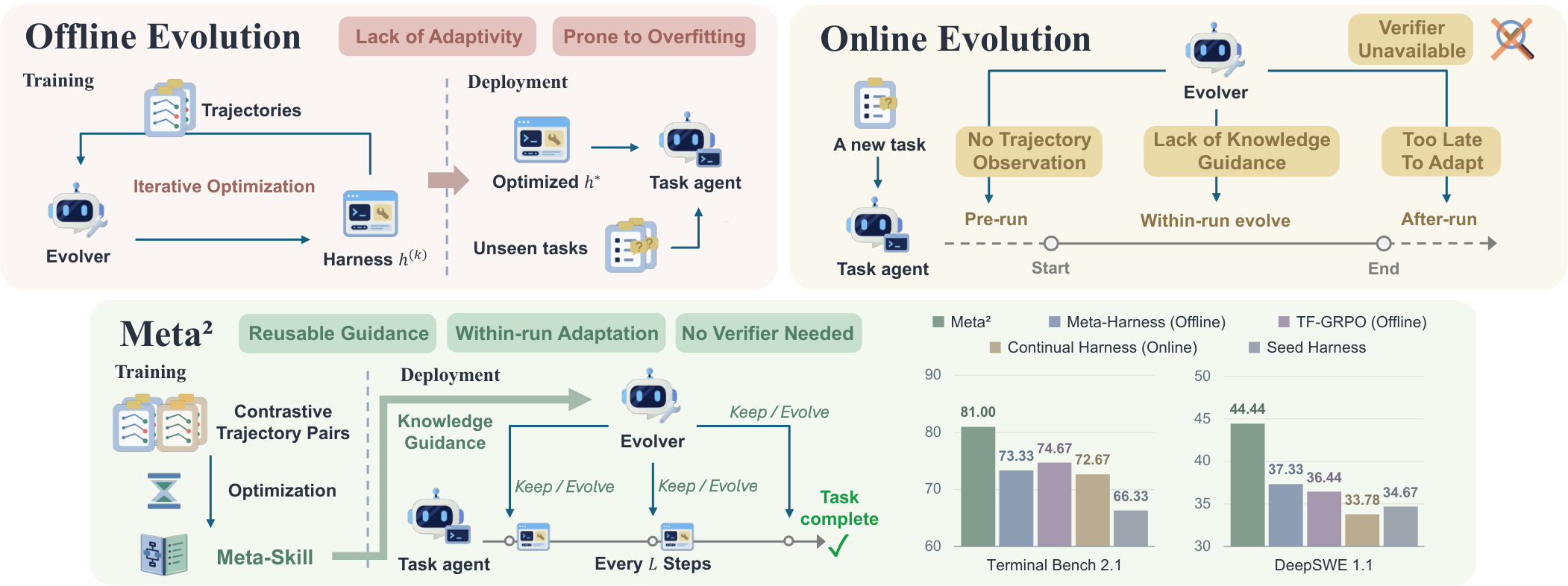
Caption: Motivation and overview of Meta². Offline evolution produces a shared harness that may overfit training tasks and cannot adapt to evidence revealed during a new run, while online methods face limitations in intervention timing, knowledge guidance, and verifier availability. By moving offline optimization one level up, Meta² learns a reusable Meta-Skill from contrastive training rollouts and freezes it to guide task-local harness evolution at checkpoints online, without access to verifier feedback at test-time. Across both evaluated benchmarks, this design yields the highest performance among the compared methods.
Why It Matters: It summarizes the paper's central design tradeoff: reusable offline knowledge is combined with adaptive but task-local online edits.
fig:experience-construction
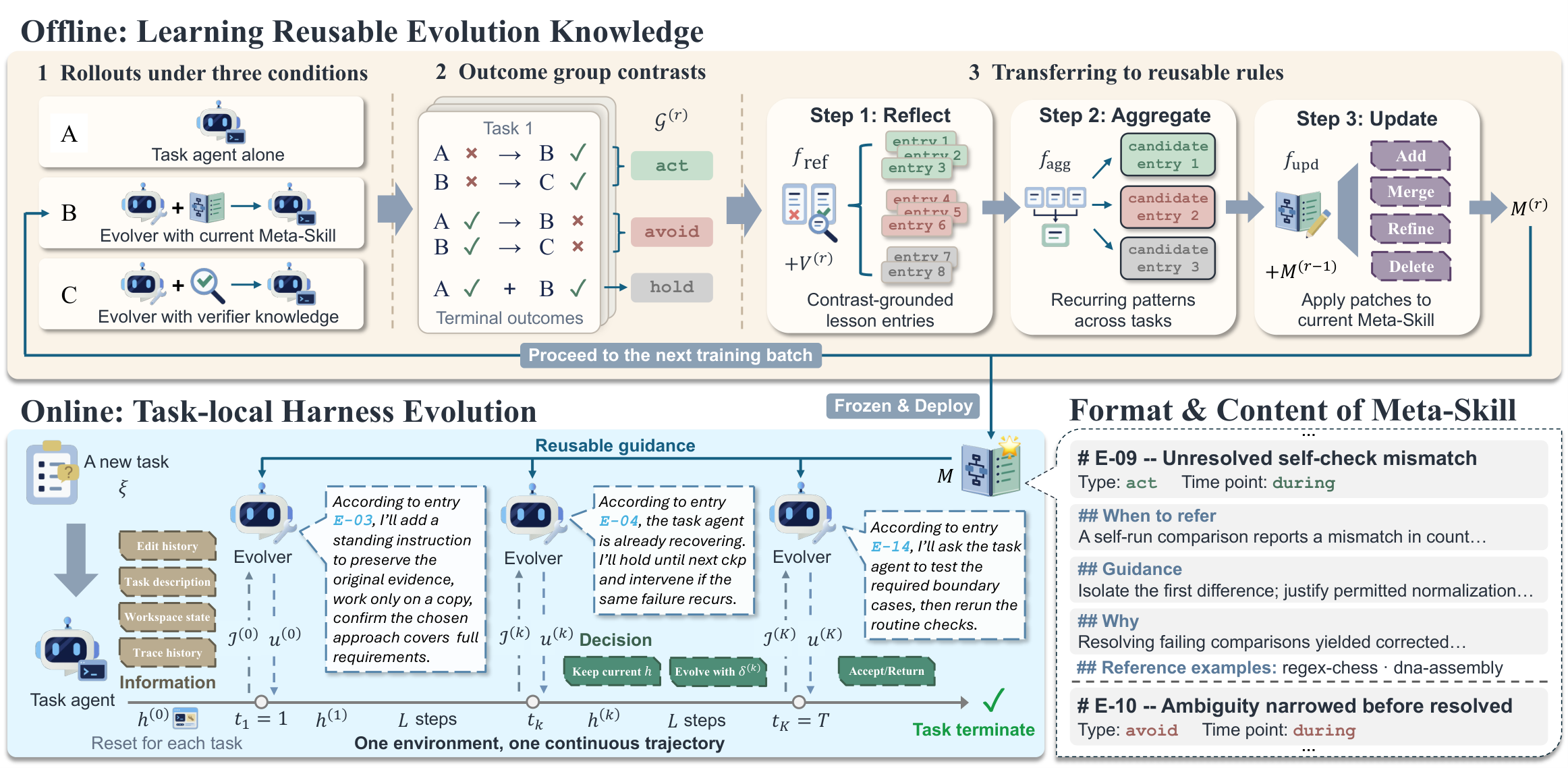
Caption: Design of Meta²: offline knowledge learning, online harness evolution and format of Meta-Skill. Offline, rollouts are collected under three conditions: the task agent alone (A), evolution guided by the current Meta-Skill (B), and evolution with verifier knowledge (C). Deterministic pairing of terminal outcomes yields act, avoid, and hold contrasts. LLM-based reflection and cross-task aggregation distill these contrasts into reusable lessons, which iteratively update the Meta-Skill. Online, the frozen Meta-Skill guides an evolver LLM to retain or modify the harness at deterministic checkpoints, while the task agent continues along a single trajectory in one environment. Meta-Skill entries sp...
Why It Matters: It exposes the full offline-to-online pipeline and clarifies how verifier-informed training signals are separated from verifier-free deployment.
fig:component-ablations
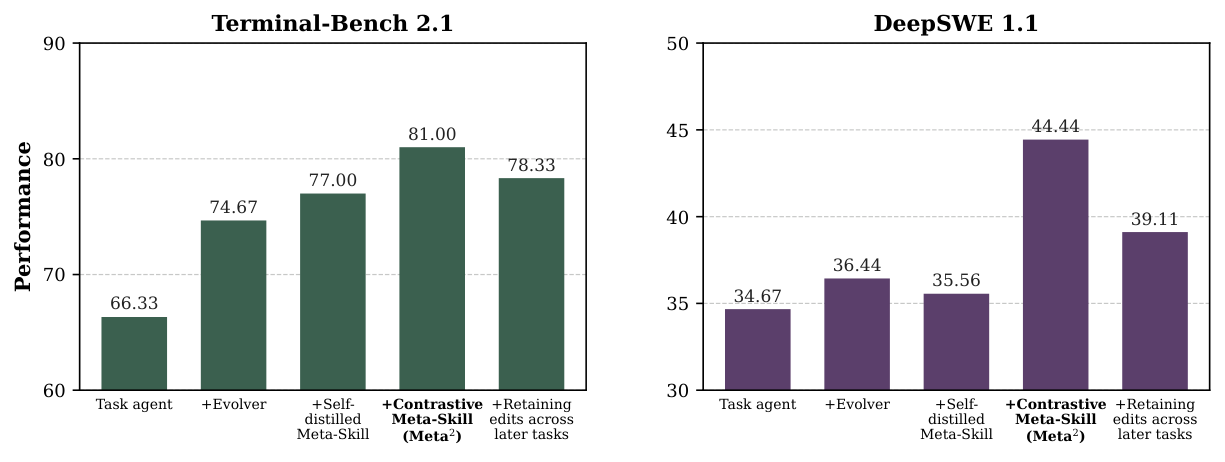
Caption: Component ablations. The first four settings evaluate the online evolver and two Meta-Skill construction methods. The fifth retains online edits across tasks instead of resetting to $h^(0)$.
Why It Matters: It isolates the contribution of the online evolver, self-distilled guidance, contrastive guidance, and task-level harness resets.
🔮 Conclusion
Meta² demonstrates a useful division of labor between offline and online adaptation. Offline training learns when and how evolution tends to help, while deployment uses that knowledge to make selective, task-local edits during the run that reveals the relevant evidence.
The reported results support the paper's central design principle: precompute how to adapt, then adapt locally as the task unfolds. The ablations further indicate that contrastive Meta-Skill construction and resetting the harness between tasks are important to the gains.
🛠️ Future Research Improvements
The next research step should test broader transfer. Because the DeepSeek experiment uses a separately constructed Meta-Skill, future work should measure whether reusable guidance can transfer across model families, reasoning settings, or harness interfaces without repeating the full offline construction phase.
The contrastive procedure also leaves causal attribution unresolved. More targeted intervention logging, controlled replay, or checkpoint-level counterfactual evaluation could distinguish which individual edits caused improvements and which merely correlate with successful task trajectories.
Further studies should expand beyond Terminal-Bench 2.1 and DeepSWE 1.1, report latency and call-count distributions, and evaluate how the offline investment amortizes as the number and diversity of deployment tasks increase.
🏭 Potential Industry Use Scenarios
The method is most directly relevant to long-running software engineering agents that operate through tools, workspaces, prompts, and validation hooks. An evolver could add a task-local instruction, check, or tool adjustment after detecting a recurring failure while preserving the current repository state and partial progress.
The same pattern could apply to operational agents that must maintain constraints over extended workflows: a frozen library of evolution guidance can be shared across jobs, while corrective changes remain isolated to the active incident, document, or workflow execution.
Deployment suitability depends on controlling the cost and safety of edits. Builders would need bounded edit channels, audit logs, rollback behavior, and domain-specific checks because the paper's approach does not use the held-out verifier to confirm an intervention during the active run.
💬 Critical Analysis
The strongest aspect of Meta² is the separation between reusable evolution knowledge and ephemeral harness state. This directly addresses a failure mode of persistent online edits: the ablation shows that carrying edits into later tasks lowers Terminal-Bench performance from 81.00% to 78.33% and DeepSWE performance from 44.44% to 39.11%.
The evidence for contrastive learning is also substantial within the reported setup. Adding an online evolver raises the baseline scores, self-distilled guidance improves Terminal-Bench, and contrastive guidance raises the scores further to 81.00% and 44.44%. However, these comparisons are system-level ablations; they do not identify which Meta-Skill entries or checkpoint decisions are responsible for each gain.
The main reproducibility questions concern the detailed construction and filtering of contrast groups, the bounded edit interface, and the operational cost of repeated evolver calls. The paper reports aggregate costs and checkpoint sensitivity, but wider validation is needed to determine whether the same performance-cost relationship holds across domains, models, and task distributions.