
📌 Highlights
DataFarm's core claim is that one calibration episode can seed a largely automated process that produces real-ready robot data without repeated robot operation or teleoperator labor. The strongest evidence is real-robot policy transfer: farm-only training reaches 93 successes versus 84 for teleoperated training in the original scenes and 87 versus 46 under unseen appearance.
- Simulation supplies the action labels, states, contacts, and timing.
- Real-image-conditioned video supplies photographic multi-view observations.
- Hidden judges and independent review reduce self-certification and render-label errors.
- The paper's main caveat is limited coverage: one dual-arm robot and five tasks.
🎯 Introduction
Teleoperation remains attractive because every recorded action is executed by the robot and every image comes from the deployment scene, but its cost scales with robot, operator, physical resets, and repeated task setup. Existing synthetic-data pipelines move that burden into scene engineering, simulator construction, asset reconstruction, or visual-domain correction. Video generation can improve appearance, but unconstrained generation may lose exact action labels or drift from the intended motion.
The paper's objective is to combine simulator-grounded actions with real-scene visual appearance. A single calibration episode identifies the scene and cameras but is not reused as an action source. The agent reconstructs and qualifies the task, writes an expert and success judge, generates trajectories from many initial states, and renders those trajectories using real reference images. Certification is separated from production because an agent that writes both an expert and its check could otherwise approve its own mistakes.
tab:related
Caption: Comparison with related data-generation pipelines. Among them, only in DataFarm does an agent build the simulation task from a single calibration episode of the scene, reusing none of its actions, with observations rendered from that episode’s own images as appearance reference.
| Method | Input from the target task | Simulation task built by | Action labels | Observations | Real robot |
|---|---|---|---|---|---|
| MimicGen | a few demos in simulation | people | simulator | simulator rendering | |
| DemoGen | one real demo | --- (no simulator) | edited demo | point clouds | |
| RoboTwin 2.0 | task description, assets | language model | simulator | rendering + DR | |
| Re³Sim | scene reconstruction | people | simulator | Gaussian splatting | |
| SplatSim | object and scene scans | people | simulator | Gaussian splatting | |
| Real2Render2Real | object scans, human video | --- (no dynamics) | retargeted | rendered scans | |
| DreamGen | real teleoperated data | --- (no simulator) | inferred (IDM/LAM) | generated video | |
| EmbodieDreamer | real demos, real-to-sim calibration | people | replayed real actions | sim-conditioned video | |
| CRAFT | a few real teleoperated demos | people (digital twin) | simulator | edge-conditioned video | |
| DataFarm | one calibration episode | agent | simulator | real-image-conditioned video |
Why It Matters: The table distinguishes DataFarm from pipelines that require human-built simulation, point-cloud observations, scanned assets, or inferred action labels.
🔬 Methodology
DataFarm separates a shared capability layer from task-specific artifacts. For each request, the agent produces grounding G, task contract T, sampler S, expert C, judge J, render contract R, and batch configuration B. Grounding identifies objects, geometry, articulation, cameras, and metric scale; quantities that cannot be determined from the calibration episode are marked as measured, fitted, assumed, or unknown and are handled through simulation randomization rather than unsupported certainty.
The workflow behaves like a compiler. A qualified simulator is selected through skill probes before expert writing. The task contract specifies stages, completion conditions, and forbidden shortcuts; a separate role freezes the judge before the expert is developed. The expert can explore development seeds but cannot inspect the judge or run held-out seeds. Accepted rollouts are single continuous executions produced afresh by the harness.
Rendering uses simulator video as structural control and real reference frames for appearance. Edge maps constrain arm pose, object positions, and timing; head and wrist views are tiled and generated together; long episodes are chunked and joined; and a vision-language model selects or flags candidate chunks. Automatic checks test objects, event timing, continuity, background, appearance, and reference-layout copying. Independent review then compares each render against the simulated state and real references before delivery.
fig:method
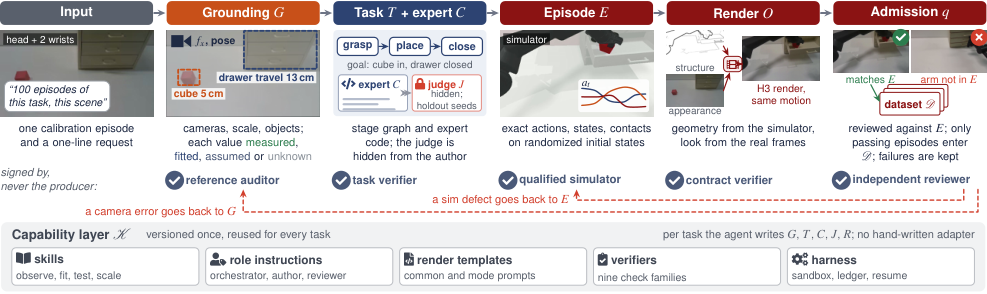
Caption: The pipeline, followed on one drawer episode. The agent builds five intermediate representations: the grounding $G$, whose quantities are each labelled by how they are known; the task contract $T$ and the expert $C$, written against a hidden judge $J$; the simulated episodes $E$; the rendered observations $O$; and the admission record $q$. Each representation is checked by a component other than its producer (seals), and a rejection returns to the stage that caused it (dashed), as for the render here that shows an arm absent from $E$. The capability layer $K$ is shared by all tasks; everything above it is written for this task.
Why It Matters: The figure shows how intermediate representations and cross-checking stages prevent a single producer from certifying its own output.
equation 1
Meaning: Defines the task-specific artifacts that the agent must create before producing the dataset.
equation 4
Meaning: Summarizes the staged transformation from calibration episode to verified data and admission evidence.
equation 2
Meaning: Accounts for one-time adaptation and contract costs together with per-attempt production costs and admission yield.
equation 3
Meaning: Shows why average episode cost declines as adaptation and contract costs are amortized over more episodes.
DataFarm per-task compilation and admission procedure
Steps: ['Ground the calibration episode into scene geometry, cameras, scale, and uncertainty labels.', 'Qualify a simulator variant with probes, then create the task contract and hidden judge.', 'Develop the expert on development seeds and admit it only after held-out-seed evaluation.', 'Roll out the expert from sampled initial states to obtain exact actions, states, contacts, and task labels.', 'Render synchronized observations, run automatic checks and independent review, and admit only certified episodes.']
Why It Matters: The procedure is the operational core that converts one calibration episode into an auditable stream of training episodes.
📊 Experiments
The evaluation is task-based rather than on a named public dataset. It uses five bimanual tasks on a dual-arm PiPER robot: stack cups, weigh apple, beat drum, pull drawer, and fold towel. Rigid and articulated tasks use SAPIEN through RoboTwin 2.0; fold towel uses Isaac Sim with particle cloth. Each task starts from one calibration episode with a head camera and two wrist cameras and requests 100 generated episodes.
Policies are trained on three equal-size sources of N=100 episodes with a shared 50-step action horizon, batch size 128, and 50k training steps: real teleoperation, simulator rendering with domain randomization, and farm-rendered observations. Evaluation uses 20 trials per task and condition with shared randomized object placements. ID trials use the original scene; OOD trials introduce unseen tablecloths and colored room lighting.
Farm-only training reaches 93/100 successes in the original scenes versus 84/100 for teleoperation. Under unseen appearance, farm training reaches 87/100 while teleoperation falls to 46/100. Sim + DR reaches only 26/100 in the original scene and 21/100 under unseen appearance, never completing weigh apple. The paper attributes the farm advantage to appearance variation around fixed, exact trajectories rather than to new action generation.
The rendering ablations support the full multi-view recipe. Farm renders have mean optical-flow deviation of 4.4 pixels from the simulator and 65% agreement on moving pixels, compared with 8.8 pixels and 41% for a half-second-shifted control. Image-statistics evaluation reports KID values of 0.83 for H3 and 0.88 for Seedance versus 1.93 for the simulator and 2.50 with domain randomization. The mean farm cost is $0.80 per additional episode, $1.06 per episode at N=100, $0.83 at N=1,000, and $107 per hour of synchronized three-view data.
fig:realrobot
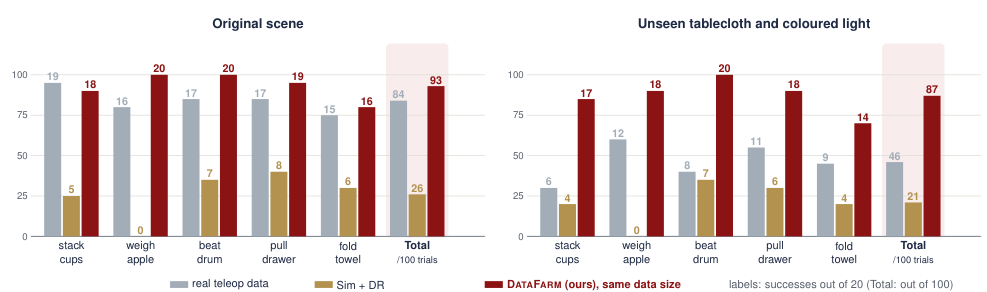
Caption: Real-robot results. (a) Successes of policies trained on 100 episodes from each source, in 20 trials per task and condition (Total: out of 100), in the original scene (left) and under an unseen tablecloth and coloured light (right). (b) Unseen-scene trials in which the policy trained on teleoperated data fails (top) and the policy trained only on farm data succeeds (bottom).
Why It Matters: This is the decisive deployment result: farm-generated data transfers to the real robot and is substantially more robust to unseen appearance than teleoperated or Sim + DR data.
tab:tasks
Caption: Tasks. Each starts from one calibration episode with a head and two wrist cameras and a request for 100 episodes; the agent generates the scene, camera fit, expert, judge, and render contract. ID: original scene; OOD: unseen tablecloth and coloured light.
| Task | What makes it hard | Simulator | Success condition | Real-robot eval. |
|---|---|---|---|---|
| Stack cups | nesting thin-walled rigid cups | SAPIEN | all three cups nested in one stack | ID, OOD |
| Weigh apple | placement on a scale with a live display | SAPIEN | apple at rest on the scale pan | ID, OOD |
| Beat drum | rhythmic contact timing | SAPIEN | drum struck at least twice | ID, OOD |
| Pull drawer | articulated object; pick, place, and close | SAPIEN | block inside the drawer, drawer closed | ID, OOD |
| Fold towel | deformable cloth | Isaac Sim | towel folded twice | ID, OOD |
Why It Matters: The task table defines the evaluated skill diversity, simulators, success criteria, and ID/OOD conditions.
real_robot_results
Caption: Main-body reported real-robot success totals for policies trained on 100 episodes from each source.
| Training source | Original scene | Unseen tablecloth and coloured light |
|---|---|---|
| Farm data | 93/100 | 87/100 |
| Teleoperated data | 84/100 | 46/100 |
| Sim + DR | 26/100 | 21/100 |
Why It Matters: The table isolates both the in-distribution parity claim and the out-of-distribution robustness claim.
tab:cost
Caption: Agent cost of each task, in USD at standard API pricing, by stage from the calibration episode to 100 simulated episodes and a render contract.
| Stage | Stack cups | Weigh apple | Beat drum | Pull drawer | Fold towel |
|---|---|---|---|---|---|
| One-time: grounding to admission | 18.22 | 10.33 | 19.25 | 19.40 | 37.38 |
| 100 rollouts and audit | 7.43 | 8.34 | 7.66 | 9.31 | 13.41 |
| Render contract | 6.11 | 4.72 | 4.11 | 4.49 | 6.23 |
| Total | 31.76 | 23.39 | 31.02 | 33.20 | 57.02 |
Why It Matters: The table provides task-level cost variation rather than only the paper-wide mean.
🔮 Conclusion
The paper demonstrates a plausible replacement for repeated teleoperator involvement: compile a task once from a calibration episode, then produce verified multi-view episodes with simulation-derived labels and real-scene appearance. The real-robot results support direct policy training and show a large advantage under unseen visual conditions, while the cost model supports amortization across larger episode counts.
The evidence is strongest for appearance transfer and workflow automation. It is not yet evidence that the method solves general robot-data collection, because simulator qualification, dynamics uncertainty, renderer quality, and embodiment coverage remain important constraints.
🛠️ Future Research Improvements
The next research step is broader validation: evaluate additional robot embodiments, more task families, and tasks whose success depends on precise mass, friction, compliance, or contact dynamics. The paper's current uncertainty strategy—labeling unobserved quantities as assumed and randomizing them—may be insufficient when dynamics dominate success.
Verification should also become more measurable and less dependent on human review. Future work could report defect recall on larger corruption suites, quantify reviewer agreement, and study how rejection rates and re-rendering affect both data quality and total cost. Comparisons should include more renderers and more direct controls while preserving the same simulator trajectories and policy-training recipe.
- Expand beyond the dual-arm PiPER robot and five evaluated tasks.
- Test dynamics-sensitive manipulation where calibration cannot identify key physical parameters.
- Quantify verifier and independent-review error rates alongside policy success.
- Report quality-cost tradeoffs as renderer prices, rejection rates, and episode counts change.
🏭 Potential Industry Use Scenarios
A practical use case is rapid bootstrapping of robot policies for warehouse, lab, or light-manufacturing tasks where a team can record one calibration episode but cannot afford extensive teleoperation. The method is especially attractive when appearance changes frequently—different table coverings, lighting, or object finishes—because those variations can be expressed in the render contract without restaging the physical scene.
The workflow could also support pre-deployment data expansion for difficult-to-simulate visual objects such as illuminated displays, textured drums, and deformable towels. Deployment should remain gated by real-robot evaluation, and every generated episode should retain provenance linking it to the simulator state, renderer, references, and review evidence.
💬 Critical Analysis
The strongest design choice is the explicit separation of responsibilities. Simulation determines executable behavior, rendering changes appearance under structural constraints, and independent checks certify the result. The real-robot comparison against both teleoperation and Sim + DR is also informative because the latter shares grounding, expert, and actions, making the observation-generation difference comparatively clear.
The main risk is that visual realism can conceal simulator error. The renderer may preserve the wrong trajectory perfectly, while assumed dynamics may produce demonstrations that look coherent but do not correspond to robust physical behavior. The paper reduces this risk through qualification, hidden judges, held-out seeds, automatic checks, and review, but those safeguards do not replace broad real-robot testing.
Reproducibility depends on details that matter operationally: simulator probes, task contracts, render contracts, chunk assembly, camera tiling, reviewer behavior, and rejection handling. The reported gains are compelling within the evaluated setup, but independent replication should verify whether the 87 versus 46 OOD gap persists when task construction, renderer choice, and robot embodiment are changed.