
📌 Highlights
EnzymeRSI separates changes to the research harness from changes to prediction and selection algorithms. In the outer loop, the model weights remain fixed while prompts, pipelines, skills, and subagents can evolve; the inner loop is invoked for a diagnosed method bottleneck. The authors report a 0.044 mean development-set Spearman gain across five ProteinGym assays, but only the CD19 first place came from outer-loop evolution.
- ThermoMPNN: development-set PCC 0.849; the paper attributes the gain to introducing ESM2 representations.
- TadA-Bench amino-acid view: development-set Spearman 0.307 in 1.13 h, with 20 formal evaluations.
- RLuc: among 32 candidates not pre-specified as RLuc8 components, 10 reached at least twice wild-type activity; design and retest rank correlation was weak (Spearman ρ = 0.175).
- A3A: Y130Q reached 90.19% 5mC conversion in CG and 46.51% in CT, under the 50% C-conversion limit.
- KOD-E: E485I plus S451L reached 31.1-fold relative catalytic efficiency on modified dATP; the paper has not demonstrated a full multi-round campaign driven by both loops.
🎯 Introduction
Directed evolution and machine-learning-guided directed evolution use measurements to choose candidates, but the paper argues that these approaches commonly hold the method itself fixed. When workflow organization, evidence use, or the ranking method is the bottleneck, changing only which candidates are assayed may not resolve the problem.
The paper’s objective is to make both the research harness and algorithmic methods explicit objects of evaluation in a falsifiable dry-to-wet system. It proposes paired comparisons under matched budgets, separately controlled harness and method changes, and laboratory feedback that includes quality-control status. The authors report promising computational and prospective enzyme results, while acknowledging that the complete multi-round loop remains untested.
🔬 Methodology
The task contract specifies the parent sequence, objective and non-negotiable constraints, experimental context, legitimately accessible data, and multidimensional budget. The policy selects actions given the research state and the active harness and algorithm versions. Trajectories record the evidence available at decision time, hypotheses, actions, results, and subsequent decisions.
The outer loop diagnoses workflow failures and proposes a minimal, falsifiable change bundle. Candidate and current harness versions are compared under the same foundation model, permissions, visible data, and budget. Adoption rules are fixed before comparison; versions may be adopted globally, retained for a defined category, or rolled back. The inner loop is reserved for named capability gaps after engineering and workflow causes are excluded. Its method-development request specifies permitted data, target metric, and resource ceiling, and accepted bundles must be reloaded and checked in a new process and sandbox.
Candidate acquisition combines predicted performance, uncertainty, novelty, and cost. The paper’s proposed wet-lab layer uses ProtoPilot to orchestrate validated protocols and Operon-S1 for bounded decisions such as pre-screening and QC. Measurements and software execution receipts are stored separately; sample identity, batch, conditions, raw-file checksums, and QC accompany evidence. The cloud-lab commission and receipt path is specified, but the prospective enzyme tests do not demonstrate it as a complete multi-round loop.
equation* 1
Meaning: Defines the task contract and the action policy conditioned on the current research state, harness version, algorithm version, and task.
equation* 2
Meaning: States the constrained objective: maximize trajectory quality subject to the resource budget and task-feasibility constraints.
equation* 3
Meaning: Defines candidate harness generation and conditional adoption or retention of the current version.
equation* 4
Meaning: Defines candidate algorithm development from the current method, diagnosed gap, allowed data, and separate development budget, followed by conditional adoption.
📊 Experiments
**Computational evaluation.** The inner-loop development tasks were ThermoMPNN stability prediction and the TadA-Bench amino-acid view. ThermoMPNN used 215,731 training records from 239 proteins and 27,328 development records from 31 proteins; the official predictor was the common starting point, with development PCC 0.804358. Each run had 20 formal evaluations, a 48-hour research wall-clock limit, and a 96 GiB memory limit. Against ten reference frameworks, EnzymeRSI reached PCC 0.849, above the highest reference, OpenRSI at 0.834; the paper associates the gain with introducing ESM2 representations. On TadA-Bench, the development-set Spearman correlation reached 0.307 in 1.13 hours, versus 0.301 for QwenCode in 2.24 hours, with 20 formal evaluations each. The paper reports that early-round training data and later-round evaluation objectives were misaligned, motivating ordinal modeling over activity bins. The trajectory comparison is shown in Figure 2.
**Outer-loop evaluation.** The five ProteinGym assays covered folding stability (OTU7A), binding to FMC63 (CD19), rhodopsin expression and localization (OPSD), cell viability (NPC1), and sodium-channel function (SCN5A/Nav1.5). The primary metric was development-set Spearman correlation (spearman_macro), with a minimum acceptable increment of 0.001. Across 196 rounds, 142 paired comparisons yielded 12 adoptions (8.5%). Mean development-set Spearman correlation increased by 0.044. CD19 rose from 0.314 to 0.335 across two adoptions in 39 rounds and was the only first place produced by evolution; OPSD’s 0.683 first place exceeded the leading published value at initialization, with 44 rounds adding 0.003. Figure 3 shows assay-level trajectories.
**Prospective enzyme studies.** RLuc nominations combined literature, sequence, and structural evidence. Among 32 candidates not pre-specified as RLuc8 components, 16 exceeded the same-plate wild type on retest and 10 reached at least twice its value; however, design rank versus retest rank had Spearman ρ = 0.175. The two luminescence readouts and retest hit counts appear in Figure 4. For A3A, 75 variants with complete paired measurements were evaluated under hard caps on unmodified-C conversion in both CG and CT contexts, ranking eligible variants by the lower 5mC conversion. At a 50% C-conversion limit, 18 variants were eligible and Y130Q led with 46.51% in the weaker context; at 60%, K47T led at 64.61%; at a 10% limit, six were eligible and Y132C led at 3.11%. Y130Q converted 5mC at 90.19% in CG and 46.51% in CT, while its corresponding C conversion was 46.44% and 6.07%. Figure 5 presents the constraint frontier and measured endpoints.
For KOD-E, the parent-relative efficiency on modified dATP started at 1.0. The 189 assayed variants yielded 125 single-substitution parent–descendant comparisons across 41 mutant parents; 10 of the 19 parents with at least two assayed descendants had both gains and losses. E485I reached 2.9-fold, and adding S451L reached 31.1-fold, whereas adding R484G reached 1.2-fold. From Q461A, the best-direct-descendant objective selected E485I, while the longest strictly monotonic path selected L457M and continued through K465Q and D718Q. In matched backgrounds, positions 676 and 680 reversed their relative ranking: His676 versus Ser676 was 3.0-fold versus 1.1-fold with Met680, but 3.9-fold versus 9.4-fold with Ile680. Figures 6 and 7 show path and background comparisons; Figure 8 provides structural distances. These are reported experimental outcomes; the paper’s broader claim that the architecture supports autonomous enzyme engineering remains a system-level interpretation.
Figure 1
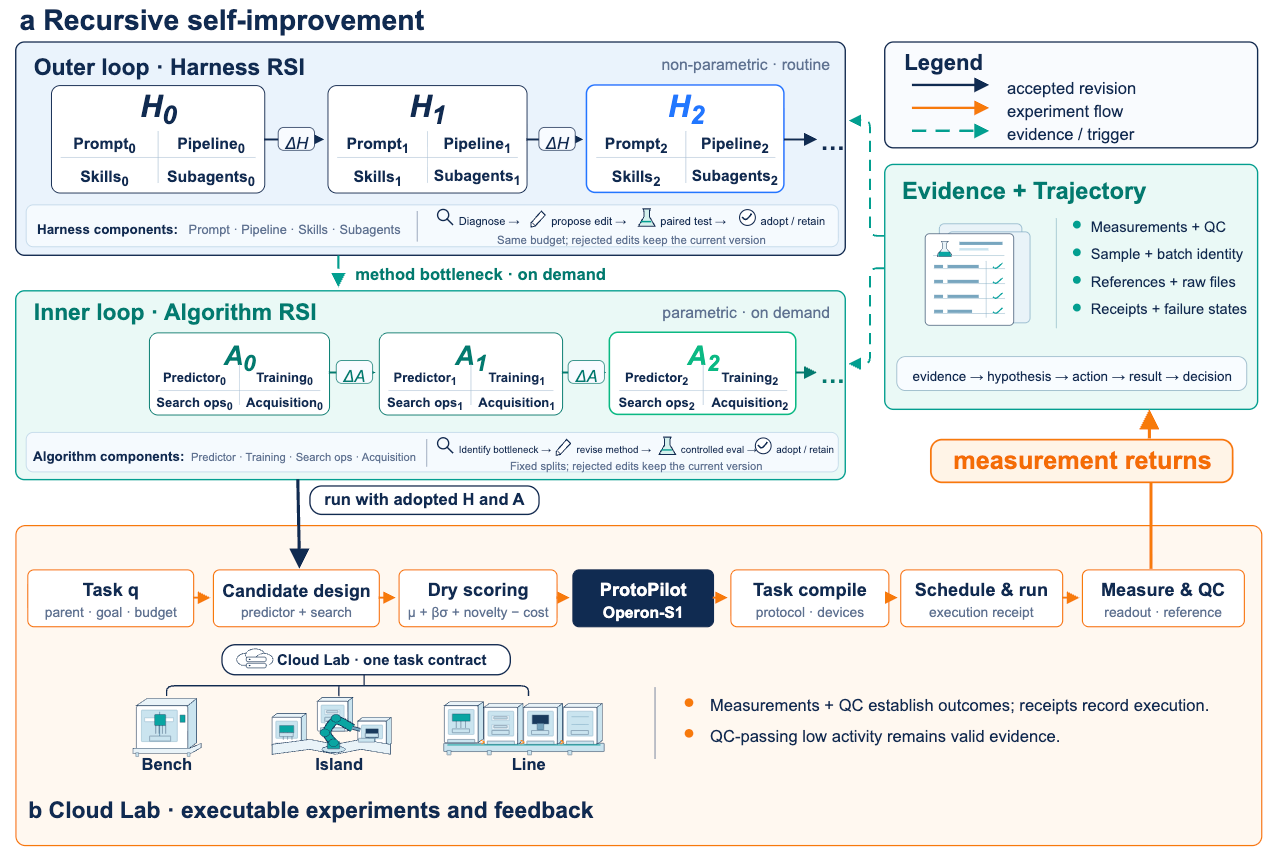
Caption: Fig. 1 | The dual-loop structure of EnzymeRSI. a, Dual-loop recursive self-improvement. The outer loop evolves versions of prompts, pipelines, skills and subagents, which are adopted or rolled back after diagnosis, a minimal consistent change bundle and a paired comparison at matched budget; model weights are not modified. The inner loop is triggered only when a method bottleneck appears, and develops predictors, training strategies, search operators and acquisition functions under controlled conditions. Missing packages and permission problems are handled as engineering faults and trigger neither loop. Adoption rules are fixed before the comparison as global adoption, scoped retention or r...
Why It Matters: Shows the separation between harness evolution, algorithm development, and quality-controlled laboratory feedback.
Figure 2
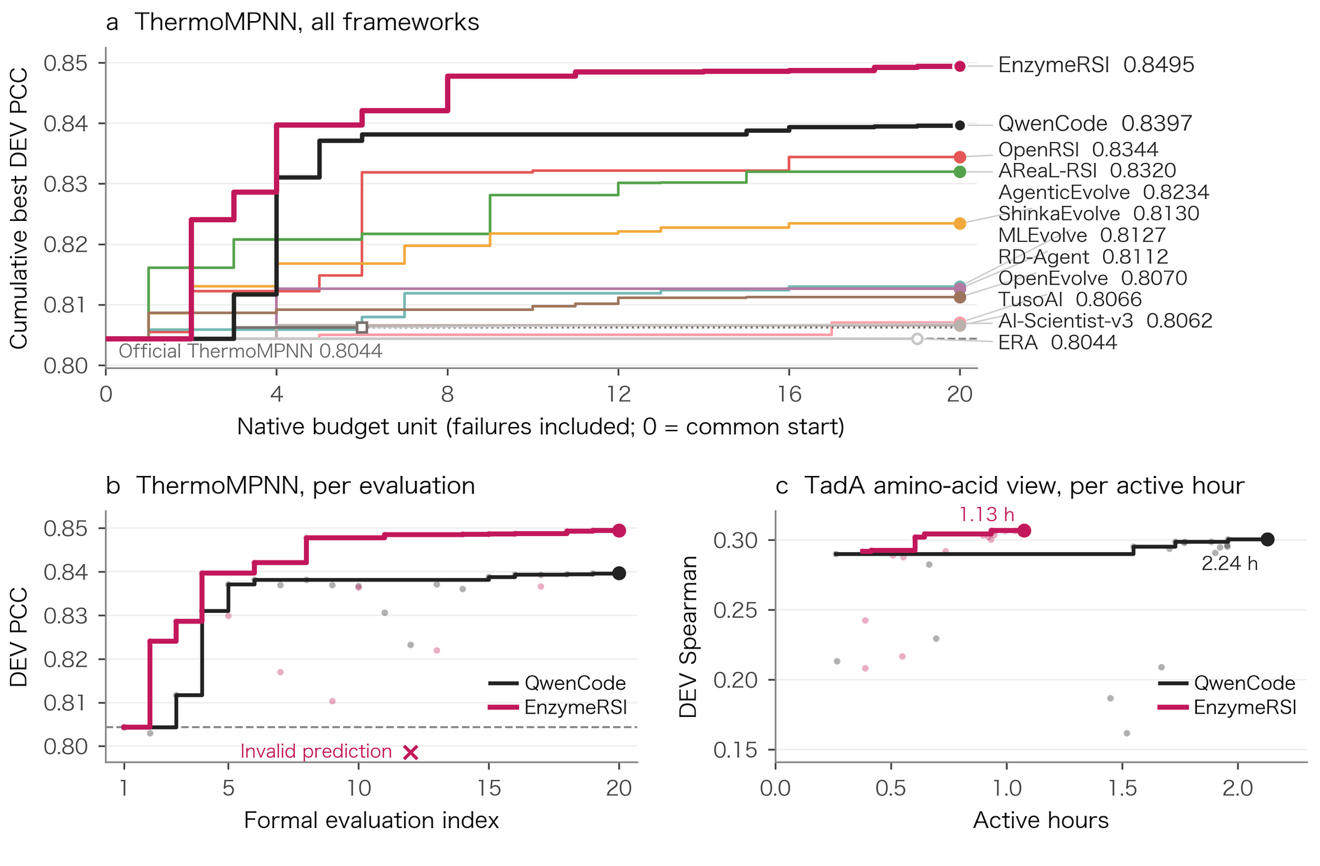
Caption: Fig. 2 | EnzymeRSI and the reference frameworks on two development tasks. a, Cumulative-best trajectory on the ThermoMPNN development set. The horizontal axis counts the framework’s own outer-loop rounds, each framework on its own scale, and includes failed evaluations; 0 is the common starting point. Horizontal position therefore does not represent equal computation across frameworks. The vertical axis is the cumulative best development-set PCC. The dashed line marks the official ThermoMPNN predictor. Filled circles denote a run that completed its native number of rounds, open circles one that did not, and squares an early stop. EnzymeRSI, QwenCode and OpenRSI, the highest of the reference...
Why It Matters: Displays development trajectories and the evaluation-count and active-time context for the two algorithm tasks.
Figure 3
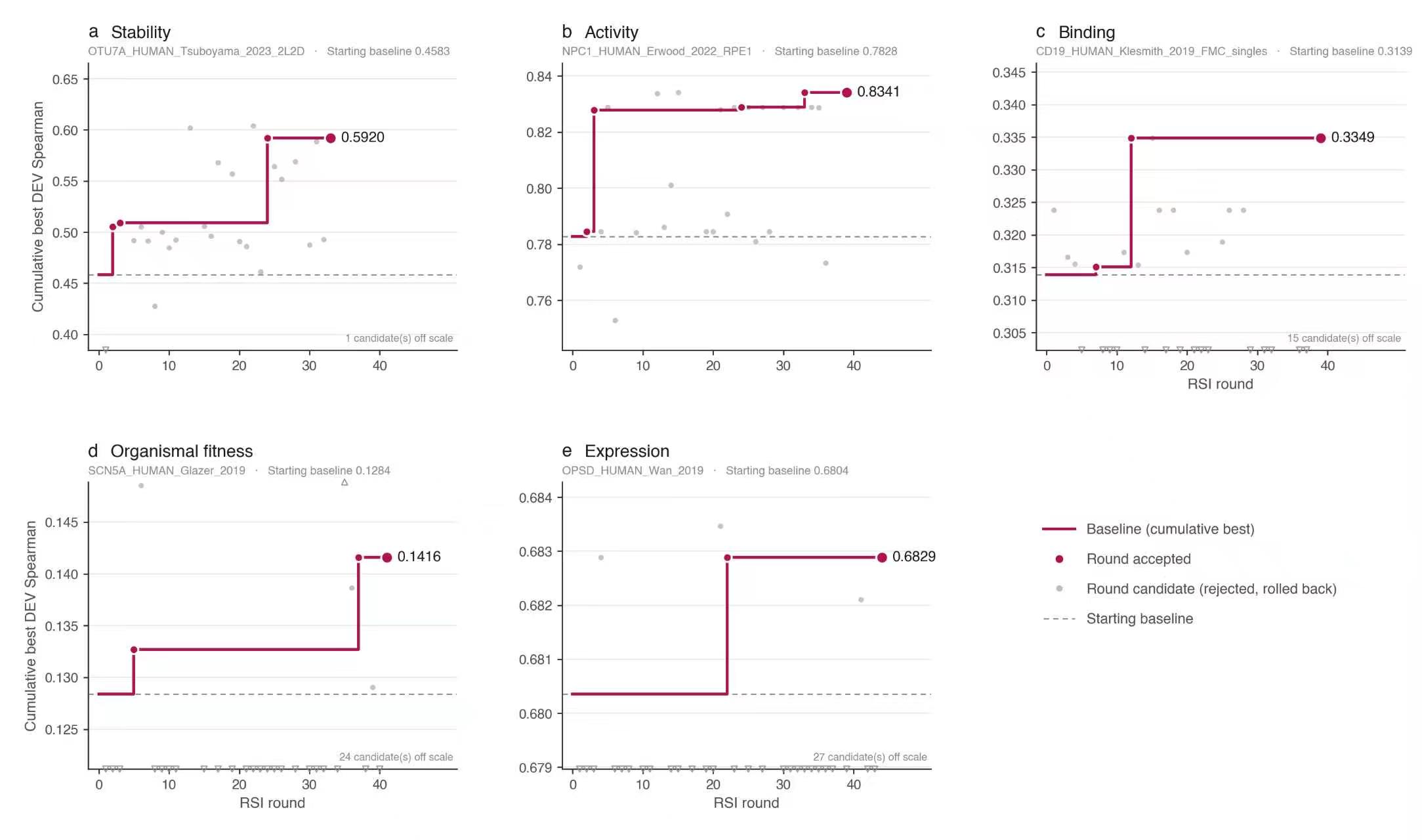
Caption: Fig. 3 | Outer-loop self-improvement trajectories on five classes of protein measurement. The 196 rounds are shown in one panel per property, each making paired comparisons on a single assay: a, folding stability; b, intracellular function; c, binding to the FMC63 monoclonal antibody; d, sodium-channel variant function; e, expression and localisation. The horizontal axis is the RSI round and the vertical axis is the cumulative best Spearman correlation on the development set of that assay. The dark magenta step line is the baseline, which rises only in a round that passes both the paired comparison and the gate. Filled circles mark adopted rounds; the filled circle at the end of each line i...
Why It Matters: Shows per-assay development trajectories and makes the limited number of adopted changes visible.
Figure 4
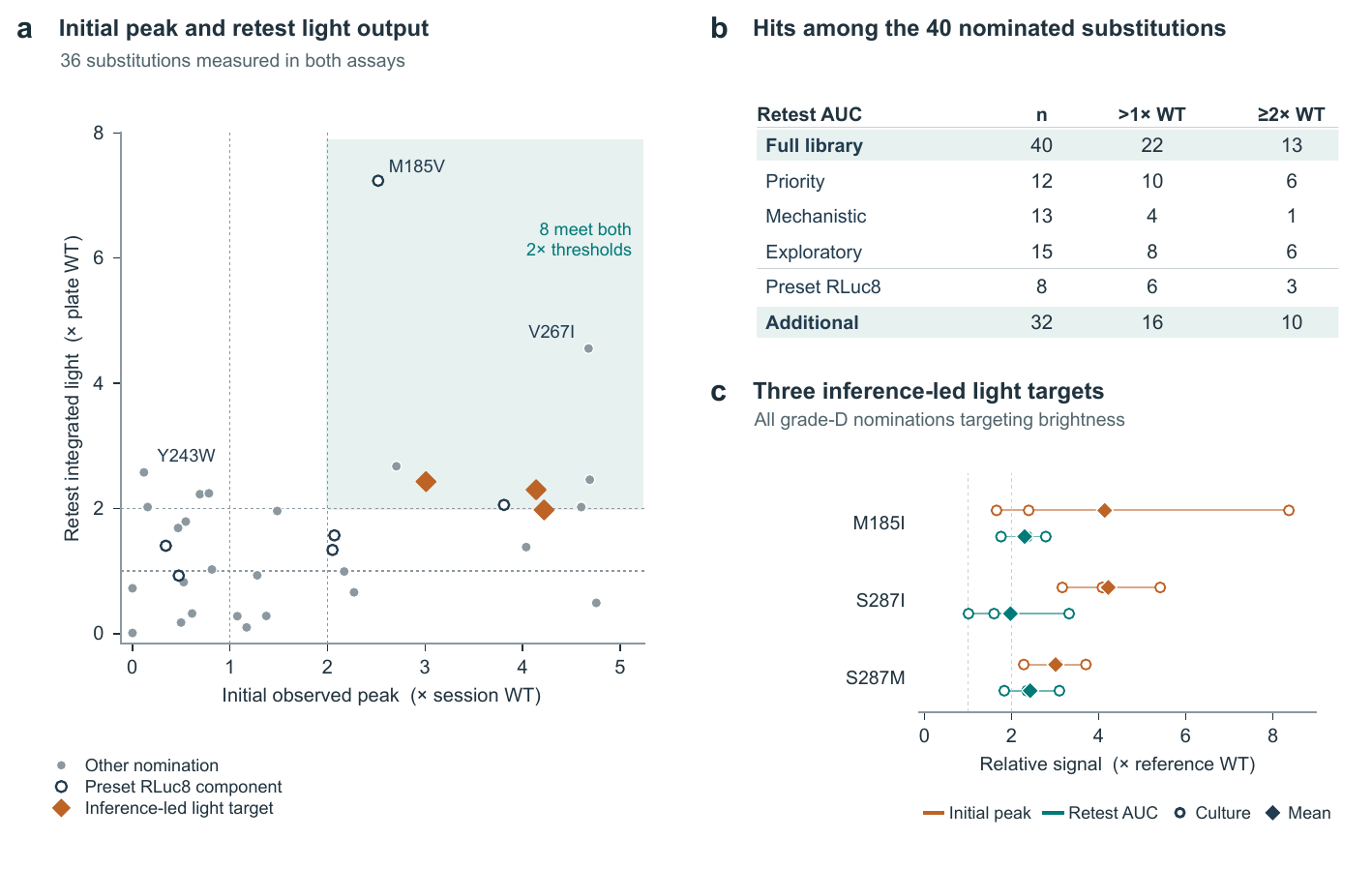
Caption: Fig. 4 | Pre-experiment single-point nominations for RLuc and two luminescence readouts. a, The 36 single substitutions with a readout in both assays. The horizontal axis is the peak over the first 120 s of the initial screen and the vertical axis is the integral over the first 290.2 s of the retest, both normalised to the same-plate wild type; diamonds mark the three brightness candidates that rest on inference alone. b, Retest hit counts for the 40 nominations, grouped by the design category assigned before the experiment. c, Readouts from independent preparations of these three candidates, with their means.
Why It Matters: Connects prospective candidate nomination to retest activity and highlights measurement variability and the ranking gap.
Figure 5
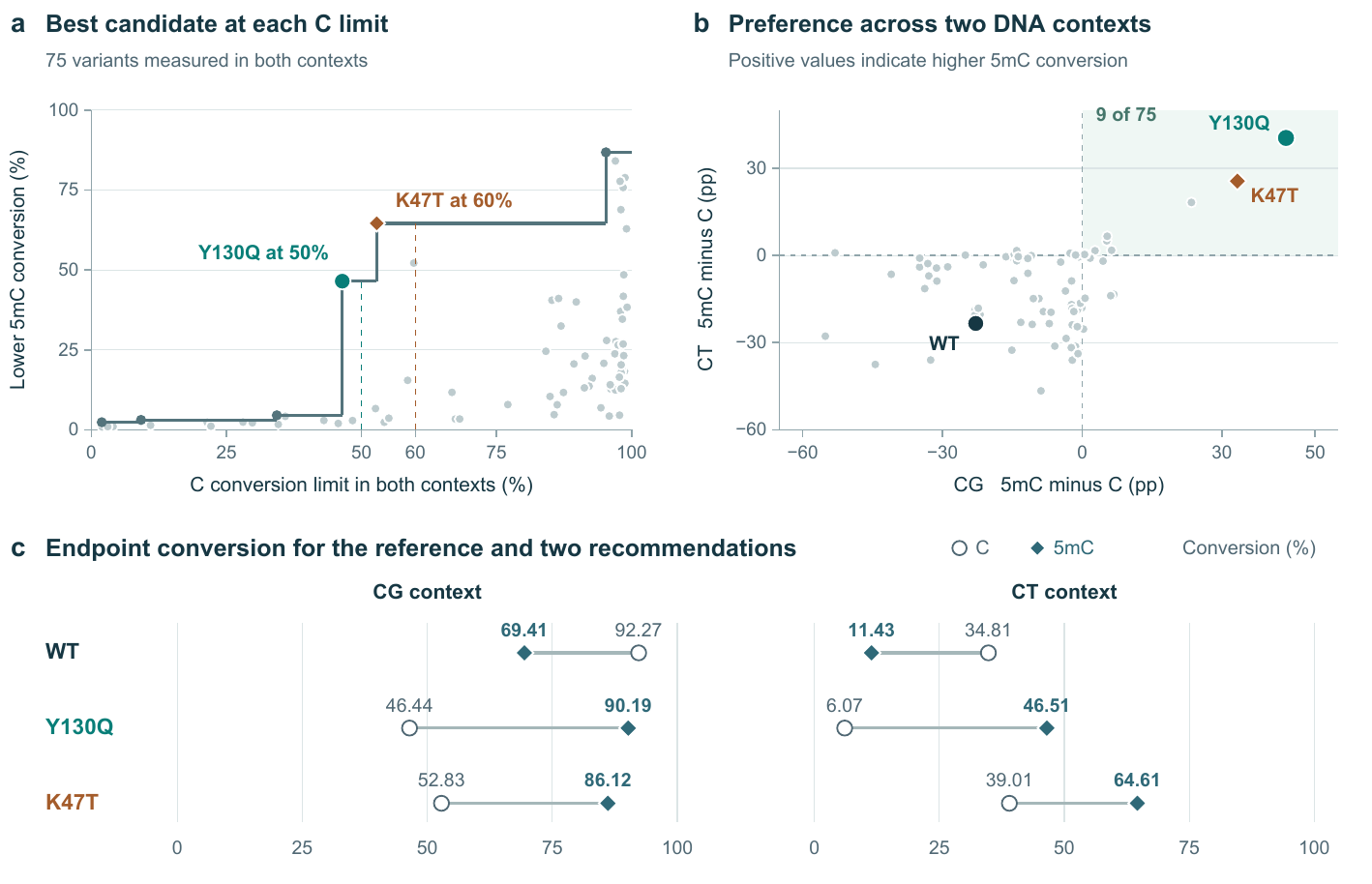
Caption: Fig. 5 | Dual substrate objectives and candidate recommendation for A3A. a, Highest attainable value of the lower 5mC conversion rate across the two contexts, given a limit on the C conversion rate in both contexts; the variants recommended at the 50% and 60% limits are labelled. b, Preference difference, 5mC minus C, within the CG and CT contexts for 75 variants; the upper right quadrant holds the 9 variants that favour 5mC in both contexts. c, Four measured endpoints for the wild type, Y130Q and K47T in the two sequence contexts.
Why It Matters: Illustrates how a hard constraint on C conversion changes the chosen A3A variant and the resulting substrate preference.
Figure 6
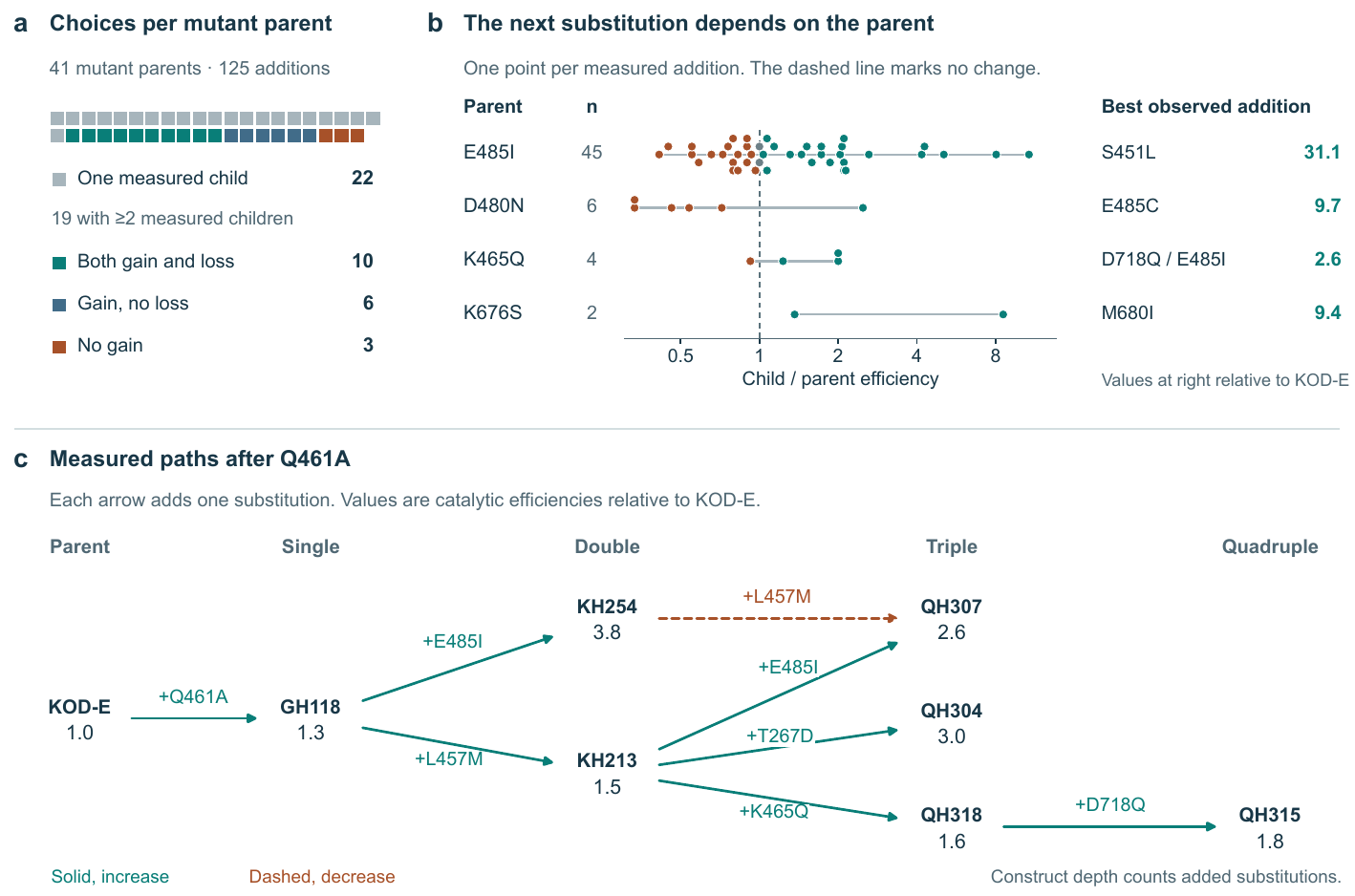
Caption: Fig. 6 | Single-step selection and evolutionary paths for KOD-E. a, Distribution of parents with one or more assayed descendants, classified by whether gains and losses both occur among the descendants. b, All comparable descendants of four parents; the horizontal axis is the efficiency ratio of the descendant to its direct parent, and the right-hand column gives the best assayed additional substitution for each parent. c, Assayed paths from Q461A, where level denotes the number of substitutions, solid lines are gain edges, dashed lines are loss edges, and values are catalytic efficiencies relative to KOD-E.
Why It Matters: Shows that route recommendations depend on the chosen objective and that descendant substitutions can produce both gains and losses.
🔮 Conclusion
The authors’ results support evaluating workflow organization and scientific methods as separate components: harness changes can improve development-set prediction, while method changes can address task-specific representation or objective mismatch. Prospective RLuc, A3A, and KOD-E studies show that pool construction, hard constraints, and evolutionary path objectives produce distinct decision problems.
The work also exposes important limits. RLuc nomination produced hits but weak within-pool ranking, the reported outer-loop gains are development-set measurements, and the full multi-round physical feedback cycle has not yet been exercised by both loops.
🛠️ Future Research Improvements
The paper proposes applying inner-loop method development directly to the RLuc ranking gap and measuring whether design-to-retest correlation improves under the same nomination budget. It also calls for a multi-round campaign in which both loops commission experiments, receive QC-qualified results, and respond to those results.
Further proposed checks include repeating development-task comparisons across independent evolution seeds and releasing the host-side evaluation contract, including duplicate-prediction and invariant-transform checks, as a reusable specification. These steps would clarify reproducibility, interaction between loops, and transfer beyond the evaluated settings.
🏭 Potential Industry Use Scenarios
The architecture could support enzyme discovery workflows where assay capacity is limited and constraints vary by use case: fluorescence or luminescence screening, substrate-selective biocatalysis, and directed evolution under competing activity and retention requirements. The RLuc and A3A experiments provide prospective evidence for candidate nomination and constraint-dependent selection; KOD-E provides evidence for path selection on a modified substrate.
A laboratory operator could adapt the task contract and execution layer to a single instrument, workcell, production line, or cloud laboratory, as the paper specifies. That is a proposed deployment scope rather than demonstrated production performance: the paper does not report a complete multi-round physical campaign driven by both recursive loops.
💬 Critical Analysis
A strength is the explicit separation of workflow and algorithm changes, together with paired comparisons, predeclared adoption criteria, budget accounting, and records of what version was actually consumed. The enzyme case studies also make objectives and constraints concrete: A3A’s recommendation changes with the C-conversion cap, and KOD-E path choice changes with the optimization rule.
The evidence is uneven across claims. ThermoMPNN and ProteinGym results are development-set outcomes, and the ProteinGym first-place comparison on OPSD was already present at initialization. RLuc highlights a material calibration problem: the nomination pool had a high hit rate, but ranking within it was weak, while reference-well composition affected whether some candidates crossed the twofold threshold. The paper identifies this as a method-layer trigger but does not test its resolution.
The architecture’s operational controls are detailed, but the supplied main-body evidence does not establish the cost, reliability, or generality of a complete closed-loop deployment. A useful next evaluation would separate candidate-generation quality from ranking quality, replicate comparisons across seeds and assays, and measure whether QC-aware multi-round feedback changes later decisions under matched budgets.