
📌 Highlights
The paper proposes a compact defense set for open-set face recognition: monitor training dynamics for Poison-label anomalies, compare detector outputs against an auxiliary model, and probe feature-extractor behavior with Cut-and-Mix.
The strongest evidence is for inference-time defenses. Detector-level Model Pairing reports average FPR of 0.81% and FNR of 4.31%, while Cut-and-Mix keeps FNR below 1.0% for nearly all evaluated well-learned extractor backdoors at FPR between 0.5% and 1.1%.
Early Poison Identification succeeds on the evaluated All-to-One Poison-label cases but fails on the evaluated All-to-One Clean-label cases.
The main unresolved issue is coverage: shared-trigger assumptions, absent antispoofing defenses, and limited evaluation of adaptive or insider-only attacks leave important deployment questions open.
- Open-set metric geometry requires defenses that inspect embeddings, detections, and landmarks rather than only class labels.
- The defenses are designed to be added to existing training or inference pipelines.
- Low reported false-positive rates make the inference methods plausible candidates for layered deployment.
- Weakly learned backdoors can produce misleadingly favorable FNR values because the attack itself may not reliably activate.
🎯 Introduction
A Face Recognition System is a sequential chain of face detection, geometric alignment, antispoofing or presentation-attack detection, and face feature extraction. The feature extractor maps faces into a high-dimensional embedding space and supports open-set verification through cosine similarity and a decision threshold.
Prior backdoor defenses are largely developed for single-model, closed-set classification. That setting does not directly cover face recognition because an attacker can manipulate embedding similarity instead of flipping a fixed class label, and because a compromised upstream detector can propagate malformed inputs into downstream modules.
The paper therefore targets a defender with control over training and inference but potentially compromised acquired data. Its objective is to provide deployable defenses for two critical stages: training-time identification of poisoned feature-extractor identities and inference-time rejection of detector or embedding behavior associated with trigger-conditioned impersonation.
🔬 Methodology
The threat model assumes that an attacker poisons a fraction of a target model's training data, while an insider enrolls with the trigger and later attackers present the same trigger. The poisoning equation covers both localized patch triggers and diffuse patterns. In feature-extractor attacks, All-to-One poisoning redirects trigger-bearing samples toward a target identity region, producing a verification match when cosine similarity exceeds the calibrated threshold.
Early Poison Identification tracks running intra-identity or training-margin-head accuracy during early batches. It records identities that become the best-matching classes unusually early and can optionally remove their samples from the training loader. The defense requires no clean reference set, trigger knowledge, or model surgery, but introduces a reported first-epoch slowdown.
Detector-level Model Pairing uses a secondary detector such as MTCNN. It rejects inputs when the number of detections differs, bounding-box IoU falls below 0.5, or normalized landmark drift exceeds a threshold calibrated from held-out validation data. Cut-and-Mix instead partitions a query with Boolean masks, pastes the chunks onto held-out clean faces, and checks whether too many mixed images retain unusually high cosine similarity with the original query.
The two source equations summarize the trigger construction and the open-set matching condition used by the attacks.
equation 1
Meaning: This controls construction of a poisoned input by applying a binary spatial mask to blend trigger pattern \(\mathbf{t}\) with clean input \(\mathbf{x}\) at strength \(\alpha\).
equation 2
Meaning: This expresses the malicious verification condition in the open-set embedding space.
📊 Experiments
The detector experiments train RetinaFace variants with MobileNetV1 and ResNet50 backbones on WIDER-Face and validate them on CelebA. The feature-extractor experiments train GhostFaceNetV2, IR-SE-50, MobileFaceNet, RobFaceNet, and ResNet50 on MS1Mv2, with validation on LFW, CFP-FF, CFP-FP, AgeDB, CALFW, CPLFW, and VGGFace2_FP. Inference-time defenses use 2,048 CelebA-Spoof faces, equally split between bonafide and spoof faces, while detector-pairing and Cut-and-Mix calibration use held-out CelebA-Spoof images.
The evaluation reports detector precision and recall, feature-extractor pair-wise matching accuracy, attack success rate, and defense FPR/FNR. Detector backdoors generally retain 98%-100% precision; except for a MobileNetV1 RetinaFace LSA-SIG case with 57.02% ASR, the detector attacks achieve an average ASR of 91.97%. For feature extractors, 12 of 12 All-to-One Poison-label attacks learn the backdoor, compared with 3 of 12 All-to-One Clean-label attacks and 0 of 0 evaluated Master Face Poison-label attacks.
Early Poison Identification finds all listed Poison-label cases in the recovered main-body table and misses the listed Clean-label cases. Detector-level Model Pairing reports average FPR of 0.81% and FNR of 4.31%; the paper reports average FNR of 7.06% for FGA and 0.65% for LSA after excluding the previously noted low-ASR case. Cut-and-Mix keeps FNR at or below 1.0% for the other evaluated models when FPR lies between 0.5% and 1.1%, while its two failures correspond to weak backdoors with 31.0% and 55.5% ASR on LFW.
The preliminary FIBA experiment reports 0.0% FNR across all five listed architectures with FPR values between 0.2% and 0.8%, supporting the paper's claim that Cut-and-Mix can extend beyond the directly trained backdoors examined in the main experiments.
tab:result_train_time_defense
Caption: Results of the training-time defense: Early Poison Identification (see Sec.~ssec:methodology_train_defenses_EPI).
| Architecture | Backdoor Regimen | Trigger | Backdoor found? |
|---|---|---|---|
| MobileFaceNet | All-to-One Clean-label | Mask | NO |
| MobileFaceNet | All-to-One Clean-label | SIG | NO |
| RobFaceNet | All-to-One Clean-label | SIG | NO |
| GhostFaceNetV2 | All-to-One Poison-label | BadNets | YES |
| GhostFaceNetV2 | All-to-One Poison-label | SIG | YES |
| IR-SE-50 | All-to-One Poison-label | BadNets | YES |
| IR-SE-50 | All-to-One Poison-label | SIG | YES |
| MobileFaceNet | All-to-One Poison-label | BadNets | YES |
| MobileFaceNet | All-to-One Poison-label | FauxIt | YES |
| MobileFaceNet | All-to-One Poison-label | Mask | YES |
| MobileFaceNet | All-to-One Poison-label | SIG | YES |
| ResNet50 | All-to-One Poison-label | BadNets | YES |
| ResNet50 | All-to-One Poison-label | SIG | YES |
| RobFaceNet | All-to-One Poison-label | BadNets | YES |
| RobFaceNet | All-to-One Poison-label | SIG | YES |
Why It Matters: It shows the defense's success on Poison-label cases and failure on the listed Clean-label cases.
Table 2
Caption: Performance result of the Cut-and-Mix defense against FIBA [7] adversarial examples.
| Architecture | FPR | FNR |
|---|---|---|
| GhostFaceNetV2 | 0.5% | 0.0% |
| IR-SE-50 | 0.5% | 0.0% |
| MobileFaceNet | 0.8% | 0.0% |
| ResNet50 | 0.2% | 0.0% |
| RobFaceNet | 0.8% | 0.0% |
Why It Matters: It provides the cross-architecture FIBA result with low false-positive rates and zero reported false negatives.
fig:introduction_figure
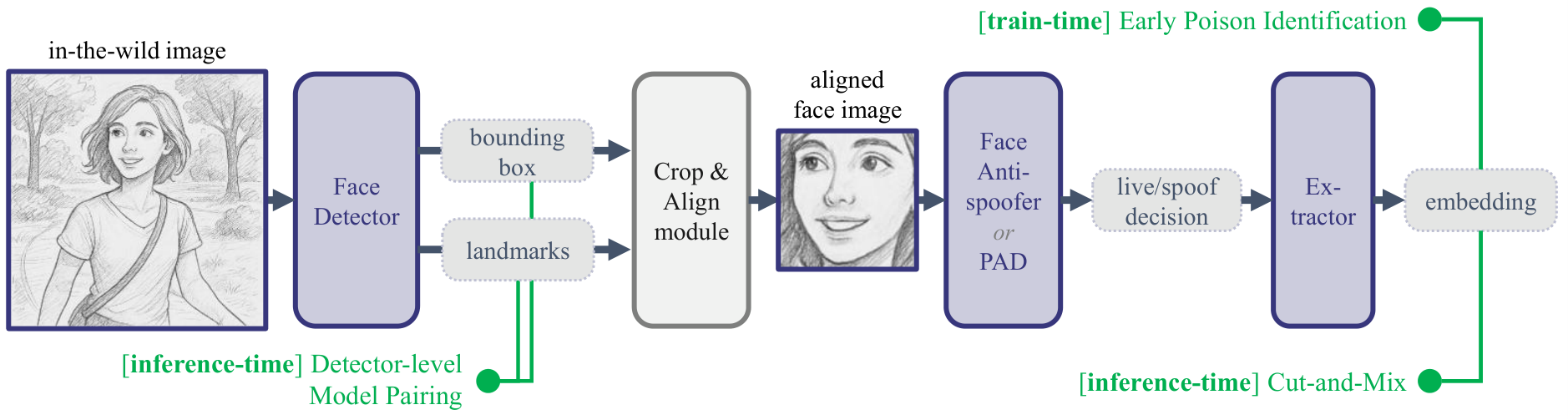
Caption: Schema of a sequential Face Recognition System, juxtaposed with the defenses covered in this paper.
Why It Matters: It locates the three defenses within the detector and feature-extractor stages of the sequential face-recognition pipeline.
fig:defense_early_poison_identification
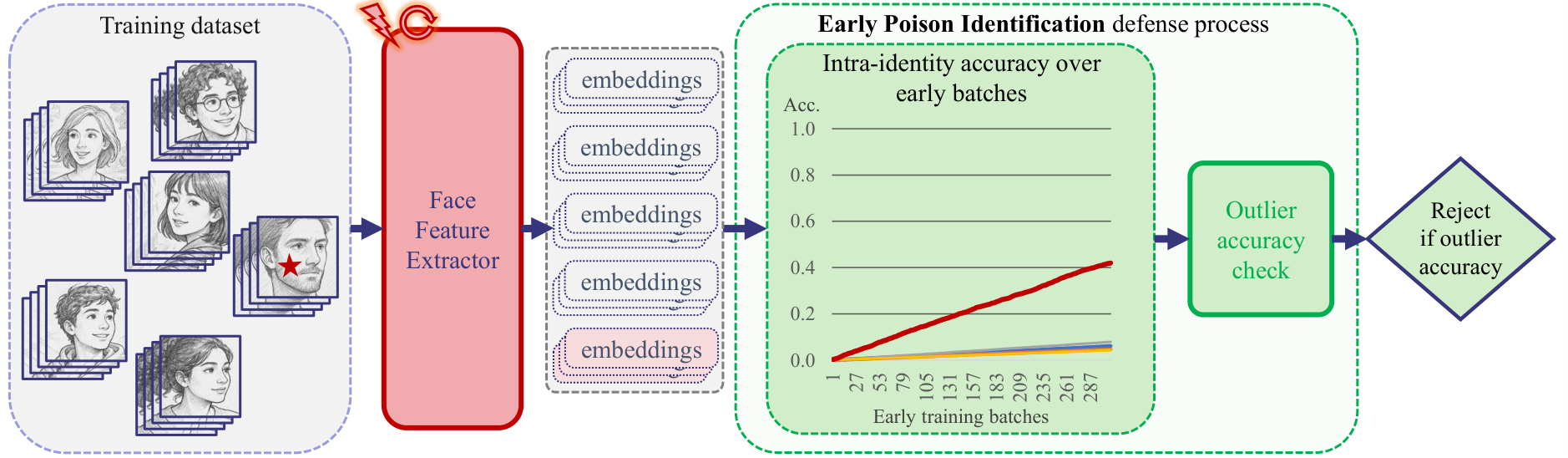
Caption: Representation of the Early Poison Identification defense. During training, the backdoor identity is learned faster than most benign identities. Capturing this behavior during early batches enables singling out backdoors.
Why It Matters: It illustrates the training-dynamics signal used to identify Poison-label backdoors.
fig:defense_detector_level_model_pairing

Caption: Representation of the Detector-Level Model Pairing defense. The outputs of the main, but possibly compromised face detector, are compared to a simpler counterpart to see if they agree: whether their predictions have similar bounding boxes; whether their landmark regressions fall within an acceptable difference range.
Why It Matters: It shows how redundancy at the detector level exposes FGA and LSA-induced inconsistencies.
fig:defense_cut_and_mix
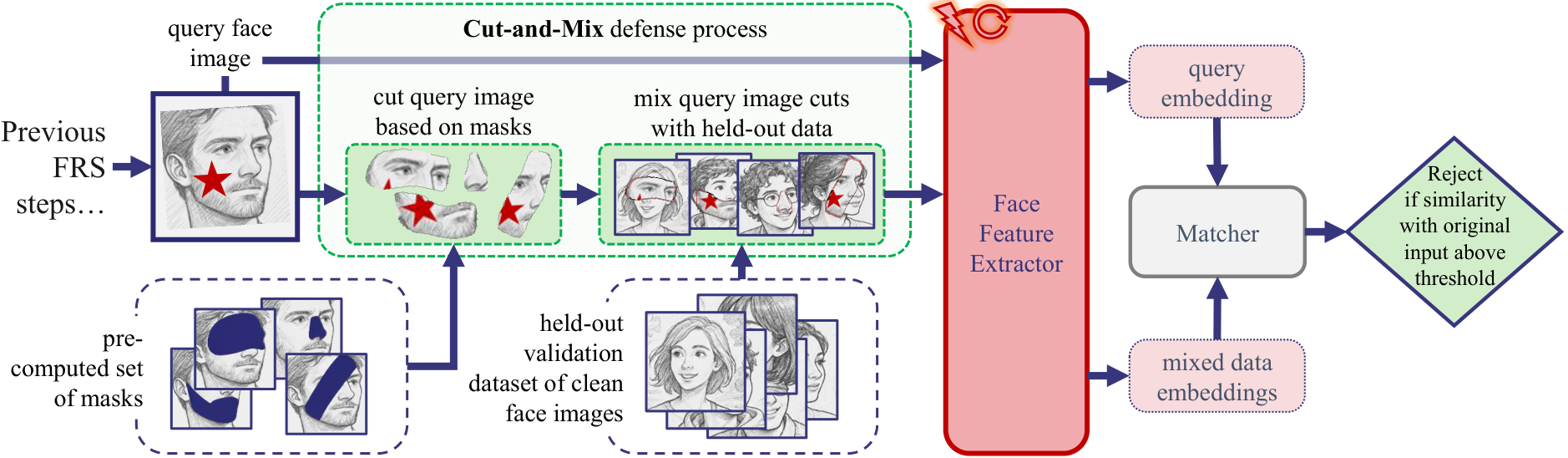
Caption: Representation of the Cut-and-Mix defense. The face query provided by a potentially malicious user is cut into pre-set chunks that are pasted on known-clean, validation data. A query image is rejected if it spuriously matches with a mixed held-out face.
Why It Matters: It clarifies how the defense tests whether a trigger fragment dominates embedding similarity.
fig:performance_ffe_a2oc
Caption: Validation Pair-Wise Accuracy (left) and Attack Success Rate (right) of face feature extractors backdoored using an All-to-One Clean-label approach~leroux2026soksurvivabilitybackdoorattacks.
Why It Matters: It provides the result-focused view of clean-label feature-extractor behavior, including the contrast between benign pair-wise performance and limited attack learnability.
🔮 Conclusion
The paper argues that backdoor mitigation for face recognition should account for open-set embeddings and the interactions among pipeline components. Its three defenses cover training-time feature-extractor monitoring and inference-time detector and embedding checks.
The reported results support strong practical value for well-learned shared-trigger attacks: detector pairing rejects most FGA and LSA cases with low FPR, while Cut-and-Mix is effective against most evaluated feature-extractor backdoors and the preliminary FIBA examples.
The conclusion is appropriately qualified by the Clean-label failure, the absent antispoofing defense, and the broader attack surface involving adaptive triggers, insider-only collisions, and adversarial examples.
🛠️ Future Research Improvements
The most direct improvement is a finer-grained training-time defense for All-to-One Clean-label poisoning. Identity-level accuracy trajectories are insufficient when clean target samples conceal the trigger, so future methods should distinguish poisoned and clean elements within the same identity class.
Evaluation should expand beyond simple patch and diffuse triggers to stronger adaptive attacks and should test whether attackers can deliberately optimize around detector agreement or Cut-and-Mix calibration.
The paper also identifies three missing directions: defenses for antispoofing modules, coverage of UniID-style insider-only collision attacks, and systematic study of how adversarial examples and backdoors interact across the full pipeline.
- Develop sample-level or representation-level training monitors for Clean-label poisoning.
- Test adaptive attacks that optimize against the auxiliary detector and held-out validation set.
- Evaluate end-to-end attack survival after simultaneous compromise of multiple pipeline stages.
- Add antispoofing models and physically implemented triggers to the benchmark.
🏭 Potential Industry Use Scenarios
Organizations that train face-recognition models with externally sourced data could run Early Poison Identification as a training gate, recording or pruning suspicious identities before deployment. The reported low number of captured identities and lack of clean reference-data requirements make this suitable for a controlled training pipeline, provided the Clean-label gap is accepted.
Authentication providers could place Detector-level Model Pairing before alignment and feature extraction, using a widely tested auxiliary detector to reject suspicious box or landmark disagreements. This is most relevant where the primary detector is difficult to retrain or independently audit.
A biometric verification service could add Cut-and-Mix as a query-level screening stage using a small, human-verified clean validation set. The reported GPU-batched delays and low FPR/FNR results suggest a possible layered deployment, but operational thresholds should be recalibrated on the deployment population and hardware.
For high-assurance deployments, the three defenses can be combined across lifecycle stages: training-time screening for data poisoning, detector redundancy at inference, and embedding-space query screening before final matching.
💬 Critical Analysis
The paper's strongest design choice is aligning each defense with a concrete property of face-recognition systems: rapid trigger learning for Poison-label identities, perceptible detector-level geometric corruption for FGA and LSA, and trigger-dominated embedding similarity for feature-extractor attacks. This produces defenses that are easier to deploy than full model replacement and that respect the open-set nature of biometric verification.
The evidence is less decisive for Clean-label and weakly learned attacks. Early Poison Identification misses the evaluated Clean-label cases, while Cut-and-Mix failures occur on backdoors whose low ASR means poisoned samples often do not match strongly enough to appear as outliers. Detector-level FNR can also rise when an attack is not properly learned because the primary detector forwards the true benign face rather than the malicious trigger region.
The evaluation is broad across architectures and named benchmarks, but the reported conclusions remain bounded by the trigger families, training schedules, calibration data, and shared-trigger attacker assumption. A builder should therefore treat the defenses as layered risk-reduction mechanisms rather than complete protection, and should validate them against adaptive attacks and the exact operating distribution of the deployed system.
- Strength: the methods target pipeline-specific failure modes rather than importing closed-set classification assumptions unchanged.
- Strength: the inference defenses report low FPR while preserving useful rejection of well-learned attacks.
- Weakness: Clean-label poisoning remains an explicit blind spot for the training-time method.
- Open question: adaptive attackers may exploit calibration sets, auxiliary-model disagreements, or the fixed mask family used by Cut-and-Mix.