
📌 Highlights
SEED reframes multimodal hallucination as a decoding-trajectory problem. The paper's central observation is that hallucinated trajectories combine prolonged low entropy with abrupt local entropy transitions, while correct trajectories maintain higher average entropy and more effective early visual grounding.
The method is training-free: it monitors entropy online and performs a targeted visual re-alignment only when both detection conditions are satisfied. In the reported experiments, it improves 21 of 27 model–benchmark settings and adds less than 5% end-to-end latency.
The principal caveat is non-uniformity. SEED performs strongly on the two Qwen3-VL backbones but produces small declines on several Llama-3.2-11B settings, especially POPE.
- Core mechanism: relative low-entropy regime plus local entropy spike triggers visual re-alignment.
- Evidence: 1,228 VQA trajectories, six benchmarks, three MLLM backbones, and intervention ablations.
- Best practical signal: accuracy gains with near-baseline efficiency on M3CoT.
- Main risk: sensitivity to architecture and short-answer formatting.
🎯 Introduction
MLLMs have advanced on cross-modal reasoning but can generate outputs that are inconsistent with the visual context, especially in long Chain-of-Thought processes where intermediate errors propagate. Existing training-based approaches use stronger supervision or reinforcement learning but increase cost, while training-free decoding methods often focus on which tokens are hallucinated rather than how multimodal interactions steer the full generation trajectory.
The paper's objective is to treat entropy as structured evidence about multimodal information integration over time. Analysis with Qwen3-VL-8B on M3CoT finds that correct trajectories maintain higher entropy across generation, while incorrect trajectories show prolonged but ineffective visual dependence. The population analysis further reports larger entropy changes and longer low-entropy runs for hallucinated responses.
Figures 1 and 2 support the motivation visually: correct trajectories converge visual attention more effectively, whereas the example hallucination develops alongside sharp entropy spikes and increasingly diffuse visual attention.
tab:population
Caption: Population-level entropy statistics on 1,228 VQA trajectories (Qwen3-VL-8B). $ H$@onset is the mean entropy change at the aligned hallucination onset ($p=0$); the remaining columns are per-trajectory statistics. $p$-values are from two-sided Mann--Whitney U tests.
| $H$@onset | Low-entropy duration | Spike frequency | Max $H$ | |
|---|---|---|---|---|
| Correct ($n=465$) | 0.012 | 17.6 | 0.085 | 1.762 |
| Hallucinated ($n=763$) | 0.245 | 21.4 | 0.101 | 1.974 |
| $p$-value | $4 \times 10^{-4}$ | $<10^{-35}$ | $<10^{-9}$ | $<10^{-16}$ |
Why It Matters: The hallucinated trajectories have larger entropy jumps at aligned onset, longer low-entropy runs, more frequent spikes, and larger maximum changes, supporting the two-condition detector used by SEED.
🔬 Methodology
SEED formulates multimodal reasoning as autoregressive generation conditioned on text and visual inputs. At each step it computes entropy from the full next-token distribution. A trigger requires both a relative low-entropy condition and a local entropy-rise condition, capturing the paper's proposed global-local mismatch: overall overconfident convergence combined with a sudden local instability.
After a trigger, the method extracts a reference visual-importance map by averaging vision self-attention across heads. It uses that map to pool visual embeddings into e_vis and adds the resulting vector to the first language-model layer's hidden state. The intervention is therefore targeted in time and operates without changing the MLLM architecture.
The reported protocol monitors decoding steps 5 through 60, uses tau_rise=0.25 and alpha=0.5, injects for two steps after each trigger, caps generation at 512 tokens, and fixes the configuration across backbones and benchmarks after selection on a small held-out M3CoT subset.
- Backbones: Qwen3-VL-8B-Instruct, Qwen3-VL-4B-Instruct, and Llama-3.2-11B-Vision.
- Architecture-specific handling: Llama-3.2-Vision visual features are rescaled before residual-stream injection.
- Reported hardware: four NVIDIA RTX 5090 GPUs with 32GB VRAM.
Equation 1
Meaning: Defines the MLLM's autoregressive multimodal token-generation distribution conditioned on the text input, visual input, and previously generated tokens.
Equation 2
Meaning: Computes the token-level entropy that SEED monitors as a trajectory-level signal of decoding uncertainty and multimodal coordination.
Equation 3
Meaning: Tests whether the current entropy is in a relative low-entropy regime during the monitoring window; the paper adapts tau_low to the mean of preceding entropy values.
Equation 4
Meaning: Detects a local entropy spike, representing a sharp transient change that may indicate instability from cross-modal conflict.
📊 Experiments
The evaluation covers six benchmarks in nine settings. General multimodal reasoning uses VStar, MMVP, VisOnly_s, VisOnly_r, and M3CoT; hallucination evaluation uses HalluBench and POPE, with POPE-R, POPE-P, and POPE-A reported as separate settings. The three backbones are compared with the base CoT setting and training-free baselines VCD, MemVR, and OPERA, using consistent generation hyperparameters.
On general reasoning, Table 2 reports SEED macro-average gains of +3.17, +3.71, and +3.15 percentage points for Qwen3-VL-8B, Qwen3-VL-4B, and Llama-3.2-11B, respectively. It improves over the corresponding base model in 13 of 15 settings. On hallucination benchmarks, Table 3 reports +2.49 and +3.56 average gains for the two Qwen3-VL models and +0.28 for Llama-3.2-11B, with the Llama scores declining on POPE-R, POPE-P, and POPE-A.
The attention-intervention ablation shows that Equal attention can improve accuracy but reduces efficiency to 0.05 and 0.07 instance/s, while Truncated SVD Project and ViT attention intervene cause large accuracy losses. SEED reaches 79.97 accuracy and 0.19 instance/s on Qwen3-VL-8B M3CoT, and 78.03 accuracy and 0.21 instance/s on Qwen3-VL-4B. The paper also reports end-to-end latency of 3.30 to 3.45 ms/token for SEED, compared with 54% overhead for VCD, 157% for MemVR, and 333% for OPERA.
The reported sensitivity analysis on Qwen3-VL-8B M3CoT finds no tested setting across alpha in [0.4, 0.7], tau_rise in [0.225, 0.300], and t1 in [40, 70] below the base model, although alpha=0.7 is the exception to the claim that all settings improve on it.
- Metric direction: all reported benchmark metrics are higher-is-better, as indicated by the upward arrows in Tables 2 and 3.
- General reasoning result: SEED is positive in 13/15 settings.
- Hallucination result: the strongest reported gains are POPE-R and POPE-P on both Qwen3-VL backbones.
- Failure case: Llama-3.2-11B POPE performance decreases by 0.2–1.8 points across the three splits.
Table 2
Caption: Comparisons across general reasoning benchmarks. The summary column reports the macro-average change in percentage points and the number of strictly positive changes over available settings. Base MLLMs use the default CoT setting.
| Method | VStar↑ | MMVP↑ | VisOnly_s↑ | VisOnly_r↑ | M3CoT↑ | Summary ∆(%) / improved |
|---|---|---|---|---|---|---|
| Qwen3-VL-8B | 73.82 | 76.23 | 42.20 | 54.60 | 78.21 | – |
| + VCD | 54.45(-19.4) | 80.00(+3.8) | 42.57(+0.4) | 55.71(+1.1) | 77.68(-0.5) | −2.93 / 3/5 |
| + MemVR | 74.87(+1.0) | 80.67(+4.4) | 41.86(-0.3) | 54.44(-0.2) | 77.68(-0.5) | +0.89 / 2/5 |
| + SEED (Ours) | 83.25(+9.4) | 76.33(+0.1) | 47.00(+4.8) | 54.37(-0.2) | 79.97(+1.8) | +3.17 / 4/5 |
| Qwen3-VL-4B | 68.06 | 76.33 | 42.14 | 52.22 | 76.79 | – |
| + VCD | 54.97(-13.1) | 78.67(+2.3) | 43.25(+1.1) | 52.73(+0.5) | 75.28(-1.5) | −2.13 / 3/5 |
| + MemVR | 66.49(-1.6) | 76.33(-0.0) | 42.14(-0.0) | 54.22(+2.0) | 76.08(-0.7) | −0.06 / 1/5 |
| + SEED (Ours) | 76.76(+8.7) | 77.33(+1.0) | 45.57(+3.4) | 56.42(+4.2) | 78.03(+1.2) | +3.71 / 5/5 |
| Llama-3.2-11B | 50.26 | 62.33 | 25.00 | 33.40 | 64.66 | – |
| + VCD | 42.41(-7.8) | 63.67(+1.3) | 27.14(+2.1) | 33.91(+0.5) | 63.13(-1.5) | −1.08 / 3/5 |
| + MemVR | 40.31(-9.9) | 60.30(-2.0) | 21.57(-3.4) | 27.78(-5.6) | - | −5.26 / 0/4 |
| + SEED (Ours) | 57.61(+7.3) | 61.33(-1.0) | 28.00(+3.0) | 36.90(+3.5) | 67.58(+2.9) | +3.15 / 4/5 |
Why It Matters: SEED has positive changes in 13 of 15 general-reasoning settings and the largest reported macro-average improvement for each backbone in this table, although individual regressions remain.
Table 3
Caption: Comparisons across hallucination benchmarks. The summary column reports the macro-average change in percentage points and the number of positive changes over available settings. Base MLLMs use the default CoT setting.
| Method | HalluBench↑ | POPE-R↑ | POPE-P↑ | POPE-A↑ | Summary ∆(%) / improved |
|---|---|---|---|---|---|
| Qwen3-VL-8B | 58.50 | 90.25 | 87.53 | 86.42 | – |
| + VCD | 56.24(-2.3) | 91.67(+1.4) | 87.03(-0.5) | 86.30(-0.1) | −0.37 / 1/4 |
| + MemVR | 55.87(-2.6) | 90.63(+0.4) | 88.12(+0.6) | 86.85(+0.4) | −0.31 / 3/4 |
| + SEED (Ours) | 59.28(+0.8) | 97.39(+7.1) | 90.94(+3.4) | 85.07(-1.3) | +2.49 / 3/4 |
| Qwen3-VL-4B | 54.80 | 90.92 | 88.64 | 87.96 | – |
| + VCD | 53.84(-1.0) | 90.60(-0.3) | 87.87(-0.8) | 87.37(-0.6) | −0.66 / 0/4 |
| + MemVR | 55.27(+0.5) | 90.77(-0.2) | 87.69(-1.0) | 88.39(+0.4) | −0.05 / 2/4 |
| + SEED (Ours) | 54.84(+0.0) | 98.45(+7.5) | 92.84(+4.2) | 90.43(+2.5) | +3.56 / 4/4 |
| Llama-3.2-11B | 42.38 | 91.33 | 88.02 | 85.04 | – |
| + VCD | 43.66(+1.3) | 86.23(-5.1) | 80.80(-7.2) | 76.43(-8.6) | −4.91 / 1/4 |
| + MemVR | 43.16(+0.8) | 91.02(-0.3) | 87.86(-0.2) | 83.83(-1.2) | −0.23 / 1/4 |
| + SEED (Ours) | 46.42(+4.0) | 91.10(-0.2) | 87.10(-0.9) | 83.27(-1.8) | +0.28 / 1/4 |
Why It Matters: SEED improves both Qwen3-VL backbones on the hallucination-focused suite, but its smaller positive average on Llama-3.2-11B shows that the intervention is architecture- and output-format-sensitive.
Table 4
Caption: Comparison of attention intervention strategies across backbones on M3CoT (Chen et al., 2024). Each backbone is evaluated in terms of accuracy and efficiency (instance/s). All hyperparameters are kept consistent. The best and second-best results are highlighted in green and blue, respectively.
| Attention Intervention Strategy | Qwen3-VL-8B Accuracy ↑ | Qwen3-VL-8B Efficiency ↑ | Qwen3-VL-4B Accuracy ↑ | Qwen3-VL-4B Efficiency ↑ |
|---|---|---|---|---|
| None (baseline) | 78.21 | 0.20 | 76.79 | 0.22 |
| + Equal attention | 80.24(+2.0) | 0.05(×0.25) | 78.02(+1.2) | 0.07(×0.32) |
| + Truncated SVD Project | 54.28(-23.9) | 0.17(×0.85) | 50.23(-26.6) | 0.18(×0.82) |
| + ViT attention intervene | 60.32(-17.9) | 0.15(×0.75) | 55.36(-21.4) | 0.16(×0.73) |
| + SEED (Ours) | 79.97(+1.8) | 0.19(×0.95) | 78.03(+1.2) | 0.21(×0.95) |
Why It Matters: The ablation separates the value of the trigger-conditioned visual intervention from simpler attention modifications: Equal attention improves accuracy but is much slower, while the other variants lose substantial accuracy; SEED retains near-baseline efficiency.
fig:preliminary1
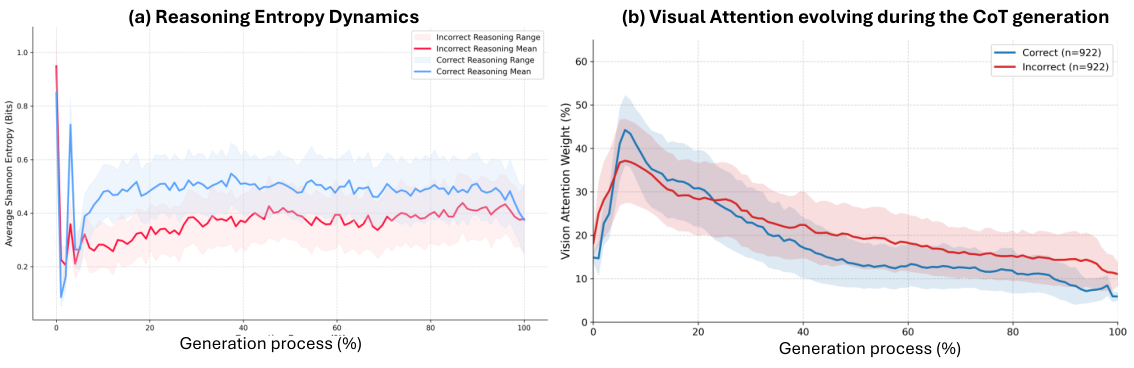
Caption: Comparison of generation dynamics between correct and incorrect multimodal reasoning trajectories. (a) Average reasoning entropy across the generation process over samples, where correct predictions consistently maintain higher entropy than incorrect ones. (b) Evolution of visual attention during CoT generation, showing that correct reasoning trajectories preserve stronger visual grounding at the early stage of reasoning, while incorrect trajectories exhibit progressively weakened but still higher attention to visual evidence. Shaded regions denote standard deviations.
Why It Matters: This motivates the paper's central reinterpretation of entropy: successful reasoning is associated with sustained controlled uncertainty and faster visual-attention convergence, whereas incorrect trajectories show lower entropy and prolonged but ineffective visual dependence.
fig:preliminary2
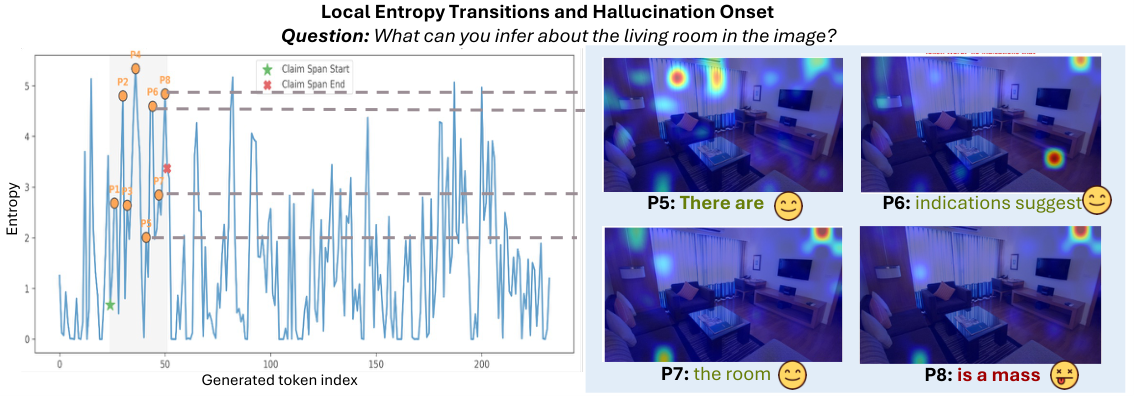
Caption: A case study illustrating hallucination emergence during MLLM reasoning. The left panel shows entropy over generated tokens, while the right panel visualizes the corresponding visual attention patterns at selected reasoning steps (P5--P8). The gray region denotes the span of incorrect generation. Hallucinated reasoning coincides with sharp entropy spikes (P8) and progressively strong but diffused visual attention. More examples can be found in Appendix~preliminary.
Why It Matters: The case study links sharp local entropy transitions with the onset of unsupported reasoning and diffuse visual attention, illustrating the event that SEED is designed to detect.
fig:pipeline
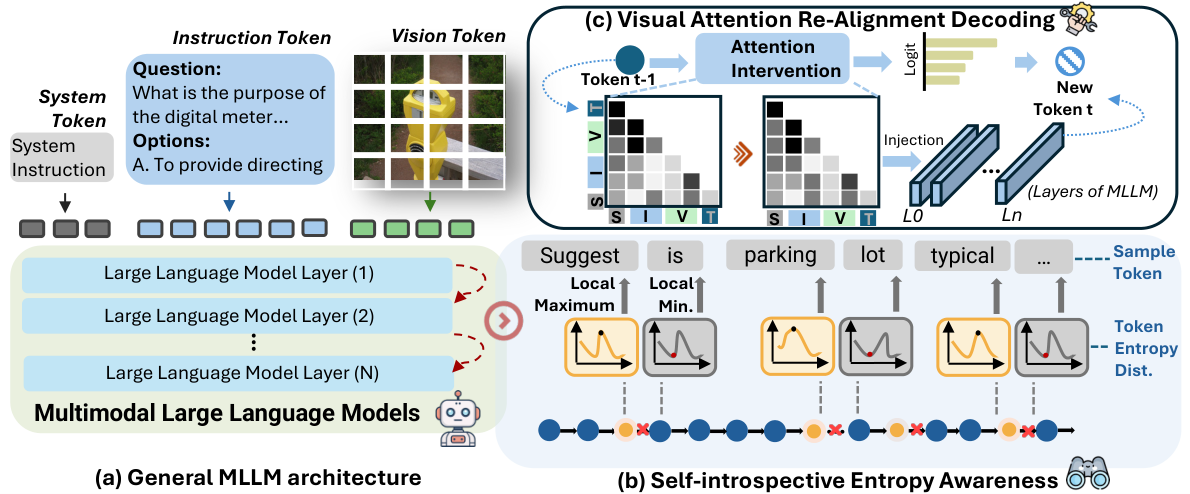
Caption: Framework overview of the proposed SEED. The figure presents three parts: (a) A standard MLLM architecture processes system instructions and visual tokens through stacked decoder layers to perform multimodal reasoning. (b) A self-introspective mechanism monitors token-level entropy dynamics throughout the decoding process, capturing locally important spikes that signal shifts in reasoning dynamics. (c) When both detection conditions are met, our method performs an attention intervention during decoding to rectify the multimodal interaction. We refer to this process as Visual Attention Re-alignment Decoding.
Why It Matters: This figure clarifies the complete inference-time path from entropy monitoring to visual-feature extraction and early hidden-state intervention.
🔮 Conclusion
The paper argues that multimodal hallucination is a dynamic failure of cross-modal coordination rather than only a static token-confidence problem. SEED operationalizes this view with entropy monitoring and targeted visual re-alignment, and the reported experiments show broad gains across reasoning and hallucination benchmarks.
The strongest practical result is the combination of positive average changes across all three backbones on general reasoning with near-baseline efficiency in the M3CoT intervention ablation. However, the Llama-3.2-11B POPE declines show that the same intervention can interact poorly with architecture-specific visual pathways and short binary output formats.
🛠️ Future Research Improvements
The paper explicitly points to query-dependent visual representations and adaptive intervention strengths as next directions. These could replace the single pooled representation and fixed alpha with signals conditioned on the question, current reasoning state, or detected visual region.
Further work should test whether entropy transitions remain predictive across larger model families, different image encoders, longer outputs, and tasks beyond the six reported benchmarks. Controlled random-trigger and no-op comparisons would also help determine whether the benefit comes from the entropy detector, the visual injection itself, or both.
- Learn or infer question-dependent visual pooling instead of using one attention-derived representation.
- Adapt intervention duration and strength to the magnitude or persistence of entropy changes.
- Evaluate calibration, visual grounding, and answer-format compliance separately.
- Measure causal intervention value with matched trigger controls.
🏭 Potential Industry Use Scenarios
SEED is most directly relevant to deployed vision-language systems that must answer questions about images while limiting unsupported claims, such as visual assistants, document-understanding tools, inspection interfaces, and multimodal customer-support agents. Its training-free design could make it attractive where model weights cannot be retrained but inference-time hooks are available.
The method is especially suitable for systems with longer reasoning traces, because the detector operates during generation and can intervene at suspected failure points. Production use would require architecture-specific validation, latency measurement under real serving loads, and safeguards for tasks where exact short-form outputs are more important than free-form reasoning.
- Visual question answering and image-grounded assistants.
- Document, chart, and screen understanding with factuality checks.
- Industrial or operational inspection systems requiring visual grounding.
- Multimodal agents where retraining is expensive but decoder instrumentation is possible.
💬 Critical Analysis
The paper's strongest aspect is the alignment between mechanism and evidence: the proposed trigger is motivated by trajectory statistics, the visual intervention directly targets the hypothesized grounding failure, and the ablation compares several alternative attention modifications. The fixed cross-setting configuration also makes the reported comparisons easier to interpret than per-benchmark tuning.
The main unresolved issue is causal interpretation. The population statistics demonstrate association between entropy dynamics and hallucination, but they do not show that entropy spikes cause the failure or that visual injection repairs the underlying reasoning state. The Llama results further indicate that the intervention may perturb output behavior without consistently improving factuality; the paper attributes the POPE decline mainly to invalid-format outputs, which should be independently verified.
Reproduction should therefore track accuracy, hallucination subtype, output-format validity, latency, trigger frequency, and intervention location together. A successful implementation should reproduce not only the positive aggregate summaries but also the reported regressions and architecture-specific behavior.
- Strength: interpretable inference-time trigger tied to measurable decoding dynamics.
- Strength: broad evaluation across reasoning and hallucination benchmarks.
- Caveat: evidence is limited to three backbones and the reported benchmark protocol.
- Open question: whether entropy is a reliable causal control signal or a useful proxy for another hidden failure process.