
📌 Highlights
ArcRAG targets compositional graph retrieval across graph constructions. It induces a query-local interface from nearby graph structure, plans multi-hop traversals, and executes them as Cypher.
On a stratified ablation sample, adding exploration improves accuracy over direct Cypher generation at all 18 tested retry/pass settings: by 15–39 points on FinReflectKG and 12–32 points on OpenIE graphs. At five retries and five passes, the best configurations report 88.0% and 74.0%, compared with 50.0% and 59.0% for Generator alone and 12.0% and 6.0% for the single-attempt Direct-Cypher agent.
With configuration fixed within each dataset, ArcRAG transfers across schema-guided and open-vocabulary graphs, but FinReflectKG scores are higher by 6.0 EM on MuSiQue, 9.0 EM on HotpotQA, and 16.3 F1 on TriviaQA.
The study uses public encyclopedic QA benchmarks; it does not establish reliability in regulated domains, and an executable witness does not guarantee factual correctness or claim-level attribution.
- Core claim: query-time interface induction supports retrieval across two graph construction families.
- Strongest controlled evidence: exploration improves over direct generation across tested retry and pass settings.
- Main caveat: the graph families differ in both structure and provenance, and the experiments do not separate their effects.
tab:ablation
Caption: Transfer across knowledge-graph families. All ArcRAG prompts, models, and hyperparameters are fixed within a dataset; only the graph family and its provenance-determined evidence store change. HippoRAG and HippoRAG~2 figures for MuSiQue and HotpotQA are as reported by bai2025autoschemakgautonomousknowledgegraph under a common harness; the HippoRAG~2 TriviaQA figure is from luo2026graphr1agenticgraphragframework. As above, prior work reports F1 only on TriviaQA.
| Method | MuSiQue EM | MuSiQue F1 | HotpotQA EM | HotpotQA F1 | TriviaQA F1 |
|---|---|---|---|---|---|
| HippoRAG | 26.2 | 35.1 | 52.6 | 63.5 | --- |
| HippoRAG 2 | 37.2 | 48.6 | 62.7 | 75.5 | 46.9 |
| ArcRAG (w/ OpenIE Graph) | 38.0 | 45.0 | 65.5 | 72.2 | 71.6 |
| ArcRAG (w/ FinReflectKG) | 44.0 | 53.0 | 74.5 | 80.8 | 87.9 |
Why It Matters: Reports cross-construction results with ArcRAG settings fixed within each dataset. The higher schema-guided scores show that portability does not imply invariant accuracy.
🎯 Introduction
Passage similarity retrieval works when an answer is contained in one passage, but compositional questions may require enumerating candidates, testing properties, and checking constraints that no individual passage states. The paper argues that flat retrieval leaves relationships among passages implicit and that multi-hop questions also require evidence whose connecting path can be traced.
GraphRAG makes relationships traversable, but retrieval strategies often assume the schema and relation semantics of the graph construction they were designed for. ArcRAG asks whether one procedure can remain effective when graph construction changes, without construction-specific schema, relation names, or retuning.
The paper contributes a query-time induced graph interface, planned and executable traversal with repair, and a paired evaluation on schema-guided and open-vocabulary graphs built from MuSiQue, HotpotQA, and TriviaQA.
🔬 Methodology
The target is a labeled property graph whose schema is read by introspection. Given question anchors, ArcRAG explores nearby structure to produce a query-local interface: relation descriptors, observed signatures, and paths that confirm them. Exploration also surfaces candidate aliases and paraphrased relation descriptors so later steps can use variants present in noisy graphs.
A planner selects a bounded set of subplans and an answer type from the question and induced interface. The generator compiles each hop as a read-only Cypher query. Unacceptable results, including errors, empty results, unbound variables, or row-cap violations, can trigger refinement of predicates and bindings while traversal shape remains fixed. Results accumulate into a witness; answers use source passages when graph edges carry chunk provenance and rows otherwise.
The retrieve-answer loop starts another pass when the answer model judges the evidence insufficient and proposes a follow-up question. The main text describes query-time exploration and the control flow, but the supplied formula extraction does not recover a verifiable numbered source equation.
page 5
page 5
page 5
page 5
ArcRAG retrieval
Steps: ['Retrieve phrases from the current question and identify graph anchors.', 'Use the retrieved chunks to bound a chunk-backed graph, or use retrieved triples as hints for an OpenIE graph.', 'Explore the graph near the anchors to induce a query-local interface of relation descriptors and paths.', 'Plan bounded subplans, compile each hop to Cypher, execute it, and refine unacceptable results within the attempt budget.', 'Accumulate the witness and compose an answer from source passages or returned rows.', 'If evidence is insufficient, form a follow-up question and repeat until sufficient, no follow-up is available, or the iteration cap is reached.']
Why It Matters: Captures the paper's staged retrieval procedure, including its validation and retrieve-answer loop.
📊 Experiments
The paper evaluates MuSiQue, HotpotQA, and TriviaQA. MuSiQue composes up to four single-hop questions with bridging entities absent from the question; HotpotQA is predominantly two-hop; TriviaQA is predominantly single-hop and serves as a control. Graphs are frozen before evaluation, questions are answered end to end without gold passages, entities, or hop counts, and the main results follow the validation-sample convention of HippoRAG and IRCoT. Component ablations use a stratified 100-question sample from all three datasets on both graph families.
Exact match (EM) is the primary metric; token-level F1 is included for comparison with prior work, which reports only F1 on TriviaQA. Scores use prior GraphRAG normalization, maximum over references, and averaging over questions. The Direct-Cypher baseline uses one attempt and one pass without exploration, planning, refinement, or follow-up. At five retries and five passes, the ablation reports 88.0% and 74.0% for ArcRAG's best configurations, 50.0% and 59.0% for Generator alone, and 12.0% and 6.0% for Direct-Cypher, respectively, on FinReflectKG and OpenIE. Exploration improves over direct generation at all 18 tested settings, but the comparisons control retries and passes rather than total inference cost.
In the cross-construction table, ArcRAG with FinReflectKG reports 44.0 EM and 53.0 F1 on MuSiQue, 74.5 EM and 80.8 F1 on HotpotQA, and 87.9 F1 on TriviaQA; with the OpenIE graph it reports 38.0 EM and 45.0 F1, 65.5 EM and 72.2 F1, and 71.6 F1, respectively. The paper attributes the gap jointly to construction and provenance. Its comparison with prior systems is a best-reported summary across differing protocols, models, and scoring code, not a controlled ranking.
tab:ablation
Caption: Transfer across knowledge-graph families. All ArcRAG prompts, models, and hyperparameters are fixed within a dataset; only the graph family and its provenance-determined evidence store change. HippoRAG and HippoRAG~2 figures for MuSiQue and HotpotQA are as reported by bai2025autoschemakgautonomousknowledgegraph under a common harness; the HippoRAG~2 TriviaQA figure is from luo2026graphr1agenticgraphragframework. As above, prior work reports F1 only on TriviaQA.
| Method | MuSiQue EM | MuSiQue F1 | HotpotQA EM | HotpotQA F1 | TriviaQA F1 |
|---|---|---|---|---|---|
| HippoRAG | 26.2 | 35.1 | 52.6 | 63.5 | --- |
| HippoRAG 2 | 37.2 | 48.6 | 62.7 | 75.5 | 46.9 |
| ArcRAG (w/ OpenIE Graph) | 38.0 | 45.0 | 65.5 | 72.2 | 71.6 |
| ArcRAG (w/ FinReflectKG) | 44.0 | 53.0 | 74.5 | 80.8 | 87.9 |
Why It Matters: Shows the paired results for fixed ArcRAG settings across graph families, alongside prior figures cited under the table's stated protocols.
tab:best-published
Caption: Best EM and F1 reported for each method on each dataset, taken across all models and configurations its authors evaluated. Protocols, answer models, and scoring code differ across sources, so this is a best-reported summary rather than a controlled comparison. Prior work reports F1 only on TriviaQA.
| Method | MuSiQue EM | MuSiQue F1 | HotpotQA EM | HotpotQA F1 | TriviaQA F1 |
|---|---|---|---|---|---|
| GraphRAG~ edge2024graphrag | 27.3 | 38.5 | 55.2 | 68.6 | 45.1 |
| LightRAG~ guo2025lightragsimplefastretrievalaugmented | 20.0 | 29.3 | 33.3 | 44.9 | 40.2 |
| PathRAG~ chen2025pathragpruninggraphbasedretrieval & 8.4 | 20.8 | 23.8 | 41.2 | 37.4 | |
| HippoRAG~ hipporag | 27.8 | 40.5 | 58.5 | 73.1 | --- |
| HippoRAG 2~ hipporag2 | 37.2 | 48.6 | 62.7 | 75.5 | 46.9 |
| HyperGraphRAG~ luo2025hypergraphragretrievalaugmentedgenerationhypergraphstructured | 10.1 | 23.2 | 29.5 | 46.9 | 45.0 |
| HiRAG~ huang2025retrievalaugmentedgenerationhierarchicalknowledge | --- | --- | 37.0 | 52.3 | --- |
| TERAG~ xiao2025teragtokenefficientgraphbasedretrievalaugmented | 18.8 | 29.6 | 46.9 | 59.8 | --- |
| CatRAG~ lau2026breakingstaticgraphcontextaware | --- | 45.0 | --- | --- | --- |
| NeuroPath~ li2025neuropathneurobiologyinspiredpathtracking | 31.4 | 44.3 | 50.5 | 64.7 | --- |
| StepChain GraphRAG~ ni2025stepchaingraphragreasoningknowledge | --- | --- | 66.7 | 79.5 | --- |
| Graph-R1~ luo2026graphr1agenticgraphragframework | --- | 46.2 | --- | 62.7 | 71.9 |
| ArcRAG (w/ FinReflectKG) | 44.0 | 53.0 | 74.5 | 80.8 | 87.9 |
Why It Matters: Gives best-reported context while preserving the paper's caveat that protocols and models differ.
fig:arch
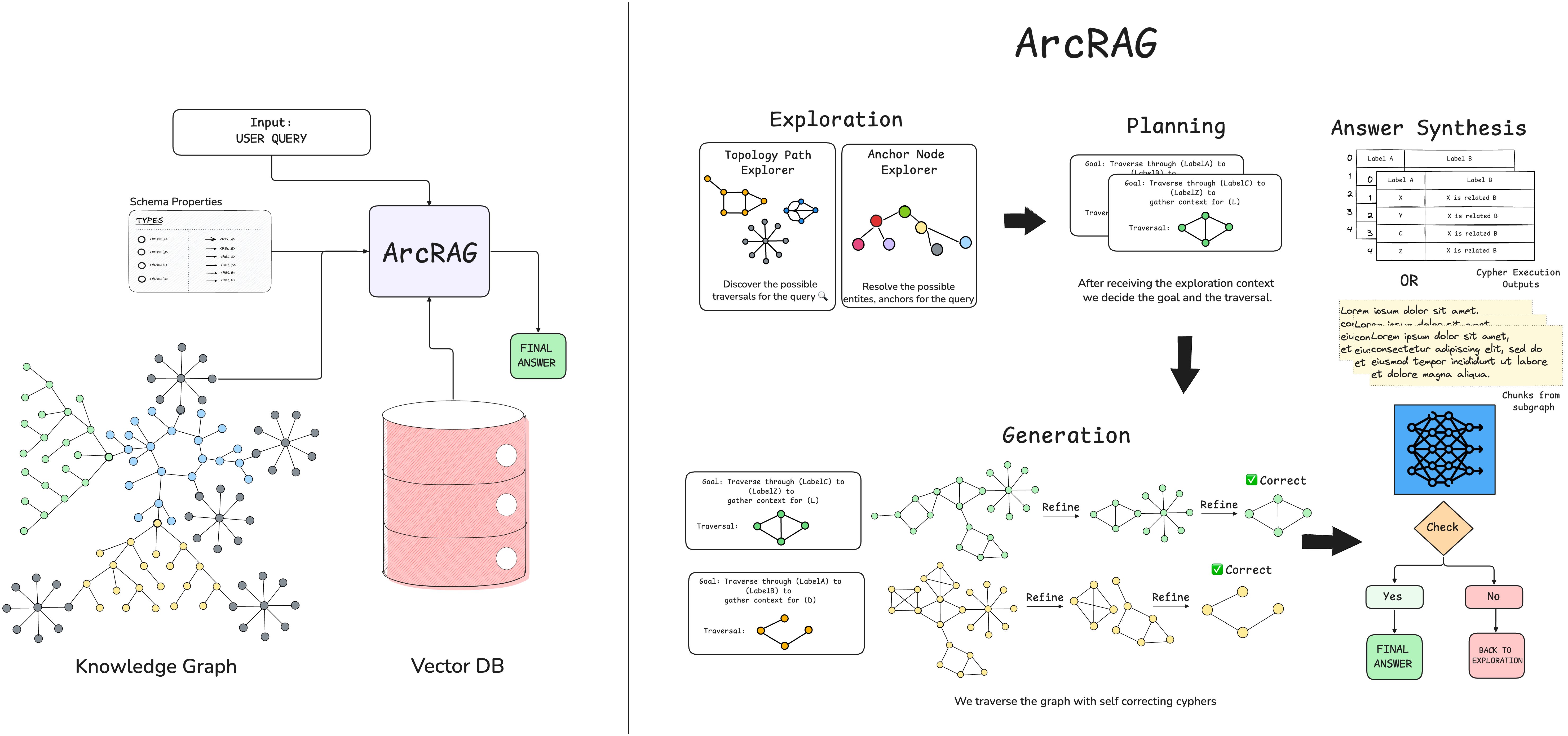
Caption: ArcRAG at inference (left) and the harness (right): exploration $ $ planning $ $ generation $ $ synthesis.
Why It Matters: Shows the retrieval stages and how the evaluation harness supplies graph and evidence stores.
🔮 Conclusion
The reported results support a bounded portability claim: one configuration per dataset can operate over both schema-guided and open-vocabulary graphs, and query-local interface induction improves on direct Cypher generation across the tested ablation budgets. Graph construction still shapes absolute accuracy, and the paired results do not disentangle structure from provenance.
The best-reported comparisons place ArcRAG's schema-guided results above the listed prior figures, but those sources use differing protocols and answer models. The paper treats this as context rather than a controlled improvement claim.
🛠️ Future Research Improvements
The authors identify a limited construction scope, confounded graph structure and provenance, unmeasured canonicalization robustness, single-run variance, and lack of regulated-domain evaluation. They also state that construction can still affect accuracy.
Useful follow-up work would vary provenance independently of graph structure, add graph families with curated ontologies and different node granularities, measure repeated-run uncertainty and total inference cost, and test claim-level evidence attribution on domain-specific tasks. These are proposed evaluations, not results established by this paper.
🏭 Potential Industry Use Scenarios
The paper motivates graph-backed retrieval for finance, law, healthcare, and compliance, where questions can span records and answers may need traceable evidence paths. ArcRAG's witness and provenance-aware answer synthesis suggest a possible system design for surfacing the graph path and supporting source review.
The experiments use encyclopedic QA and do not establish reliability in those domains. An executable witness shows how retrieval proceeded, not that the answer is correct; domain validation, claim-level attribution checks, and human oversight would be necessary before operational use.
💬 Critical Analysis
A strength is the paired transfer setup: graph family changes while each dataset's ArcRAG prompts, models, and hyperparameters remain fixed. The Direct-Cypher comparison and budgeted component ablations provide evidence that exploration contributes beyond direct query generation, while the planner's value is graph- and budget-dependent.
The evidence has clear limits. The two graph families differ in structure and provenance, and prior-system scores are not controlled comparisons. Exploration and planning add LLM calls, but the reported ablations control retry and pass budgets rather than total cost. The paper notes that query refinement fixes traversal shape, which may prevent a correct candidate from surviving a mistaken earlier choice.
The system returns an executable witness but does not verify claim-level attribution; answer synthesis and evidence sufficiency are model-judged. Public benchmark questions and a large pretrained answer model may contribute parametric knowledge. Repeated runs, cost measurements, and domain-specific validation would strengthen the practical case.