
📌 Highlights
ArtiVidRM’s central design is to observe visible artifacts before assigning a quality score, turning the artifact list into an explicit and inspectable rubric. The strongest evidence is its out-of-domain preference performance together with downstream improvements in both open-weight and closed-source video generation.
The method is technically interesting because it aligns the intermediate artifact representation and final preference decision with separate but coordinated rewards. The main caveat is that the artifact annotations depend on multimodal-language-model supervision and the downstream gains vary by benchmark dimension.
- Best or tied-best pairwise accuracy on GenAI-Bench and best results on both VBench-2.0 settings.
- Second-best MonetBench performance behind VisionReward.
- Wan2.1 Motion Smoothness improves from 97.41 to 98.38 and Imaging Quality from 61.31 to 63.85.
- ArtiVidRM-refined Veo-3.1 videos are preferred in 71% of blind comparisons, with 18% ties.
- The ablation results support the importance of SFT and semantic artifact-recall reward.
🎯 Introduction
The paper addresses reward modeling for text-to-video generation, where reinforcement learning and preference optimization require a reliable signal for judging generated clips. Existing scalar preference models compress diverse spatial, temporal, and semantic defects into opaque values, while reasoning-based models may produce rationales that are not faithful to or explicitly optimized as the basis of the final decision.
ArtiVidRM’s paper-level objective is to make reward decisions verifiable and actionable. It predicts an open-vocabulary list of visible artifacts, assigns severity information, and then uses that list to support pairwise preference prediction, reward-guided diffusion optimization, and iterative refinement of closed-source generators.
🔬 Methodology
The data construction process begins with 26.5K prompt and video-pair triplets from VideoGen-RewardBench, containing overall and aspect-specific preference labels for Visual Quality, Motion Quality, and Text Alignment. Gemini-2.5-Pro and Qwen3-VL-32B independently inspect each pair, a consolidator merges equivalent artifact descriptions, and Qwen3-VL-32B verifies whether each candidate artifact is visibly supported. The verifier removes 26.8% of consolidated candidates, leaving 22,640 pairs and a mean of 6.11 artifacts per video. An expert spot-check reports 87.84% recall, 84.37% precision, and Fleiss’ κ = 0.78.
Training has two stages. Stage I applies autoregressive SFT to structured artifact annotations. Stage II treats each preference example as a two-turn interaction, samples response groups with GRPO, and optimizes normalized group-relative advantages under KL regularization to the SFT policy. The total reward combines format validity, semantic artifact recall, pairwise preference correctness, and an asymmetric length penalty. The paper instantiates the model with Qwen3-VL-8B-Instruct and uses eight NVIDIA H100 GPUs with verl and vLLM.
equation 2
Meaning: The autoregressive SFT objective trains the model to serialize a structured artifact annotation from a prompt and video.
equation 3
Meaning: GRPO normalizes each sampled trajectory reward within its response group to produce the policy-update advantage.
equation 4
Meaning: The RL objective combines GRPO optimization with KL regularization toward the SFT checkpoint.
equation 5
Meaning: The total trajectory reward balances valid formatting, artifact recall, preference correctness, and artifact-list length.
📊 Experiments
The evaluation covers pairwise preference prediction on GenAI-Bench, VBench-2.0, and MonetBench; multi-video ranking on T2VQA-DB, which contains 1,000 prompts with 10 videos per prompt and MOS labels from 27 human raters; pointwise scoring on T2VQA-DB and VideoFeedback2; diffusion optimization of Wan2.1-1.3B evaluated with VBench; and closed-source refinement of Veo-3.1. All preference evaluations are reported as out-of-domain with no training overlap.
ArtiVidRM reaches 0.753 accuracy on GenAI-Bench without ties, 0.572 with ties on VBench-2.0, and 0.524 without ties on VBench-2.0. On MonetBench it reaches 0.606 with ties and 0.697 without ties, ranking second to VisionReward. For multi-video ranking, the paper reports the highest Kendall’s τ and best Hit@3 and Hit@5, while VideoAlign has higher Hit@1 and Spearman’s ρ. ArtiVidRM also outperforms all baselines on VideoFeedback2 Pearson correlation and matches the strongest baseline on T2VQA-DB.
For generator optimization, Wan2.1 improves on VBench Motion Smoothness from 97.41 to 98.38 and Imaging Quality from 61.31 to 63.85. Veo-3.1 refinement improves four of five reported dimensions, including Imaging Quality from 70.14 to 71.44 and Aesthetic Quality from 64.39 to 66.24, while Scene changes from 72.66 to 72.64. Blind human comparisons prefer the optimized Wan2.1 outputs in 60% of cases with 14% ties, and prefer refined Veo-3.1 outputs in 71% of cases with 18% ties.
The ablations show that removing SFT causes a marked drop, removing semantic recall consistently weakens preference prediction, and removing the length penalty changes artifact-list behavior. Average predicted artifact-list length is 1.7 for the base model, 5.9 without SFT, 4.7 for ArtiVidRM, 4.0 without recall reward, and 2.7 without length penalty.
tab:ood
Caption: Pairwise preference prediction accuracy on out-of-domain benchmarks. w/T: accuracy with ground-truth ties retained; w/oT: accuracy after removing ground-truth tie pairs. Each model uses its default tie threshold when applicable. Best results are shown in bold and second-best results are underlined; ``--'' indicates unavailable results. $^*$ denotes results directly taken from the corresponding original publications.
| Model | GenAI-Bench w/T | GenAI-Bench w/oT | VBench-2.0 w/T | VBench-2.0 w/oT | MonetBench w/T | MonetBench w/oT |
|---|---|---|---|---|---|---|
| VideoScore | 0.481 | 0.719 | 0.429 | 0.459 | 0.491$^*$ | 0.549$^*$ |
| VideoAlign | 0.494 | 0.726 | 0.525 | 0.473 | 0.505 | 0.594 |
| VisionReward | 0.518$^*$ | 0.744$^*$ | -- | -- | 0.640$^*$ | 0.721$^*$ |
| UnifiedReward | 0.459 | 0.689 | 0.541 | 0.402 | 0.434 | 0.404 |
| VideoScore2 | 0.456 | 0.678 | 0.404 | 0.468 | 0.449 | 0.453 |
| ArtiVidRM (Ours) | 0.518 | 0.753 | 0.572 | 0.524 | 0.606 | 0.697 |
Why It Matters: ArtiVidRM is best on both VBench-2.0 settings, ties VisionReward on GenAI-Bench w/T, leads GenAI-Bench w/oT, and ranks second on MonetBench.
tab:ablation
Caption: Ablation study on training components. SFT = supervised fine-tuning stage; $r_rec$ = defect recall reward; $r_len$ = length penalty. w/T and w/oT metrics are consistent with Table~tab:ood.
| Variant | SFT | r_rec | r_len | GenAI-Bench w/T | GenAI-Bench w/oT | VBench-2.0 w/T | VBench-2.0 w/oT | VisionRewardDB w/T | VisionRewardDB w/oT | VideoFeedback2 w/T | VideoFeedback2 w/oT |
|---|---|---|---|---|---|---|---|---|---|---|---|
| Base (Qwen3-VL-8B) | ✗ | ✗ | ✗ | 0.435 | 0.497 | 0.508 | 0.226 | 0.346 | 0.411 | 0.543 | 0.575 |
| w/o SFT | ✗ | ✓ | ✓ | 0.342 | 0.431 | 0.580 | 0.183 | 0.232 | 0.330 | 0.473 | 0.483 |
| w/o Recall Reward | ✓ | ✗ | ✓ | 0.469 | 0.624 | 0.407 | 0.358 | 0.398 | 0.554 | 0.551 | 0.599 |
| w/o Length Penalty | ✓ | ✓ | ✗ | 0.459 | 0.605 | 0.392 | 0.312 | 0.439 | 0.536 | 0.574 | 0.622 |
| ArtiVidRM | ✓ | ✓ | ✓ | 0.518 | 0.753 | 0.572 | 0.524 | 0.606 | 0.697 | 0.567 | 0.619 |
Why It Matters: The full objective is strongest on most reported benchmarks, while removing SFT or semantic recall causes substantial degradation.
Figure 5b data
Caption: Raw VBench scores displayed in Figure 5(b), with values shown before → after optimization or refinement.
| Model transition | MS | IQ | SC | SubC | AQ |
|---|---|---|---|---|---|
| Wan2.1-1.3B → Wan2.1 w/ ArtiVidRM | 97.41 → 98.38 | 61.31 → 63.85 | 26.60 → 34.30 | 93.61 → 95.40 | 56.61 → 57.17 |
| Veo-3.1 → Veo-3.1 w/ ArtiVidRM | 98.54 → 98.97 | 70.14 → 71.44 | 72.66 → 72.64 | 93.90 → 94.15 | 64.39 → 66.24 |
Why It Matters: The downstream results show larger gains for the open-weight diffusion model and more selective improvements for prompt-based closed-source refinement.
fig:intro
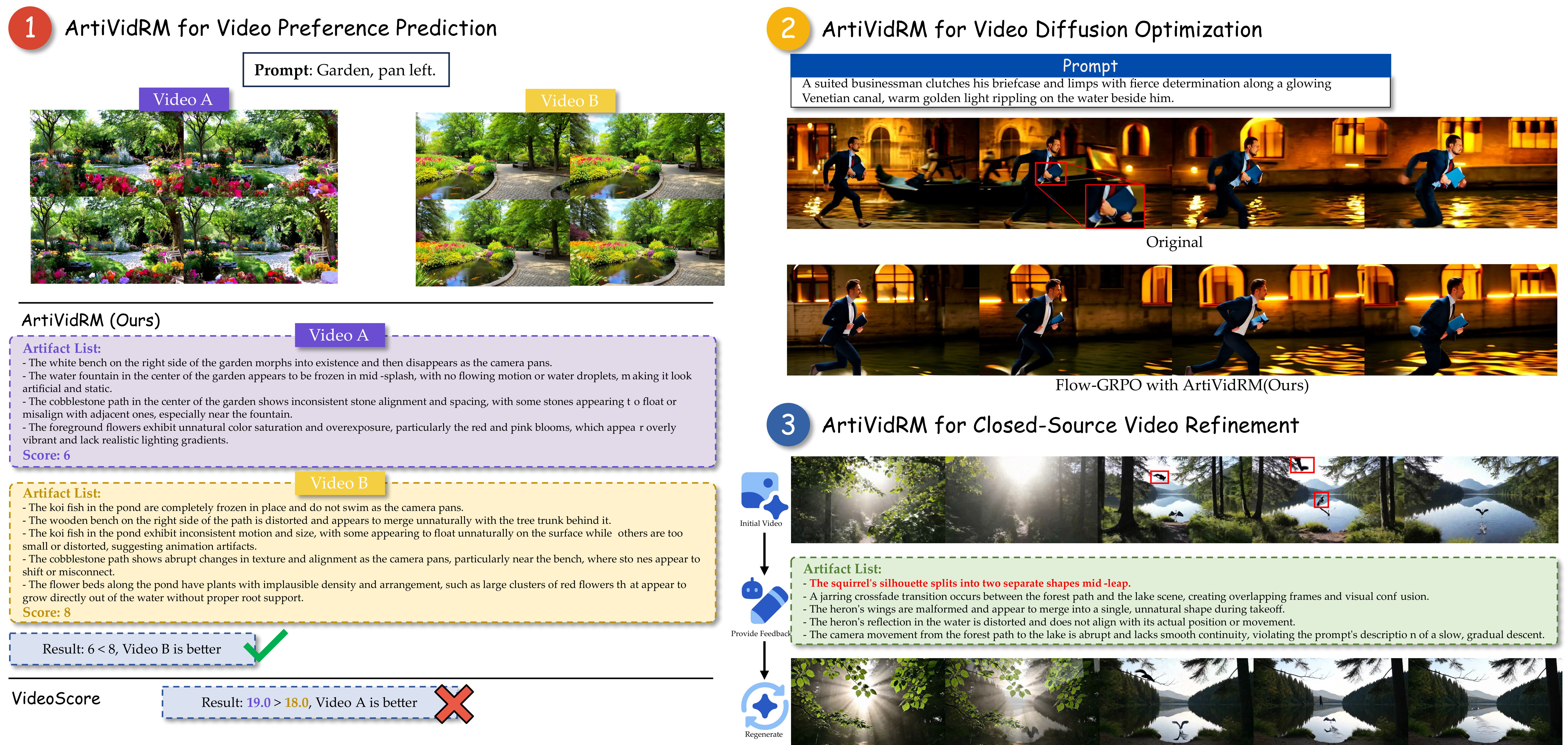
Caption: Overview of ArtiVidRM. By explicitly predicting structured artifact lists before quality scoring, ArtiVidRM enables (1) accurate video preference prediction, (2) reward-guided optimization of text-to-video diffusion models, and (3) artifact-guided refinement of closed-source video generators. The closed-source refinement example shown in the figure uses Veo 3.1.
Why It Matters: This figure communicates the central observe-then-score design and the two practical routes for using the reward model after training.
fig:framework
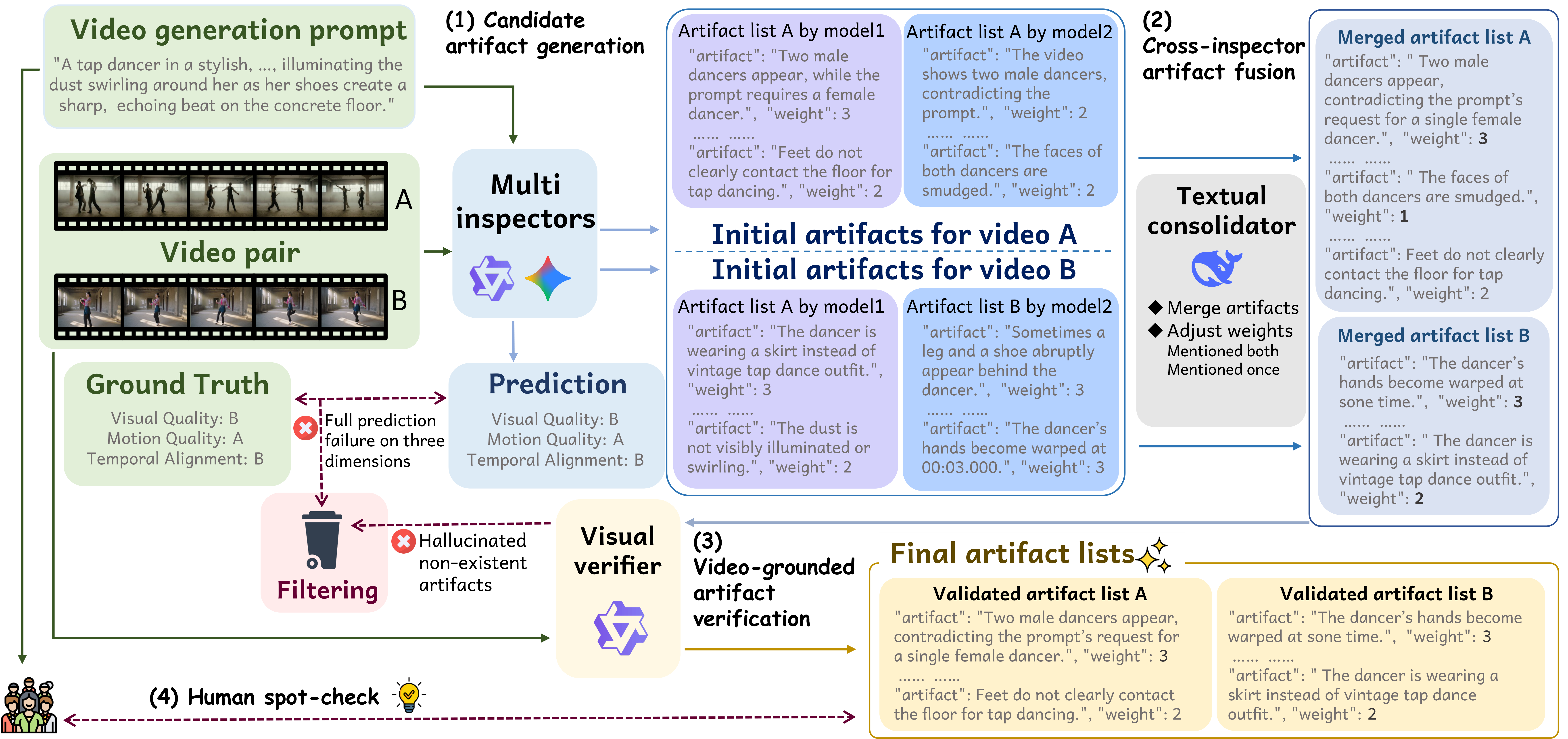
Caption: Overview of the artifact-augmented preference data construction pipeline.
Why It Matters: It shows how independent artifact proposals are fused, verified against video evidence, and converted into training annotations.
fig:train
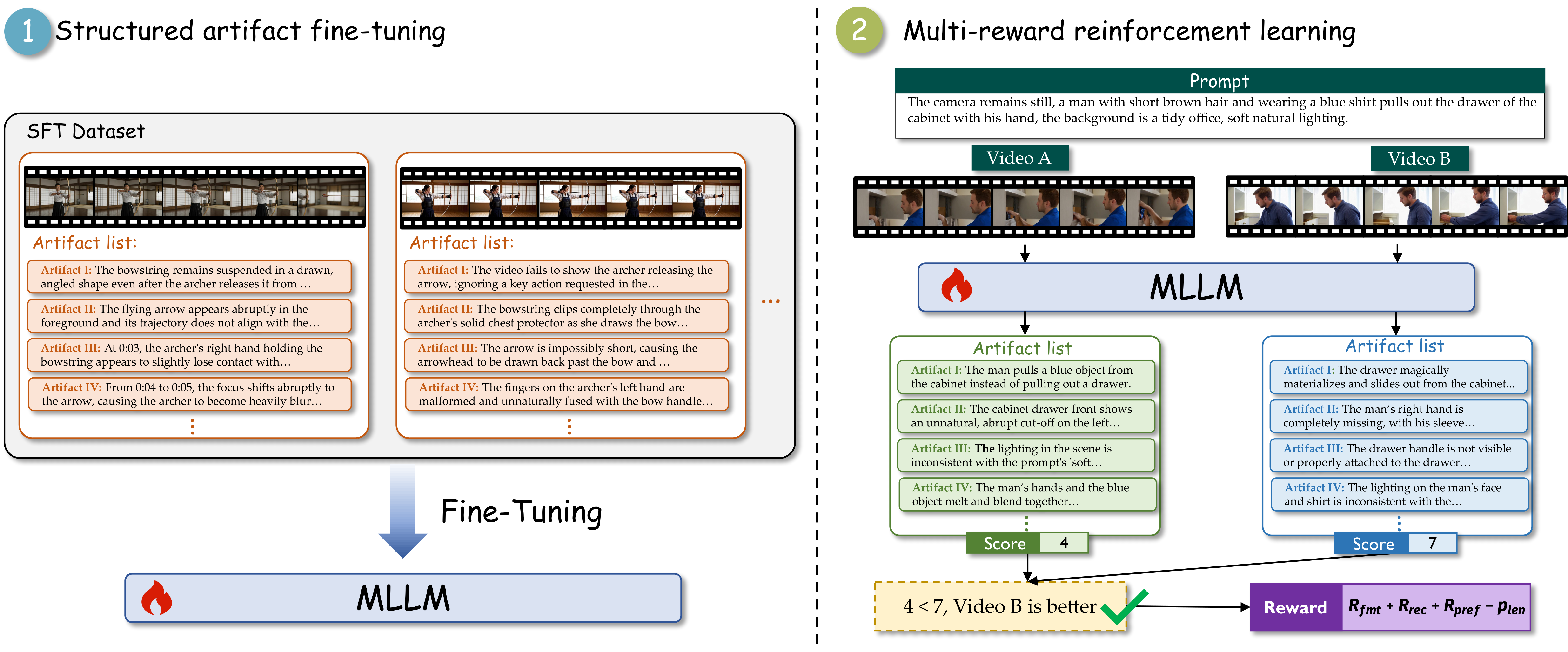
Caption: Overview of the two-stage training pipeline of ArtiVidRM.
Why It Matters: The figure clarifies the separation between structured artifact SFT and multi-reward reinforcement learning.
fig:placeholder
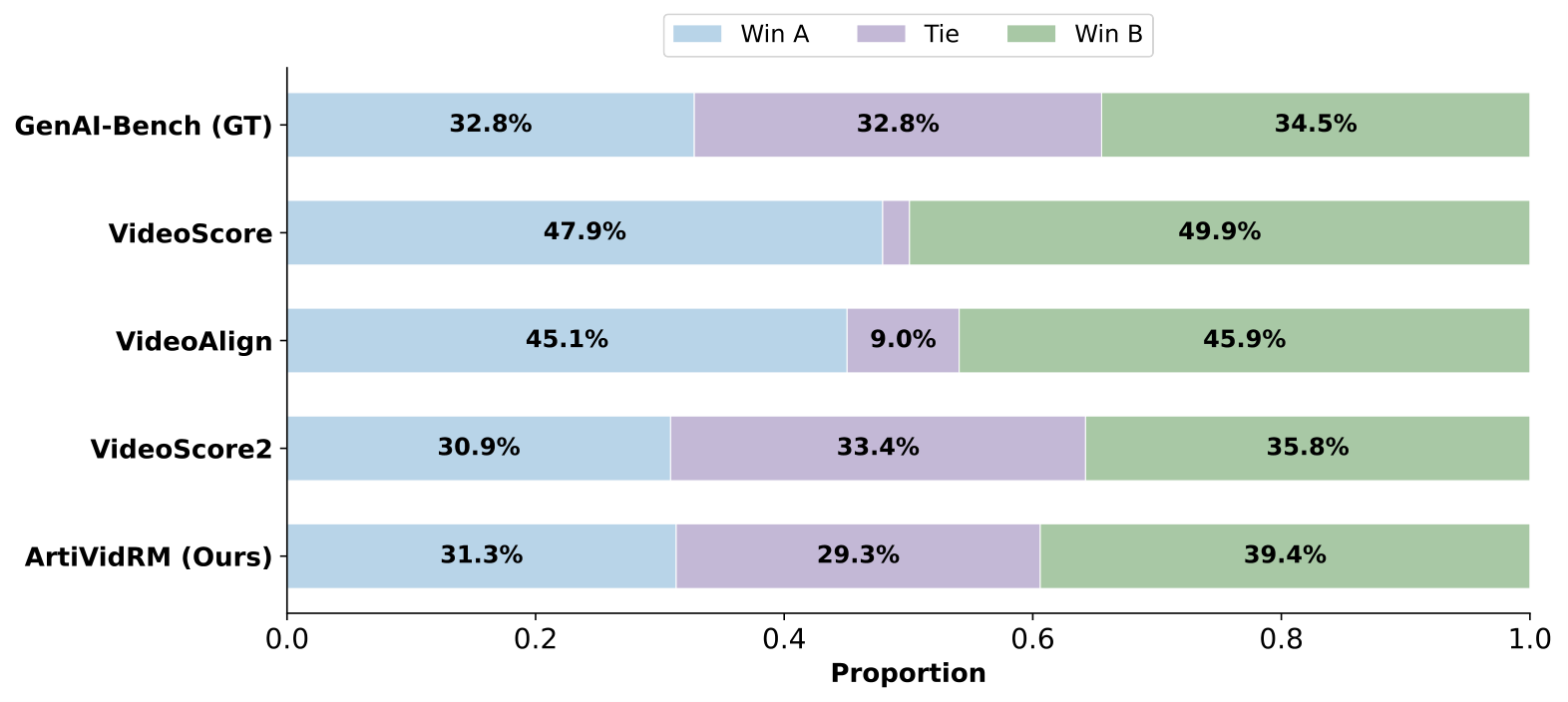
Caption: (a) Preference prediction distributions of different reward models on GenAI-Bench. (b) Multi-video ranking performance on T2VQA-DB.
Why It Matters: It provides a compact view of tie calibration and ranking behavior, including ArtiVidRM’s strengths on Kendall’s τ and Hit@3/Hit@5.
fig:Pearson
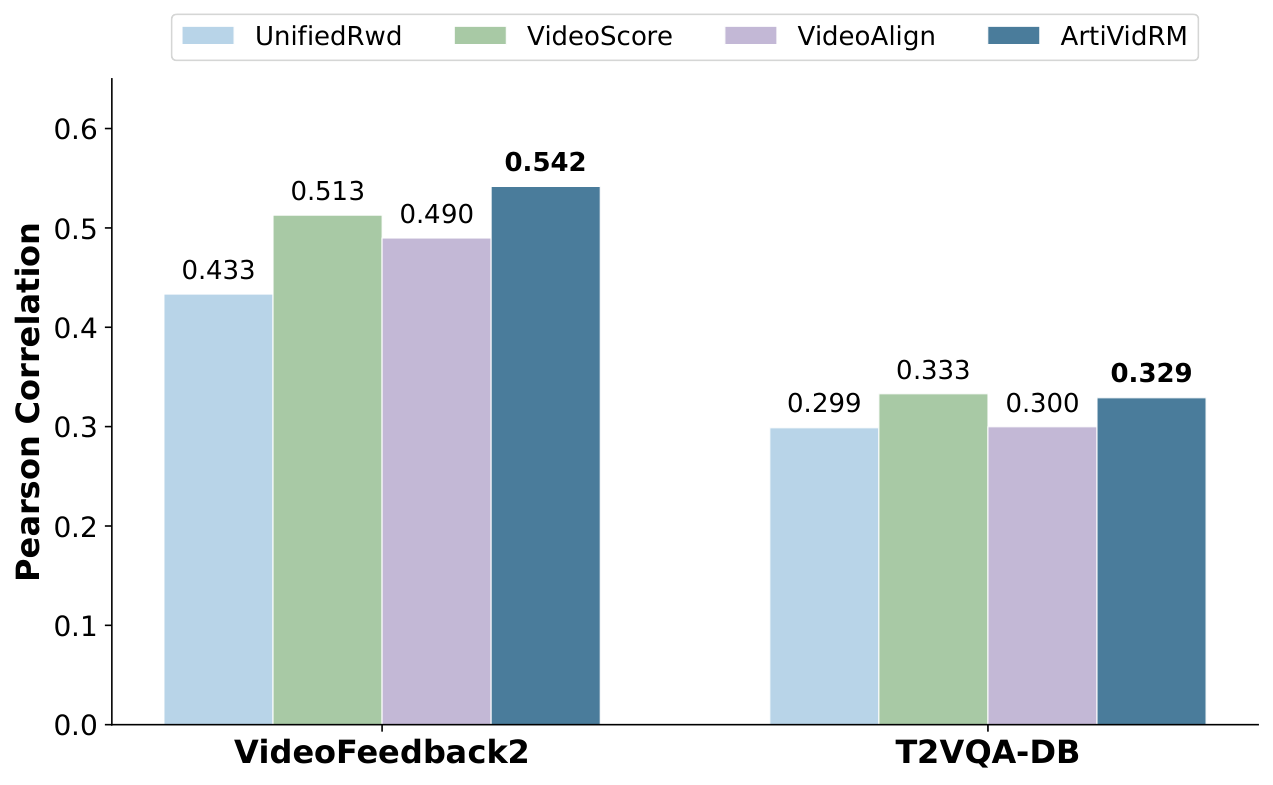
Caption: (a) Pointwise quality scoring performance measured by Pearson Correlation between predicted quality scores and human quality ratings. (b) VBench evaluation results of the diffusion model (Wan2.1-1.3B) before and after optimization with ArtiVidRM, and of Veo-3.1 before and after refinement with ArtiVidRM feedback. MS: Motion Smoothness; IQ: Imaging Quality; SC: Scene; SubC: Subject Consistency; AQ: Aesthetic Quality. Each axis is scaled to its own value range; the raw scores (before $ $ after) are listed next to each axis. (c) A qualitative comparison between Wan-2.1 before and after optimization with ArtiVidRM. (d) A qualitative comparison between Veo-3.1 before and after refinement with Ar...
Why It Matters: This figure connects reward-model quality to downstream generator improvement and shows both quantitative and qualitative effects.
🔮 Conclusion
The paper presents ArtiVidRM as a reward model that makes video-quality judgments more inspectable by grounding scores in explicit artifact lists. The reported results support three uses: preference prediction, reward-guided optimization of open-weight diffusion models, and feedback-based refinement of closed-source generators.
The most convincing evidence is the combination of strong out-of-domain preference accuracy, ablations supporting the two-stage objective, and human preference gains for both Wan2.1 and Veo-3.1. However, the improvements are not uniform across all VBench dimensions and remain dependent on the quality and faithfulness of generated artifact annotations.
🛠️ Future Research Improvements
The next research priority is to improve artifact-label reliability and coverage beyond the reported spot-check. Larger expert-labeled sets could test severity calibration, temporal localization, inter-rater consistency, and whether the reward model identifies artifacts that matter to users rather than merely artifacts that are easy for a verifier to describe.
Evaluation should also expand beyond one backbone, one open-weight generator, and one closed-source refinement loop. Repeated trials across seeds, prompts, generator families, and human panels would clarify how much of the observed gain comes from the artifact representation versus the specific Qwen3-VL and GRPO configuration.
- Measure artifact-level precision, recall, severity calibration, and temporal grounding separately.
- Compare structured artifacts against free-form rationales under matched model size and training compute.
- Evaluate robustness to prompt distribution shifts, video length changes, and generator-specific artifacts.
- Study whether artifact feedback can be used for localized editing rather than full regeneration.
🏭 Potential Industry Use Scenarios
ArtiVidRM could serve as an automated quality gate for text-to-video generation systems, ranking candidate clips and exposing concrete defects for human review. Its structured outputs are more operationally useful than a single score when production teams need to decide whether a clip fails because of temporal flicker, object deformation, prompt misalignment, or rendering quality.
For open-weight generators, the model can provide per-sample rewards during reinforcement-learning fine-tuning. For closed-source systems, the artifact list can be converted into targeted prompt feedback for a second generation round, enabling quality improvement without model-weight access. These scenarios are supported by the reported Wan2.1 and Veo-3.1 experiments, but deployment would require stronger reliability and cost measurements.
- Candidate ranking and best-of-N video selection.
- Automated defect reports for creative-production review queues.
- Reward-guided fine-tuning of proprietary or open-weight video diffusion models.
- Prompt-based refinement of closed-source video generators.
- Dataset auditing and artifact-aware regression testing for new generator versions.
💬 Critical Analysis
The paper’s strongest design choice is making the artifact list part of the optimized decision process rather than treating explanations as an after-the-fact narrative. The ablation results support this mechanism: removing SFT reduces performance, removing semantic recall weakens preference prediction, and the length penalty changes the balance between comprehensive and excessive artifact descriptions.
The main validity question is whether the intermediate artifacts are genuinely faithful causal evidence for the final score or simply a useful correlated representation. The automated annotation process, limited expert spot-check, and small human evaluations leave room for verifier bias, severity inconsistencies, and benchmark-specific behavior. The uneven VBench changes and the possibility of new artifacts after closed-source regeneration also suggest that the reward model should be used with monitoring rather than treated as a universally reliable quality oracle.
- Strength: explicit, inspectable artifact evidence is directly connected to preference optimization.
- Strength: evaluation spans pairwise, ranking, pointwise, open-weight optimization, and closed-source refinement.
- Caveat: automated artifact supervision may encode the biases of the inspecting and consolidating models.
- Caveat: reported human validation is relatively small and does not establish broad deployment reliability.
- Open question: whether artifact-guided rewards generalize to unseen generator families and user-specific quality preferences.