
📌 Highlights
KHC turns robot embodiment into a zero-rate visual prediction signal. It is designed for remote VLA execution where the robot already shares joint state, robot geometry, and camera calibration with the policy server.
The strongest reported result is closed-loop: on 1,600 paired LIBERO episodes per row, OpenVLA-OFT success rises from 22.75% with HIST-skip to 43.12% with KHC-skip at 6 kbps, while the measured rates remain 5.98 and 6.07 kbps.
The compression gain is causal in the paper's controls: shuffled kinematics, a second history reference, and a global pose vector do not reproduce the benefit, while removing the robot-layer hypothesis increases BD-rate by 26.39% relative to full KHC.
The main deployment caveat is synchronization. A one-frame state/image offset changes BD-rate by +43.8% versus clean HIST, and exterior DROID cameras without usable extrinsics fall back to HIST.
- 23.9% lower PSNR BD-rate than capacity-matched HIST on the LIBERO test split.
- 40-56% lower bit rate than the reported low-delay x264, x265, and SVT-AV1 anchors in the main comparison.
- 72.6% OpenVLA-OFT success at 6 kbps after lower-rate training.
- No additional learned parameters relative to the 7.0 M-parameter capacity-matched host.
🎯 Introduction
The paper addresses remote robot policies whose camera observations travel over cellular, satellite, shared-access, or underwater links with only a few kilobits per second. Existing learned video codecs primarily condition on decoded history, while a robot's temporal changes are strongly structured by its own motion: wrist cameras move with the arm, and third-person cameras observe articulated links and grasped objects following trajectories determined by joint states.
The paper-level objective is to exploit this decoder-available embodiment information without sending it again. The authors argue that a global pose vector is insufficient for moving pixels into the correct locations, whereas geometry-derived hypotheses can transport content and reduce the residual information that the codec must encode.
equation 2
Meaning: Expresses the ideal reduction in expected code length when kinematic context is available in addition to decoded history.
🔬 Methodology
The shared context contains decoded frames, joint states, prior actions, the robot model, and camera calibration. From the previous and current states, KHC constructs J=D+5 warped references: identity, D inverse-depth plane hypotheses, an articulated robot layer, an end-effector plane, background memory, and an auxiliary slot. The robot layer uses link-specific motion and rendered depth, while the background memory retains regions uncovered by the moving arm.
KinFusion converts the hypothesis volume into contexts at H, H/2, and H/4 resolutions. These are added to the history contexts through zero-initialized 1×1 mixers and condition the analysis transform, synthesis transform, and temporal entropy prior. The host remains otherwise unchanged, and the same context is used by the sender and receiver. Kinematic SKIP selects a hypothesis slot when its estimated cost is below the coded-frame cost.
The analysis also provides three useful design principles: embodiment side information cannot increase the ideal conditional rate-distortion function; transport is necessary when displacement exceeds a history codec's receptive field; and depth uncertainty can be reduced to a one-dimensional plane family under known camera motion.
equation 1
Meaning: Defines the shared context available at the receiver before decoding: decoded frames, joint states, prior actions, the robot model, and camera calibration.
equation 5
Meaning: Generates the plane-sweep homography for inverse-depth hypothesis \(\rho_d\), allowing static-scene pixels to be transported under camera motion.
equation 8
Meaning: Reprojects a rendered robot pixel according to the motion of its individual kinematic link between the previous and current states.
equation 9
Meaning: Shows how KinFusion's multiscale kinematic context is added to the host codec's history context through zero-initialized mixers.
📊 Experiments
The main benchmark is LIBERO. Demonstrations are rendered at 256×256 with wrist and static third-person cameras. Training uses LIBERO-90, validation uses the last demonstration of each task, and testing uses 200 episodes from LIBERO-Spatial, LIBERO-Object, LIBERO-Goal, and LIBERO-Long. The paper also evaluates 100 DROID episodes from Franka robots at 320×180 and 15 Hz, split by laboratory into 63/7/30 episodes; only the wrist camera has usable self-calibrated hand-eye geometry.
The coding evaluation uses real bitstreams at stride 8 and reports RGB PSNR, MS-SSIM, LPIPS, and OpenVLA-OFT action deviation. On LIBERO, KHC achieves -23.9% PSNR BD-rate versus HIST across both cameras, -24.6% at LPIPS, and -26.2% at action deviation. It also reports -49.0% to -55.8% PSNR BD-rate against low-delay x264 and x265 variants and -39.7% against SVT-AV1. Against DCVC-RT, KHC is +7.5% in PSNR but -23.2% at equal action deviation.
The ablations support the intended mechanism. Removing the robot layer changes BD-rate by +26.39% relative to full KHC, compared with +8.96% without plane-sweep slots, +5.83% without background memory, and +5.32% without the end-effector plane. Shuffled kinematics, two history references, and global pose vectors remain near the HIST baseline. The closed-loop OpenVLA-OFT experiment uses 1,600 paired episodes per row at 6, 8.3, and 10.7 kbps; KHC-skip reaches 43.12%, 71.88%, and 88.50% success versus 22.75%, 57.06%, and 85.19% for HIST-skip. With lower-rate training, KHC-LR-skip reaches 72.6%, 86.0%, and 88.9% at those budgets.
Transfer evidence is positive but bounded: KHC saves 7.0% inside a Scale-Space-Flow host, 7.8–12.2% in an entropy-only host, and 11.2% on the DROID wrist camera. At 10% packet loss and 8.3 kbps, KHC-skip reaches 46.4% success versus 22.9% for HIST-skip. With π0.5 at its middle budget, success rises from 55.5% to 77.4%.
tab:bd_main
Caption: BD-rate of KHC against every anchor on the LIBERO test split (200 episodes, real bitstreams, stride 8). Negative values are bit savings of KHC at equal quality (bold); positive values mean that the anchor needs fewer bits. LPIPS and action deviation (L1 distance between the OpenVLA-OFT action chunks predicted from decoded and original frames) are pooled over both cameras. 95\\% episode-bootstrap confidence intervals in brackets; --: not evaluated.
| Type | Anchor | PSNR BD-rate (%) Both cameras | PSNR BD-rate (%) Wrist | PSNR BD-rate (%) Third-person | MS-SSIM (%) Both | LPIPS (%) Both | Action dev. (%) Both |
|---|---|---|---|---|---|---|---|
| Capacity-matched | HIST (history context) | $-$23.9 [$-$25.0, $-$22.8] | $-$12.3 [$-$12.9, $-$11.6] | $-$37.9 [$-$39.8, $-$36.0] | $-$18.2 [$-$19.5, $-$16.8] | $-$24.6 [$-$25.5, $-$23.7] | $-$26.2 [$-$27.6, $-$24.9] |
| Neural | DCVC-RT | +7.5 [$-$0.5, 16.4] | +7.2 [3.1, 11.7] | $-$0.2 [$-$11.5, 13.1] | +9.3 [2.0, 17.4] | $-$13.6 [$-$20.8, $-$5.1] | $-$23.2 [$-$26.5, $-$19.8] |
| Standard | x265 (4:4:4, low-delay) | $-$49.1 [$-$52.3, $-$45.5] | $-$46.6 [$-$48.6, $-$44.3] | $-$55.7 [$-$59.7, $-$50.0] | $-$52.0 [$-$55.7, $-$47.7] | $-$40.1 [$-$44.1, $-$35.5] | $-$48.8 [$-$50.8, $-$46.6] |
| Standard | SVT-AV1 (4:2:0, low-delay) | $-$39.7 [$-$44.1, $-$34.8] | $-$40.5 [$-$43.4, $-$37.3] | $-$40.4 [$-$46.5, $-$33.1] | $-$40.8 [$-$45.7, $-$35.0] | $-$41.1 [$-$46.1, $-$35.4] | -- |
| Standard | VTM-23 (4:4:4, low-delay P) | +42.1 [33.9, 51.3] | +53.4 [47.9, 59.7] | +23.5 [12.8, 36.1] | +25.3 [16.7, 35.3] | +25.3 [16.0, 36.1] | +11.4 [6.5, 16.8] |
tab:ablation
Caption: Ablation of the hypothesis families and of the plane count $D$ (all variants trained 100k steps; BD-rate on the LIBERO test split, both cameras, 95\\% CI). Latency: encoder+decoder P50 per frame on an RTX 4090 (batched implementation).
| Variant | vs. full KHC (%) | vs. HIST (%) | ms |
|---|---|---|---|
| Full KHC ($D=32$) | -- | $-$9.99 [$-$10.8, $-$9.2] | 41.3 |
| w/o plane-sweep slots | +8.96 [8.2, 9.7] | $-$3.03 [$-$4.0, $-$2.0] | -- |
| w/o robot-layer slot | +26.39 [24.5, 28.3] | +11.76 [10.1, 13.3] | -- |
| w/o end-effector plane | +5.32 [4.5, 6.2] | $-$6.40 [$-$7.4, $-$5.2] | -- |
| w/o background memory | +5.83 [5.2, 6.5] | $-$5.73 [$-$6.7, $-$4.7] | -- |
| $D=4$ | $-$3.45 [$-$4.0, $-$2.8] | $-$12.62 [$-$13.6, $-$11.6] | 41.3 |
| $D=8$ | +2.88 [2.0, 3.9] | $-$7.84 [$-$9.1, $-$6.6] | 41.2 |
| $D=16$ | +3.50 [3.0, 4.0] | $-$7.66 [$-$8.6, $-$6.6] | 41.8 |
| Oracle scene depth (upper bound) | $-$18.28 [$-$19.0, $-$17.5] | $-$25.44 [$-$26.5, $-$24.4] | -- |
tab:cl
Caption: Closed-loop results with OpenVLA-OFT on LIBERO (4 suites × 10 tasks × 40 initial states = 1,600 paired episodes per row). Success with Wilson 95% interval; rate is the measured mean over episodes (payload, state and headers).
| Budget | Uplink | Success (%) | Rate (kbps) | SKIP |
|---|---|---|---|---|
| 6 kbps | HIST-skip | 22.75 [20.8, 24.9] | 5.98 | 0.47 |
| 6 kbps | KHC-skip (ours) | 43.12 [40.7, 45.6] | 6.07 | 0.46 |
| 8.3 kbps | HIST-skip | 57.06 [54.6, 59.5] | 8.15 | 0.24 |
| 8.3 kbps | KHC-skip (ours) | 71.88 [69.6, 74.0] | 8.18 | 0.22 |
| 10.7 kbps | HIST-skip | 85.19 [83.4, 86.8] | 10.46 | 0.11 |
| 10.7 kbps | KHC-skip (ours) | 88.50 [86.8, 90.0] | 10.44 | 0.09 |
| 6 kbps | x265 (CBR) | 32.44 [30.2, 34.8] | 9.85 | -- |
| 8.3 kbps | x265 (CBR) | 63.75 [61.4, 66.1] | 12.35 | -- |
| 10.7 kbps | x265 (CBR) | 79.50 [77.5, 81.4] | 15.74 | -- |
fig:teaser
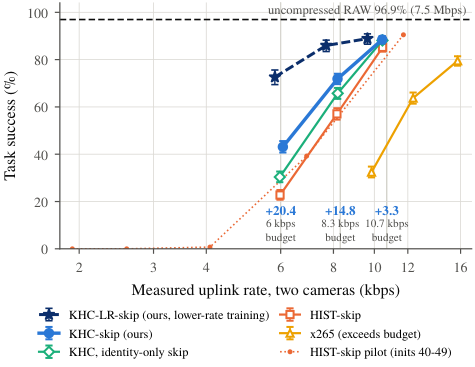
Caption: Task success of OpenVLA-OFT on LIBERO versus the measured uplink rate of two 256$ $256 cameras (1,600 paired episodes per point, Wilson 95\\% intervals). shifts the success cliff to lower rates; blue numbers are the paired gains over HIST-skip in percentage points ($+20.4$, $+14.8$ and $+3.3$ at 6, 8.3 and 10.7\\,kbps), while x265 needs 47--64\\% more bits and still succeeds less often. Dark stars: -LR-skip, the same context with lower-rate training (Section~sec:lr; 800 paired episodes per point).
Why It Matters: It shows the central systems claim: embodiment-conditioned coding shifts the policy's success cliff toward lower uplink rates.
fig:overview
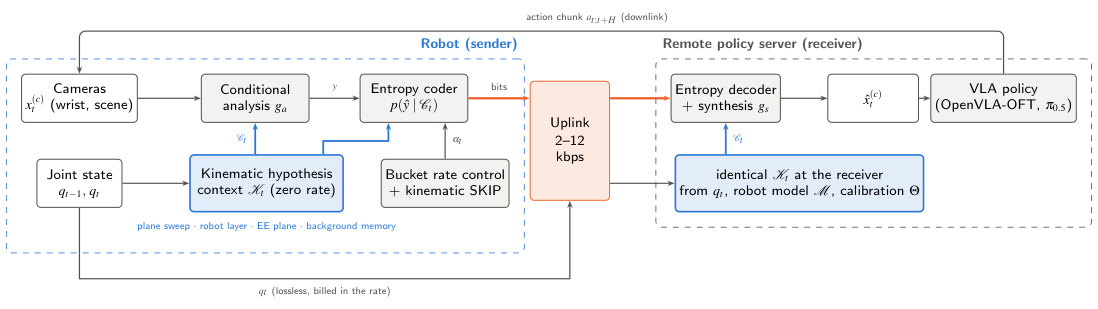
Caption: Remote-policy uplink with . The robot sends its joint state losslessly and one coded frame per camera; sender and receiver construct the identical kinematic hypothesis context $ _t$ from the decoded reference, the joint states, the robot model $ M$ and the calibration $ $, and use it to condition analysis, entropy model and synthesis. A leaky-bucket controller sets the rate parameter $ _t$ and may replace a frame by a kinematic SKIP.
Why It Matters: It makes the deployment topology explicit: the same geometry-derived context is built at both endpoints without sending the hypotheses.
fig:method
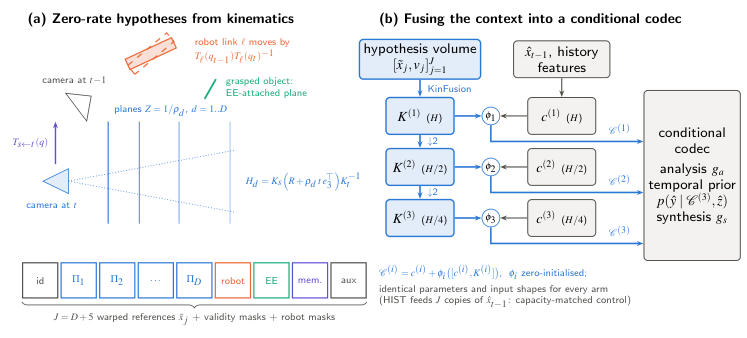
Caption: (a) Kinematics turn the robot's motion into zero-rate hypotheses: fronto-parallel plane homographies for camera ego-motion, per-link rigid reprojection for the robot, an end-effector-attached plane for grasped objects, and a background memory. (b) KinFusion maps the volume to three context scales that are added to the history contexts through zero-initialized mixers $ _i$; the codec is otherwise unchanged and identical for every compared arm.
Why It Matters: It summarizes the four hypothesis families and how they enter the multiscale conditional codec.
fig:rd
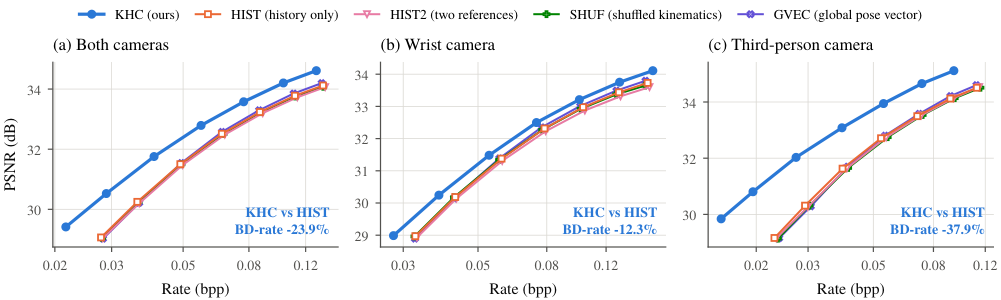
Caption: Rate--distortion on the LIBERO test split (stride 8, real bitstreams). (a)--(c) against the capacity-matched controls for both cameras, the wrist camera and the third-person camera; HIST2, SHUF and GVEC coincide with HIST, whereas is separated at every rate. (d)--(f) Bits saved by the lower-rate model -LR relative to each neural and standard codec at equal (d) PSNR, (e) LPIPS and (f) action deviation of the OpenVLA-OFT action chunk, as a function of rate (negative: -LR needs fewer bits; bands: episode-bootstrap 95\\% intervals; shaded: closed-loop operating range of -LR-skip). The closer the measure is to the policy, the lower the curves. BD-rates: Tables~tab:bd_main and~tab:lr_bd; raw PSNR...
Why It Matters: It compares KHC against matched controls and stronger neural and standard codecs across pixel-, perceptual-, and policy-level quality.
fig:ablation
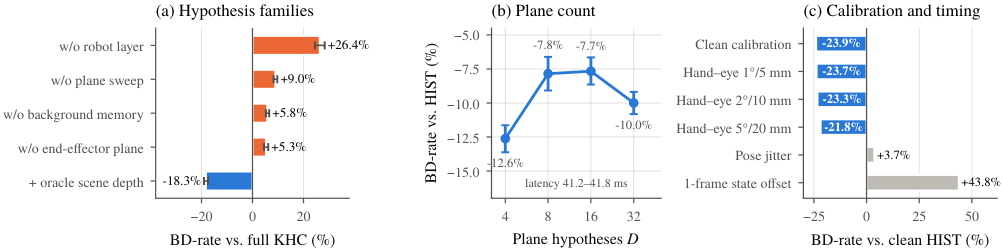
Caption: (a) Removing each hypothesis family of (all models trained 100k steps), and the oracle-depth upper bound. (b) BD-rate vs.\\ HIST as a function of the number of plane hypotheses $D$. (c) Hand--eye miscalibration applied at both ends, pose jitter and a one-frame state/image offset (BD-rate vs.\\ clean HIST, both cameras).
Why It Matters: It isolates which geometric components matter and exposes the practical failure modes around calibration and timing.
fig:transfer
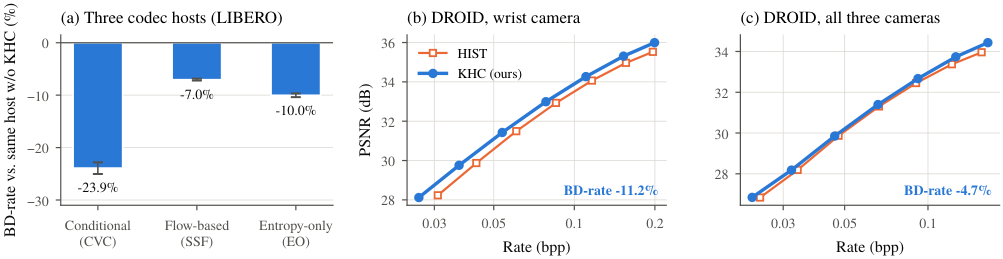
Caption: (a) BD-rate of inside three codec hosts on LIBERO, each against the same host without kinematic context (95\\% CI). (b), (c) Real-robot DROID data (30 test episodes from held-out laboratories, stride 4): the self-calibrated wrist camera gains 11.2\\%; exterior cameras without extrinsics fall back to HIST, as designed.
Why It Matters: It tests whether the context is tied to one host architecture and shows the gap between calibrated wrist-camera transfer and unsupported exterior-camera deployment.
🔮 Conclusion
The paper's evidence supports the claim that robot embodiment can function as useful side information for learned video coding. KHC improves rate-distortion performance against a capacity-matched history codec, preserves gains across cadence and codec hosts, and changes the behavior of a remote policy at low budgets by making skipped frames reflect the robot's current pose.
The most practically important result is the closed-loop connection: a coding improvement becomes a task-success improvement when the uplink operates near the policy's success cliff. The lower-rate extension further shows that training coverage of the actual deployment range matters independently of the geometric context.
equation 6
Meaning: Relates a codec's BD-rate advantage \(\gamma\) to expected task-success improvement as a function of the slope of the policy's success curve.
🛠️ Future Research Improvements
The clearest next step is stronger depth and geometry estimation. The oracle scene-depth upper bound improves BD-rate by 18.3% relative to full KHC, so learned or sensor-assisted depth hypotheses could narrow the remaining gap while preserving the zero-rate property.
Real-world evaluation should expand beyond a self-calibrated wrist camera. The DROID exterior cameras lacked usable extrinsics and therefore provide a direct test of how the system should behave when only partial embodiment information is available. Future studies should also evaluate broader robot embodiments, more camera placements, longer deployments, and network conditions beyond the reported 10% packet-loss experiment.
Engineering work should target robust state-image synchronization and online calibration monitoring, because the reported one-frame offset and pose-jitter tests show that timing failures can erase the benefit even when the codec itself is unchanged.
🏭 Potential Industry Use Scenarios
The most direct use case is cloud- or edge-controlled manipulation over constrained wireless links. A robot with calibrated wrist and external cameras could send joint state plus KHC-coded frames to a remote VLA service while using kinematic SKIP to preserve current-pose feedback during severe bandwidth shortages.
Fleet deployments sharing an access point are a plausible fit because the reported controller explicitly tracks kilobit budgets and bills state and header bytes. Cellular, satellite, and underwater systems are also technically aligned with the paper's target setting, provided the robot model, calibration, and state timing are reliable.
A codec-host integration layer is attractive for production systems: the paper reports transfer into conditional, flow-based, and entropy-only hosts, so the embodiment context could potentially be added without replacing the entire video-compression stack. Deployment decisions should nevertheless be validated on the target robot and policy, since the strongest real-data evidence is limited to the calibrated wrist-camera case.
💬 Critical Analysis
The strongest part of the work is the causal decomposition. Capacity-matched controls, shuffled kinematics, a second reference, and a global pose vector distinguish the benefit of transporting pixels according to embodiment from generic extra context. The robot-layer ablation is especially informative because removing it causes the largest degradation among the individual hypothesis families.
The closed-loop evaluation is also stronger than an open-loop policy metric: paired episodes, measured payload-plus-state rates, skip decisions, packet loss, and a second policy expose how stale observations affect behavior. However, the task-success conclusions remain tied to LIBERO suites and two evaluated policies, while DROID transfer is partial and camera-dependent.
For a builder, the main risk is operational rather than conceptual. Calibration, synchronization, camera placement, and the available robot model determine whether the hypothesis volume is predictive. The paper's results justify prototyping on calibrated wrist-camera streams first, then measuring end-to-end task success rather than assuming that improvements in PSNR will transfer automatically.