
📌 Highlights
IAPO targets a specific weakness in sequential multi-agent orchestration: decisions are coupled through the evolving history. An earlier evidence-finder call has little value if a later analyst cannot read its output, while changing visibility without producing evidence is also ineffective. The paper therefore expands policy improvement into individual and interaction terms, then uses the first two orders to construct bounded candidate updates. Its theoretical analysis argues that the omitted interaction structure can represent a substantial fraction of attainable improvement, while its certification procedure prevents an apparently good candidate from being deployed without fresh-data evidence.
The empirical headline is a strong quality-cost tradeoff on constructed long-input versions of five benchmarks. With Qwen2.5-7B-Instruct workers, IAPO reports 81.8% on GSM8K, 48.6% on MATH, 74.2% on DROP, 80.9% on MBPP, and 84.3% on HumanEval in the matched-budget table, with average accuracy 73.9 and average cost 32.4 thousand tokens. The key causal evidence is the ablation: removing the interaction term costs 17.3 accuracy points on MBPP and 7.2 on HumanEval for IAPO, while IAPO uses only 32% to 58% of the first-order variant's tokens across the five benchmarks.
- Core claim: orchestration decisions should be optimized jointly when their usefulness depends on shared history and visibility.
- Main method: exact interaction expansion, bounded second-order updates, and fresh-trajectory certification.
- Benchmarks: long-input GSM8K, MATH, DROP, MBPP, and HumanEval.
- Strongest ablation effect: −17.3 points on MBPP and −7.2 points on HumanEval when the interaction term is removed.
- Primary caveat: results are on constructed long-input tasks, and deployment transfer remains to be tested.
🎯 Introduction
The paper frames multi-agent orchestration as the problem of deciding which worker to call, what earlier outputs that worker may read, and when to stop. Earlier systems use fixed roles or manually designed communication pipelines; later systems optimize topologies, route queries, or search complete workflows. These approaches improve organization, but the introduction argues that many of them fix the organization before execution and therefore cannot adapt it to intermediate results. Sequential orchestration addresses this limitation by allowing a central policy to act repeatedly as the task state evolves.
The limitation identified by the paper is not simply that the orchestrator has many actions. It is that the actions are dependent. A decision changes later states, available evidence, worker outputs, and call costs. Standard policy objectives assign an advantage to each decision while treating other decisions as fixed. The paper argues that this can miss cases in which no individual change helps alone but a coordinated pair does. It also notes that small per-step changes can accumulate across a long episode, weakening a trust-region argument based only on individual-step divergence. IAPO's objective is therefore to make these interactions explicit, quantify the error from truncating them, and accept only updates whose improvement is supported by fresh validation data.
The paper's contribution is both theoretical and procedural. The theory identifies the first-order objective as one component of a finite expansion and characterizes higher-order terms through policy likelihood ratios. The procedure keeps the first two orders, constrains candidate updates, and compares two lower-bound estimators. This combination matters for builders because it links the representation of orchestration decisions to the operational question of whether a learned workflow should actually replace the current one.
🔬 Methodology
The environment is an episodic MDP with tasks q drawn from a distribution, a set of workers, a finite output space, and at most K calls. At an orchestrator step, the action is either stop or a pair (j,E), where j identifies the worker and E is a subset of earlier outputs made visible to that worker. The worker then samples an output from its fixed policy, the output is added to the history, and control returns to the orchestrator. A call to worker j receives reward −lambda c-j, while stopping receives the task reward R(q,h). The optimized objective is expected task reward minus the weighted sum of call costs. The experiments update only the orchestrator, although the analysis states that it also covers settings in which some workers are trained.
For a reference policy pi and candidate pi-prime, the paper uses the likelihood ratio rho-t and the overlap condition pi-prime-t(a|s) <= W pi-t(a|s). Importance sampling gives an exact policy-difference expression. Expanding the product of likelihood-ratio changes produces first-order, pairwise, and higher-order terms. Theorem 3.2 defines the order-m term using the advantage at the later decision; the first-order term recovers the usual advantage-weighted objective, while the second-order term captures interactions among two orchestration decisions. The associated curvature result says that the first-order objective has the correct local gradient but omits the interaction-induced Hessian component, which can affect finite updates.
IAPO makes the expansion tractable by retaining J(1)+J(2). It defines beta from the maximum total-variation distance between candidate and reference orchestrator policies and bounds the omitted terms using the trajectory reward bound G-bar. The candidate policy is generated from a centered score u-theta and step size eta in [0,1], producing a bounded likelihood-ratio change. For orchestrator steps, the resulting statistic Z2 groups pairwise terms by their later decision and can be computed with a prefix sum in O(H) trajectory operations. Candidate fitting is performed separately for each eta in the finite grid Lambda.
Certification is deliberately separated from fitting. After candidates are fixed, n fresh trajectories are sampled under the current policy. IAPO computes a second-order estimate with a truncation penalty and an exact importance-sampling estimate. Empirical Bernstein confidence radii account for sample variability and finite bounds. The larger lower confidence bound is used for selection; a positive value is required for deployment. The paper's certified-selection theorem states that, with probability at least 1−delta, the chosen policy is no worse than the current policy and achieves an oracle-style relation to the best candidate up to twice its confidence penalty.
Equation (1)
Meaning: This is the optimization target: maximize task reward while penalizing the costs of worker calls.
Equation (3)
Meaning: This states the exact finite decomposition of policy improvement into interaction orders.
Equation (4)
Meaning: This defines the order-m interaction term, with likelihood-ratio changes representing coordinated policy changes across m decisions.
Equation (6)
Meaning: This lower bound justifies retaining first- and second-order terms while subtracting a bound on the omitted higher-order interactions.
Equation (7)
Meaning: This bounded parameterization constructs a valid candidate policy whose change is controlled by the step size eta.
Equation (13)
Meaning: This combines the second-order truncation certificate and exact importance-sampling certificate, selecting the larger valid lower bound on improvement.
Algorithm 1 Interaction-Aware Policy Optimization
Steps: ['Initialize the current policy pi, score family f-theta, step-size grid Lambda, training batch size N, validation batch size n, and confidence level delta.', 'Collect N training trajectories under pi and add earlier trajectories reweighted to pi.', 'Estimate the scalar baseline b from the new trajectories.', 'For every eta in Lambda, fit theta-eta by approximately maximizing the empirical mean of Z2, then construct the bounded candidate pi-prime-eta.', 'Collect n fresh validation trajectories under pi and assign delta-kappa=delta/2-kappa.', 'For every candidate, compute L-eta using the fixed baseline and the validation statistics.', 'Select the candidate with the largest L-eta; keep pi if the largest certificate is nonpositive, otherwise replace pi with the selected candidate and repeat.']
Why It Matters: The algorithm operationalizes the paper's main claim: interaction-aware fitting is useful only when candidate updates are bounded and independently checked before deployment.
📊 Experiments
The empirical evaluation has two parts. First, controlled tasks with enumerated trajectories test whether interaction-aware scoring recovers gains missed by first-order scoring and avoids harmful updates. The tasks are Complementarity, Redundancy, and Evidence threshold. Second, the paper evaluates LLM orchestration on constructed long-input versions of GSM8K, MATH, DROP, MBPP, and HumanEval. Each target problem is placed among 30 to 90 units from other problems; the resulting documents contain 81, 91, 31, 61, and 61 units respectively. The test splits contain 790, 220, 800, 333, and 131 problems. These are explicitly constructions rather than the standard benchmark distributions.
All workers use Qwen2.5-7B-Instruct served by vLLM at temperature 1. The orchestrator can make at most five decisions, or four on code, and can select among seven general roles plus a code-specific test-and-repair operator. The reward is accuracy minus lambda times tokens per 32,768. IAPO uses lambda=0.076, while IAPO-Lite uses lambda=1 to trade accuracy for tokens. Trajectories are capped at 32,768 tokens, whereas baselines that read the whole document run with 131,072 or 393,216 tokens. Training uses 6,400 proposal episodes, three certified leaps, and 8,000 validation episodes; the test problems are not used for fitting or selection. Each test problem is run four times, and matched-budget results use majority voting, or program selection on code, within the strongest baseline's token budget.
The comparison includes fifteen published systems: CoT, ComplexCoT, self-consistency, MultiPersona, LLM-Debate, LLM-Blender, DyLAN, AgentVerse, MacNet, AutoAgents, GPTSwarm, ADAS, AFlow, MAS-Zero, and MaAS. At matched compute, the paper reports that IAPO leads by 2.3 points on GSM8K, 3.6 on DROP, and 9.7 on MBPP, while remaining level with the strongest baseline on MATH (+0.3) and HumanEval (+0.5). IAPO-Lite improves on GSM8K by 5.6 points, MATH by 6.0, and MBPP by 7.2, but gives up 4.5 points on DROP and 8.1 on HumanEval in exchange for fewer tokens.
The cost results are central. A deployed IAPO episode costs 5.1k to 11.5k tokens versus 26.5k to 121.9k for the strongest baselines, or 2.7 to 24 times fewer. IAPO-Lite costs 1.0k to 5.6k tokens. On MBPP, one IAPO episode reaches 81.1% at 5.1k tokens versus DyLAN's 71.2% at 121.9k; on HumanEval, IAPO reaches 83.7% at 9.9k tokens versus MaAS's 83.8% at 26.5k. The interaction ablation supports the proposed mechanism: for IAPO, including Z2 raises accuracy by 17.3 points on MBPP and 7.2 on HumanEval, while the interaction-aware policy uses 32% to 58% of the first-order variant's tokens. In the controlled tasks, first-order scoring is zero on Complementarity despite an oracle gain of 0.148, overshoots on Redundancy with 0.006 against 0.010, and Z2 plus ZIS reaches 0.356 on Evidence threshold; across 6,000 validation runs, no negative-gain candidate was accepted.
Table 1
Caption: Table 1: Accuracy (%) with its change from Vanilla, and cost (grey, thousand tokens per problem; one episode for baselines, all voted episodes for IAPO) with Qwen2.5-7B-Instruct on long-input versions of five benchmarks. Bold: best; underline: runner-up. IAPO and IAPO-Lite (trained with λ=1) vote (on code, select programs) within the best baseline’s tokens per column. Avg. covers GSM8K, MATH, MBPP and HumanEval. Two-seed baselines are averaged; “–”: not run; †better accuracy of the upstream and diagnostic arms.
| Method | GSM8K Acc. | GSM8K Tok. | MATH Acc. | MATH Tok. | DROP Acc. | DROP Tok. | MBPP Acc. | MBPP Tok. | HumanEval Acc. | HumanEval Tok. | Avg. Acc. | Avg. Tok. |
|---|---|---|---|---|---|---|---|---|---|---|---|---|
| Vanilla | 61.9 | 3.8 | 36.7 | 5.5 | 42.6 | 9.1 | 67.5 | 7.7 | 72.9 | 8.8 | 59.8 | 6.5 |
| LLM-Debate | 79.5 ↑17.6 | 28.6 | 27.8 ↓8.9 | 43.5 | 70.6 ↑28.0 | 57.1 | 69.9 ↑2.4 | 49.8 | 75.6 ↑2.7 | 56.7 | 63.2 | 44.6 |
| DyLAN | 71.5 ↑9.6 | 29.8 | 48.3 ↑11.6 | 54.3 | – | – | 71.2 ↑3.7 | 122 | 41.2 ↓31.7 | 125 | 58.1 | 82.8 |
| MaAS | 66.0 ↑4.1 | 20.1 | 29.4 ↓7.3 | 50.3 | 54.5 ↑11.9 | 50.9 | 64.0 ↓3.5 | 18.4 | 83.8 ↑10.9 | 26.5 | 60.8 | 28.8 |
| IAPO | 81.8 ↑19.9 | 25.1 | 48.6 ↑11.9 | 50.8 | 74.2 ↑31.6 | 46.0 | 80.9 ↑13.4 | 33.1 | 84.3 ↑11.4 | 20.4 | 73.9 | 32.4 |
| IAPO-Lite | 85.1 ↑23.2 | 25.8 | 54.3 ↑17.6 | 51.1 | 66.1 ↑23.5 | 51.7 | 78.3 ↑10.8 | 29.0 | 75.7 ↑2.8 | 21.6 | 73.4 | 31.9 |
Why It Matters: The table makes the quality-cost tradeoff explicit and preserves the paper's reported accuracy changes, token costs, missing entries, and averaged values.
Figure 1
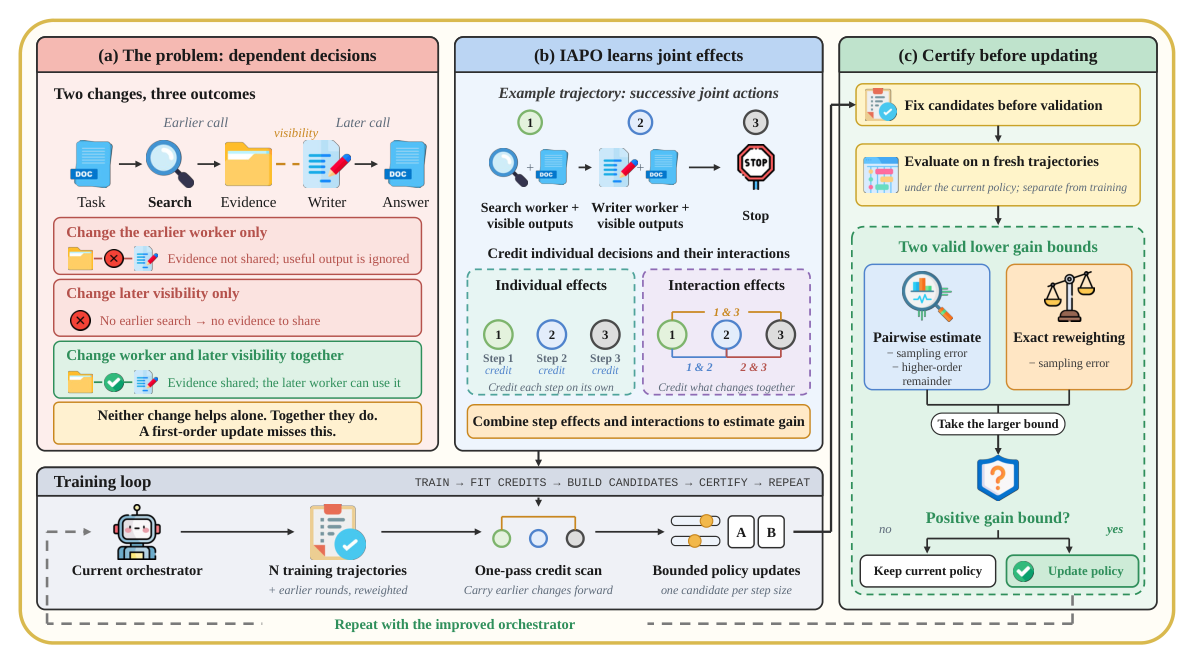
Caption: Figure 1: Overview of IAPO. (a) Orchestration decisions depend on one another: a new earlier worker helps only if a later call may read its output, so neither change helps alone. (b) IAPO credits each orchestrator step and every pair of steps in one pass over each training trajectory, and fits one bounded update per step size. (c) With the candidates fixed, IAPO computes two lower bounds on the gain from fresh trajectories, keeps the larger one, and updates the policy only if it is positive.
Why It Matters: This figure gives the clearest system-level explanation of why independent decision credit is insufficient and how candidate fitting, certification, and policy replacement form one loop.
Figure 2
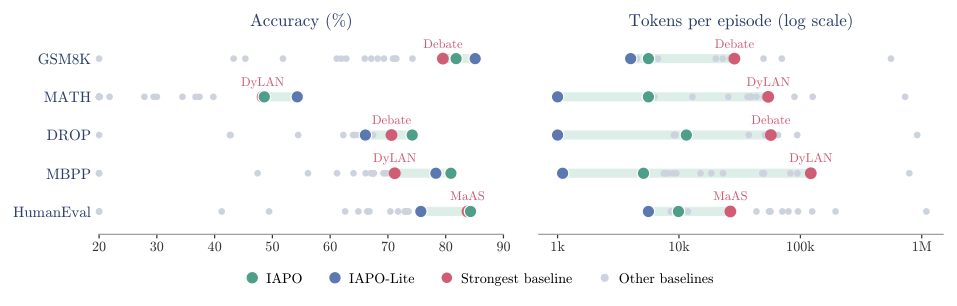
Caption: Figure 2: Accuracy (left) and tokens per episode (right, log scale) of IAPO, IAPO-Lite, the strongest baseline of each benchmark and the other baselines. Accuracy is that of the voted plan within the strongest baseline’s budget; tokens are those of a single episode.
Why It Matters: The paired accuracy and token plots show the paper's central quality-cost comparison across all five constructed benchmarks.
Figure 3
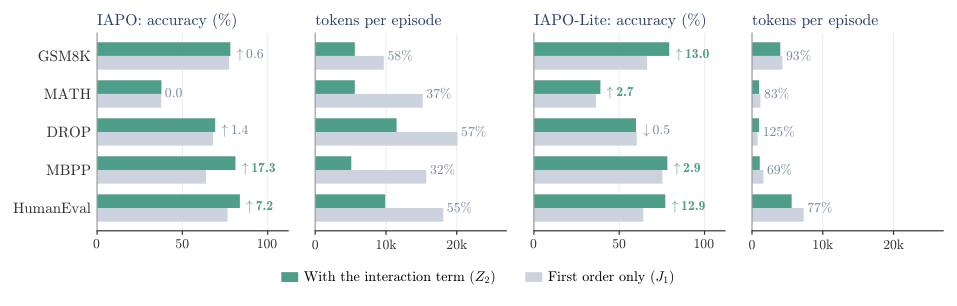
Caption: Figure 3: With the interaction term (Z2) and with first order only (J1), for IAPO (left) and IAPO-Lite (right): accuracy with its gain in points (bold: z>2), and tokens per episode with IAPO’s tokens as a share of the first-order variant’s.
Why It Matters: This is the decisive ablation visualization: it isolates the contribution of the interaction term while also showing its effect on token use.
🔮 Conclusion
The paper presents IAPO as a policy-improvement method tailored to orchestration decisions whose effects are conditional on other decisions. Its exact expansion clarifies what first-order methods omit, while the bounded update and validation certificate provide a practical route to using interaction terms without accepting every fitted candidate. The controlled tasks support the theoretical mechanism, and the long-input experiments show that the method can achieve strong accuracy with much lower deployed token use than the compared systems.
The most concrete evidence is the interaction ablation: the pairwise term changes which workflows are selected, including combinations such as producing a program before applying test-and-repair and following evidence finding with analysis. These results suggest that the value of an agent role should be measured in context, not in isolation. The conclusion is promising for adaptive multi-agent systems, but the benchmark construction and validation-dependent nature of the evidence mean that broader transfer still requires direct testing.
🛠️ Future Research Improvements
A natural next step is to test the interaction expansion beyond pairwise terms. The paper truncates at second order for tractability and controls the remainder analytically, but longer orchestration horizons and richer visibility graphs may contain meaningful three-way dependencies. Measuring when third-order terms materially improve candidate selection would clarify whether the second-order approximation is sufficient for practical systems.
The evaluation should also expand beyond the constructed long-input setting. Useful tests would vary the executor model, worker specialization, retrieval quality, document length, task distribution, and maximum number of decisions. Because the certificate is about validation-distribution return while test performance remains empirical, repeated distribution shifts and held-out domains would be especially informative. Finally, future implementations should report training compute, validation cost, inference latency, and token usage separately so that the savings from deployed plans can be compared with the cost of learning them.
- Measure the value and variance of third-order interaction estimates on longer episodes.
- Test transfer across executors, worker policies, role inventories, and non-constructed task distributions.
- Study adaptive validation budgets and confidence-bound choices as the candidate set grows.
- Report end-to-end training, certification, inference, latency, and token costs separately.
🏭 Potential Industry Use Scenarios
IAPO is most directly applicable to systems that coordinate retrieval, analysis, generation, verification, and repair. In enterprise question answering, an orchestrator could learn when an evidence finder should expose material to an analyst and when a checker should follow. In code generation, the reported workflow behavior suggests a concrete use case: generate a program, then invoke test-and-repair only when the program-producing step makes that repair action useful. In document-heavy operations, the same framework could choose whether to call a summarizer, calculator, verifier, or second answerer based on the intermediate artifacts already available.
The method is also relevant where inference cost is a first-class constraint. The paper's reward includes call costs, and the experiments report substantially fewer deployed tokens than the strongest baselines on the constructed tasks. A production implementation could use the certificate as a deployment gate for newly learned routing policies, retaining a known policy when validation evidence is insufficient. However, organizations should first establish that the validation distribution represents production traffic, that worker outputs are stable enough for learned interactions to persist, and that certification overhead is acceptable relative to the cost of occasional workflow errors.
- Long-document research assistants with retrieval-plus-analysis pipelines.
- Code agents combining generation, testing, program selection, and repair.
- Customer-support systems that route cases among specialist agents and verifiers.
- Enterprise workflow automation where quality and token cost must be optimized jointly.
💬 Critical Analysis
The strongest aspect of the paper is the alignment between its conceptual example, mathematical decomposition, algorithm, and ablation. The visibility example explains why a worker call and a later read decision can be complementary. The exact likelihood-ratio expansion formalizes that dependency, and the second-order statistic turns it into an implementable training objective. The controlled tasks further isolate the mechanism: first-order scoring can be zero despite a positive coordinated gain, while the combination of second-order and exact importance-sampling certificates can recover improvement. This is more persuasive than reporting only an end-to-end accuracy increase.
The experiments also make a useful distinction between accuracy and token cost. The matched-budget comparison, single-episode cost comparison, and first-order ablation answer different questions. The results show that IAPO can use fewer tokens while maintaining competitive accuracy, and that interaction-aware plans can be structurally different rather than merely larger versions of first-order plans. The observation that IAPO deploys test-and-repair after a program exists, while the first-order variant does not, is a concrete example of the proposed dependency structure affecting policy behavior.
Several questions remain. The long-input benchmarks are purpose-built distributions, and the paper warns that their absolute accuracies are not comparable with results on the original benchmarks. Baselines also have different reading and token regimes, so although matched-budget evaluation improves fairness, end-to-end cost comparisons still depend on the precise accounting boundary. The validation certificate provides a statistical guarantee for net return on the validation distribution, not a universal guarantee on future test or production traffic. Finally, the paper's practical scalability depends on the action space, horizon, candidate grid, and validation sample size. Broader replication should therefore verify the method with independent implementations, multiple executor models, more varied task distributions, and explicit accounting for training and certification overhead.
- Strength: theory, algorithm, controlled tasks, and ablation all target the same interaction hypothesis.
- Strength: the paper reports both quality and token metrics rather than treating accuracy as the only objective.
- Caveat: constructed long-input benchmarks limit direct comparison with standard benchmark results.
- Caveat: certificate validity on validation data does not eliminate distribution-shift risk.
- Open question: how the second-order approximation scales with longer horizons and richer action spaces.