
📌 Highlights
Concertina's main claim is architectural: continuous robot control should be native to the vision-language model rather than delegated to a discrete vocabulary head, a separate trajectory expert, or a post-hoc action module. The model represents one complete action vector at each timestep as one continuous latent token and reconstructs action blocks with the same masked blockwise operator used by its diffusion VLM backbone. This gives manipulation and cognition a shared forward path through all Transformer layers and a shared backward path through physical-coordinate supervision. The design is unusually parameter-efficient at the interface: the paper reports 0.21% active action-interface capacity in a 4.46B model and no separate action-generator layers.
The strongest empirical evidence is broad benchmark coverage combined with controlled interventions. Concertina reports 98.15% average success on regular LIBERO, 85.9% over all 10,030 LIBERO-Plus tasks, and 4.142 average completed chain length on 1,000 CALVIN ABC-D chains. The reported gains are not attributed to blockwise generation alone: K=10 blocks capture 21.3% of measured coherent action mass versus 9.8% for K=5, physical coordinate weighting and state masking materially change CALVIN performance, and a probability-valued gripper objective improves the factorial mean by +0.427 AvgLen. The central limitation is that these results are benchmark results, not evidence of real-robot deployment or universal robustness.
The Action Interface Audit adds a mechanistic perspective. It reports a 25.14× physical-error span for 256-bin quantization, 77.93%–82.23% invalid trajectory shapes for compressed tokenizers under single-token edits, zero interface-only cross-time response for Concertina, and layerwise temporal coupling emerging in middle and late shared-backbone layers. These diagnostics support the paper's thesis, but builders should treat them as design evidence to reproduce rather than as sufficient proof that shared-backbone coupling will transfer unchanged to another embodiment or control frequency.
- Continuous action tokens preserve physical coordinate structure while keeping sequence length proportional to H.
- Causal-across-block and bidirectional-within-block generation supports coherent action segments.
- The main benchmarks are regular LIBERO, LIBERO-Plus, and CALVIN ABC-D.
- The most consequential design variables are block size, physical coordinate weighting, state masking, objective compatibility, and execution-horizon alignment.
- The paper's strongest caveat is the absence of demonstrated real-robot deployment evidence in the supplied main body.
🎯 Introduction
The paper starts from the standard VLA objective of transferring visual perception, semantic grounding, and generalization from a pretrained vision-language model into physical manipulation. Its stated design question is how a pretrained VLM can output precise continuous actions while preserving the model architecture, training paradigm, and visual-language generalization. The authors argue that existing designs usually compromise one of these requirements by treating action as an external attachment. The VLM may understand the scene and instruction while another representation, module, or objective performs action generation and coordinate supervision.
The paper identifies two main forms of decoupling. RT-2 and OpenVLA quantize action coordinates into vocabulary bins, so cross-entropy does not encode the physical distance between adjacent and distant errors. FAST-style compression can entangle multiple timesteps and dimensions, making a single token error capable of corrupting a trajectory chunk. Continuous policies such as π0, π0.5, SmolVLA, GR00T N1, and X-VLA preserve physical coordinates but delegate trajectory generation to a dedicated action expert or external Transformer. In that arrangement, action computation and its gradients can be separated from the VLM, with gradient blocking or insulation used to control instability.
Concertina's paper-level objective is therefore stronger than adding a continuous head: it seeks an Embodied Vision-Language Model in which actions occupy the backbone's continuous hidden space, trajectories are generated by the same shared parameters and native generative operator, and physical-coordinate reconstruction updates the vision-language representation end to end. The intended result is reciprocal coupling. Visual and linguistic representations condition manipulation at every layer, while manipulation gradients shape the backbone's spatial cognition instead of remaining confined to an external motor module.
🔬 Methodology
Concertina predicts a horizon-H trajectory from visual observations, language, and proprioceptive state. The complete D-dimensional action at timestep i is encoded by E_phi into one d-dimensional token z_i, while D_psi reads the Transformer hidden state h_i back into physical coordinates. The two projections operate independently at each timestep, so they cannot themselves create temporal dependencies. Instead, the shared Transformer F_theta processes the multimodal prefix and all action tokens together. This makes the backbone responsible for both cross-modal conditioning and cross-time trajectory computation. The representation also preserves the coupling among translation, rotation, and gripper coordinates inside one token rather than distributing one timestep across many scalar symbols.
The horizon is divided into M blocks of at most K steps. Blocks are ordered causally, but tokens within a block are reconstructed bidirectionally. This topology is intended to preserve execution direction across blocks while allowing contiguous phases such as approaching, closing, and lifting to be coordinated in parallel. Training packs the conditioning prefix, corrupted action copy, and clean teacher-forced copy into one sequence. A corrupted query can attend to the prefix, its own corrupted block, and earlier clean blocks; clean queries expose teacher-forced context through their own block. Predictions are read from the corrupted branch, avoiding current-block target leakage while supervising all block-conditional distributions in one forward pass.
Corruption is stratified across blocks rather than sampled from one undifferentiated level. Selected positions are replaced by an unknown-action sentinel, and the physical-coordinate loss is weighted by active-coordinate validity and the reported 500:10:1 translation, rotation, and gripper weights. The inverse masking-probability factor in the action objective compensates for different corruption levels. At inference, the multimodal prefix is cached once, blocks are generated sequentially, action proposals are ranked by a risk head, and completed blocks are re-encoded into the persistent cache. The important implementation consequence is that proposal, refinement, and block transition operations all remain inside F_theta; there is no external flow or action Transformer.
The paper's equations make the division of labor explicit. Equation 1 defines the position-wise physical-to-hidden and hidden-to-physical maps. Equation 3 defines the packed training sequence. Equation 5 creates block-specific corruption levels, Equation 6 defines weighted coordinate reconstruction, Equation 7 applies inverse masking-probability weighting, and Equation 9 later measures non-local temporal response. The action interface is therefore lightweight, but the shared backbone must carry the full burden of contextualization, temporal coupling, and objective compatibility.
Equation 1
Meaning: The position-wise encoder converts one physical action vector into one continuous hidden-space token, and the position-wise decoder converts a contextualized hidden state back into physical action coordinates.
Equation 3
Meaning: Packed teacher forcing places the multimodal prefix, corrupted action sequence, and clean action sequence into one training input so the shared Transformer can learn block-conditional reconstruction.
Equation 5
Meaning: Block-stratified corruption assigns every action block a sampled masking level spanning the corruption range, with a lower clip for numerical stability.
Equation 6
Meaning: The per-token loss applies validity masks and physical coordinate weights, emphasizing translation relative to rotation and gripper coordinates under the reported 500:10:1 weighting.
📊 Experiments
The main evaluation covers regular LIBERO, LIBERO-Plus, and CALVIN ABC-D. Regular LIBERO reports success rate over four suites—Spatial, Object, Goal, and LIBERO-10—with 2,000 episodes total. LIBERO-Plus evaluates all 10,030 perturbed tasks across the same suites. CALVIN ABC-D evaluates 1,000 official five-task instruction chains in unseen environment D after training on environments A, B, and C. The paper reports success rate for LIBERO and LIBERO-Plus, and average completed chain length together with SR@1 through SR@5 for CALVIN. The main training description uses an 80.2M-frame multi-embodiment mixture, 60,000 updates followed by a 30,000-update continuation, eight GPUs, and global batch size 1,536 for CALVIN; regular-LIBERO finetuning uses global batch size 448.
On regular LIBERO, Concertina reaches 99.0% Spatial, 100.0% Object, 98.8% Goal, and 94.8% LIBERO-10, for a 98.15% average over 2,000 episodes. The paper reports this as the highest average among the compared methods, above π0 at 94.2%, π0.5 at 97.5%, X-VLA at 98.1%, Discrete Diffusion VLA at 96.4%, and Dream-VLA at 97.2%. On LIBERO-Plus, Concertina obtains 87.7% Spatial, 88.0% Object, 83.0% Goal, and 85.1% LIBERO-10, or 85.9% overall with 8,615 of 10,030 tasks successful. The paper reports 79.8% for EFFVLA and 69.6% for OpenVLA-OFT. On CALVIN ABC-D, Concertina obtains 4.142 AvgLen, 98.6% SR@1, 93.8% SR@2, 83.2% SR@3, 73.7% SR@4, and 64.9% SR@5.
The ablations explain why the headline numbers depend on the complete recipe. With fixed 2,400-step LIBERO and 2,600-step CALVIN finetuning budgets, changing from ten K=5 blocks to five K=10 blocks raises regular-LIBERO success from 38.5% to 73.0%, including Spatial from 50% to 82%, Object from 62% to 100%, Goal from 24% to 54%, and LIBERO-10 from 18% to 56%. On CALVIN, AvgLen rises from 0.055 to 1.945, SR@1 from 5.1% to 78.2%, and SR@5 from 0% to 11.7%. The AgiBot analysis measures directional cosine similarity of action increments at 0.775 for lag 5 and 0.663 for lag 10, with the first drop below 0.5 at lag 19; K=10 captures 21.3% of coherent action mass versus 9.8% for K=5.
The pretraining study reports that replacing uniform coordinate weights with 500:10:1 increases CALVIN AvgLen from 0.406 to 1.837 with state masking and from 0.535 to 1.093 without state masking. Adding state masking under physical weighting raises AvgLen from 1.093 to 1.837, while visual random-resized crop raises the full-trainable-backbone result from 0.607 to 1.589. Table 4 shows that aligning execution with K=10 raises AvgLen from 3.535 at H=50 to 4.135 at H=10, and multi-block continuation reaches 4.142 versus 3.934 for frozen-interface single-block continuation. Finally, the objective intervention reports −0.891 gradient cosine between relative and auxiliary absolute-action objectives, a 5.12× teacher action loss increase, and CALVIN collapse from 2.970 to 0.237. The 2×2×2 study reports +0.427 mean AvgLen for probability-valued gripper BCE and +0.311 for trainable action interfaces.
Table 2
Caption: Table 2: Main results across regular LIBERO, LIBERO-Plus, and CALVIN ABC–D, grouped by architectural paradigm. Regular-LIBERO Avg. is the arithmetic mean of its four suite scores. Bold and underline mark the best and second-best result per column. The π0.5 and IMLE-VLA rows follow the comparison reported by Hosseinkhani et al. (Hosseinkhani et al., 2026). EFFVLA reports suite-level LIBERO-Plus averages, while Concertina and the remaining LIBERO-Plus rows report the official 10,030-task benchmark with Long labeled LIBERO-10. CALVIN reports average completed chain length and sequence success rates (SR@1–5) on ABC→D.
| Method | Regular Spatial (%) | Object (%) | Goal (%) | LIBERO-10 (%) | Avg. | LIBERO-Plus Spatial (%) | Object (%) | Goal (%) | LIBERO-10 (%) | Overall | CALVIN AvgLen | SR@1 | SR@2 | SR@3 | SR@4 | SR@5 |
|---|---|---|---|---|---|---|---|---|---|---|---|---|---|---|---|---|
| π0 | 96.8 | 98.8 | 95.8 | 85.2 | 94.2 | 60.7 | 61.4 | 44.9 | 48.4 | 53.6 | – | – | – | – | – | – |
| π0.5 | 97.2 | 99.0 | 97.8 | 96.0 | 97.5 | – | – | – | – | – | – | – | – | – | – | – |
| X-VLA | 98.2 | 98.6 | 97.8 | 97.6 | 98.1 | – | – | – | – | – | 4.43 | 97.1 | 92.6 | 88.5 | 84.4 | 78.8 |
| OpenVLA-OFT | 97.6 | 98.4 | 97.9 | 94.5 | 97.1 | 84.0 | 66.5 | 63.0 | 66.4 | 69.6 | – | – | – | – | – | – |
| LLaDA-VLA | – | – | – | – | – | – | – | – | – | – | 4.01 | 95.6 | 87.8 | 79.5 | 73.9 | 64.5 |
| Discrete Diffusion VLA | 97.2 | 99.4 | 96.8 | 92.2 | 96.4 | – | – | – | – | – | – | – | – | – | – | – |
| Dream-VLA | 97.6 | 98.8 | 97.2 | 95.0 | 97.2 | – | – | – | – | – | – | – | – | – | – | – |
| Concertina | 99.0 | 100.0 | 98.8 | 94.8 | 98.15 | 87.7 | 88.0 | 83.0 | 85.1 | 85.9 | 4.142 | 98.6 | 93.8 | 83.2 | 73.7 | 64.9 |
Why It Matters: This is the central benchmark comparison. It shows Concertina's regular-LIBERO average, its complete LIBERO-Plus coverage, and its CALVIN chain-survival profile alongside representative discrete, external-expert, and shared-backbone policies.
Table 3
Caption: Table 3: Controlled pretraining ablation evaluating physical coordinate weighting (ωd), proprioceptive state masking, early-layer freezing, and random-resized crop (RRC). Every configuration runs 4,800 pretraining updates on AgiBot followed by 2,600 CALVIN finetuning updates (global batch 1,536) and is evaluated on all 1,000 official CALVIN ABC–D chains.
| Pretraining configuration | Coord. weights ωd | State mask | Early-layer freeze | Visual RRC | AvgLen | SR@1 | SR@2 | SR@3 | SR@4 | SR@5 |
|---|---|---|---|---|---|---|---|---|---|---|
| Full pretraining recipe | 500 : 10 : 1 | ✓ | Layers 0–1 | ✓ | 1.837 | 73.1 | 50.4 | 30.5 | 18.9 | 10.8 |
| Full trainable backbone, w/o state mask | 500 : 10 : 1 | × | None (all 36L) | ✓ | 1.589 | 69.9 | 42.7 | 23.9 | 14.4 | 8.0 |
| w/o proprioceptive state mask | 500 : 10 : 1 | × | Layers 0–1 | ✓ | 1.093 | 61.9 | 30.1 | 11.2 | 4.4 | 1.7 |
| w/o state mask, w/o visual RRC | 500 : 10 : 1 | × | Layers 0–1 | × | 1.027 | 56.4 | 26.7 | 12.3 | 4.9 | 2.4 |
| Full trainable backbone, w/o state mask & RRC | 500 : 10 : 1 | × | None (all 36L) | × | 0.607 | 40.6 | 15.2 | 3.6 | 1.0 | 0.3 |
| Uniform coordinate weights, w/o state mask | 1 : 1 : 1 | × | Layers 0–1 | ✓ | 0.535 | 36.5 | 13.0 | 3.0 | 0.8 | 0.2 |
| Uniform coordinate weights, w/ state mask | 1 : 1 : 1 | ✓ | Layers 0–1 | ✓ | 0.406 | 31.0 | 7.5 | 1.5 | 0.6 | 0.0 |
Why It Matters: The controlled matrix separates physical scaling, proprioceptive masking, early-layer freezing, and visual augmentation. The largest reported effects come from physical coordinate weighting and state masking.
Table 4
Caption: Table 4: Synergy between multi-block pretraining and receding-horizon closed-loop execution on CALVIN ABC–D (1,000 chains per row, 5,000 finetuning updates). Aligning the downstream finetuning horizon to the K = 10 receding-horizon execution block raises AvgLen from 3.535 to 4.135, while retaining multi-block causal-bidirectional context during continued pretraining (H = 20, M = 2, K = 10) outperforms single-block continued pretraining (H = 10, M = 1, K = 10) by +0.208 AvgLen (95% paired bootstrap CI [+0.119, +0.298]).
| Training & execution configuration | Pretraining stage | Downstream (H, M, K) | Exec. H_exec | AvgLen | SR@1 | SR@2 | SR@3 | SR@4 | SR@5 |
|---|---|---|---|---|---|---|---|---|---|
| Multi-block finetuning (H = 50) | 60k (H = 50, M = 5, K = 10) | (50, 5, 10) | 10 | 3.535 | 92.6 | 82.5 | 70.2 | 59.3 | 48.9 |
| Two-block finetuning (H = 20), 2-block exec. | 60k (H = 50, M = 5, K = 10) | (20, 2, 10) | 20 | 3.768 | 95.3 | 85.8 | 74.8 | 64.9 | 56.0 |
| Two-block finetuning (H = 20), 1-block exec. | 60k (H = 50, M = 5, K = 10) | (20, 2, 10) | 10 | 3.924 | 96.4 | 89.2 | 79.9 | 69.2 | 57.7 |
| Aligned 1-block finetuning (H = 10) | 60k (H = 50, M = 5, K = 10) | (10, 1, 10) | 10 | 4.135 | 98.7 | 93.9 | 84.6 | 72.1 | 64.2 |
| Single-block +40k cont. (trainable interfaces) | 60k + 40k (H = 10, M = 1, K = 10) | (10, 1, 10) | 10 | 3.786 | 97.6 | 89.0 | 75.5 | 64.3 | 52.2 |
| Single-block +40k cont. (frozen interfaces) | 60k + 40k (H = 10, M = 1, K = 10) | (10, 1, 10) | 10 | 3.934 | 97.9 | 90.3 | 79.7 | 67.2 | 58.3 |
| Multi-block +30k cont. (Concertina) | 60k + 30k (H = 20, M = 2, K = 10) | (10, 1, 10) | 10 | 4.142 | 98.6 | 93.8 | 83.2 | 73.7 | 64.9 |
Why It Matters: This table separates the benefits of multi-block pretraining from those of receding-horizon execution and shows why downstream horizon alignment matters.
Equation 7
Meaning: The action objective averages over valid timesteps and reweights masked positions by the inverse masking probability, balancing contributions from different corruption levels.
Equation 9
Meaning: The non-local response ratio measures how much perturbation energy from one input action coordinate propagates to outputs at least six timesteps away, locating cross-time trajectory coupling.
Figure 1
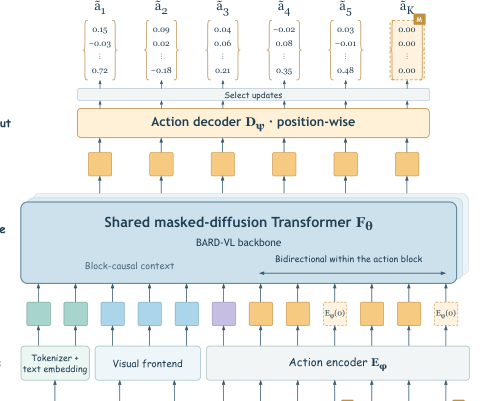
Caption: Figure 1: Concertina (eVLM) reconstructs continuous action blocks inside a shared diffusion vision-language model. Multimodal inputs and continuous latent action tokens are jointly processed across all layers of the shared Transformer Fθ, combining position-wise continuous coordinate projections (Eϕ, Dψ), packed blockwise teacher forcing during training, and risk-guided blockwise reconstruction at inference. Amber tiles denote complete action vectors; dashed “M” tiles denote masked vectors.
Why It Matters: This is the clearest architectural view of how action tokens, shared Transformer processing, packed training, and sequential blockwise reconstruction fit together.
Figure 2
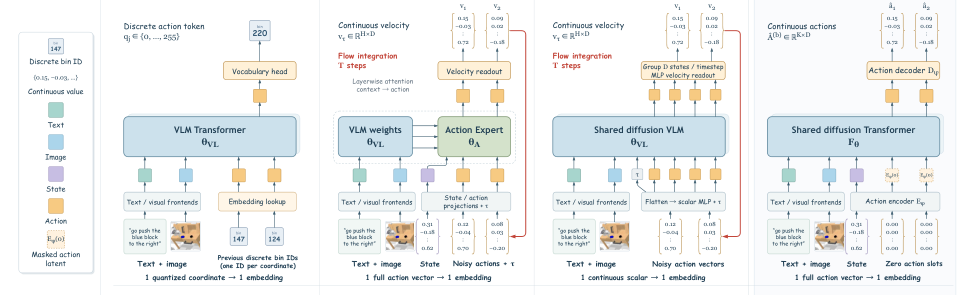
Caption: Figure 2: From decoupled VLAs to an Embodied Vision-Language Model (eVLM). Comparison of four architectural routes to robot manipulation: (A) OpenVLA quantizes coordinates into discrete vocabulary tokens (language-objective VLA); (B) π0 delegates continuous trajectory generation to a separate flow-matching action expert (separate-objective VLA); (C) Dream-VLA retains a shared diffusion VLM backbone but switches to a flow-matching objective for continuous control (switched-objective VLA); (D) Concertina instantiates an eVLM that preserves both the shared diffusion VLM backbone and its native masked block reconstruction operator over continuous latent action tokens.
Why It Matters: The comparison makes the paper's architectural distinction concrete by separating discrete representation, external action generation, objective switching, and native continuous reconstruction.
Figure 3
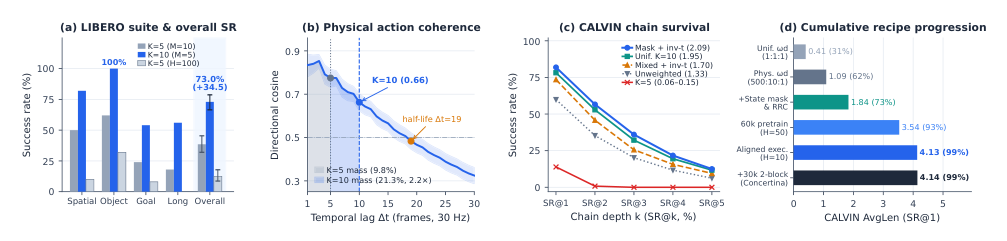
Caption: Figure 3: Blockwise horizon partition, physical action coherence, and cumulative recipe progression. (a) Regular-LIBERO suite-level and overall success over 200 episodes (40 tasks × 5 episodes, Wilson 95% CIs) at fixed 2,400-step finetuning budgets, showing consistent gains across all four suites (38.5% →73.0% overall). (b) Directional cosine similarity of physical action increments across temporal lags ∆t = 1 . . . 30 over 999,830 AgiBot frames (30 Hz, 95% task-bootstrap CI); enlarging the block size from K = 5 to K = 10 more than doubles intra-block coherent action mass (9.8% →21.3%, 2.17×). (c) Official 1,000-sequence CALVIN ABC–D chain survival curves (SR@1–5) across block partitions (K...
Why It Matters: This figure connects the architectural block choice to measured action coherence and then to benchmark performance, making the K=10 design rationale testable.
Figure 4
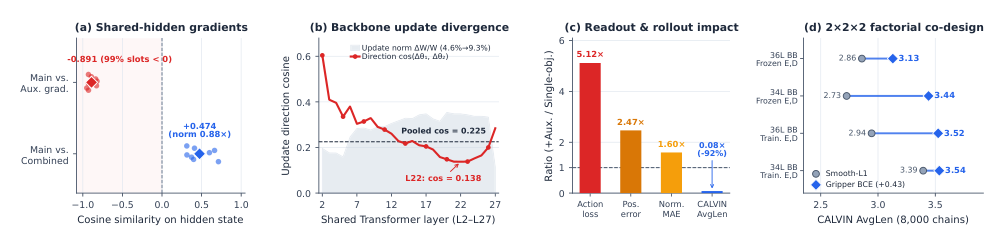
Caption: Figure 4: Co-design of action representation and supervision objective in the shared hidden space. (a) Shared-hidden gradient cosine between the main relative-action objective and auxiliary absolute-action objective across eight fixed windows is −0.891 (99% of action slots < 0), reducing combined-vs-main alignment to +0.474 (auxiliary/main norm ratio 0.88×). (b) Layerwise parameter update divergence across all 26 active Transformer layers (L2–L27): while relative update norm ∆W/W rises from 4.6% to 9.3% with identical overall magnitude (1.003×), the parameter update direction cosine plunges from 0.604 at Layer 2 to 0.138 at Layer 22 (pooled cosine 0.225). (c) Resulting readout degradation (...
Why It Matters: The counterfactual objective intervention is important evidence that a shared hidden space cannot safely absorb arbitrary coordinate losses; representation and supervision must be co-designed.
Figure 5
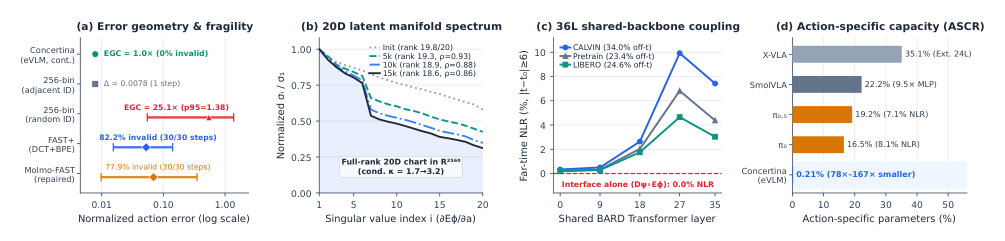
Caption: Figure 5: Action Interface Audit across representational, computational, and parameter coupling. (a) Physical action error span (p05–p50–p95) and structural decoding fragility under single-token substitutions: continuous coordinates (Concertina) preserve unit error geometry (EGC = 1.0×, 0% invalid), whereas 256-bin quantization induces a 25.1× error span and compressed DCT+BPE tokenizers (FAST+, MolmoAct2-FAST) suffer 82.2% and 77.9% invalid trajectory shapes while perturbing 30/30 steps on valid decodes. (b) Normalized Jacobian singular value spectrum (σi/σ1) of Concertina’s continuous action encoder ∂Eϕ/∂a ∈R2560×20 across pretraining updates, maintaining a full-rank 20D manifold (effecti...
Why It Matters: This figure summarizes the paper's diagnostic claim across physical error geometry, latent-manifold stability, the layerwise origin of temporal coupling, and parameter allocation.
🔮 Conclusion
The paper presents Concertina as a shared-backbone eVLM that represents each control timestep with a continuous latent action token, reconstructs temporally ordered blocks through the diffusion VLM's native operator, and supervises actions directly in physical coordinates. Its benchmark results are strong across regular LIBERO, LIBERO-Plus, and CALVIN ABC-D, while the ablations provide a coherent explanation for the recipe: K=10 blocks preserve more coherent motion, physical weighting restores the importance of translation, state masking increases visual-language grounding, multi-block continuation strengthens closed-loop execution, and gripper BCE is better aligned with the shared model than Smooth-L1 for the tested setting.
The broader conclusion is conditional rather than automatic. Sharing the backbone does not make every action objective compatible; the dual-objective intervention shows that conflicting gradients can damage both readouts and closed-loop behavior. Concertina's contribution is therefore a coupled representation, topology, and loss design in which the motor interface is small but the shared Transformer carries the temporal computation. The reported evidence supports this design on the supplied benchmarks, while deployment robustness and real-world generality remain to be established.
🛠️ Future Research Improvements
The most direct next research step is to test whether Concertina's coupling principles survive changes in embodiment, action dimensionality, sensor configuration, and control frequency. The paper supports heterogeneous action spaces through validity masks and a shared maximum coordinate width, but the reported benchmark evidence does not show how performance changes when the coordinate scales, trajectory smoothness, or gripper semantics differ substantially. A stronger study would hold the shared backbone and data budget fixed while varying K, H, and execution rate across multiple robot platforms.
Evaluation should also extend beyond success rates and chain length. Builders should measure action latency, memory use, proposal and refinement cost, failure recovery, sensitivity to visual perturbations, and performance under delayed or noisy state. The Action Interface Audit could be extended with intervention tests that connect NLR, EGC, and ASCR to actual task failures. Finally, objective design deserves broader treatment: the severe relative-versus-absolute gradient conflict suggests that multi-task supervision should be tested with adaptive weighting, geometry-aware targets, or staged compatibility checks before being added to the shared hidden space.
🏭 Potential Industry Use Scenarios
A practical use case is a general-purpose manipulation controller for warehouse, laboratory, or light industrial work where a single model must interpret natural-language instructions, visual scenes, and continuous robot state while producing short-horizon actions. Concertina's one-token-per-timestep representation and blockwise receding-horizon execution are especially relevant when a system needs to combine semantic instructions with spatially precise reaching, grasping, placement, and obstacle-avoidance behaviors. The shared parameter path could also simplify system integration by removing a separate action Transformer and reducing the action-specific parameter share.
The architecture may be useful for multi-embodiment fleets because inactive coordinates can be masked while active physical coordinates remain directly supervised. A product team could use the Action Interface Audit as a diagnostic before deployment: EGC can probe whether action errors have predictable physical meaning, NLR can reveal where temporal coupling is computed, and ASCR can quantify how much capacity is isolated from the general model. However, industrial adoption would require additional evidence on safety constraints, deterministic latency, calibration, hardware variation, recovery after failed grasps, and real-robot performance. The supplied results justify prototyping and controlled pilots, not unattended deployment.
💬 Critical Analysis
The paper's strongest aspect is the alignment between its conceptual claim and its measurements. It does not only report that Concertina uses a shared backbone; it measures the physical error geometry of representations, locates cross-time response with finite differences, counts action-specific capacity, and performs a counterfactual objective intervention. The reported 0.21% ASCR, zero interface NLR, and middle-to-late-layer emergence of temporal coupling are directly relevant to the proposed distinction between a true shared eVLM and a VLA with a motor attachment. The block-size and objective ablations further reduce the risk that the benchmark result is explained by one unexamined implementation detail.
At the same time, the benchmark comparison has important interpretive limits. Table 2 contains missing cells for many method-benchmark combinations, and the compared systems differ in architecture, pretraining, action representation, and evaluation coverage. The reported regular-LIBERO and LIBERO-Plus results are compelling within the listed settings, but they do not by themselves isolate the contribution of shared-backbone generation from data scale, backbone initialization, or other training choices. The CALVIN analysis is stronger because it includes matched ablations, yet it still reflects one simulated environment-transfer protocol.
The biggest technical risk is optimization fragility. The dual-objective intervention produces −0.891 shared-hidden gradient cosine and a 92.0% CALVIN collapse, showing that a unified model can fail sharply when objectives compete in the same representation. This sensitivity makes reproduction details unusually important: coordinate normalization, masking schedule, action horizon, block width, gripper loss, interface trainability, and execution alignment all matter. The paper also reports a full-rank latent chart and stable distance correlation, but these diagnostics do not guarantee good conditioning under unseen embodiments or distribution shift. A builder should therefore reproduce the ablations before generalizing the architecture, and should treat real-time, safety, and physical-robot validation as open requirements rather than implied consequences of the benchmark scores.