
📌 Highlights
PBPO targets the likelihood-evaluation mismatch between masked diffusion generation and autoregressive policy optimization. Its central design separates conditioning granularity from importance-weighting granularity: tokens in a block share one prefix-block state, but each token is clipped independently.
- Main claim: token-level clipping under block-level conditioning is more stable than multiplying token ratios into a single block ratio.
- Evidence: results are reported for LLaDA-8B-Instruct and LLaDA-1.5 on GSM8K, MATH500, HumanEval, MBPP, Countdown, and Sudoku at lengths 128, 256, and 512.
- Strongest stability evidence: the MATH500 reward curve shows early collapse for the direct block-level objective and stable training for PBPO.
- Important caveat: the method optimizes a tractable surrogate rather than the exact diffusion response likelihood.
🎯 Introduction
Masked diffusion language models iteratively denoise masked positions and can update multiple tokens in parallel. Modern systems such as LLaDA and LLaDA-1.5 use block-wise decoding, combining autoregressive dependence across blocks with parallel denoising within each block. This creates a natural RL action structure but does not provide the unique left-to-right likelihood factorization available to autoregressive models.
The paper's objective is to make block-aware policy optimization tractable and stable. It first constructs a prefix-block state and a factorized one-step block surrogate, then argues that the resulting product ratio couples all token updates within a block. PBPO retains the block-conditioned state while applying surrogate importance weighting and clipping independently at token level.
🔬 Methodology
For a response divided into blocks of length B_l, the prefix-block state z_i^{<b} reveals blocks before b and masks every position from block b onward. The dLLM predicts all masked positions from this shared state, so a single forward pass supplies the token probabilities needed for the current block. The direct block surrogate multiplies those probabilities and forms a block ratio across all tokens.
PBPO changes only the weighting granularity. For token t in block b_t^i, it computes a token ratio under z_i^{<b_t^i} and applies the clipped PPO-style term independently. Tokens in the same block therefore share conditioning but do not share a multiplicative importance weight. The objective uses the unnormalized group-relative advantage A_i=R(q,o_i)-1/G sum_j R(q,o_j).
When rollouts are reused for multiple inner updates, PBPO independently masks prompt tokens and samples a response masking pattern, using only the revealed-prefix portion for each block. Algorithm 1 combines these corrupted states with block-diffusion sampling, group-relative rewards, and repeated optimizer updates. The paper's analysis states that the block ratio can amplify gradient variance relative to token-level weighting under additional assumptions.
Equation 3
Meaning: Defines the prefix-block state: previously generated blocks are revealed, while the current and future response positions remain masked.
Equation 5
Meaning: Shows the direct block-level product ratio that couples all token changes within a block.
Equation 7
Meaning: Defines the token-level PBPO objective under prefix-block conditioning.
Equation 8
Meaning: Defines the corrupted prefix-block state for inner update u.
Algorithm 1 Prefix-Block Policy Optimization (PBPO)
Steps: ['Initialize the policy and behavior policy.', 'Sample grouped responses, compute rewards, and form group-relative advantages.', 'For each inner update, resample prompt and prefix masks, build prefix-block states, and compute token ratios.', 'Update the policy with the token-level clipped objective.']
Why It Matters: It operationalizes the separation between block-level conditioning and token-level importance weighting.
📊 Experiments
The evaluation covers six benchmarks. GSM8K and MATH500 measure mathematical reasoning with final-answer matching; Countdown measures valid target-reaching expressions; Sudoku measures complete-puzzle correctness; HumanEval and sanitized MBPP use execution-based pass@1. Training uses the GSM8K training split, MATH excluding MATH500, three-number TinyZero Countdown problems, a 4 × 4 Sudoku split, and KodCode-Light-RL-10K, with held-out evaluation sets described in the main body.
PBPO is initialized from LLaDA-8B-Instruct and LLaDA-1.5 and compared with d1, wd1, GDPO, and DMPO. Training is task-specific, uses LoRA, and shares a confidence-based block-wise decoder that unmasks the two highest-confidence positions in the current block at each denoising step. The source reports generation lengths of 128, 256, and 512.
Table 1 reports broad gains in several settings but also shows benchmark-dependent tradeoffs. At length 512, PBPO reports 84.38 GSM8K, 41.40 MATH500, 47.47 MBPP, and 38.13 Sudoku on LLaDA-8B-Instruct; on LLaDA-1.5 it reports 84.61 GSM8K, 39.00 MATH500, 44.36 MBPP, and 36.17 Sudoku. Countdown remains a notable comparison point where GDPO reports 73.05 on LLaDA-8B-Instruct and 71.88 on LLaDA-1.5, above PBPO's 64.45 and 69.53 at length 512.
For the masking ablation, the main-body text states that prompt masking alone and masking both prompt and prefix-block states consistently outperform clean prompt and clean prefix-block states. The supplied evidence does not contain recoverable numeric cells for that referenced table, so the ablation is reported qualitatively. Figure 1 provides the clearest optimization comparison: PBPO remains stable on MATH500 while the direct block-level objective collapses early.
Table 1
Caption: Main results across six reasoning and coding benchmarks at generation lengths 128, 256, and 512. Best result per column within each backbone block is in bold, and the second-best is underlined.
| Backbone | Baseline | GSM8K (128 / 256 / 512) | MATH500 (128 / 256 / 512) | HumanEval (128 / 256 / 512) | MBPP (128 / 256 / 512) | Countdown (128 / 256 / 512) | Sudoku (128 / 256 / 512) |
|---|---|---|---|---|---|---|---|
| LLaDA-8B-Instruct | LLaDA-8B-Instruct | 69.37 / 77.94 / 79.61 | 26.80 / 32.80 / 34.20 | 23.17 / 31.71 / 30.49 | 35.41 / 39.69 / 40.86 | 19.92 / 17.97 / 17.97 | 9.33 / 5.74 / 5.12 |
| LLaDA-8B-Instruct | d1 | 72.55 / 78.01 / 81.20 | 29.00 / 34.40 / 37.60 | 29.88 / 35.37 / 37.80 | 41.25 / 42.41 / 41.63 | 30.08 / 23.44 / 30.08 | 21.29 / 14.98 / 9.76 |
| LLaDA-8B-Instruct | wd1 | 73.01 / 80.06 / 81.50 | 32.80 / 34.80 / 36.20 | 27.44 / 34.15 / 37.20 | 42.80 / 42.02 / 42.80 | 48.83 / 51.17 / 49.22 | 24.40 / 24.16 / 22.97 |
| LLaDA-8B-Instruct | GDPO | 75.66 / 79.91 / 80.59 | 31.40 / 34.80 / 37.40 | 23.17 / 37.20 / 36.59 | 42.41 / 41.25 / 42.80 | 62.50 / 73.05 / 73.05 | 28.09 / 28.09 / 26.12 |
| LLaDA-8B-Instruct | DMPO | 75.59 / 80.74 / 82.79 | 29.80 / 35.40 / 38.20 | 24.39 / 35.98 / 37.80 | 43.19 / 43.58 / 43.58 | 50.00 / 57.81 / 64.84 | 21.15 / 17.13 / 15.50 |
| LLaDA-8B-Instruct | PBPO (Ours) | 76.72 / 84.08 / 84.38 | 34.80 / 36.80 / 41.40 | 30.49 / 37.20 / 37.80 | 43.97 / 48.25 / 47.47 | 52.73 / 64.06 / 64.45 | 34.93 / 38.13 / 38.13 |
| LLaDA-1.5 | LLaDA-1.5 | 71.27 / 79.38 / 82.11 | 28.40 / 32.20 / 38.40 | 21.95 / 30.49 / 34.76 | 36.19 / 44.36 / 38.91 | 21.09 / 18.36 / 21.09 | 13.78 / 10.10 / 8.33 |
| LLaDA-1.5 | d1 | 74.15 / 81.35 / 80.74 | 28.00 / 36.20 / 36.00 | 26.22 / 33.54 / 33.54 | 40.86 / 46.69 / 42.02 | 29.69 / 19.14 / 33.20 | 21.05 / 15.69 / 11.53 |
| LLaDA-1.5 | wd1 | 73.09 / 78.77 / 81.12 | 30.00 / 34.80 / 36.40 | 23.78 / 35.98 / 31.71 | 40.08 / 40.47 / 42.41 | 42.97 / 56.25 / 48.05 | 24.31 / 23.16 / 22.73 |
| LLaDA-1.5 | GDPO | 74.60 / 78.39 / 79.38 | 30.20 / 34.40 / 38.40 | 23.78 / 36.59 / 35.98 | 38.91 / 45.91 / 41.25 | 51.56 / 67.58 / 71.88 | 25.50 / 26.70 / 24.26 |
| LLaDA-1.5 | DMPO | 49.81 / 50.87 / 51.33 | 31.40 / 35.80 / 39.00 | 25.00 / 39.63 / 35.37 | 42.41 / 44.36 / 43.19 | 49.61 / 58.98 / 69.92 | 26.12 / 24.98 / 23.88 |
| LLaDA-1.5 | PBPO (Ours) | 78.24 / 83.47 / 84.61 | 33.40 / 42.00 / 39.00 | 31.71 / 41.46 / 35.98 | 42.80 / 46.69 / 44.36 | 57.03 / 69.14 / 69.53 | 37.75 / 39.33 / 36.17 |
Why It Matters: This table provides the central cross-backbone and cross-length comparison, including task-specific variation across mathematical reasoning, coding, Countdown planning, and Sudoku.
Figure 1
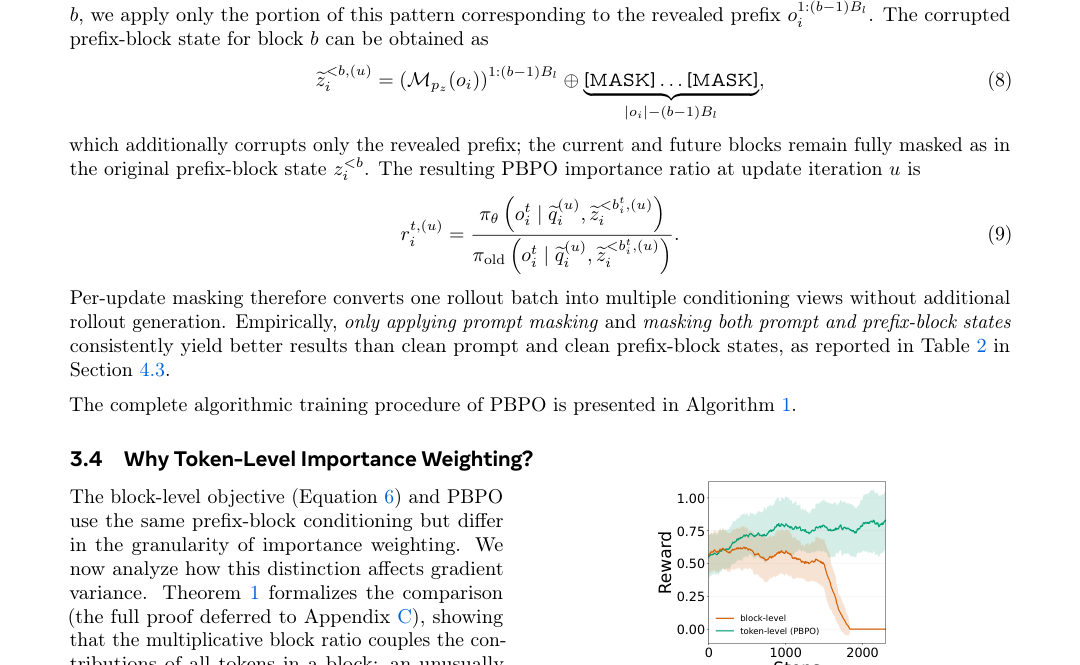
Caption: Reward dynamics on MATH500, trained upon LLaDA-8B-Instruct. PBPO demonstrates stable training, while block-level objective collapses early during training.
Why It Matters: This is the paper's direct optimization-stability comparison: under identical training configurations, PBPO remains stable while the direct block-level formulation collapses earlier.
🔮 Conclusion
The paper presents PBPO as a practical compromise for RL post-training of block-wise masked diffusion language models: it preserves the shared prefix-block context required by the generation process while preventing a single block product ratio from coupling all token updates. The reported benchmark results are competitive across two LLaDA-family initializations, and the reward trajectory supports the claim that token-level weighting is more stable than the direct block-level objective.
The result is strongest as an optimization design for a particular dLLM generation structure, not as an exact solution to diffusion likelihood evaluation. Its broader value depends on whether the same stability and accuracy behavior transfers to other masked-diffusion architectures and training settings.
🛠️ Future Research Improvements
A useful next study would isolate the contributions of prefix-block conditioning, token-level clipping, prompt masking, and prefix masking with fully recovered numeric ablations and matched compute budgets. This would clarify whether the gains come primarily from the weighting granularity, the conditioning state, or the diversified views.
Further evaluation should expand beyond the two LLaDA-family initializations and six task benchmarks, while separately measuring training compute, rollout generation cost, memory, and inference latency. The method's factorized surrogate and shared block evaluation suggest possible efficiency benefits, but those system-level claims are not established by the supplied results.
🏭 Potential Industry Use Scenarios
PBPO could be relevant to verifiable-reward post-training for diffusion language models used in mathematical reasoning, code generation, constrained planning, and puzzle solving, because the paper directly evaluates those task families with answer matching, execution-based pass@1, or rule-based correctness.
A production implementation could use prefix-block states for parallel denoising while applying token-level safeguards during policy updates. Before deployment, engineers would need to verify behavior under domain-specific reward functions, longer responses, different block sizes, and operational constraints such as throughput and memory.
💬 Critical Analysis
The strongest technical idea is the separation between conditioning granularity and importance-weighting granularity. It is aligned with the structure of block-wise dLLM decoding and avoids the direct product-ratio failure mode highlighted by the theorem and reward dynamics. The use of per-update masking is also consistent with masked-diffusion pre-training and reuses rollout data across multiple conditioning views.
The evidence is less conclusive about universal superiority. PBPO does not dominate every benchmark or generation length; for example, Countdown values at length 512 are higher for GDPO than PBPO on both listed backbones, while several PBPO gains are task- and initialization-dependent. The theorem's variance inequality is stated under additional assumptions, and the supplied main body does not establish how sensitive the result is to block length, clipping coefficients, or reward distribution.
For reproducibility, the main body identifies the datasets, baselines, decoding rule, LoRA usage, and broad training structure, but complete reward definitions and hyperparameters are outside the supplied evidence. A builder should therefore treat the reported numbers as a strong starting point for reproduction rather than a complete deployment recipe.