
📌 Highlights
TactileLab's central claim is that dense shear-relevant tactile feedback can be generated efficiently from rigid-body contact kinematics and then transferred to real sensors through a learned intermediate representation.
The strongest simulated result is the combined depth-and-flow policy: it reaches 27.01 ± 2.82 seconds time-to-fail with an 11.76% fall rate within the training distribution and 25.08 ± 3.50 seconds with an 18.69% fall rate on OOD objects.
In real in-hand rotation, depth plus flow averages 1.95 ± 0.81 rotations and maintains the full 30-second evaluation horizon, compared with 0.82 ± 0.56 rotations for proprioception alone.
The main caveat is that the transfer pipeline assumes sticking contact and remains sensor-dependent, especially for rotational shear estimation from markerless tactile images.
- Flow provides tangential-motion information that depth-only simulation omits.
- Depth and flow are complementary: depth describes contact geometry, while flow describes contact evolution.
- PETS-Net reduces the adaptation burden by combining spatial tactile encoding with temporal proprioceptive context.
- TacFlowNet makes sensor-specific real observations compatible with a shared simulated policy space.
🎯 Introduction
The paper targets contact-rich manipulation tasks in which maintaining contact, reacting to slip-like motion, or following an object requires tangential information. Existing soft-body tactile simulators can model compliant contact with higher fidelity but are computationally expensive for large-scale reinforcement learning. Rigid-body simulators are faster and scalable, but commonly provide only depth-like or instantaneous normal-contact signals, leaving shear and temporal contact evolution underrepresented.
The paper-level objective is to close this gap with a compact representation that is efficient to simulate and transferable across tactile sensors. TactileLab therefore combines contact depth with simulated tactile flow, supplies environments for single-arm, dual-arm, and dexterous manipulation, introduces PETS-Net for multimodal temporal adaptation, and validates real-to-sim transfer through dual-arm following and in-hand rotation.
🔬 Methodology
The simulator generates three classes of observations: low-dimensional contact descriptors such as force, position, and shear; a contact-depth image representing normal penetration; and a two-channel tactile-flow field representing image-space tangential displacement. Flow is computed by identifying contact pixels, projecting the associated contacted object-surface points into the tactile image plane, transforming those points by relative rigid-body motion, and taking the projected displacement. This keeps the representation spatially aligned with depth while avoiding explicit elastomer deformation.
The policy system treats the robot as partially observed. A privileged teacher is trained with object properties, motion, disturbances, and hand orientation unavailable during deployment. A frozen base policy then receives a latent interaction representation predicted by PETS-Net from proprioceptive, action, and tactile histories. PETS-Net applies frequency-band positional encoding to joint and action histories, modality-specific convolutional encoders to depth and flow, and temporal aggregation before predicting the latent.
TacFlowNet addresses the real-to-sim observation gap. It receives two consecutive real tactile images, concatenated along the channel dimension, and predicts a simulated flow field. Training combines a conditional adversarial objective with masked pixel-level flow reconstruction inside the simulated contact mask. Contact-depth translation is used as a supporting modality, while the flow translator preserves dynamic, pixel-level information rather than reducing shear to a single vector.
display equation 2
Meaning: Defines the multimodal tactile observation as contact depth, tactile flow, and low-dimensional contact descriptors.
display equation 3
Meaning: Defines the two-channel tactile-flow vector at every tactile-image pixel.
display equation 4
Meaning: Creates the binary contact mask used to restrict flow computation to contacted pixels.
display equation 5
Meaning: Sets the dense flow field to the computed displacement in contact and zero elsewhere.
📊 Experiments
The paper does not rely on a named public benchmark dataset. It evaluates two simulated task benchmarks—dual-arm 6D object following and dexterous in-hand rotation—using Allegro Hand and LEAP Hand embodiments, plus a paired real-to-sim tactile dataset collected from prescribed 6D contact poses and motions. The sensor study covers markerless GelSight Mini, DIGIT, 9DTact, GelSight Mini with markers, flat TacTip, and hemispherical TacTip. Simulation reports time-to-fail, rotation counts, and fall rate; real in-hand trials report rotations and time to termination; flow grounding reports MAE and R².
In the in-hand simulation, the depth-plus-flow policy is strongest in both evaluation regimes: 27.01 ± 2.82 seconds time-to-fail, 1.28 ± 0.85 rotations, and 11.76% fall rate within distribution; 25.08 ± 3.50 seconds, 1.27 ± 0.94 rotations, and 18.69% fall rate OOD. Flow alone outperforms depth alone on the shear-sensitive dual-arm task, while combining both modalities gives the fastest convergence and highest final reward in the in-hand task. Rich tactile inputs also reach strong performance with approximately 5–10 history steps, whereas proprioception and low-dimensional contact generally benefit from approximately 10–15 steps.
The PETS-Net ablations support the proposed architecture but also bound the claim. Positional encoding improves over no positional encoding, with K = 2 reported as best and K = 1 and K = 4 competitive. Among temporal encoders, the TCN achieves the highest final reward and stable convergence, with GRU slightly lower; the Transformer does not improve performance at the evaluated history horizon and requires more VRAM. The full spatial-plus-temporal model outperforms reduced variants, indicating that temporal aggregation is most useful after extracting spatial tactile features.
For real-to-sim grounding, simulated inputs produce translational MAEs of 0.29–0.30 mm/s, rotational MAEs of 1.29–1.42°/s, and R² = 0.99 across sensors. For markerless GelSight Mini, translation reduces translational MAE from 1.79 to 0.34 mm/s and rotational MAE from 4.50 to 1.18°/s. In real dual-arm following, position/orientation errors are 0.91 mm/0.019 rad and 1.42 mm/0.021 rad for straight and circular motion on the rigid cube, rising to 4.20 mm/0.041 rad and 6.43 mm/0.057 rad on the foam brain. In real in-hand rotation, depth plus flow averages 1.95 ± 0.81 rotations overall and achieves 2.25 ± 0.07, 2.43 ± 0.37, and 1.33 ± 1.00 rotations for cylindrical, round, and cube-shaped objects.
- Higher is favorable for time-to-fail, rotation counts, and R²; lower is favorable for fall rate, MAE, position error, and orientation error.
- The main comparison is modality-based rather than dataset-based: proprioception, low-dimensional contact, depth, flow, and depth-plus-flow.
- Real evaluation includes unseen motion patterns, object geometries, compliance, textures, and surface properties.
tab:simulation_results
Caption: In-hand manipulation performance across tactile observation modalities on within-distribution and out-of-distribution objects in simulation. Results are reported as mean ± standard deviation.
| Observations | Within Training Distribution: Time-to-Fail (s) | Within Training Distribution: Rot. Counts | Within Training Distribution: Fall Rate (%) | Out-of-Distribution: Time-to-Fail (s) | Out-of-Distribution: Rot. Counts | Out-of-Distribution: Fall Rate (%) |
|---|---|---|---|---|---|---|
| Oracle Teacher | 27.45 ± 2.13 | 1.88 ± 0.66 | 9.37 | 25.11 ± 3.51 | 1.74 ± 0.81 | 18.09 |
| Prop. | 19.87 ± 4.04 | 0.97 ± 0.88 | 47.66 | 16.64 ± 4.24 | 0.88 ± 0.85 | 57.85 |
| Prop. + LD Contact | 25.18 ± 3.34 | 1.21 ± 0.90 | 21.33 | 22.00 ± 4.09 | 1.19 ± 0.88 | 31.21 |
| Prop. + Flow (Ours) | 25.57 ± 3.30 | 1.24 ± 0.84 | 17.45 | 22.80 ± 3.89 | 1.19 ± 0.91 | 29.82 |
| Prop. + Depth (Ours) | 26.19 ± 3.14 | 1.21 ± 0.89 | 14.26 | 22.27 ± 4.08 | 1.20 ± 0.91 | 29.91 |
| Prop. + Depth + Flow (Ours) | 27.01 ± 2.82 | 1.28 ± 0.85 | 11.76 | 25.08 ± 3.50 | 1.27 ± 0.94 | 18.69 |
Why It Matters: The combined depth-and-flow observation gives the strongest simulated retention and lowest fall rate in both training-distribution and OOD evaluations.
tab:Real-to-Sim_flow_transfer
Caption: Tactile-flow-based shear estimation performance for simulated, real, and real-to-sim inputs. Each entry reports MAE/R², averaged over 8 independently trained regressors (identical data, stochastic weight initialization/batch order). Sim denotes the in-domain result obtained directly from simulated test flow, Real denotes the result obtained directly from real tactile image pairs, and Real-to-Sim denotes the result obtained from real tactile image pairs translated into simulated tactile flow before shear estimation.
| Sensor | Press depth | v_xy (mm/s): Sim | v_xy (mm/s): Real | v_xy (mm/s): Real-to-Sim | ω_z (°/s): Sim | ω_z (°/s): Real | ω_z (°/s): Real-to-Sim |
|---|---|---|---|---|---|---|---|
| GelSight Mini, markerless | 1 mm | 0.30/0.99 | 1.79/-0.02 | 0.34/0.98 | 1.33/0.99 | 4.50/0.89 | 1.18/0.99 |
| DIGIT, markerless | 1 mm | 0.29/0.99 | 0.64/0.94 | 0.48/0.96 | 1.32/0.99 | 3.61/0.92 | 3.33/0.92 |
| 9DTact, markerless | 1 mm | 0.30/0.99 | 0.45/0.97 | 0.35/0.98 | 1.29/0.99 | 2.02/0.97 | 1.29/0.99 |
| GelSight Mini, markers | 1 mm | 0.30/0.99 | 0.35/0.98 | 0.27/0.99 | 1.30/0.99 | 0.90/1.00 | 0.97/1.00 |
| Flat TacTip | 1 mm | 0.30/0.99 | 0.26/0.99 | 0.24/0.99 | 1.30/0.99 | 1.02/0.99 | 1.00/0.99 |
| Hemispherical TacTip | 1 mm | 0.30/0.99 | 0.27/0.99 | 0.29/0.99 | 1.42/0.99 | 2.09/0.98 | 2.22/0.97 |
| Hemispherical TacTip | 5 mm | 0.29/0.99 | 0.25/0.99 | 0.27/0.99 | 1.32/0.99 | 0.91/1.00 | 1.25/0.99 |
Why It Matters: It shows both the promise and the sensor dependence of the real-to-sim interface: markerless sensors often improve after translation, but performance is not uniform.
fig:tactile_illustration
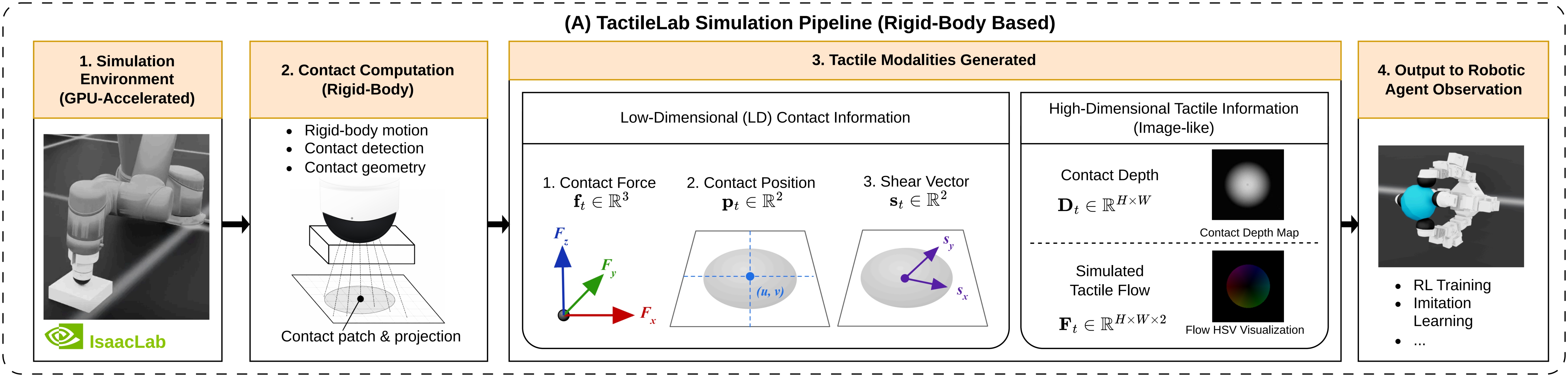
Caption: Overview of the TactileLab simulation framework and simulated tactile-flow computation. The rigid-body simulation pipeline computes contact geometry and generates low-dimensional contact descriptors, contact-depth images, and dense tactile-flow fields for policy learning. Simulated tactile flow is obtained by projecting the three-dimensional contact patch onto the tactile image plane and calculating the image-space displacement induced by the relative motion between the tactile sensor and the contacted object.
Why It Matters: This is the central system view: it shows how rigid-body contact geometry becomes depth, flow, and low-dimensional tactile observations.
fig:multimodal_policy_learning
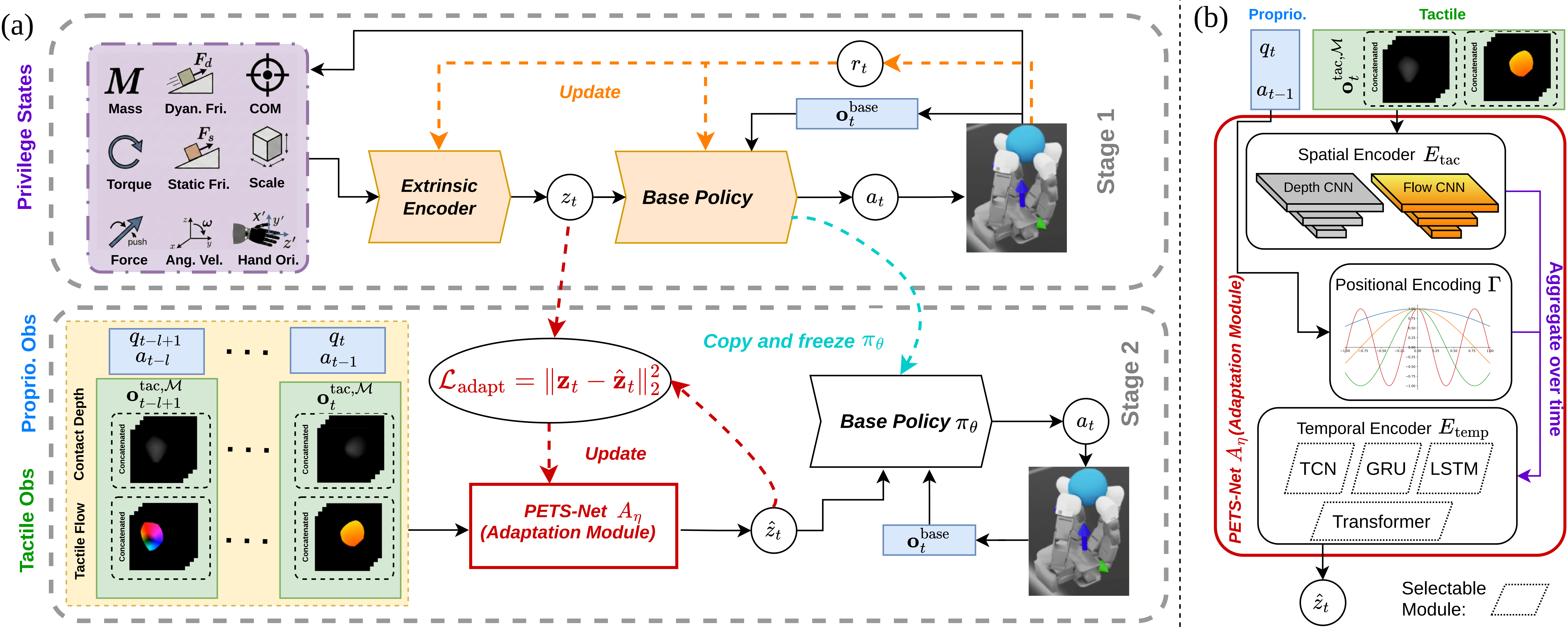
Caption: (a) Overview of multimodal tactile policy learning for dexterous in-hand manipulation. To evaluate the benefit of our rich tactile observations, unknown random force and torque perturbations are applied to the manipulated object, making the task more challenging and requiring robust and informative tactile feedback. (b) The structure of the proposed PETS-Net for high-dimensional tactile policy learning.
Why It Matters: It connects the privileged teacher, tactile-proprioceptive adaptation, and PETS-Net architecture used for deployable policies.
fig:tacflownet
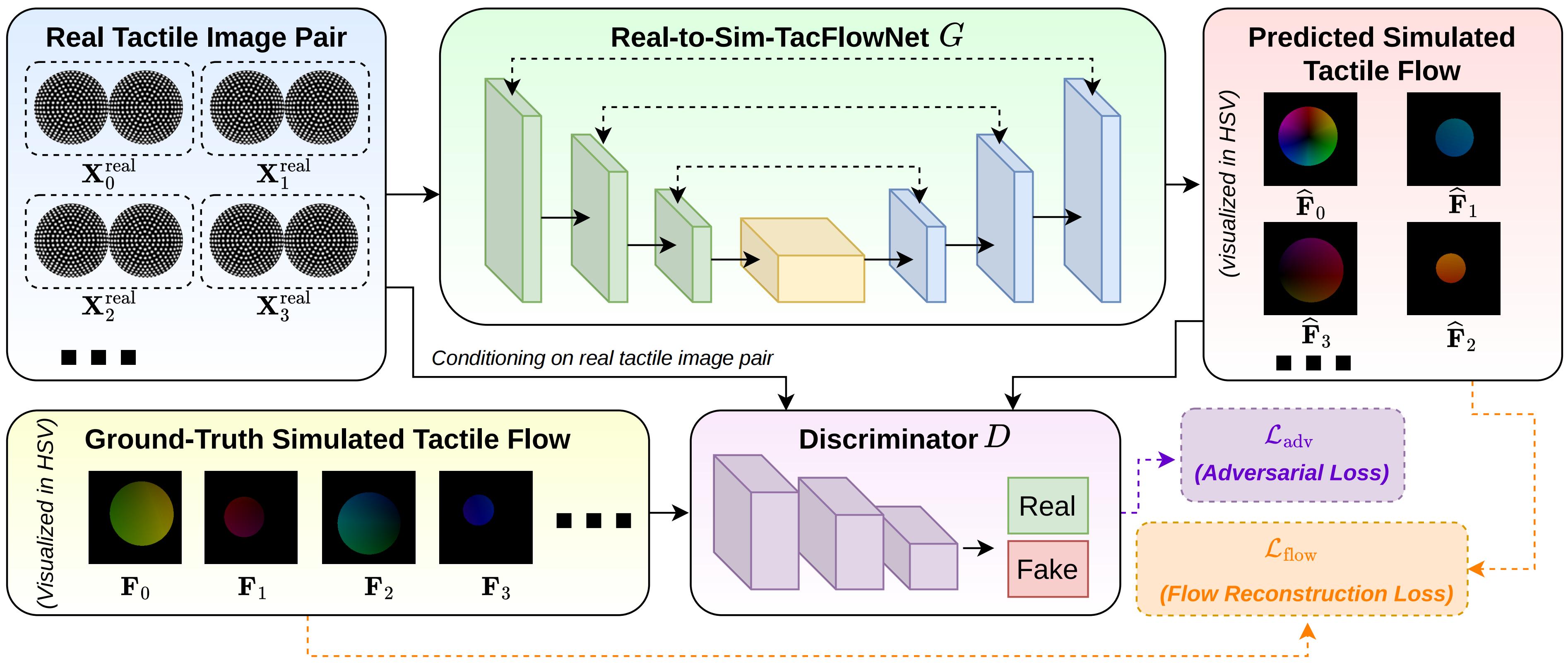
Caption: Overview of Real-to-Sim-TacFlowNet. A pair of real tactile images is concatenated and passed to a pix2pix-style generator \(G\), which predicts a pixel-level simulated tactile-flow field. During training, the predicted flow is supervised by a paired simulated tactile-flow target through a reconstruction loss and by a discriminator \(D\) through an adversarial loss. The HSV flow images are used only for visualization; the network output is a two-channel flow field \( F\).
Why It Matters: It clarifies the sensor-specific perception bridge that lets policies consume the same flow representation during real deployment.
fig:abl_main
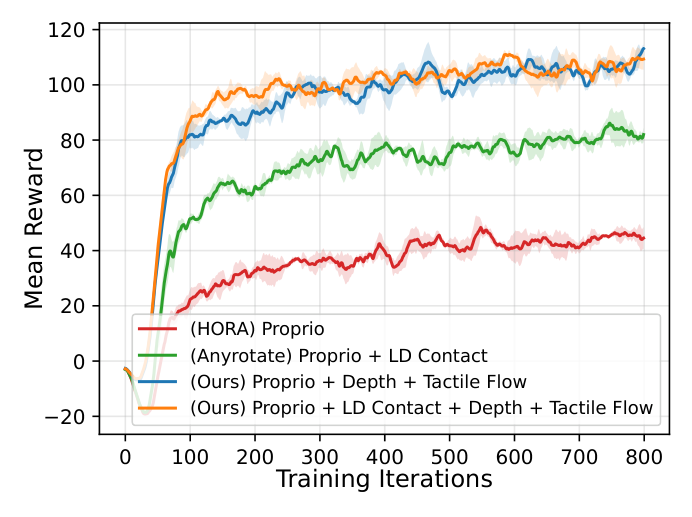
Caption: Ablation studies of tactile observation richness and temporal history in the in-hand manipulation task. (a) Policy input modalities compared with proprioception-only HORA~qi2023inhand and LD contact AnyRotate~yang2024anyrotate. (b) Comparison of contact depth, tactile flow, and their combination. (c) Final reward across modalities and history lengths, with percentages showing gains over the preceding shorter history. Dense tactile observations, particularly tactile flow, approach saturation with shorter histories. Solid curves show the mean over three random seeds, with shaded regions denoting ±1 standard deviation. Values in (c) report mean ± standard deviation across three random seeds.
Why It Matters: It provides the main modality and history-length evidence for why dense tactile observations outperform proprioception and low-dimensional contact.
fig:abla_ts
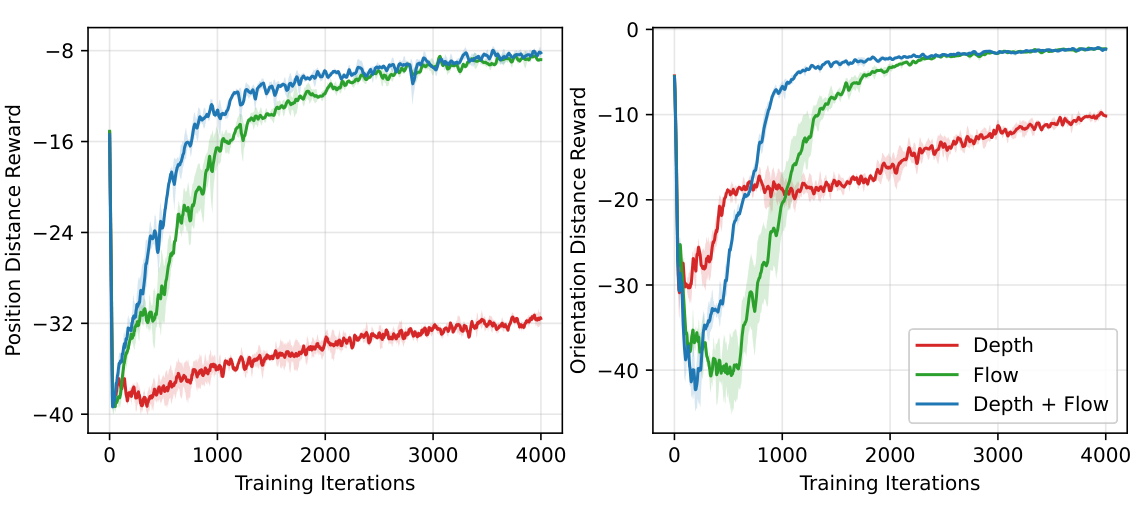
Caption: Ablation studies of contact depth and tactile flow for the shear-sensitive dual-arm object-following task. Solid curves show the mean over three random seeds, with shaded regions denoting ±1 standard deviation.
Why It Matters: It isolates the role of flow in a task whose success depends directly on tangential contact motion.
fig:abla_pe
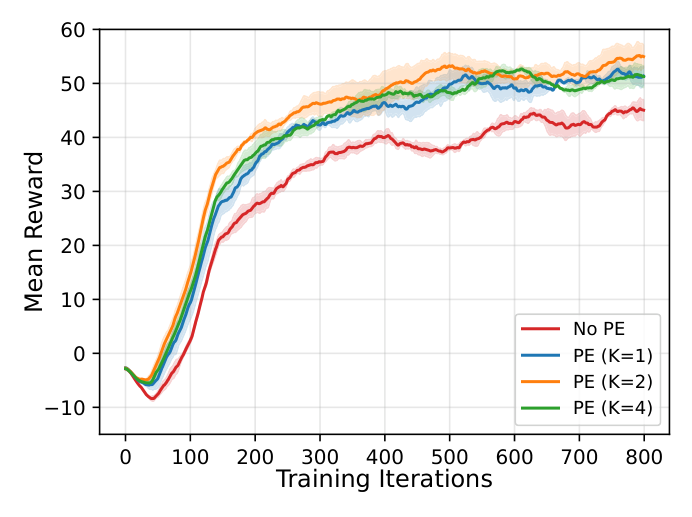
Caption: Ablation studies of PETS-Net. (a) Effect of positional encoding frequency in the adaptor. (b) Effect of temporal-history encoder structure. (c) Effect of spatial and temporal components. Solid curves show the mean over three random seeds, with shaded regions denoting ±1 standard deviation.
Why It Matters: It tests the architectural choices behind PETS-Net rather than only comparing final tactile modalities.
🔮 Conclusion
TactileLab demonstrates that rigid-body simulation can supply useful shear-sensitive tactile observations when contact depth is complemented by dense projected motion. Across simulated and real tasks, flow improves contact-rich control, depth adds geometric information, and their combination provides the most consistent performance. PETS-Net and TacFlowNet complete the pipeline by connecting long-horizon tactile policy adaptation with heterogeneous real sensors.
The evidence supports TactileLab as an efficient representation and transfer strategy rather than as a replacement for high-fidelity tactile physics in every setting. Its practical value is strongest when scalable policy learning and cross-sensor deployment matter more than exact elastomer or optical reproduction.
🛠️ Future Research Improvements
The paper identifies slip as a central open problem. A stronger system should detect and represent slip explicitly, incorporate slip into simulation, and test recovery behavior after abrupt contact changes rather than assuming stable sticking contact.
Generalization also requires larger and more structured real-to-sim datasets. Future collection should vary local curvature, contact orientation, object shape, compliance, surface properties, and sensor morphology, potentially with geometry-aware translators that explain how identical tangential motions produce different image-space flow.
A useful next comparison would compute the same tactile-flow representation from soft-body deformation or rendered tactile images and quantify the trade-off among fidelity, training throughput, transfer accuracy, and downstream manipulation success.
🏭 Potential Industry Use Scenarios
The framework could support robotic assembly and insertion systems that need persistent contact while following moving parts, especially when training data must be generated at scale and the deployed sensor may differ from the simulated interface.
Dexterous grippers and hands could use the shared depth-flow representation for grasp stabilization, object reorientation, packaging, sorting, or tool handling where local contact changes are difficult to infer from vision or proprioception alone.
The sensor-agnostic transfer design could also support a robotics platform with multiple tactile hardware options: a new sensor would require a real-to-sim observation translator while downstream policy representations remain unchanged. Deployment risk remains highest in applications with frequent slip, severe deformation, or contact geometries far outside the collection data.
💬 Critical Analysis
The paper's strongest technical choice is separating policy learning from sensor appearance. Simulated flow is physically interpretable enough to encode tangential motion, yet simple enough to derive from rigid-body kinematics and align with depth. The ablations consistently support the mechanism: flow is particularly useful for shear-sensitive following, depth and flow complement one another in-hand, and PETS-Net benefits from both spatial encoding and temporal aggregation.
The main concern is scope. The reported real-world successes are impressive relative to the training distributions, but they do not establish robustness to slip, broad object-shape distributions, or arbitrary tactile sensors. The real-to-sim table also shows that translation quality is uneven: some sensors approach simulated performance, while DIGIT retains a 3.33°/s rotational MAE after translation. The paper therefore supports a strong engineering pattern, but not yet a universal tactile abstraction.
For reproducibility, builders should verify the complete data-collection protocol, sensor calibration, contact-maintenance behavior, teacher-student hyperparameters, and the precise definition of evaluation episodes. The reported gains may depend on stable contact, carefully paired real and simulated motions, and the chosen object randomization. Those dependencies should be stress-tested before treating tactile flow as a generally sufficient state representation.