
📌 Highlights
SpecCTMC addresses the sequential evaluation cost of exact event-driven generation in absorbing-mask diffusion language models. It uses no separate draft model: tentative token updates are proposed from prior predictions, target distributions for intermediate states are evaluated in batches, and proposals are verified in order. Residual correction at the first rejection preserves the target conditional mark distribution; the event clock remains valid because its rate depends on the number of remaining masks.
The paper proves equality of the joint event-time, position-token, and state trajectory distributions with DirectCTMC under its stated conditions. Across five text benchmarks, it reports average NFE reductions of 2.79× for LLaDA-8B-Instruct and 2.85× for Dream-v0-Instruct-7B. These are sequential target evaluation reductions, not guaranteed latency multipliers: Dream’s average wall-clock speedup is 1.36×, and some benchmark averages are near parity or below it.
The evaluation also covers LLaDA-V on MathVerse and MathVista, with reported NFE reductions from 5.93× to 6.69×. For builders, the key decision is whether batched verification yields useful runtime savings on the intended hardware and sequence lengths while preserving task quality and the desired stochastic sampling behavior.
- Core claim: exact speculative acceleration of the masked-diffusion CTMC sampling law, under stated conditions.
- Strongest reported text result: up to 4.38× fewer sequential target evaluations in the LLaDA table; multimodal LLaDA-V reaches 6.69× on MathVista at length 512.
- Main caveat: evaluation-count reductions can exceed wall-clock gains because batched calls still incur computation and hardware-dependent overhead.
🎯 Introduction
Masked diffusion language models generate text by iteratively unmasking positions in a partially masked sequence, without requiring a fixed left-to-right order. In the paper’s continuous-time formulation, generation is a CTMC that unmasks one token at each event. DirectCTMC samples event times and then samples a position-token update conditioned on the current sequence, so each event requires a sequential model evaluation.
Prior acceleration strategies make different tradeoffs. Fixed-step solvers such as τ-leaping approximate multiple transitions over an interval, while practical decoders use greedy choices, confidence-guided unmasking, caching, or parallel token commitments. But positions predicted from the same masked context may be dependent: unmasking one token can change another token’s conditional distribution. Independent parallel commitments can therefore alter the sampling law. Deterministic decoding also does not explore alternative answers across repeated attempts.
The paper’s objective is to reduce the sequential bottleneck without that parallel factorization error and without requiring a separate drafter. SpecCTMC applies speculation to the underlying absorbing-mask CTMC, including its random event times and joint position-token marks. Its claim is that exact target verification and residual correction recover the DirectCTMC trajectory distribution while allowing tentative future states to share batched evaluation.
🔬 Methodology
The state x is a token sequence, and A(x) is the set of positions still containing the mask token; m(x) counts them. An event mark z=(d,v) selects a masked position d and a non-mask replacement token v. The target generator assigns rate pθ(v|x,d)/t to that mark. Because the token probabilities at each masked position are normalized, the total exit intensity is m(x)/t, and the event mark distribution is uniform over masked positions with token values drawn from the model. The next event time is sampled from that intensity using a unit exponential variable.
This clock structure is the key to speculative batching. Each event removes one mask, so the future event-time law depends on how many masks remain, not on which tokens were selected. SpecCTMC can sample event times before it knows the marks. For a round of depth at most K, it drafts tentative marks and states, evaluates target distributions at states before each tentative update in a batch, and verifies the proposed marks sequentially. The proposal acceptance probability is min(1,P_i(z)/D_i(z)). At rejection, a corrected mark is drawn from the positive residual between target and draft distributions, normalized by rejection probability. The corrected state becomes the starting point of a new speculative round; later tentative marks and states are discarded.
The algorithm stops speculative events at the model-time cutoff ε and applies the same deterministic completion rule used by DirectCTMC. The paper states that its implementation’s drafter chooses masked positions uniformly and samples replacement tokens from a mixture of previously computed target probabilities and a uniform distribution over non-mask tokens. Under Conditions C1 to C8, the theorem establishes equality of the joint law over the initial state, event count, times, marks, and resulting states. The supplied evidence does not include those condition details because they are in the appendix, so an implementation should verify the full assumptions in the paper before relying on exactness.
Equation 3
Meaning: Defines the event rate for replacing a mask at position d with token v; summing these rates gives total intensity m(x)/t.
Equation 5
Meaning: Defines the target distribution over the position-token mark at an event.
Equation 6
Meaning: Transforms a unit exponential draw into the next event time for the current number of masked positions.
Equation 10
Meaning: Sets the probability of accepting a drafted mark against the target mark distribution.
Algorithm 1: Exact speculative simulation of one marked CTMC block
Steps: ['Initialize the mask count, time, and committed-event index; sample the event clock through the cutoff.', 'Draft up to K successive position-token marks and their tentative states.', 'Batch target-distribution evaluations for the states preceding the proposed updates.', 'Verify proposals in sequence using their acceptance probabilities.', 'At the first rejection, sample a residual-corrected mark, commit it, and restart drafting from the corrected state; if all are accepted, commit the draft.', 'Apply the common deterministic completion rule at the cutoff.']
Why It Matters: Captures the procedure that enables batched target computation while maintaining sequential conditioning and the DirectCTMC path law.
📊 Experiments
The authors evaluate LLaDA-8B-Instruct and Dream-v0-Instruct-7B on GSM8K, MATH, MBPP, HumanEval, and IFEval. They report accuracy, wall-clock time, and sequential target-model evaluation reduction relative to DirectCTMC. Generation lengths are 32, 64, 128, 256, and 512 tokens at sampling temperature one; speculation depth is selected separately per condition from 2 through 8 using warmed timing on five fixed questions. The paper reports results averaged across fixed evaluation examples and sampling seeds, and states that wall-clock measurements generally use one NVIDIA B200 GPU.
For LLaDA, average NFE reduction ranges from 2.01× on MBPP to 3.66× on IFEval, with 2.79× averaged across benchmarks; average wall-clock speedup ranges from 1.05× to 2.43×, averaging 1.55×. Dream averages 2.85× fewer evaluations and 1.36× wall-clock speedup. Its GSM8K average wall-clock ratio is 0.97×, while its MATH and MBPP ratios are 1.01×. The authors state that paired 95% confidence intervals for LLaDA accuracy differences contain zero. At length 256, the LLaDA table reports NFE reductions from 2.80× to 4.38× across the five text benchmarks.
The multimodal evaluation uses LLaDA-V on MathVerse and MathVista, at lengths 256 and 512 with depth 8. Reported NFE reductions are 5.93× and 6.56× on MathVerse, and 6.04× and 6.69× on MathVista; acceptance rates range from 0.698 to 0.806. The paper also compares approximate τ-leaping and trapezoidal solvers on LLaDA GSM8K with 256 generated tokens at temperature 1.0. It reports that SpecCTMC achieves the same observed Pass@8 as 256-step τ-leaping (71.88%) with 724 rather than 2,056 median cumulative evaluations, about 2.84× fewer. For stochastic coverage, DirectCTMC and SpecCTMC both reach 85.94% observed Pass@32, while median cumulative evaluations fall from 8,140 to 2,901 (2.81×).
The hardware analysis finds that three-state batching can cost less than three separate calls for short sequences on B200, while the cost approaches three separate calls as sequence length grows; L40S reaches that regime at shorter lengths. Complete-generation speedups vary by hardware and task, and the paper reports depth 8 on GSM8K exceeds L40S memory. These results support measuring latency directly rather than treating NFE reduction as a substitute.
Tables 2 and 3
Caption: Exact speculative CTMC sampling on LLaDA and Dream. Wall-clock speedup and sequential target-model evaluation reduction are relative to DirectCTMC; accuracy is reported as DirectCTMC → SpecCTMC averaged over lengths.
| Model | Benchmark | Avg. wall-clock speedup | Avg. NFE reduction | Accuracy: DirectCTMC → SpecCTMC |
|---|---|---|---|---|
| LLaDA-8B-Instruct | GSM8K | 1.05× | 2.58× | 27.1 → 28.3 |
| LLaDA-8B-Instruct | MATH | 1.14× | 2.40× | 13.2 → 12.6 |
| LLaDA-8B-Instruct | MBPP | 1.09× | 2.01× | 5.4 → 6.5 |
| LLaDA-8B-Instruct | HumanEval | 2.07× | 3.30× | 5.2 → 6.0 |
| LLaDA-8B-Instruct | IFEval | 2.43× | 3.66× | 29.0 → 28.8 |
| LLaDA-8B-Instruct | Avg. | 1.55× | 2.79× | 16.0 → 16.5 |
| Dream-v0-Instruct-7B | GSM8K | 0.97× | 2.07× | 20.5 → 20.6 |
| Dream-v0-Instruct-7B | MATH | 1.01× | 2.59× | 6.6 → 6.9 |
| Dream-v0-Instruct-7B | MBPP | 1.01× | 2.79× | 8.8 → 9.3 |
| Dream-v0-Instruct-7B | HumanEval | 1.75× | 3.39× | 7.8 → 7.4 |
| Dream-v0-Instruct-7B | IFEval | 2.03× | 3.42× | 30.3 → 28.6 |
| Dream-v0-Instruct-7B | Avg. | 1.36× | 2.85× | 14.8 → 14.6 |
Why It Matters: Summarizes the main text benchmark comparisons and separates evaluation reductions from observed latency.
Table 4
Caption: DirectCTMC vs. SpecCTMC on multimodal LLaDA-V. NFE is averaged across the fixed evaluation set and sampling seeds.
| Dataset | L | Depth | Direct. | Spec. | NFE reduction | Accept. |
|---|---|---|---|---|---|---|
| MathVerse | 256 | 8 | 256.00 | 43.17 | 5.93× | 0.698 |
| MathVerse | 512 | 8 | 512.00 | 78.04 | 6.56× | 0.784 |
| MathVista | 256 | 8 | 256.00 | 42.41 | 6.04× | 0.718 |
| MathVista | 512 | 8 | 512.00 | 76.48 | 6.69× | 0.806 |
Why It Matters: Provides the recovered NFE and acceptance comparisons for image-conditioned generation.
fig:intro-overview
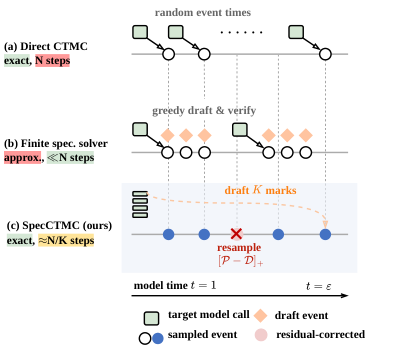
Caption: Sampling a masked diffusion LLM as a CTMC. (a) Direct event simulation is exact but requires one sequential target model evaluation per unmasking event. (b) Speculative dLLM decoders verify drafts against a finite-step greedy decoder, with restricted lossless guarantees. (c) preserves the exact random event clock and the distribution of joint marks. The diagram's \(N/K\) label is the full-acceptance ideal when all drafted states fit in one target-model call; generally, one speculative round commits up to \(K\) events.
Why It Matters: Shows how SpecCTMC batches tentative states while preserving the random event clock and verifying marked events.
Figure ure
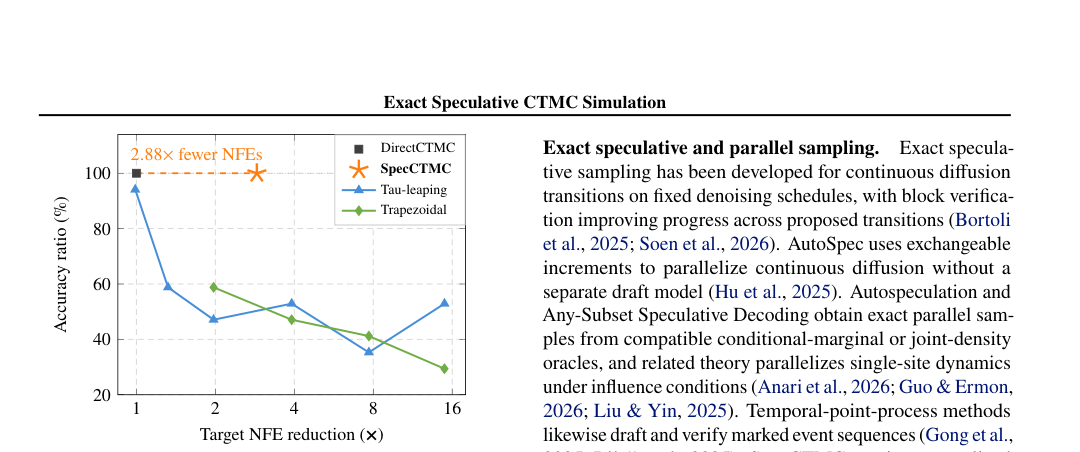
Caption: Figure 2. Exact law preserving of SpecCTMC on NFE accelera- tion. On GSM8K with LLaDA-8B-Instruct (256 generated tokens), SpecCTMC reduces target NFEs by 2.88× relative to DirectCTMC while preserving expected accuracy. Finite-step samplers trade accuracy for fewer evaluations.
Why It Matters: Compares sequential evaluation reduction and accuracy for exact SpecCTMC and approximate finite-step samplers.
Figure 3
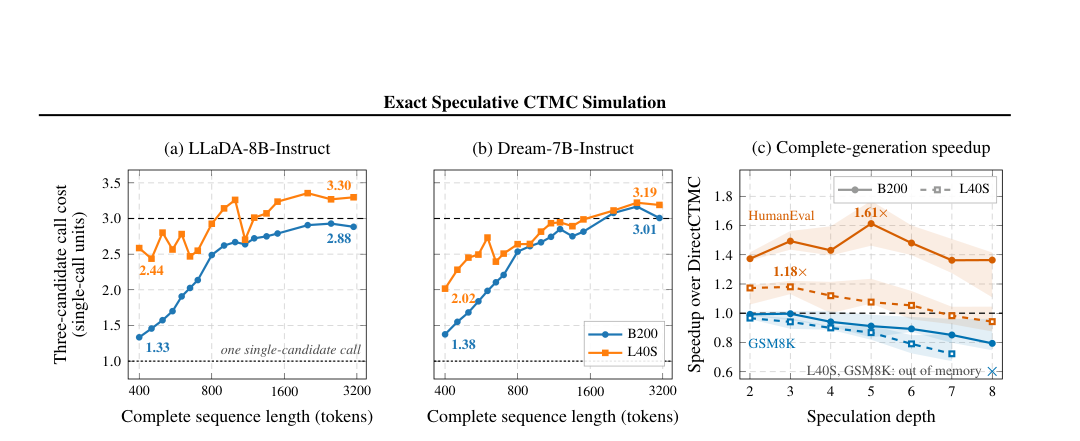
Caption: Figure 3. Batching cost and complete-generation speedup depend on the hardware. (a, b) Forward-only relative cost of one threecandidate target call against one single-candidate call, versus complete sequence length for LLaDA-8B-Instruct and Dream-7B-Instruct on a B200 and an L40S GPU. The dashed line marks the cost of three separate calls and the dotted line one single-candidate call. At short lengths on the B200, one three-state call costs less than three separate calls. As sequence length grows, the three-state call approaches the cost of three separate calls on both GPUs, with the L40S reaching that regime at shorter lengths. (c) Complete-generation speedup of SpecCTMC over DirectCTMC ve...
Why It Matters: Makes the hardware and sequence-length dependence of batching cost and end-to-end speed visible.
Figure ure
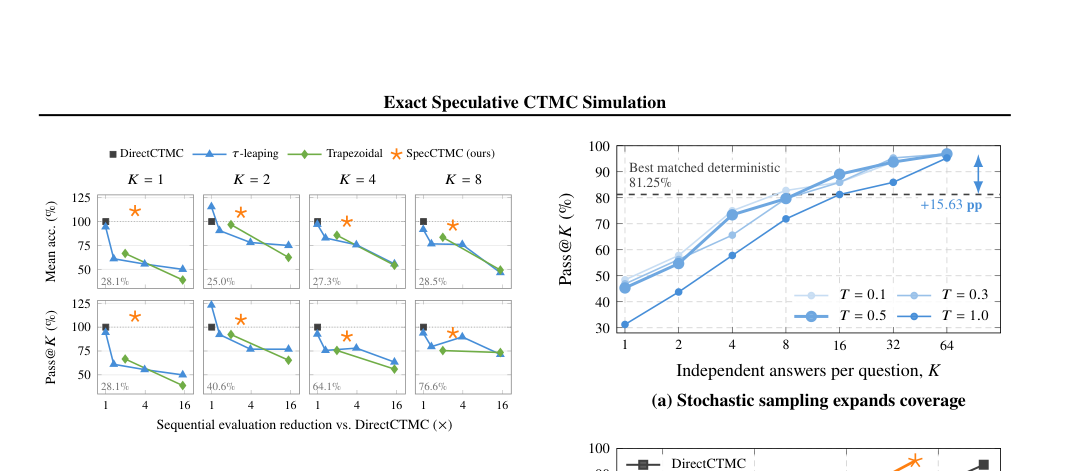
Caption: Figure 4. Output quality versus sequential evaluation reduction. LLaDA-8B-Instruct, GSM8K, 256 tokens, 𝑇= 1.0. Columns: 𝐾 answers per question. Rows: mean accuracy and Pass@𝐾, normal- ized to DirectCTMC at the same 𝐾(absolute DirectCTMC score in the lower-left corner). The horizontal axis is the ratio of median cumulative sequential target-model evaluations (DirectCTMC / method). From left to right, 𝜏-leaping uses 256, 192, 64 and 16 steps and trapezoidal uses 64 and 8 steps; at 𝑆+ 1 and 2𝑆+ 1 evaluations per answer, 16-step 𝜏-leaping and 8-step trapezoidal are cost matched.
Why It Matters: Compares accuracy and Pass@K against evaluation reduction for exact speculation and approximate solvers.
🔮 Conclusion
The paper presents SpecCTMC as an exact speculative sampler for absorbing-mask diffusion CTMCs. Its core mechanism separates event-time sampling from mark generation, batches target evaluations over tentative states, and uses sequential verification with residual correction to retain the DirectCTMC joint path law under stated conditions. This provides a way to reduce sequential target evaluations without changing the reference sampling distribution.
Results across text and multimodal evaluations show substantial NFE reductions, while wall-clock gains depend on model, task, sequence length, and hardware. The method is therefore most compelling where sequential calls are the measured bottleneck and batched verification is efficient. The paper also shows that exact stochastic sampling can support repeated-sample solution coverage, while emphasizing that approximate solvers can trade quality for evaluation count.
🛠️ Future Research Improvements
The results point to several concrete follow-ups. First, characterize how proposal quality and speculation depth interact with latency across models, prompt lengths, and accelerators; the paper’s hardware comparison shows that equal evaluation reductions can yield different wall-clock outcomes. Second, test depth-selection policies that account for batch cost and memory limits, since a depth that reduces sequential calls may still be impractical for long prompts or constrained devices.
Third, broaden exactness and performance evaluation to additional absorbing-mask models, masking schedules, and multimodal tasks, with the theorem assumptions checked explicitly for each setting. Fourth, assess stochastic coverage across more tasks and sampling temperatures while reporting both single-sample accuracy and Pass@K. These are suggested evaluation directions from the observed scope and caveats; the supplied main-body evidence does not present them as a formal future-work list.
🏭 Potential Industry Use Scenarios
A plausible use is serving masked diffusion models for reasoning or code generation when an application benefits from multiple stochastic candidates. The paper evaluates GSM8K, MATH, MBPP, and HumanEval, and reports repeated-sample Pass@K results on GSM8K; this makes candidate generation and coverage exploration a research-backed scenario. SpecCTMC could be useful where exact sampling relative to the model’s CTMC is a requirement and sequential target calls dominate runtime.
The multimodal LLaDA-V results on MathVerse and MathVista suggest a second scenario: image-conditioned answer generation where repeated model evaluations are costly. These results report NFE reduction and acceptance, not end-to-end product latency or production quality. Teams would need to benchmark their own prompt lengths, accelerator, batching strategy, memory budget, and answer-selection process. The paper explicitly shows that evaluation reduction alone does not determine wall-clock benefit, so deployment value remains workload-specific.
💬 Critical Analysis
The central technical strength is that the method preserves sequential conditioning rather than committing independent same-context predictions. Sampling event times in advance is justified by the absorbing-mask rate structure, and residual correction supplies the target mark distribution after rejection. This directly addresses the dependency problem identified in the paper and gives a meaningful exactness guarantee beyond matching a finite-step decoder. The experiments also distinguish sequential evaluation count from wall-clock speed and include both text-only and multimodal settings.
The reported gains should be interpreted with care. NFE reductions are consistently larger than the wall-clock improvements, and Dream’s GSM8K average is below parity at 0.97×. Batch evaluation still performs computation on multiple states; its benefit depends on sequence length and hardware, and depth 8 on L40S GSM8K exceeds memory. The exactness theorem is conditional on assumptions whose full list is outside the supplied main-body evidence, so builders should inspect those conditions and ensure numerical implementation of acceptance and residual probabilities is faithful.
The benchmark evidence is useful but bounded: two text models, five text benchmarks, one multimodal model, and two multimodal datasets. Reported accuracy differences are not a substitute for broader uncertainty and quality analyses across deployment prompts. The GSM8K coverage experiment supports stochastic candidate exploration, but the paper says it does not evaluate a selector that chooses one final answer. Reproduction should therefore preserve the distinction between sampling coverage, single-answer accuracy, evaluation count, and end-to-end serving latency.