
📌 Highlights
The paper's central claim is that a single history-preserving patient world model can serve multiple ICU health-system simulation questions when its clinical outputs are connected to scenario-specific operating rules. The strongest evidence is not only endpoint prediction: the model preserves observed policy effects and recovers a history-dependent recovery contrast that compact state models cannot represent.
The result is promising for comparative operational analysis, but the model is not uniformly calibrated at the trajectory level. Aggregate ICU retention is close to observed data, while support-start incidence, dual-support occupancy, respiratory episode duration, and circulatory heterogeneity show identifiable biases.
- MIMIC-IV v3.1 training data are converted into sparse histories with 64 state variables and 25 event types.
- A frozen model supports ICU admission, care-delivery, and post-ICU discharge scenarios through different mappings.
- Reported AUROC reaches 0.937 for in-hospital mortality and 0.881 for 30-day ICU admission.
- The 24-hour recovery contrast is -6.40 percentage points in the model versus -6.68 observed; Markov and semi-Markov models produce zero contrast in the matched comparison.
- The simulator supports comparative policy analysis, but absolute operational quantities require local workflow calibration and external validation.
🎯 Introduction
Health-system simulation links evolving patient trajectories to competing demands for beds, staff, and services. Conventional models make this tractable by specifying compact clinical states and transitions for one policy question, but every added history dependency expands the state space and requires new transition estimation. A state definition that is adequate for admission planning may omit information needed for care dispatch, discharge capacity, or continuous-time alignment.
The paper's objective is therefore to learn a shared clinical representation from longitudinal EHRs and query it at arbitrary future times on a common simulation clock. The proposed pWM is intended to preserve richer patient history than a small mutually exclusive state machine while remaining separable from explicit ICU resource mechanics.
🔬 Methodology
The study uses MIMIC-IV v3.1, containing 364,627 patients and 94,444 ICU stays. Patients are partitioned deterministically, with 80% used for training and the remaining patients divided into validation and held-out test groups. The EHR representation stores irregular observations on a sparse two-dimensional grid. Continuous measurements are discretized into ten quantile bins; event labels are grouped into retained ATC and ICD categories plus an “other” category.
The pWM uses six Transformer layers, 12 attention heads, hidden dimension 768, feed-forward dimension 3,072, dropout 0.1, and 32 log-scale Fourier time features. Variable-axis attention mixes entries within a time column, causal time-axis attention reads each slot's prior history, and a query mixer combines representations at the requested future time. Separate heads produce state-bin probabilities, event intensities, and conditional event-label distributions. Fixed-history queries leave context unchanged; rollouts sample updates and append them before the next query.
Training uses teacher forcing and combines next-time state, event, and label losses with a competing-risk endpoint loss. The event-intensity term uses positive rates from softplus-transformed logits, while the endpoint objective treats target and stopping hazards as piecewise constant over log-spaced intervals. The final checkpoint is frozen for all evaluations, with validation-fitted recalibration parameters applied to endpoint probabilities, state distributions, and event rates.
equation 1
Meaning: This defines the joint future prediction queried from history H at interval Δ.
equation 2
Meaning: This converts competing target and stopping hazards into survival and first-event probabilities.
equation 3
Meaning: This controls the balance between next-time trajectory modeling and endpoint supervision.
display equation 5
Meaning: This controls learning of event intensities from observed counts over each interval.
📊 Experiments
The evaluation has four layers. First, six fixed-history clinical queries are tested on 1,024 held-out records each: hospital mortality, ICU mortality at admission, ICU mortality at 24 hours, 30-day ICU admission, 30-day hospital readmission, and 30-day ICU readmission. The reported AUROCs are 0.937, 0.881, 0.814, and 0.682 for in-hospital mortality, 30-day ICU admission, 30-day ICU readmission, and 30-day hospital readmission, respectively. Across 24 task-horizon queries, the median recalibrated slope is 0.988, with an interquartile range of 0.885–1.051.
Second, 16 recalibrated 14-day rollouts are generated from each of 670 held-out ICU-admission patients, producing 10,720 trajectories. The virtual cohort has a restricted mean ICU stay of 2.923 days versus 2.800 observed and a median of 1.917 versus 1.738 days. The model tracks live discharge incidence at 14 days, 92.1% versus 89.9%, and ICU death incidence, 5.3% versus 7.6%, but overestimates respiratory support starts, 44.2% versus 29.7%, and circulatory support starts, 42.7% versus 27.3%.
Third, the frozen model is compared with task-fitted Markov and semi-Markov models in admission, care-delivery, and discharge simulations. Increasing staffed beds raises admission and reduces pre-ICU waiting; acute-first dispatch reduces acute queue burden most strongly under low staffing; and increasing post-ICU transfer slots shortens proposal-to-release time and raises admission fractions. At 12 staffed beds, the neural model admits 66.1% with 43.63 hours of restricted waiting, compared with 83.3% and 25.05 hours for the semi-Markov comparator. At low staffing, acute-first reduces acute queue burden by 13.41 hours per patient for the neural model, versus 7.12 for semi-Markov and 2.98 for Markov.
Finally, matched-history analysis uses 404 held-out pairs sharing the same single-organ support state and ICU age at entry, but differing in whether they arrived from no support or dual support. The neural model predicts an upward-minus-downward 24-hour recovery difference of -6.40 percentage points versus -6.68 observed, while the compact-state baselines produce zero contrast. The model also reproduces a negative difference in support-related task requests, although it underestimates the magnitude and differs on some individual trigger components.
main-body-clinical-results
Caption: Clinical prediction results reported in the main body.
| Endpoint | AUROC |
|---|---|
| In-hospital mortality | 0.937 |
| 30-day ICU admission | 0.881 |
| 30-day ICU readmission | 0.814 |
| 30-day hospital readmission | 0.682 |
Why It Matters: These are the explicitly reported discrimination results for four of the six fixed-history clinical queries.
main-body-cohort-results
Caption: Observed-versus-generated ICU cohort quantities reported in the main body.
| Quantity | Generated neural cohort | Observed cohort |
|---|---|---|
| Restricted mean ICU stay (days) | 2.923 | 2.800 |
| Median ICU stay (days) | 1.917 | 1.738 |
| Live ICU discharge incidence at 14 days | 92.1% | 89.9% |
| ICU death incidence at 14 days | 5.3% | 7.6% |
Why It Matters: The comparison shows close aggregate stay and terminal-outcome behavior while leaving room for event-level bias.
main-body-operational-results
Caption: Selected operational comparisons reported in the main body.
| Scenario and quantity | Neural model | Comparator or observed reference |
|---|---|---|
| Admission fraction at 12 staffed beds | 66.1% | 83.3% semi-Markov |
| Restricted waiting at 12 staffed beds | 43.63 h | 25.05 h semi-Markov |
| Acute queue reduction at low staffing | 13.41 h/patient | 7.12 h/patient semi-Markov; 2.98 h/patient Markov |
| Mean proposal-to-bed-release time with one transfer slot | 6.45 h | 10.01 h Markov; 12.56 h semi-Markov |
| Mean proposal-to-bed-release time with four transfer slots | 4.00–4.02 h | 4 h service duration |
Why It Matters: These values illustrate that the model can produce materially different absolute operational estimates while preserving the direction of capacity and dispatch responses.
fig:framework
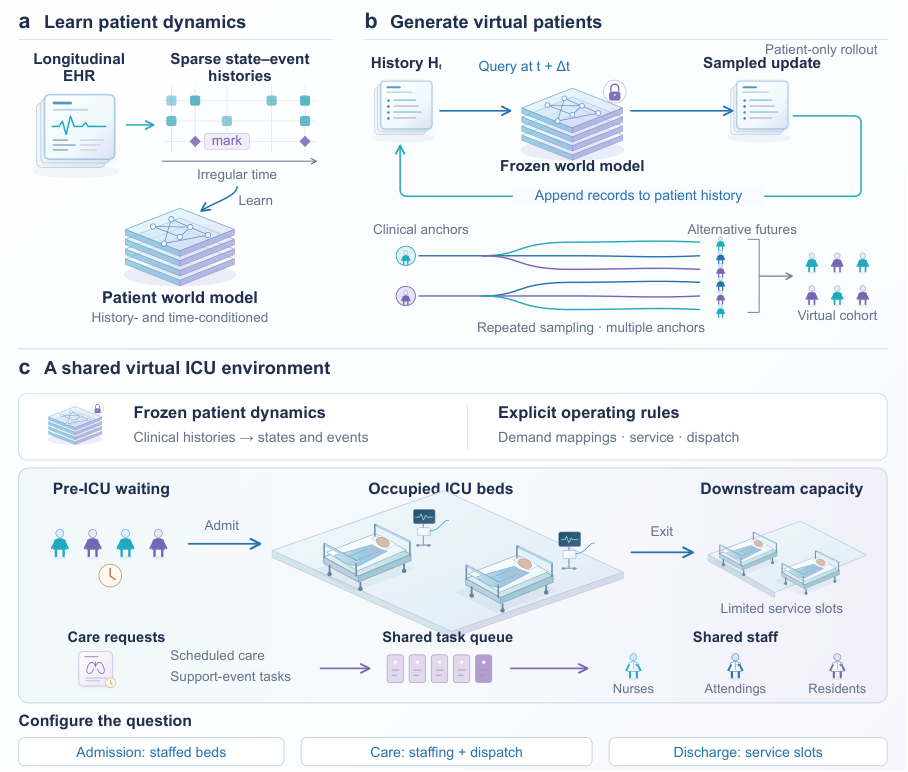
Caption: A shared patient world model for different ICU simulation questions. a, Longitudinal EHRs are encoded as sparse state–event sequences over a shared clinical vocabulary, preserving variable values, events with categorical labels and irregular observation times to train a generative patient world model conditioned on history and forecast interval Δ. b, With learned parameters held fixed, querying the model at a requested future time returns state and event distributions, from which sampled updates are appended to history before the next query. Repeated rollouts from a single patient's anchor history generate alternative individual futures; rollouts across patients construct a virtual cohort....
Why It Matters: It shows the central separation between learned clinical dynamics, sampled patient futures, and scenario-specific ICU operating rules.
fig:patient-validity
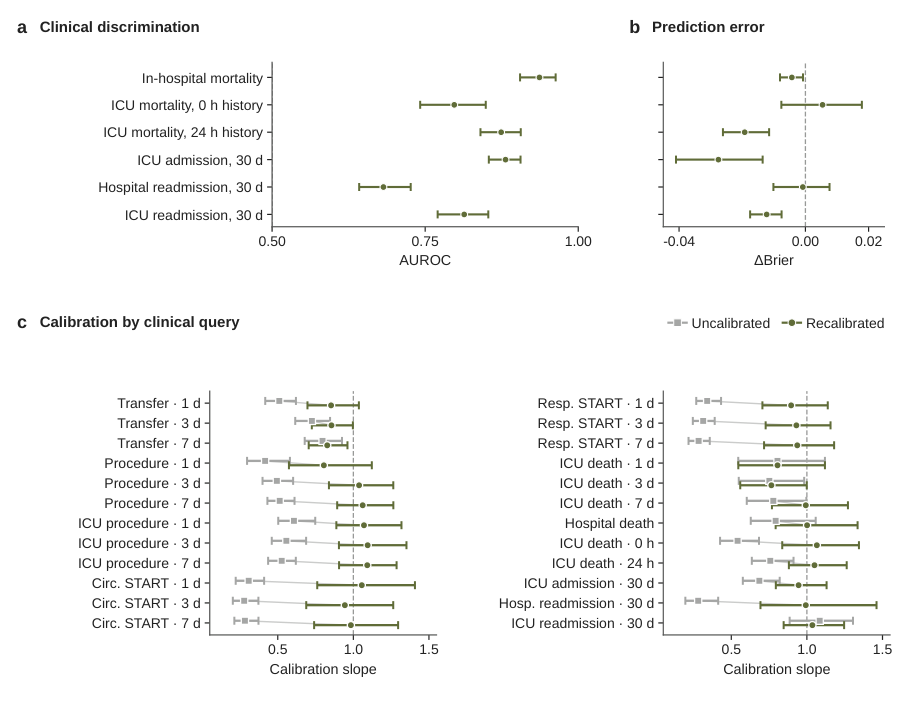
Caption: Clinical queries from a frozen patient model. a, AUROC across six clinical endpoints, each evaluated on 1,024 held-out test records from 956–981 patients. For ICU mortality, 0 and 24 h denote observed history after ICU admission. b, Brier score differences (model minus empirical-frequency reference); negative values favor the model. c, Uncalibrated and recalibrated slopes across 24 binary task–horizon queries; connecting lines pair estimates for the same query and the dashed line marks slope one. Whiskers in a–c show 95% patient-cluster bootstrap intervals from 1,000 resamples. All queries and calibration settings share the same frozen model parameters.
Why It Matters: It tests whether one frozen representation can support multiple endpoint and horizon queries with useful discrimination, error, and calibration.
fig:population-validity
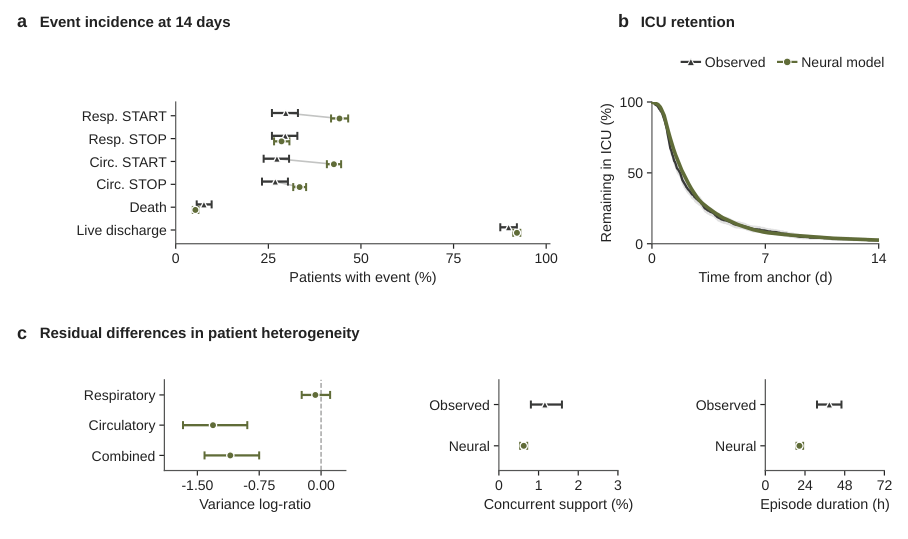
Caption: Longitudinal generation of virtual ICU cohorts. Sixteen recalibrated 14-day rollouts are generated from each of 670 held-out test patients at ICU admission (10,720 trajectories). a, Day-14 support-transition and terminal-event incidence; lines pair observed and model estimates. b, Fraction of patients remaining in the ICU over 14 days. c, Patient-level heterogeneity: generated-to-observed variance log-ratios for per-patient support initiations ($0$ indicates equal variance), dual-support occupancy as a fraction of follow-up patient-hours, and mean duration of respiratory episodes ending with an explicit stop (unadjusted for terminal censoring). Whiskers and bands show 95% patient-bootstrap...
Why It Matters: It distinguishes aggregate occupancy fidelity from event-level and heterogeneity biases that can accumulate during autoregressive generation.
fig:operational-reuse
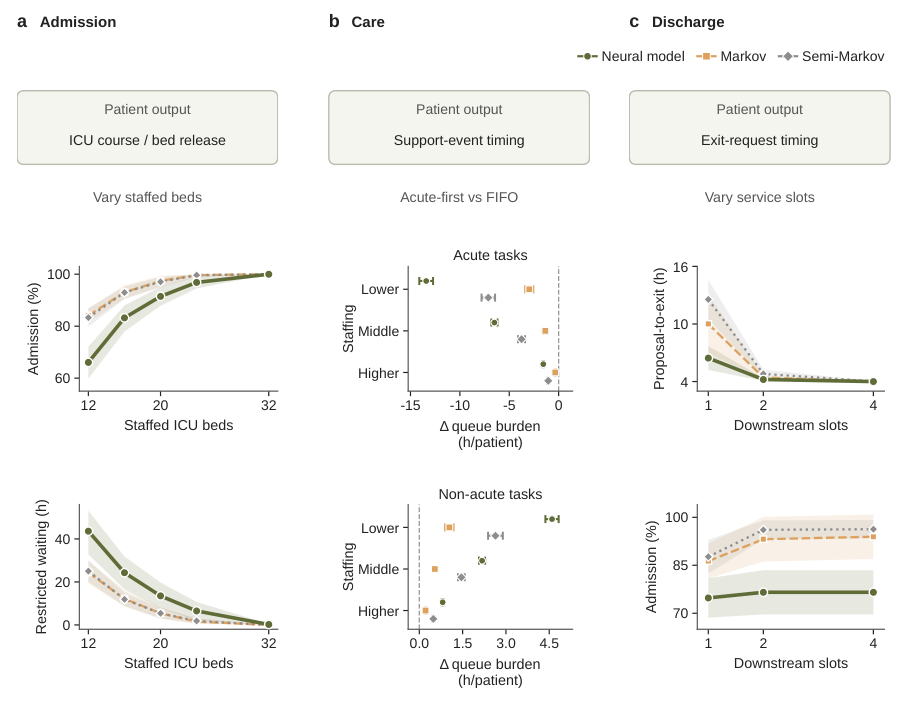
Caption: Operational responses across admission, care-delivery and discharge simulations. Headers above each column indicate the mapped patient-model output and the varied operational control across separately configured scenarios, comparing the frozen neural model with task-fitted Markov and semi-Markov baselines. a, ICU admission fraction and restricted pre-ICU waiting across staffed-bed capacities, sharing pre-ICU admission requests from the calibrated neural model (bands, repeat-bootstrap 95% intervals over eight replications). b, Acute-first-minus-FIFO differences in acute and non-acute queue burden (cumulative task-waiting hours per initial patient) across staffing levels using model-specific...
Why It Matters: It demonstrates reuse of the same frozen clinical model across three operational questions and compares its directional responses with compact-state baselines.
fig:capacity-decisions
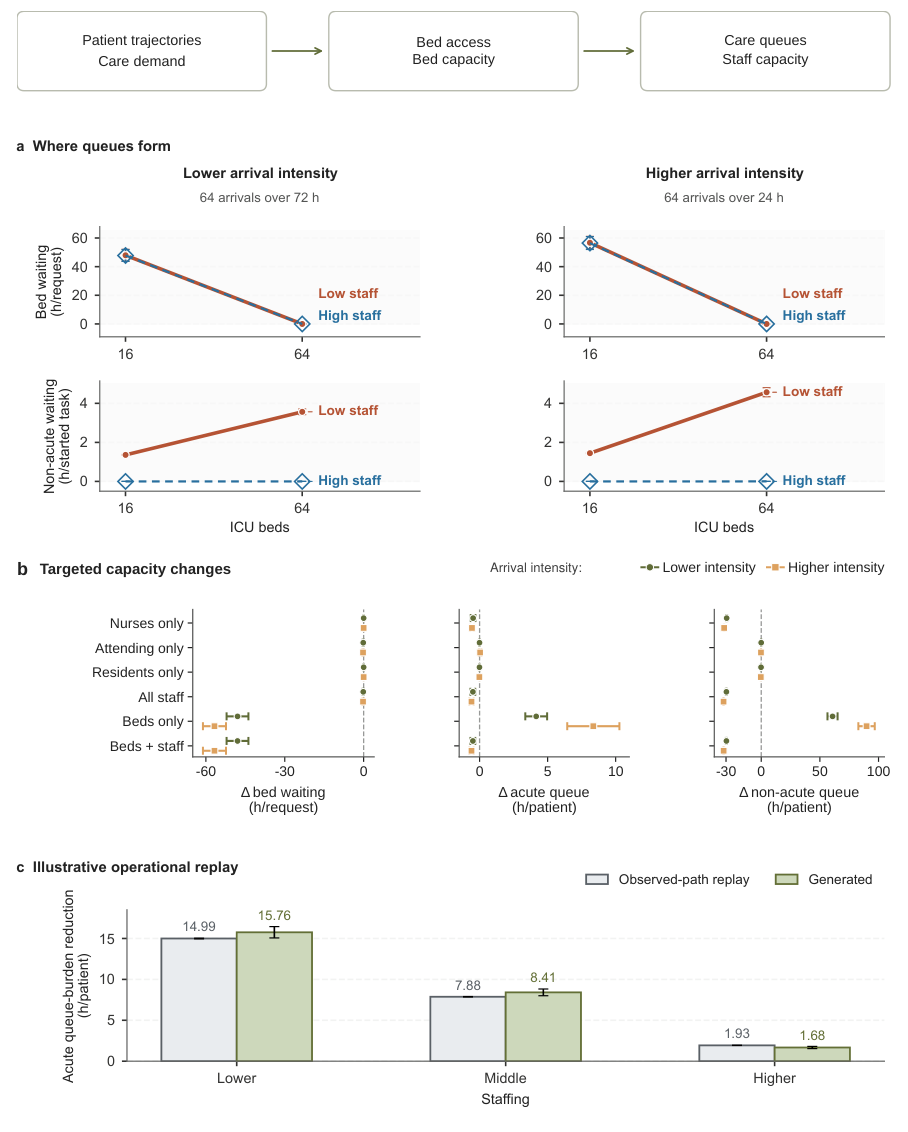
Caption: Bed-and-staff capacity interactions and observed-trajectory operational replay. The upper schematic illustrates how expanding bed access shifts demand into staff-constrained care queues when staffing is fixed. a, Restricted bed-request waiting (hours per request) and started non-acute task waiting (hours per started task) across bed capacities ($16$ versus $64$ beds) and staffing levels at two arrival intensities ($64$ arrivals over $72 h$ or $24 h$). b, Paired capacity-expansion effects on bed waiting and on acute and non-acute queue burden (cumulative task-waiting hours per initial patient) relative to the $16$-bed, low-staffing baseline. c, FIFO-minus-acute-first reductions in acute queu...
Why It Matters: It tests whether the simulator reproduces bottleneck shifting between beds and staff and whether generated trajectories preserve observed dispatch-policy effects.
fig:history-reuse
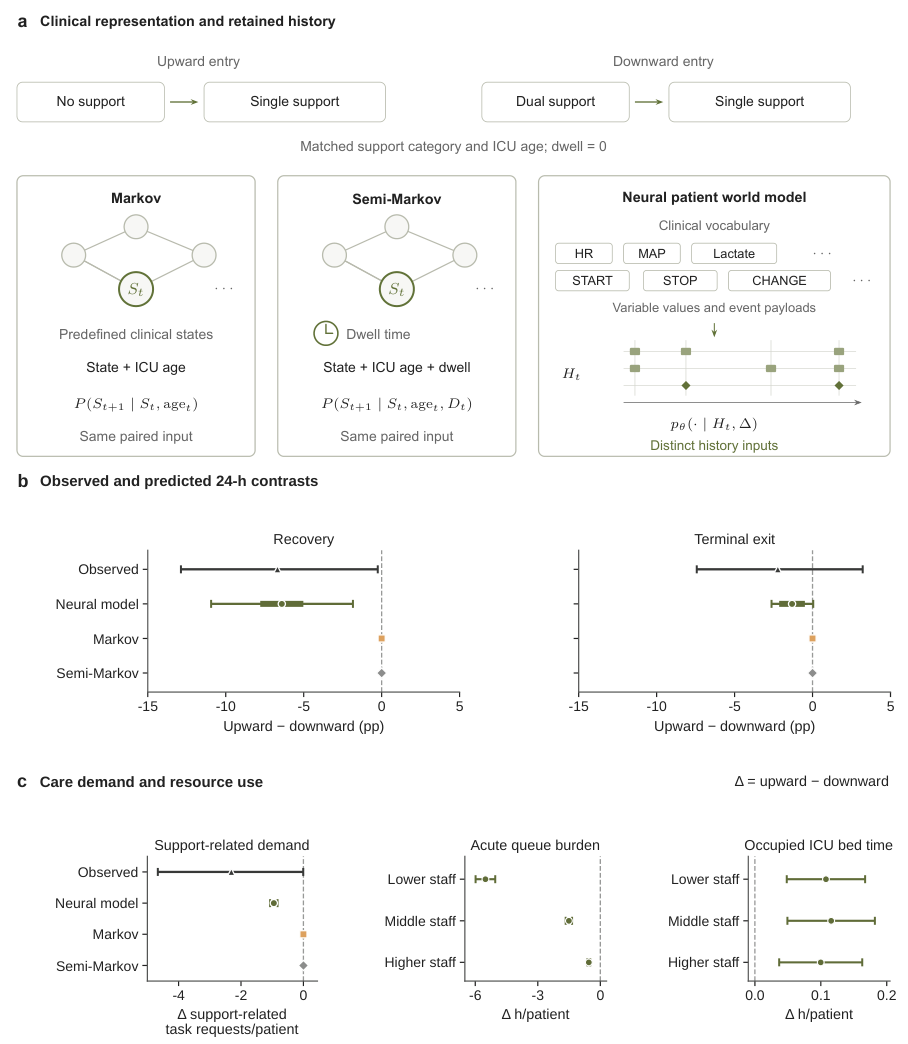
Caption: Retained clinical history within a shared support state and its operational consequences. a, Matched entry paths in $404$ held-out test pairs sharing the same single-organ support state $S_t$ and hours since ICU admission at state entry ($D_t=0$), entered either from no support (upward entry) or from dual support (downward entry). Schematics compare inputs of the Markov ($S_t$ and ICU hours), semi-Markov (adding state dwell time $D_t$, clock) and neural models (multivariable history $H_t$ and query interval Δ). HR, heart rate; MAP, mean arterial pressure. b, Upward-minus-downward $24$-h differences in recovery (reaching no-support status within $24 h$) and terminal exit (death or live ICU d...
Why It Matters: It provides the clearest test that retained history changes clinical predictions and downstream operational outcomes beyond the current compact support state.
🔮 Conclusion
The study supports the feasibility of using a single frozen pWM as a shared clinical engine for several ICU simulation questions. The model matches the direction of capacity, staffing, dispatch, and transfer-capacity responses from compact-state comparators, reproduces observed-trajectory dispatch gains, and retains history-dependent clinical distinctions that influence downstream workload and bed use.
The evidence is strongest for comparative behavior under a controlled virtual environment. Aggregate occupancy and operational response patterns are useful, but event-rate biases and noncausal observational training limit claims about absolute workflow forecasts or clinical outcomes after policy changes.
🛠️ Future Research Improvements
The next research step should be validation beyond MIMIC-IV and calibration of the operational layer against measured hospital arrivals, staff schedules, service durations, queue logs, and downstream transfer capacity. This would test whether the model's comparative behavior survives institutional changes and whether its absolute waiting-time estimates become operationally meaningful.
Trajectory fidelity also needs targeted improvement. The reported biases in support starts, dual-support occupancy, episode termination, and circulatory heterogeneity suggest evaluating alternative event-intensity calibration, longer-horizon distribution matching, and explicit checks of policy rankings under generated versus observed trajectories.
A further direction is causal or off-policy modeling. The current simulator can compare resource and dispatch configurations under historical associations, but it does not establish how changing treatment timing or care delivery would change patient outcomes.
🏭 Potential Industry Use Scenarios
A hospital operations team could use this architecture as a decision-support layer for ICU bed-capacity planning, staffing expansion, acute-task prioritization, and post-ICU transfer-slot sizing. The paper's scenario mappings make it possible to test these questions around a common patient-dynamics model while keeping resource rules explicit.
The same pattern could support a local hospital digital twin in which the pWM supplies calibrated patient trajectories and the external simulator represents institution-specific queues and service constraints. In practice, such use should begin with retrospective replay and local validation, and should treat outputs as comparative planning evidence rather than autonomous clinical recommendations.
- ICU bed and admission-capacity planning.
- Nurse, attending, and resident staffing analysis.
- Acute-first versus FIFO care-task dispatch.
- Post-ICU transfer capacity and bed-turnover analysis.
- Pre-deployment testing of triage or care-pathway policies after local calibration.
💬 Critical Analysis
The strongest design choice is the separation of clinical dynamics from operational mechanics. It makes the reuse claim testable: the same frozen model is evaluated under distinct admission, care-delivery, and discharge mappings, and its generated trajectories are also replayed against observed patient courses. The matched-history experiment is particularly informative because it targets a concrete failure mode of compact states rather than relying only on aggregate occupancy.
The main concern is calibration at the level that matters for simulation. Strong fixed-history AUROC and near-unit recalibrated slopes do not guarantee faithful long-horizon event sequences. The model overestimates support starts and shows residual heterogeneity and episode-duration errors, so an apparently reasonable occupancy curve may still produce distorted staff workload or queue estimates under a different mapping.
The operational conclusions are therefore best interpreted as conditional comparisons. The simulator's workflow parameters are not learned from empirical queue or staffing logs, and the pWM inherits confounding from historical care. Before deployment, builders should verify policy rankings with observed replay, local workflow data, external cohorts, and causal safeguards where interventions alter treatment rather than only capacity or scheduling.