
📌 Highlights
Scientist World treats the scientific literature as a supply of executable research tasks. Each accepted environment has a reproduced source method and result, a task specification, evaluation code, and a record of its construction. Builders first reproduce the paper, then define what counts as progress and which changes remain within the original question, package the experiment, and have an independent verifier audit it. This design makes measured execution the basis for comparison.
The release contains 1,000 environments. In the model benchmark, a fixed cohort of ten lower-compute environments is run in improve mode, where the source method is supplied, and innovate mode, where the model designs from the problem alone. The paper reports that models beat the reproduced method in 84% of improve attempts and 74% of innovate attempts. These rates describe attempts on that benchmark cohort, not success on every environment in the release.
The strongest leaderboard model differs by mode: Fable 5 reaches mean FNI 118.5 in improve mode, while Fable 5.1 reaches 76.3 in innovate mode. In the training demonstration, Qwen3-8B ideas, executed by a fixed GPT 5.6 Sol implementer on ten held-out papers, rise from median FNI 41 at base to 84 after SFT and 106 after GRPO. The paper’s key caveat is that this isolates ideation rather than a complete autonomous research loop.
- The environment is a constrained, runnable task anchored to a reproduced paper result.
- Improve and innovate are distinct evaluation modes and produce different model rankings.
- The reported model benchmark covers ten lower-compute environments; do not generalize its rates to all 1,000.
- Training gains are measured with a fixed frontier implementer executing the small model’s ideas.
🎯 Introduction
The paper frames research as a repeated process: identify an unexplained problem, propose an explanation, test it, learn from failure, revise, and carry that judgment to new problems. On this account, success at one bounded task is not enough to establish research ability. A useful AI-scientist evaluation needs varied problems and should measure the quality of proposed work through outcomes.
The authors argue that scientific papers provide both open questions and a shared record of methods, findings, successes, and failures. But a paper is a record of completed work, not itself a place where a new researcher can test a method. Earlier environments, as characterized in the paper, tend to rely on past competitions, simulated settings, hand-picked paper tasks, fixed suites, reproduction of known results, or text judgments of ideas. The authors identify scale, evolution with new literature, and grounding in real execution as properties that are not jointly provided by those approaches.
Scientist World’s objective is to convert papers into tasks where a new method can be evaluated against a recovered source result. Its initial release comprises 1,000 environments. The same collection is used to evaluate existing models, preserve complete research trajectories, and train a smaller model using measured outcomes. This is a system and benchmark contribution: the ambition is to make paper-derived research tasks repeatable and extensible, while the main-body evaluation tests models on a smaller fixed cohort.
Figure 2
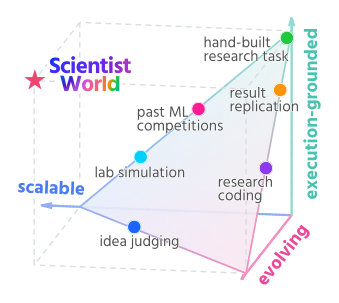
Caption: Figure 2. Where Scientist World stands. Prior AI-Scientist environments sit on the trade-off surface we describe; Sci- entist World reaches the corner where scale, evolve, and execution meet.
Why It Matters: Illustrates the paper’s framing of scale, evolution, and execution-grounding as joint properties.
🔬 Methodology
The environment-building workflow uses four roles that work in sequence on a shared workspace. The reproducer implements the paper’s method and evaluation, using released code where available or implementing from scratch otherwise, and scales up runs until the main result is recovered. The designer turns that reproduction into a task by specifying a problem statement, target metric, permitted directions, and constraints. It creates visible and held-out evaluation sets and uses the source result as the baseline. The packager declares dependencies and replaces local-only files with fetch scripts so a fresh clone can rebuild and rerun the experiment. An independent verifier checks code validity, score-to-log consistency, and compliance with the task design.
Construction is iterative: each builder audits the previous milestone claim and demotes it when the workspace does not support it. Work that misses a required milestone can roll back to an earlier iteration or fail. A shared compute pool runs jobs outside the builder loop, with a per-paper GPU budget enforced externally. The paper describes a nine-iteration build allocation: three reproducer iterations, three designer iterations, one packager, and two verifier passes. Accepted environments must pass independent verification.
A task remains open to new approaches by separating its research question and scoring interface from the source method. Environments may reduce experiment scale to fit budget, but should preserve the kind of scientific question and outcome being tested. Constraints can hold model size, data, pretraining, or compute fixed where these are not the intended research variable. The environment’s evaluator compares new methods with the reproduced source method over the paper-relevant metrics and experiments, using visible data for development and a held-out slice to detect overfitting or shortcuts.
The aggregate score is Frontier-Normalized Improvement. The extracted main-body text gives the score as a weighted sum of signed metric gains, normalized by a frozen frontier cohort’s metric spread and a scale factor. The paper defines zero as matching the reproduced source method, positive values as improvement, and negative values as worse performance. The notation below preserves the printed expression as recovered from the supplied text; the source conversion may render the subscripted summation and fraction imperfectly.
Table 2
Caption: A produced environment on average. The mean size and makeup of one environment.
| Measure | Average |
|---|---|
| Experiments | 3.3 |
| Metrics | 32 (16 visible + 16 hidden) |
| Datasets | 1.6 |
| Files | 59 (3.8k lines of code) |
Why It Matters: Shows that an environment packages multiple experiments and metrics with visible and hidden splits.
Frontier-Normalized Improvement (FNI)
Meaning: Aggregates weighted signed gains over the source method across metrics. Here \(\delta_c\) is the signed gain on metric \(c\), \(w_c\) its weight, \(\sigma_c\) the frozen frontier cohort’s spread on it, and \(b\) sets the cohort’s mean absolute FNI to 100. Zero matches the reproduced paper method; negative is worse. The equation is transcribed from the extracted main-body text.
📊 Experiments
The model benchmark uses a fixed cohort of ten lower-compute environments because running every model on all 1,000 would be too costly to repeat. Every model attempts each environment under the same compute budget in two settings: improve mode starts from the reproduced source method, while innovate mode gives the problem without the source code and is intended to prevent leakage of the original solution. Scores are evaluated on both visible and held-out splits and averaged across the two. FNI is oriented so zero matches the source method and higher is better. The central reported rates are 84% of improve attempts and 74% of innovate attempts beating the reproduced method.
Leaderboard values differ by mode. In improve mode, Fable 5 has mean FNI 118.5, followed by Opus 4.7 at 108.2 and GPT 6 Astra at 102.2. In innovate mode, Fable 5.1 leads at 76.3, Fable 5 follows at 71.9, and GLM 5.2 is third at 61.1. The paper reports these scores averaged over visible and held-out splits with xhigh effort for all models. The results should be interpreted as performance on this ten-environment cohort and setup. The authors also report that model rank relationships across modes are loose, indicating related but distinct abilities.
The paper checks whether leaderboard results are explained by effort. It reports little association between score and compute hours or agent turns, with Figure 14 caption values of R² = 0.00 and 0.02, respectively; the prose gives R² ≤ 0.02. An LLM judge’s ratings of research quality track scores with ρ = 0.89. This is an association reported by the authors, not evidence that the ratings cause performance. The attempt corpus records a mean of 3.7 idea revisions, 6 method revisions, 25 experiments, 35 commits, and 5.4 hours of work per record.
For the training experiment, Qwen3-8B is first supervised fine-tuned on 1,000 trajectory-derived examples and then trained with off-policy GRPO on 1,500 already-scored ideas, using measured outcomes as rewards. The base, SFT, and GRPO ideas are implemented by the same GPT 5.6 Sol implementer under identical conditions on ten held-out papers. Median held-out FNI rises from 41 to 84 to 106; the paper also reports mean FNI rising from 51 to 90 across the training progression. Because implementation is fixed and frontier-level, this evaluates ideation quality with an executor, not end-to-end autonomous research. The paper reports no conventional named benchmark dataset for the model cohort; it evaluates on its own paper-derived environments.
Table 4
Caption: Dataset statistics. Each experiment is stored with its log; hours of work is the scientist’s end-to-end running wall-clock time.
| Record | Average |
|---|---|
| Idea revisions | 3.7 |
| Method revisions | 6 |
| Experiments run | 25 |
| Commits | 35 |
| Hours of work | 5.4 |
Why It Matters: Summarizes the scale and contents of an average preserved research trajectory.
🔮 Conclusion
The paper presents a conversion from finished empirical papers into reusable research settings, with reproduced results, constrained tasks, execution-based scoring, and verification. Its initial 1,000 environments serve as a benchmark, a trace corpus, and a training ground. The benchmark results suggest that frontier models can improve on reproduced methods in many attempts, while the Qwen3-8B study shows that outcome-rewarded ideation training can raise held-out scores when paired with a fixed implementer.
The authors describe each environment as a scaled-down paper and each score as one contingent research trajectory. Their intended longer-term loop—an agent that proposes, executes, and updates within the world—remains an emerging objective rather than a demonstrated capability of the small trained model.
🛠️ Future Research Improvements
A clear next step is to broaden model evaluation beyond the fixed cohort of ten lower-compute environments. Sampling more environments across the eight areas would test whether the leaderboard ordering and the 84% and 74% beat rates persist across different research tasks. Repeated runs and uncertainty reporting would also help distinguish stable model ability from the outcome variance the authors note is inherent in research.
The training setup could be extended from ideation to a complete research loop. The paper explicitly notes that Qwen3-8B cannot yet carry out long-horizon implementation and debugging, and addresses this by using a fixed frontier implementer. Future work can test whether training and evaluation remain effective when the same agent must implement, debug, and revise its own methods.
The paper reports automated quality gates and independent agent verification. Further evaluation could measure how often independent human reviewers agree with task validity, reproduction fidelity, constraint fairness, and the absence of shortcuts. Reduced-scale environments also merit per-task validation that the smaller experiment continues to test the same scientific question rather than a nearby proxy.
🏭 Potential Industry Use Scenarios
Research teams could use paper-derived environments as internal test beds for agents that propose changes to established methods. A team could encode a target metric and constraints, retain the reproduced implementation as a reference, and compare candidate methods on visible and held-out data. This could help identify promising experiments for human follow-up, provided the task’s reduced scale and evaluator are appropriate to the intended research question.
Organizations building research agents could use the trajectory records to study how ideas evolve through implementation, experiments, and revisions, rather than training only on final papers or final code. The paper’s Qwen3-8B experiment suggests one way to reward ideation using measured outcomes while holding implementation constant, though its evidence does not establish an autonomous production scientist.
A continually refreshed collection of executable tasks could support regression checks as models or research tools change. The paper describes a pipeline intended to grow with incoming literature, but operational use would depend on validating new environments, resource costs, data access, and task-specific constraints. The evidence supports these as plausible workflows, not as demonstrated deployments in commercial scientific operations.
💬 Critical Analysis
The strongest design choice is anchoring improvement to a reproduced method and evaluating actual experiments. Separating task specification from the source implementation, using held-out data, and requiring an independent verifier address several common sources of benchmark fragility. The collection’s multiple experiments and metrics can also make it harder to optimize a single headline number. Reported reproduction within margin for 99% of environments and independent approval for all released environments are useful process evidence, though they do not alone establish that every task faithfully captures the paper’s scientific question.
The headline model results have a narrow empirical basis: ten lower-compute environments chosen for repeatable evaluation. Scores are averaged across visible and held-out splits, but the supplied main-body account does not provide uncertainty intervals for the leaderboard or establish representativeness of this cohort. Improve and innovate also differ in what information is provided, so their scores should not be read as interchangeable measures of one ability. The 84% and 74% attempt success rates are not equivalent to a model succeeding on that fraction of all released environments.
The training result is promising but specifically measures ideas routed through a fixed frontier implementer on ten held-out papers. It does not show that Qwen3-8B itself can implement, debug, and complete research tasks. Similarly, the reported correlation between judge-rated research quality and scores is observational, and the near-zero effort associations do not prove that compute or trajectory length never matter outside this setup.
Finally, the construction workflow’s automated checks and scale are substantial, but quality depends on task-specific reproduction, constraint design, and evaluation validity. Human review could reveal errors that builder and verifier agents share. The paper’s results therefore support Scientist World as a useful infrastructure and evaluation proposal, while claims about general research autonomy, broad domain coverage, or real-world scientific productivity require wider and more independent validation.