
📌 Highlights
A2-MEAS frames long-horizon robot autonomy as cooperation between a learned action policy and a task-level feedback system. A2-WLA handles ordinary continuous control, MetaBrain maintains the complete task objective, and diagnostic agents determine whether a physical condition is satisfied, violated, or unknown. The shared execution record makes the system reason over what was actually dispatched and observed rather than over unexecuted proposals alone.
The central technical idea is a correction code that combines corrective language, grounded spatial evidence, executed history, and a fresh base-policy proposal. A condition encoder converts this context into a latent representation, and an adapter injects position-dependent residuals into the action expert after layer nine. The base model is frozen during correction learning and all parameters remain fixed at deployment, so new failures change the conditioning context rather than triggering online weight updates.
The strongest public long-horizon result is 0.6411 Q-score and 45.40% complete-task success on 100 BEHAVIOR 2026 tasks and 1,000 episodes, with at least one complete success on 88 tasks. The paper also reports 0.6191 Q-score and 41.40% success on task IDs 0–49, 93.98% average RoboTwin 2.0 success for A2-WLA, and 57.92% macro success for the full A2-WLA configuration on 12 real-robot tasks. A key caveat is that the benchmark results combine different model configurations and evaluation cohorts, so each number must remain attached to its stated setting.
- A2-MEAS complete system: 0.6411 Q-score and 45.40% success on the 100-task public BEHAVIOR 2026 evaluation.
- The correction subset ablation improves from 0.5310 Q-score and 41.67% success without an adapter to 0.6108 and 52.50% with all correction conditions.
- History-conditioned real-robot recovery completes coffee filter-handling steps in 94/100 and 82/100 trials, versus 14/100 and 8/100 for base-policy retries.
- The infrastructure reports 427.1 demonstration samples per second on eight GPUs and an 18.1-hour measured 1,000-episode evaluation.
🎯 Introduction
The paper targets embodied agents that must complete extended physical activities rather than merely choose a plausible next action. In a long task, each interaction changes the state for subsequent operations: a grasp can leave an object in an unusable orientation, a local placement can fail to satisfy the original goal, and an apparently successful movement can create a later obstruction. The authors therefore treat sustained autonomy as a combination of action generation, task-level reasoning, diagnosis, and recovery. This framing is broader than one-step visual control because it asks whether the robot can continue toward the same complete objective after unexpected outcomes.
Prior language-guided skill selection and feedback-driven replanning can decide what to attempt next, but a retry instruction does not specify how the next trajectory should differ from the failed one. Vision-language-action policies map observations and instructions to controls, while predictive approaches connect actions to future visual dynamics. The paper identifies the missing interface as the ability to carry a diagnosis into a physically grounded modification of the next trajectory. A2-MEAS addresses that gap by allowing language to express intended change while spatial evidence, temporal history, and a fresh proposal specify where and how the change should occur.
The paper-level objective is not simply to add a larger reasoning model around a robot policy. It proposes a division of labor in which recurring control competence is learned into A2-WLA, while MetaBrain and diagnostic agents intervene at critical points. The action model uses motion-aware history and a latent world model before any online correction is added, and the correction branch learns from MetaBrain-generated instructions and expert continuations. This allows the same deployment-time interface to accept heterogeneous diagnostic tools without requiring those tools to share the action model's architecture.
🔬 Methodology
A2-MEAS organizes execution around a local control loop and a task-level reasoning loop. A2-WLA repeatedly predicts action chunks from the complete task instruction, recent multiview observations, and proprioception. The execution layer dispatches only a prefix, then obtains fresh observations. MetaBrain monitors progress against the full goal and invokes diagnostic functions when an abnormal event occurs. Diagnostic agents cover perceptual grounding, spatiotemporal grounding, and interaction or feasibility assessment. They can use localization, segmentation, tracking, depth or 3D estimation, robot-state signals, and analytical kinematics, but the paper presents these as query-dependent capabilities rather than a mandatory fixed tool list.
A2-WLA uses five past frames and the current frame from each camera. Its motion-aware history encoder groups the six frames into pairs, compresses paired representations, and uses adjacent differences as temporal features. The latent world model learns a shared transition representation from current and future multiview features during pretraining. At deployment it predicts a latent transition from current observations, history, and language, then decodes future visual features that are spatially compressed into future context. The action expert receives current context, future context, and proprioception. It uses 18 transformer layers and conditional flow matching to generate a 50-step action chunk through ten numerical integration steps, while a separate head predicts local skill-phase progress.
Recovery begins from a fresh state. MetaBrain reviews the interval from the last verified nominal state to the anomaly, preserving the complete task goal and identifying how the next attempt should change. Diagnostic agents attach object regions, interaction points, spatial relations, timestamps, and coordinate-frame references. The correction context also records executed prefixes and the fresh unexecuted proposal. Equation (2) converts these inputs into a correction code, and Equation (3) injects the code-conditioned residual into hidden states after the ninth action layer. Because the residual is position-dependent, an action chunk can first lift an object, then realign it, and then perform a later placement without imposing one constant offset on every control step.
Correction training is constructed offline. At a demonstration state, the frozen base policy generates a causal proposal, which is aligned with the expert continuation in time, units, and coordinates. Windows with large normalized deviations at critical manipulation steps are retained. Grounding agents and MetaBrain construct the correction context, while the expert continuation remains the target. The base policy parameters are frozen and only the correction encoder, adapter, and residual scale are optimized. At runtime, evidence freshness, joint limits, obstacle clearance, and physical premises are checked before a prefix is dispatched. A recovery event permits at most three physical retries, two additional viewpoints, a ten-second MetaBrain request, and 60 seconds overall.
Equation (2)
Meaning: The correction encoder combines instruction, grounding, history, and the fresh base proposal into the code used by the adapter.
Equation (3)
Meaning: The residual adapter modifies action hidden states at each internal flow step while the code stays fixed for one candidate.
Equation (4)
Meaning: The deviation criterion selects offline correction windows with sufficiently large expert-versus-base error at critical positions.
Equation (14)
Meaning: Flow matching trains the action expert to transform noisy action chunks into demonstrated continuous controls.
📊 Experiments
The main benchmark is BEHAVIOR 2026, a 100-task long-horizon household-control suite built from 20,000 teleoperated demonstrations totaling approximately 1,950 hours across seven scenes. The public evaluation uses ten instances per task, or 1,000 episodes per configuration. The policy receives six frames per view, predicts 50 controls, and executes at most 32 before observing again. The paper reports Q-score, which measures the fraction of goal conditions satisfied, complete-task success rate, and successful task coverage. Higher values are better for all three metrics, but Q-score is not equivalent to completing the entire task.
On the 100-task public evaluation, a shared A2-WLA model reaches 0.4597 Q-score and 27.20% success, a multiple-model A2-WLA configuration reaches 0.6040 and 40.60%, and the complete A2-MEAS system reaches 0.6411 and 45.40%, with 454 successes out of 1,000 and at least one success on 88 tasks. On task IDs 0–49, the task-specialized A2-WLA configuration reports 0.5755 Q-score and 37.40% success, while the complete system reports 0.6191 and 41.40%. The paper compares these values with BEHAVIOR 2025 public-dataset results, including RLC's 0.2605 Q-score, but explicitly groups the entries by evaluation context. The hidden-set submission is separate: with Qwen3.5-2B MetaBrain, A2-MEAS reports 0.4975 Q-score and 32.05% success, compared with 0.4951 and 30.95% for the separate A2-WLA submission.
RoboTwin 2.0 evaluates 50 bimanual tasks under Clean and Randomized conditions. A2-WLA reaches 94.26% and 93.70%, respectively, for a 93.98% average; A2-MEAS reaches 95.08% and 95.02%, averaging 95.05%. These results indicate strong short-horizon manipulation, but the small margin between high-performing systems leaves less room to distinguish recovery mechanisms than the longer BEHAVIOR evaluation. On physical hardware, the paper evaluates 12 tabletop tasks across five household settings with 20 trials per task. The full A2-WLA configuration reaches 57.92% macro success, compared with 26.67% for π0.5, while the staged configurations rise from 39.58% for base fine-tuning to 47.08% with a latent world model and 54.17% after adding six-frame history.
The fixed-policy correction studies use a 12-task subset and 120 episodes per configuration. Without an adapter, the system obtains 0.5310 Q-score and 41.67% success. The full adapter reaches 0.6108 and 52.50%. Removing language and grounding, restricting history to the latest record, removing the candidate proposal, or removing structured grounding lowers performance. On a disjoint set of instances, the full adapter reaches 0.6782 Q-score and 58.33% success versus 0.6185 and 50.83% for the base policy. The interface comparison reports 54.93% physical recovery for the latent residual adapter versus 52.05% for VLM plus inverse kinematics, but final completion is 43.66% versus 45.21%; the paper warns that triggered-episode cohorts differ. Finally, the real-robot coffee study evaluates a history-conditioned adapter variant after rollback: Step 2 completes in 94/100 trials and Step 7 in 82/100, versus 14/100 and 8/100 for base-policy retries.
Table 5
Caption: Public-set evaluation results for BEHAVIOR 2026, with 100 tasks and 1,000 recorded episodes per configuration.
| Configuration | Q-score | Success (%) | Successes | Coverage |
|---|---|---|---|---|
| A2-WLA single model | 0.4597 | 27.20 | 272/1,000 | 70/100 |
| A2-WLA multiple models | 0.6040 | 40.60 | 406/1,000 | 80/100 |
| A2-MEAS complete system | 0.6411 | 45.40 | 454/1,000 | 88/100 |
Why It Matters: This table is the primary complete-system comparison on the 100-task public benchmark.
Table 7
Caption: Public-set results on task IDs 0–49 of BEHAVIOR 2026, with 500 recorded episodes per configuration, and BEHAVIOR 2025 public-dataset results grouped by evaluation setting.
| Method | Q-score | SR (%) | Evaluation context |
|---|---|---|---|
| RLC [18] | 0.2605 | 11.20 | 4 checkpoints |
| Comet [17] | 0.1830 | 14.40 | Competition submission |
| SimpleAI Robot [17] | 0.1943 | 14.00 | Competition submission |
| The North Star [17] | 0.1702 | 12.80 | Competition submission |
| Openpi Comet [31] | 0.3450 | — | 2 checkpoints, reinforcement fine-tuning |
| π0.5 [15] | 0.2626 | — | 4 epochs, single checkpoint |
| G0.5 [15] | 0.2904 | — | 1 epoch, single checkpoint |
| G0.5 [15] | 0.3136 | — | 4 epochs, single checkpoint |
| A2-WLA single model | 0.4522 | 25.60 | 4 epochs, single checkpoint |
| A2-WLA multiple models | 0.5755 | 37.40 | 25 checkpoints |
| A2-MEAS complete system | 0.6191 | 41.40 | Including the full system |
Why It Matters: The context column is essential for interpreting comparisons across benchmark editions and model configurations.
Table 8
Caption: Public references and our results on RoboTwin 2.0. Public entries follow their respective source protocols. Average is the arithmetic mean of Clean and Randomized success rates.
| Method or configuration | Clean (%) | Randomized (%) | Average (%) |
|---|---|---|---|
| π0.5 [9, 32] | 82.74 | 76.76 | 79.75 |
| LingBot-VLA (without depth) [32] | 86.50 | 85.34 | 85.92 |
| LingBot-VLA (with depth) [32] | 88.56 | 86.68 | 87.62 |
| Motus [33] | 88.70 | 87.00 | 87.85 |
| StarVLA [34] | 88.70 | 87.80 | 88.25 |
| LingBot-VA [35] | 92.90 | 91.50 | 92.20 |
| Fast-WAM [36] | 91.90 | 91.80 | 91.85 |
| G0.5 [15] | 93.70 | 92.80 | 93.25 |
| LingBot-VLA 2.0 [37] | 93.52 | 92.80 | 93.16 |
| MotuBrain [38] | 95.80 | 96.10 | 95.95 |
| A2-WLA | 94.26 | 93.70 | 93.98 |
| A2-MEAS | 95.08 | 95.02 | 95.05 |
Why It Matters: This table separates Clean and Randomized performance and shows the limited incremental headroom on short tasks.
Equation (23)
Meaning: The benchmark metrics average goal satisfaction and complete-task success across tasks.
Figure 1
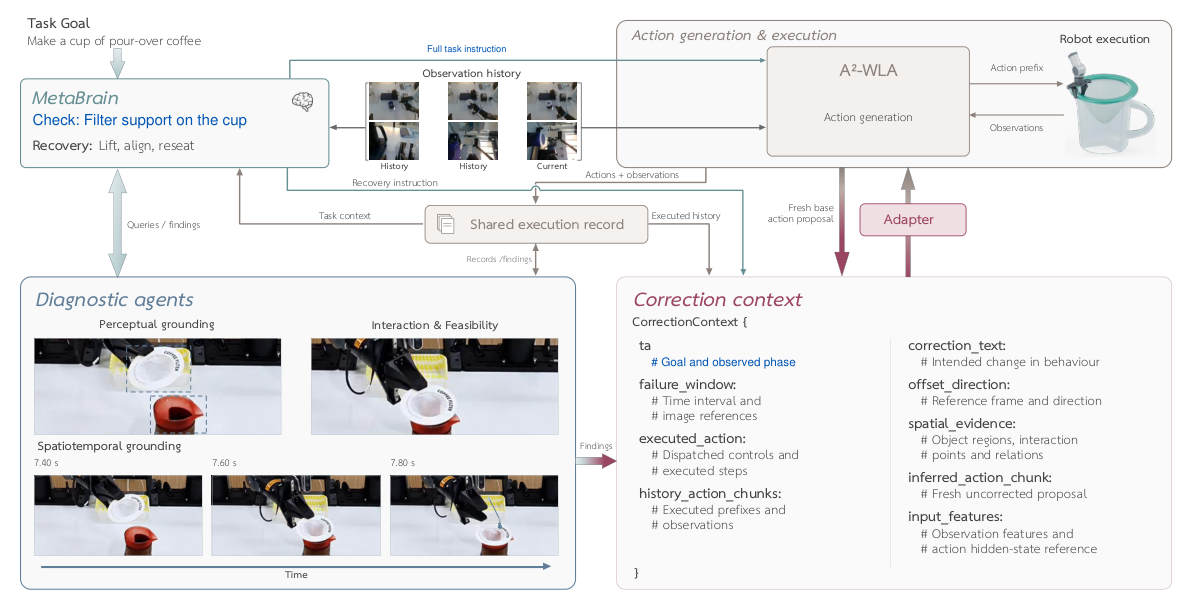
Caption: Figure 1 The A2-MEAS framework. The MetaBrain coordinates task reasoning and recovery. Grounding agents provide specialized evidence. The correction interface combines recovery language, spatial evidence, executed history, and a fresh base-action proposal to modulate A2-WLA. These agents cooperate to control one robot.
Why It Matters: This is the clearest system-level view of how task reasoning, diagnostic evidence, the shared execution record, and continuous action generation interact.
Figure 3
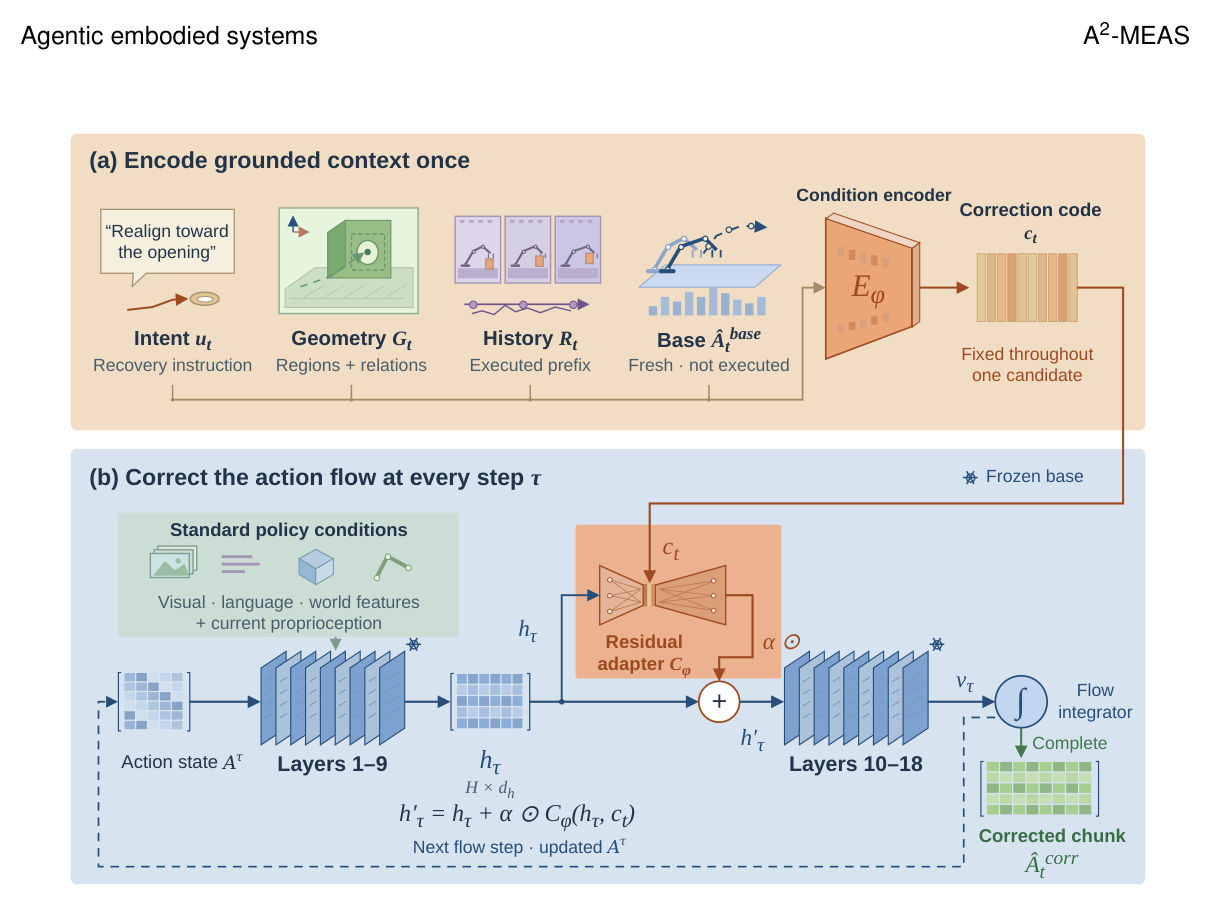
Caption: Figure 3 The correction interface within action generation. Language, spatial evidence, executed history and a fresh base proposal are encoded once per candidate. At every flow step, the adapter uses the current action hidden states to produce position-dependent residuals. Injection after the ninth of 18 action layers allows subsequent layers to convert the modified state into a corrected flow velocity. Orange modules are trained during correction learning while the base model is frozen. All parameters remain fixed during deployment.
Why It Matters: It shows the precise insertion point and timing of the correction residual, which are important for implementing the interface without directly altering joint-space actions.
Figure 5
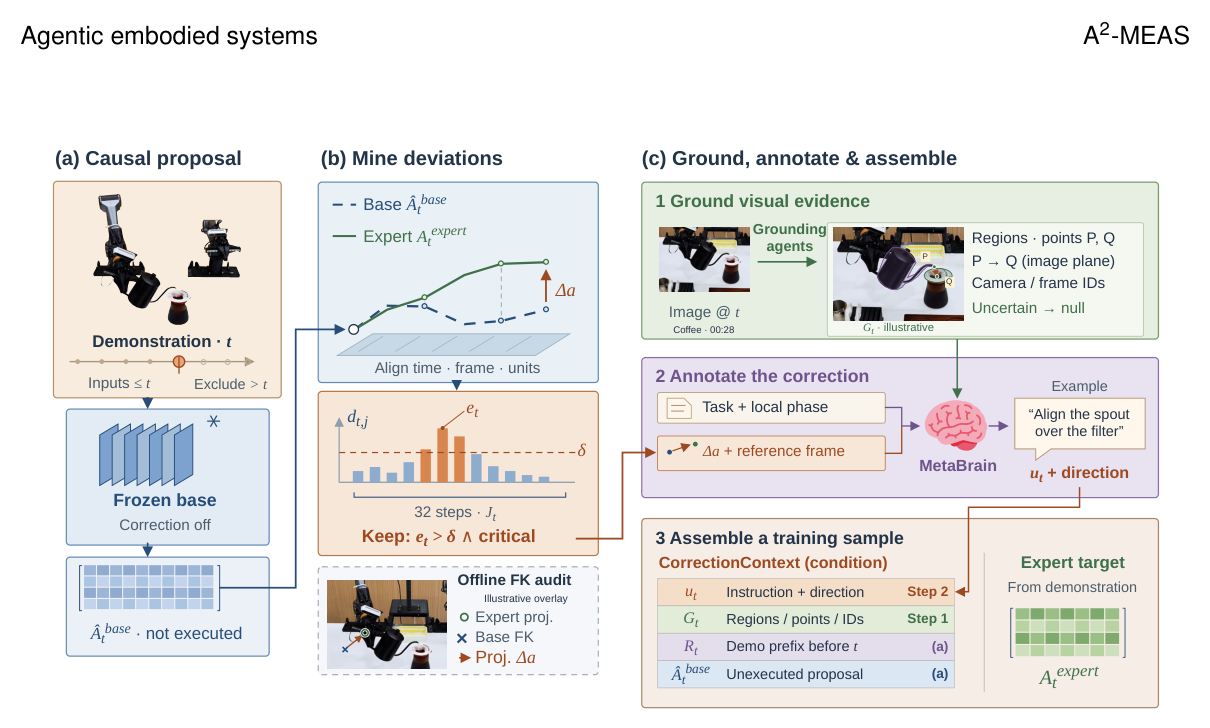
Caption: Figure 5 Offline construction of correction supervision. A frozen policy predicts a candidate at a demonstration state. Candidate and expert actions are aligned in time, units and coordinates, and windows with a large deviation at critical manipulation steps are retained. Visual evidence and the candidate-to-expert direction support context construction. The expert continuation is a training target. The projected positions in the example are an offline quality check.
Why It Matters: The figure clarifies that correction examples come from mined policy deviations rather than necessarily from physically failed executions.
Figure 6
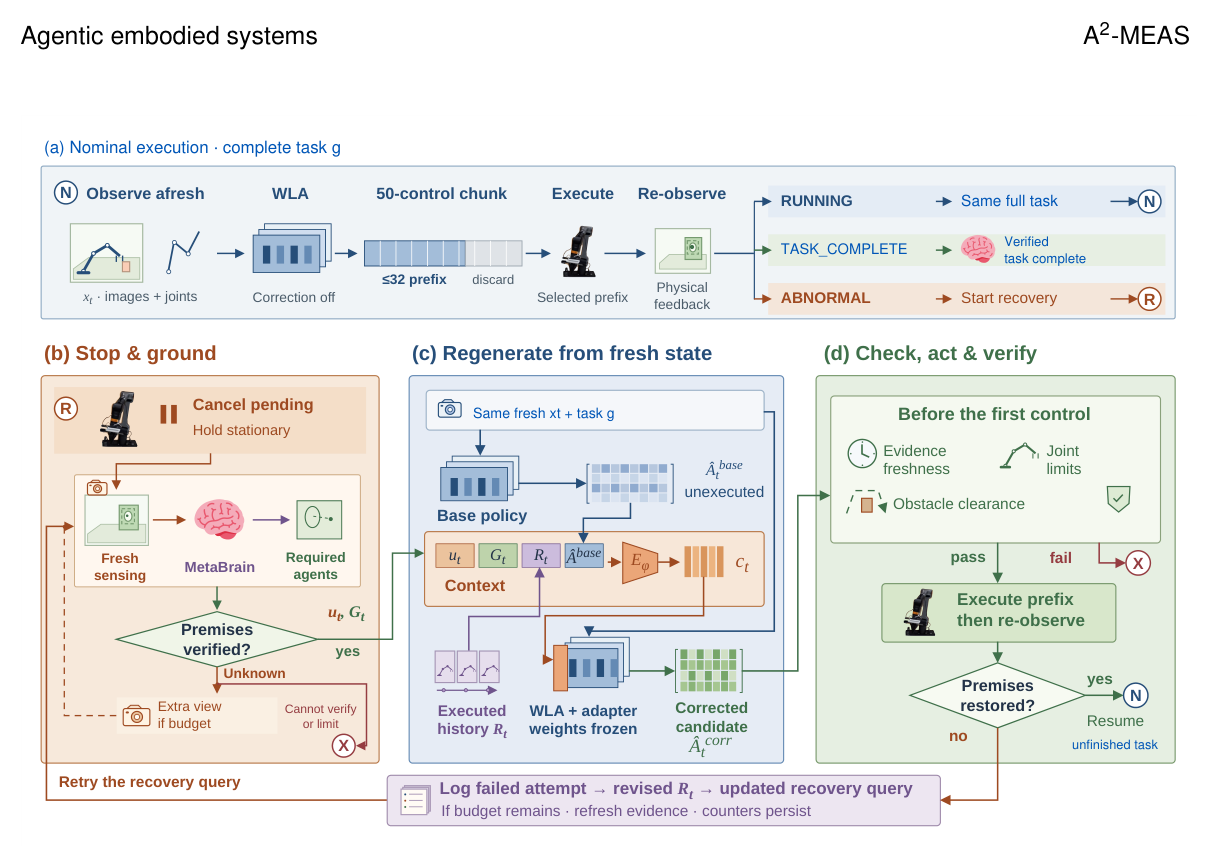
Caption: Figure 6 Execution and recovery as one feedback loop. Ordinary action generation records the executed prefix and its observed outcome. An abnormal event invokes the MetaBrain and the required grounding agents. A fresh recovery state conditions both the base proposal and corrected generation. Failed attempts update the evidence and consume the remaining event budget. Verified recovery resumes execution toward the unfinished task goal. A timeout, exhausted budget or failed feasibility check exits recovery.
Why It Matters: It captures the runtime state machine, including freshness checks, retries, budget consumption, verification, and return to the unfinished task.
Figure 7
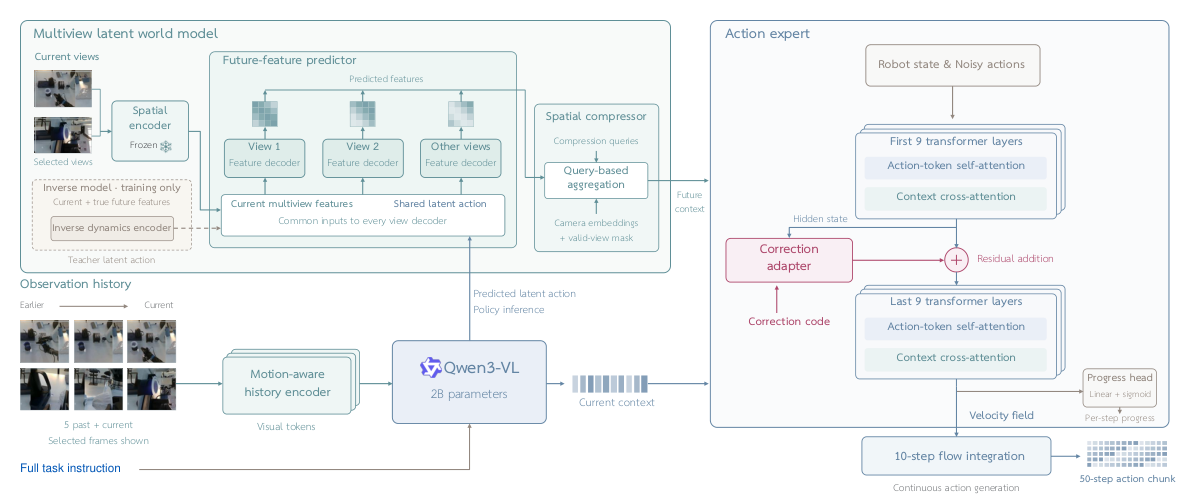
Caption: Figure 7 Architecture of A2-WLA. A motion-aware history encoder converts six-frame multiview histories into visual tokens. A 2B Qwen3-VL backbone combines these tokens with the task instruction to produce current context and a latent action. The world model predicts future visual features, which a spatial compressor aggregates into future context. An 18-layer action expert uses both contexts to generate a 50-step action chunk through ten-step flow integration, while a separate head estimates per-step progress. During recovery, a correction adapter injects a code-conditioned residual after the ninth layer. The lower panel shows how adjacent differences between paired-frame representations pr...
Why It Matters: This architecture figure connects the temporal visual representation, predicted future context, action expert, progress head, and recovery adapter.
Figure 8
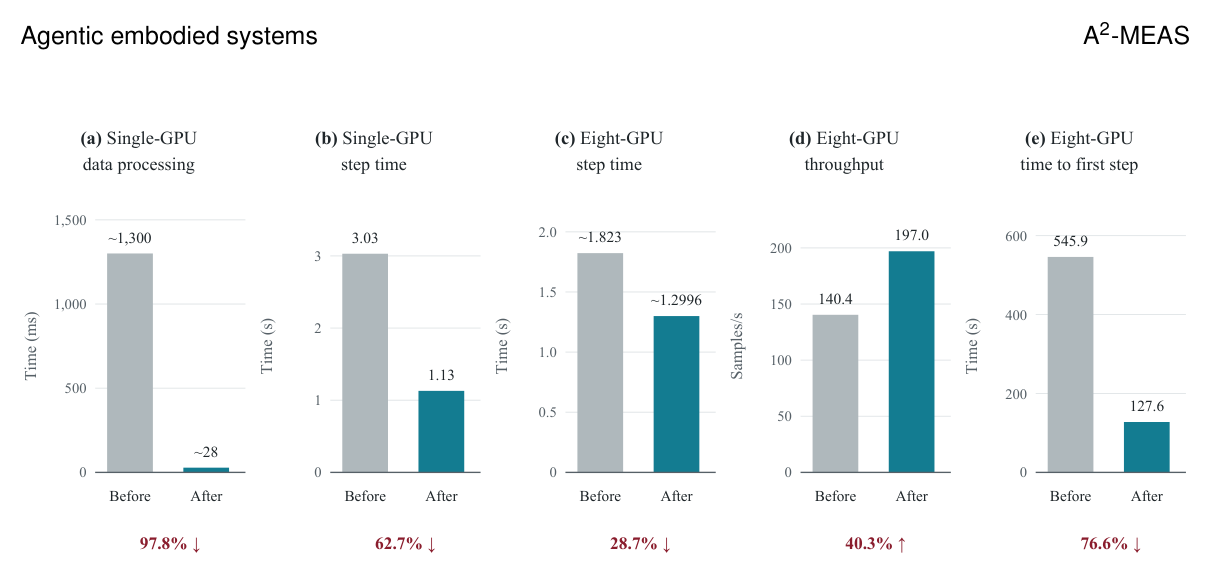
Caption: Figure 8 Data processing and distributed execution performance before and after optimization. (a) single-GPU data processing time, (b) single-GPU step time, (c) eight-GPU step time, (d) eight-GPU throughput, and (e) eight-GPU time to first step. Approximate values are marked with ∼. Percentages below the panels indicate relative decreases (↓) or increases (↑), calculated from the reported values. Single-GPU and eight-GPU comparisons use their respective fixed configurations and do not form one continuous ablation sequence.
Why It Matters: The figure reports the engineering changes that reduce input-processing, distributed-step, startup, and throughput costs, while warning that the panels are separate fixed comparisons.
🔮 Conclusion
A2-MEAS presents a coherent division between learned continuous control and agent-guided intervention. A2-WLA supplies a strong action foundation through temporal history, predicted future visual features, and flow-based trajectory generation, while MetaBrain and diagnostic agents decide when the current execution no longer supports the complete task. The correction code provides a practical interface between heterogeneous evidence and the action expert without changing weights at deployment.
The evidence supports meaningful gains but also defines their scope. The complete system reaches 0.6411 Q-score and 45.40% complete-task success on 100 BEHAVIOR 2026 tasks, while fixed-policy studies show improvements from grounded correction on held-out instances. Short-horizon RoboTwin and real-robot results demonstrate transfer across settings, and coffee recovery shows that failure-history conditioning can restore progress after missed grasps. However, only 11 public tasks succeed in all ten recorded instances, so reliable end-to-end completion remains substantially harder than obtaining partial goal satisfaction.
🛠️ Future Research Improvements
The paper's most direct next step is to collect correction data from actual execution failures rather than relying primarily on unexecuted proposal deviations at demonstration states. Such data should preserve the changed object arrangement, contact state, grasp configuration, recovery attempt, and eventual continuation outcome. This would reduce the distribution gap between offline correction training and deployment-time anomalies.
A second priority is faster intervention. The current runtime pauses for diagnosis, requests additional views when evidence is unknown, and enforces explicit retry and time budgets. A learned fast path for routine contact failures could handle urgent corrections while reserving MetaBrain for ambiguous or consequential events. The authors also motivate broader interaction data covering object properties, contact configurations, successful and failed attempts, and subsequent task continuation.
Evaluation should expand across robot embodiments, physical environments, task families, and independent training runs. Comparisons should keep coordinator size, checkpoint selection, parameter count, compute budget, and evaluation cohort explicit. In particular, future work should measure whether the full four-input correction interface transfers to physical robots, since the reported coffee results use a separate history-conditioned adapter variant.
🏭 Potential Industry Use Scenarios
The framework is most naturally suited to household or service robots that perform multi-step manipulation in changing environments. A robot loading a kitchen, sorting food waste, retrieving objects from confined storage, or preparing a drink could use A2-WLA for routine action generation and invoke grounded recovery when an object slips, a placement loses support, or a required contact condition is uncertain. The shared execution record is useful in these settings because operators and diagnostic tools need to know which prefixes actually executed.
Warehouse, laboratory, and light-industrial manipulation are also plausible extensions when the system has reliable object localization, state tracking, robot-state feedback, and feasibility checks. The code interface could allow specialized inspection tools to contribute evidence without sharing the action policy's backbone. The infrastructure results suggest value for development teams that need to run large long-horizon simulation suites repeatedly, although deployment cost includes the separately hosted reasoning service and the paper does not establish production reliability or safety certification.
The strongest near-term product pattern is supervised autonomy with bounded recovery: the robot attempts routine tasks, pauses on abnormal events, gathers evidence, applies a limited correction budget, and escalates when premises cannot be verified. This is more credible than treating the reported results as proof of unrestricted general-purpose autonomy. Industry pilots should therefore track complete-task success, intervention frequency, recovery latency, unsafe-state exits, and performance on unseen physical configurations.
💬 Critical Analysis
The paper's strongest idea is the explicit interface between reasoning and control. Corrective language alone is underspecified, while raw spatial evidence alone does not say what behavioral change is intended. Combining language, grounded geometry, executed history, and a fresh proposal gives the adapter enough context to distinguish a new correction from a generic retry. The fixed-policy ablations support this interpretation: removing language and grounding, long history, candidate encoding, or structured grounding consistently reduces performance on the correction subset. The runtime design is also unusually concrete about freshness, coordinate frames, feasibility checks, retry budgets, and the distinction between an executed prefix and an unexecuted proposal.
The main empirical concern is attribution. The 100-task result compares a shared model, a multiple-model configuration, and the complete system, so specialization and correction are not isolated in that table. The 50-task comparison mixes BEHAVIOR 2026 results with BEHAVIOR 2025 entries and different training protocols. The real-robot recovery result uses a history-conditioned adapter with approximately 860,000 trainable parameters, whereas the full simulation interface encodes four correction-context fields and injects its residual at an intermediate action layer. These distinctions do not invalidate the results, but they require builders to avoid treating every gain as evidence for one unified configuration.
The paper appropriately reports that Q-score and complete-task success diverge. Food storage, for example, has high goal satisfaction but only one successful instance out of ten, and several tasks with no complete successes still have positive Q-score. This supports the authors' claim that local correction does not automatically yield reliable task continuation. The interface comparison reinforces the point: the latent adapter has the highest reported physical recovery and effective continuation rates, yet VLM plus inverse kinematics has higher final completion in the stated triggered cohorts. Recovery should therefore be evaluated as a sequence from diagnosis to physical restoration to completion of the original goal.
Reproducibility will depend on matching infrastructure and model-serving conditions. The reported 8.8× evaluation speedup compares a measured optimized worker pool with a projected naive eight-GPU baseline based on ideal scaling, and the reasoning service is hosted separately. Training throughput comparisons use matched hardware and stated image resolution and action horizon, but batch sizes are selected for resource utilization. Before claiming equivalent performance, an implementation should reproduce checkpoint selection, coordinator size, episode budgets, diagnostic tools, and exact task cohorts. The paper's planned release of code, models, training scripts, and infrastructure will be important for resolving these questions.